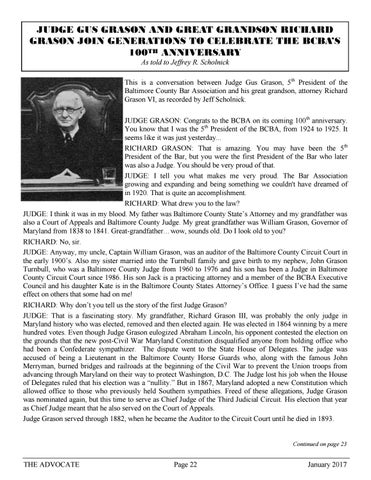
JUDGE GUS GRASON AND GREAT GRANDSON RICHARD GRASON JOIN GENERATIONS TO CELEBRATE THE BCBA’S 100TH ANNIVERSARY As told to Jeffrey R. Scholnick This is a conversation between Judge Gus Grason, 5th President of the Baltimore County Bar Association and his great grandson, attorney Richard Grason VI, as recorded by Jeff Scholnick. JUDGE GRASON: Congrats to the BCBA on its coming 100th anniversary. You know that I was the 5th President of the BCBA, from 1924 to 1925. It seems like it was just yesterday... RICHARD GRASON: That is amazing. You may have been the 5th President of the Bar, but you were the first President of the Bar who later was also a Judge. You should be very proud of that. JUDGE: I tell you what makes me very proud. The Bar Association growing and expanding and being something we couldn't have dreamed of in 1920. That is quite an accomplishment. RICHARD: What drew you to the law? JUDGE: I think it was in my blood. My father was Baltimore County State’s Attorney and my grandfather was also a Court of Appeals and Baltimore County Judge. My great grandfather was William Grason, Governor of Maryland from 1838 to 1841. Great-grandfather…wow, sounds old. Do I look old to you? RICHARD: No, sir. JUDGE: Anyway, my uncle, Captain William Grason, was an auditor of the Baltimore County Circuit Court in the early 1900’s. Also my sister married into the Turnbull family and gave birth to my nephew, John Grason Turnbull, who was a Baltimore County Judge from 1960 to 1976 and his son has been a Judge in Baltimore County Circuit Court since 1986. His son Jack is a practicing attorney and a member of the BCBA Executive Council and his daughter Kate is in the Baltimore County States Attorney’s Office. I guess I’ve had the same effect on others that some had on me! RICHARD: Why don’t you tell us the story of the first Judge Grason? JUDGE: That is a fascinating story. My grandfather, Richard Grason III, was probably the only judge in Maryland history who was elected, removed and then elected again. He was elected in 1864 winning by a mere hundred votes. Even though Judge Grason eulogized Abraham Lincoln, his opponent contested the election on the grounds that the new post-Civil War Maryland Constitution disqualified anyone from holding office who had been a Confederate sympathizer. The dispute went to the State House of Delegates. The judge was accused of being a Lieutenant in the Baltimore County Horse Guards who, along with the famous John Merryman, burned bridges and railroads at the beginning of the Civil War to prevent the Union troops from advancing through Maryland on their way to protect Washington, D.C. The Judge lost his job when the House of Delegates ruled that his election was a “nullity.” But in 1867, Maryland adopted a new Constitution which allowed office to those who previously held Southern sympathies. Freed of these allegations, Judge Grason was nominated again, but this time to serve as Chief Judge of the Third Judicial Circuit. His election that year as Chief Judge meant that he also served on the Court of Appeals. Judge Grason served through 1882, when he became the Auditor to the Circuit Court until he died in 1893. Continued on page 23
THE ADVOCATE
Page 22
January 2017