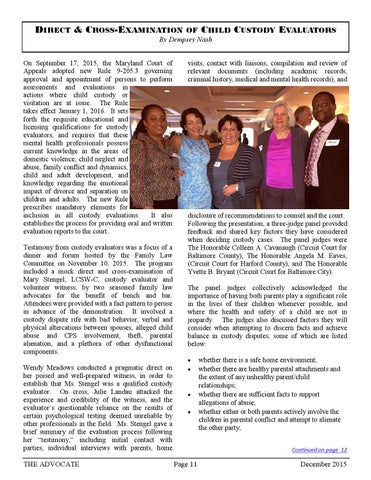
DIRECT & CROSS-EXAMINATION OF CHILD CUSTODY EVALUATORS By Dempsey Nash On September 17, 2015, the Maryland Court of Appeals adopted new Rule 9-205.3 governing approval and appointment of persons to perform assessments and evaluations in actions where child custody or visitation are at issue. The Rule takes effect January 1, 2016. It sets forth the requisite educational and licensing qualifications for custody evaluators, and requires that these mental health professionals possess current knowledge in the areas of domestic violence, child neglect and abuse, family conflict and dynamics, child and adult development, and knowledge regarding the emotional impact of divorce and separation on children and adults. The new Rule prescribes mandatory elements for inclusion in all custody evaluations. It also establishes the process for providing oral and written evaluation reports to the court. Testimony from custody evaluators was a focus of a dinner and forum hosted by the Family Law Committee on November 10, 2015. The program included a mock direct and cross-examination of Mary Stengel, LCSW-C, custody evaluator and volunteer witness, by two seasoned family law advocates for the benefit of bench and bar. Attendees were provided with a fact pattern to peruse in advance of the demonstration. It involved a custody dispute rife with bad behavior, verbal and physical altercations between spouses, alleged child abuse and CPS involvement, theft, parental alienation, and a plethora of other dysfunctional components. Wendy Meadows conducted a pragmatic direct on her poised and well-prepared witness, in order to establish that Ms. Stengel was a qualified custody evaluator. On cross, Julie Landau attacked the experience and credibility of the witness, and the evaluator’s questionable reliance on the results of certain psychological testing deemed unreliable by other professionals in the field. Ms. Stengel gave a brief summary of the evaluation process following her “testimony,” including initial contact with parties, individual interviews with parents, home
THE ADVOCATE
visits, contact with liaisons, compilation and review of relevant documents (including academic records, criminal history, medical and mental health records), and
disclosure of recommendations to counsel and the court. Following the presentation, a three-judge panel provided feedback and shared key factors they have considered when deciding custody cases. The panel judges were The Honorable Colleen A. Cavanaugh (Circuit Court for Baltimore County), The Honorable Angela M. Eaves, (Circuit Court for Harford County), and The Honorable Yvette B. Bryant (Circuit Court for Baltimore City). The panel judges collectively acknowledged the importance of having both parents play a significant role in the lives of their children whenever possible, and where the health and safety of a child are not in jeopardy. The judges also discussed factors they will consider when attempting to discern facts and achieve balance in custody disputes, some of which are listed below:
whether there is a safe home environment; whether there are healthy parental attachments and the extent of any unhealthy parent/child relationships; whether there are sufficient facts to support allegations of abuse; whether either or both parents actively involve the children in parental conflict and attempt to alienate the other party; Continued on page 12
Page 11
December 2015