and Middle School campuses with two game-changing building projects; and she initiated curricular initiatives that included a full-day Beginners program, world language courses such as Arabic in the Upper School and Spanish in the early grades, and the introduction of a schoolwide global education program. Her steady hand was especially important in turbulent times. Her concern and care for the members of the BB&N community was profound and far-reaching. It was a muchneeded beacon during human tragedies such as 9/11, which occurred during the second week of her tenure, and the 2013 Boston Marathon bombing, both of which directly affected students and families at the School. And the BB&N tenets of “honor” and “kindness” were never in finer display than in the way the community rallied around Zack McLeod ’10 after he suffered a traumatic brain injury during a football scrimmage in September 2008. Upham’s care also extended to BB&N’s alumni/ae community. From floods in Houston to wildfires in Los Angeles, she was always quick to pen a note of concern to those affected. And her forthright acknowledgment and reckoning of past abuses by BB&N faculty members was guided first and foremost by a desire for healing of any community member impacted by those terrible deeds. Upham also was an innovator—one whose reputation, much like BB&N’s, increased well beyond regional borders to reach
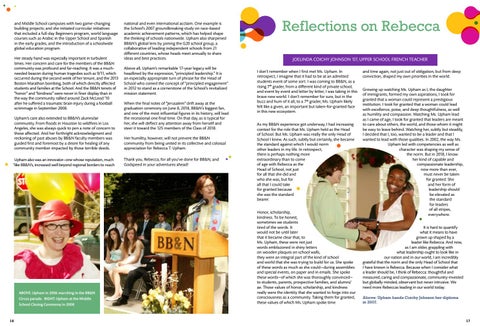
ABOVE: Upham in 2006 marching in the BB&N Circus parade. RIGHT: Upham at the Middle School Closing Ceremony in 2008
16
national and even international acclaim. One example is the School’s 2007 groundbreaking study on race-based academic achievement patterns, which has helped shape the thinking of schools nationwide. Upham also sharpened BB&N’s global lens by joining the G20 school group, a collaborative of leading independent schools from 21 different countries, whose heads meet annually to share ideas and best practices. Above all, Upham’s remarkable 17-year legacy will be headlined by the expression, “principled leadership.” It is an especially appropriate turn of phrase for the Head of School who coined the concept of “principled engagement” in 2012 to stand as a cornerstone of the School’s revitalized mission statement. When the final notes of “Jerusalem” drift away at the graduation ceremony on June 8, 2018, BB&N’s biggest fan, and one of the most influential figures in its history, will lead the recessional one final time. On that day, as is typical for her, she will deflect any attention away from herself and steer it toward the 125 members of the Class of 2018. Her humility, however, will not prevent the BB&N community from being united in its collective and colossal appreciation for Rebecca T. Upham. Thank you, Rebecca, for all you’ve done for BB&N, and Godspeed in your adventures ahead!
Reflections on Rebecca JOELINDA COICHY JOHNSON ’07, UPPER SCHOOL FRENCH TEACHER I don’t remember when I first met Ms. Upham. In retrospect, I imagine that it had to be at an admitted students event of some sort. I was coming to BB&N, as a rising 7th grader, from a different kind of private school, and event by event and letter by letter, I was taking in this brave new world. I don’t remember for sure, but in the buzz and hum of it all, to a 7th grader, Ms. Upham likely felt like a given, an important but taken-for-granted face in this new ecosystem. As my BB&N experience got underway, I had increasing context for the role that Ms. Upham held as the Head of School. But Ms. Upham was really the only Head of School I knew. As such, subtly but certainly, she became the standard against which I would norm other leaders in my life. In retrospect, there is perhaps nothing more extraordinary than to come of age with Rebecca as the Head of School, not just for all that she did and who she was, but for all that I could take for granted because she was the standard bearer. Honor, scholarship, kindness. To be honest, sometimes we students tired of the words. It would not be until later that it became clear that, to Ms. Upham, these were not just words emblazoned in shiny letters on wooden plaques on school walls, they were an integral part of the kind of school and world that she was trying to build for us. She spoke of these words as much as she could—during assemblies and special events, on paper and in emails. She spoke these words—of which she was thoroughly convinced— to students, parents, prospective families, and alumni/ ae. Those values of honor, scholarship, and kindness really were the identity that she wanted to forge into our consciousness as a community. Taking them for granted, these values of which Ms. Upham spoke time
and time again, not just out of obligation, but from deep conviction, shaped my own priorities in the world. Growing up watching Ms. Upham as I, the daughter of immigrants, formed my own aspirations, I took for granted that a woman could represent a prestigious institution. I took for granted that a woman could lead with excellence, poise, and deep thoughtfulness, as well as humility and compassion. Watching Ms. Upham lead as I came of age, I took for granted that leaders are meant to care about others, the world, and those whom it might be easy to leave behind. Watching her, subtly but steadily, I decided that I, too, wanted to be a leader and that I wanted to lead with those qualities. In 2002, the way Ms. Upham led with competencies as well as character was shaping my sense of the norm. But in 2018, I know her kind of capable and compassionate leadership, now more than ever, must never be taken for granted. She and her form of leadership should be elevated as the standard for leaders of all stripes, everywhere. It is hard to quantify what it means to have grown up shaped by a leader like Rebecca. And now, as I am older, grappling with what leadership ought to look like in our nation and in our world, I am incredibly grateful that the norm and the only Head of School that I have known is Rebecca. Because when I consider what a leader should be, I think of Rebecca: thoughtful and measured, caring and compassionate, community-invested but globally minded, observant but never intrusive. We need more Rebeccas leading in our world today. Above: Upham hands Coichy Johnson her diploma in 2007.
17