80
84
Eden Parties
Pride Events
NIGHTLIFE FOOD
95
SPIRITS
SEX
SOCIETY
ROMANCE
www.ebar.com ✶ www.bartabsf.com
Adam Killian
LEATHER
PERSONALS Vol. 44 • No. 26 • June 26-July 2, 2014
Lea DeLaria Butch Dyke Sings the Blues by David-Elijah Nahmod
L
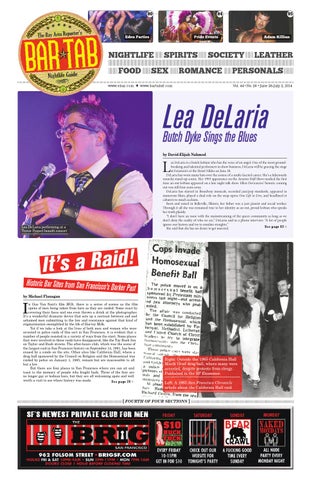
Lea DeLaria performing at a Trevor Project benefit concert
courtesy GLBT Historical Society
ea DeLaria is a butch lesbian who has the voice of an angel. One of the most groundbreaking and talented performers in show business, DeLaria will be gracing the stage at Feinstein’s at the Hotel Nikko on June 28. DeLaria has worn many hats over the course of a multi-faceted career. She’s a hilariously raunchy stand-up comic. Her 1993 appearance on the Arsenio Hall Show marked the first time an out lesbian appeared on a late night talk show. Ellen DeGeneres’ historic coming out was still four years away. DeLaria has starred in Broadway musicals, recorded jazz/pop standards, appeared in numerous films, played a dual role on the soap opera One Life to Live, and headlined at cabarets to much acclaim. Born and raised in Belleville, Illinois, her father was a jazz pianist and social worker. Through it all she was remained true to her identity as an out, proud lesbian who speaks her truth plainly. “I don’t have an issue with the mainstreaming of the queer community as long as we don’t deny the reality of who we are,” DeLaria said in a phone interview. “A lot of people ignore our history and try to emulate straights.” See page 82 >> She said that she has no desire to get married.
! d i a R a It’s
Historic Bar Sites from San Francisco’s Da rker by Michael Flanagan
Past
I
n Gus Van Sant’s film Milk, there is a series of scenes as the film opens of men being taken from bars as they are raided. Some react by covering their faces and one even throws a drink at the photographer. It’s a wonderful dramatic device that sets up a contrast between sad and ashamed men submitting to the law and resistance against that kind of stigmatization exemplified by the life of Harvey Milk. Yet if we take a look at the lives of both men and women who were arrested in police raids of this sort in San Francisco, it is evident that a number of people resisted in a variety of ways from the start. Some places that were involved in these raids have disappeared, like the Tay Bush Inn on Taylor and Bush streets. The after-hours club, which was the scene of the largest raid in San Francisco history on September 14, 1961, has been erased by a condo on the site. Other sites like California Hall, where a drag ball sponsored by the Council on Religion and the Homosexual was raided by police on January 1, 1965, remain but are inaccessible to all but a few. But there are four places in San Francisco where you can sit and toast to the memory of people who fought back. Three of the four are no longer gay or lesbian bars, but they are all welcoming spots and well worth a visit to see where history was made. See page 78 >>
Right: Outside the 1965 California Hall Mardi Grad drag ball, where many were arrested, despite protests from clergy. Published in the SF Examiner. Left: A 1965 San Francisco Chronicle article about the California Hall raid.
{ FOURTH OF FOUR SECTIONS }