<< Out There
14 • Bay Area Reporter • January 9-15, 2014
Purple is the new blue
t
by Roberto Friedman
B
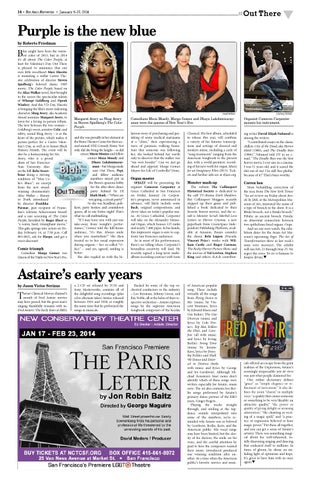
lue might have been the warmest color of 2013, but in 2014 it’s all about The Color Purple, at least for Valentine’s Day. Out There is pleased to announce that our own little sweetheart Marc Huestis is mounting a stellar Castro Theatre celebration of director Steven Spielberg’s beloved classic 1985 movie. The Color Purple, based on the Alice Walker novel, first brought to the screen the spectacular talents of Whoopi Goldberg and Oprah Winfrey. And this VD Day, Huestis is bringing the film’s most endearing character, Shug Avery, aka Academy Award nominee Margaret Avery, to town for a loving in-person tribute. The love between the two women – Goldberg’s sweet, sensitive Celie, and sultry, sexual Shug Avery – is at the heart of the picture, which makes it picture-perfect for a Castro Valentine’s Day, as well as to honor Black History Month. The event will be also be a homecoming for Ms. Avery, who is a proud alum of San Francisco State University. Also on the bill: Bebe Sweetbriar doing a stirring rendition of “Miss Celie’s Blues”; an excerpt from the new awardwinning documentary Alice Walker – Beauty in Truth, introduced by director Pratibha Parmar, past recipient of Frameline’s Lifetime Achievement Award; and a rare screening of The Color Purple, heralded by Roger Ebert as “a warm, hard, triumphant movie.” This gala springs into action on Friday, February 14, at 7:30 p.m. Call 863-0611, ask for Harpo, and get a sweet discount!
Comic triumph
Comedian Marga Gomez was Queen of the Night on New Year’s Eve,
David Wilson
Margaret Avery as Shug Avery in Steven Spielberg’s The Color Purple.
and she was proudly in her element at the Brava Theater Center for their second annual NYE Comedy Fiesta. Not only did she bring the laughs – as did emcee Mario Montes and fellow comics Micia Mosely and Dhaya Lakshminarayanan – but Marga made sure Out There, Pepi, and fellow audience members stayed put in the Brava’s spacious lobby for the after-show dance party helmed by DJ Mark Mark – “Where are you going, a circuit party?” So she was headliner, publicist, party hostess and countdown queen, all in one festive night! That’s what we call multitasking. “If I may leave you with just one take-away from tonight’s performance,” Gomez told the full-house audience, “it’s this: Always smile when you masturbate!” She then treated us to her usual expression during orgasm – her so-called “Oface” – and yes, agreed, smiling is better. She also regaled us with the hi-
Comedians Micia Mosely, Marga Gomez and Dhaya Lakshminarayanan were the queens of New Year’s Eve.
larious story of purchasing and partaking of some medical marijuana at a “clinic,” then experiencing a wave of paranoia walking home. Sure that someone was following her, she looked behind her warily only to discover that the stalker was “my own hoodie!” Can we just go ahead and appoint Marga Gomez Mayor-for-Life of Coolsville? Done.
Organ master
SFJAZZ will be presenting the organist Cameron Carpenter at Grace Cathedral in San Francisco on Friday, January 24. Carpenter’s program, never announced in advance, will likely include some Bach, original compositions, and clever takes on today’s popular music. At Grace Cathedral, Carpenter will take on the Alexander Memorial Organ, which houses 125 ranks and nearly 7,466 pipes. In his hands, this impressive organ is sure to captivate San Francisco audiences. As in most of his performances, there’s no telling where Carpenter’s boundless creativity will lead. He recently signed a long-term multialbum recording contract with Sony
Astaire’s early years by Jason Victor Serinus
T
urner Classical Movies channel’s month of Fred Astaire movies may have passed, but the great man’s singing thankfully remains with us. Fred Astaire: The Early Years at RKO,
a 2-CD set released by TCM and Sony Masterworks, contains all of the delightful song recordings (plus a few alternate takes) Astaire released between 1934 and 1938, at roughly the same time that he performed the songs in musicals.
Backed by some of the top orchestral conductors in the industry – Leo Reisman, Johnny Green, and Ray Noble, all at the helm of their respective orchestras – Astaire reprises songs by the supreme American Songbook composers of the heyday
Courtesy SFJAZZ
Organist Cameron Carpenter mounts his instrument.
Classical. His first album, scheduled to release this year, will combine a variety of his famous transcriptions and settings of classical and modern music, including a cycle of “song treatments” ranging from the American Songbook to the present day, with a world-premiere recording of his new work for organ, Music for an Imaginary Film (2013). Tickets and further info are at sfjazz.org.
ing writer David-Elijah Nahmod is among the writers. “I contributed essays on the classic chillers City of the Dead, aka Horror Hotel (1960), and The Deadly Bees (1966),” Nahmod told OT in an email. “The Deadly Bees was the first horror movie I ever saw in a cinema. I was 11 years old, and it scared the shit out of me! I’m still ‘bee-phobic’ because of it!” That’s buzz-worthy.
Monster mash-up
Correx box
The website The Collinsport Historical Society is dedicated to the cult TV-drama Dark Shadows. But Collinsport bloggers recently stepped up their game and published a book dedicated to their favorite horror movies, and the result is Monster Serial: Morbid Love Letters to Horror Cinema, a new paperback from CreateSpace Independent Publishing Platform, available at Amazon. Essays consider the classic Bela Lugosi Dracula, Vincent Price’s works with William Castle and Roger Corman, The Rocky Horror Picture Show, and the movies of Val Lewton, Stephen King and others. B.A.R. contribut-
of American popular song. These include virtually all the songs from Flying Down to Rio (music by Vincent Youmans, lyrics by Edward Eliscu and Gus Kahn); The Gay Divorcee (music and lyrics by Cole Porter); Top Hat, Follow the Fleet, and Carefree (all with music and lyrics by Irving Berlin); Swing Time (music by Jerome Kern, lyrics by Dorothy Fields); and Shall We Dance and Damsel in Distress (both with music and lyrics by George and Ira Gershwin). Although Michael Feinstein’s liner notes don’t identify which of these songs were written especially for Astaire, many were. The set also contains two Berlin songs performed by Astaire’s primary dance partner of the RKO years, Ginger Rogers. Playing the tracks straight through, and smiling at the tapdance sounds interpolated into some of the numbers, we’re reminded why Astaire was so beloved by Gershwin, Berlin, Kern, and the American public. His vocal range may have been limited, but the clarity of his diction, the smile on his voice, and the careful attention he paid to how the composers wanted their music introduced produced one winning rendition after another. At a time when the American public’s favorite movies and musi-
Most befuddling correction of the year, from The New York Times: “An art review on Friday about Jewels by JAR, at the Metropolitan Museum of Art, misstated the name of a type of brooch in the show. It is a fibula brooch, not a fistula brooch.” Fibula: an ancient brooch. Fistula: an abnormal connection between two epithelium-lined organs. Oops. And on our own watch, the exhibition dates for the Asian Art Museum’s upcoming Yoga: The Art of Transformation show in last week’s issue were incorrect. The exhibit will run Feb. 21 through May 25. We regret the error. To err is human; to forgive divine.t
cals offered an escape from the grim realities of the Depression, Astaire’s seemingly irrepressible joie de vivre was just what people clamored for. One online dictionary defines “grace” as “simple elegance or refinement of movement.” It also defines the noun “charm” in multiple ways: “a quality that causes someone or something to be very likeable: an attractive quality,” “the power or quality of giving delight or arousing admiration,” “the chanting or reciting of a magic spell,” and “a practice or expression believed to have magic power.” Put these all together, and you can get a sense of Astaire’s artistry. There was something magical about his well-rehearsed, totally disarming singing and dancing that endeared itself to millions. In times of gloom, he shone an unfailing light of optimism and hope. It’s great to have him with us once again.t