PHYLLIS GRABER JENSEN
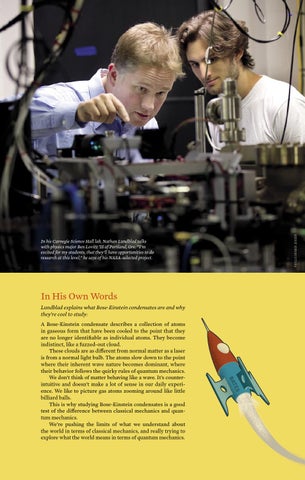
In his Carnegie Science Hall lab, Nathan Lundblad talks with physics major Ben Lovitz ’15 of Portland, Ore. “I’m excited for my students, that they’ll have opportunities to do research at this level,” he says of his NASA-selected project.
In His Own Words Lundblad explains what Bose-Einstein condensates are and why they’re cool to study: A Bose-Einstein condensate describes a collection of atoms in gaseous form that have been cooled to the point that they are no longer identifiable as individual atoms. They become indistinct, like a fuzzed-out cloud. These clouds are as different from normal matter as a laser is from a normal light bulb. The atoms slow down to the point where their inherent wave nature becomes dominant, where their behavior follows the quirky rules of quantum mechanics. We don’t think of matter behaving like a wave. It’s counterintuitive and doesn’t make a lot of sense in our daily experience. We like to picture gas atoms zooming around like little billiard balls. This is why studying Bose-Einstein condensates is a good test of the difference between classical mechanics and quantum mechanics. We’re pushing the limits of what we understand about the world in terms of classical mechanics, and really trying to explore what the world means in terms of quantum mechanics.
Fall 2014
39