MPhil/PhD Architectural Design
This thesis explores some of the ways in which the contexts of epistemology, ethics and designing architecture are each concerned with undecidable questions – that is, with those questions that have no right answers. Drawing on design research, second-order cybernetics and radical constructivism, I have understood this undecidability to follow in each case from our being part of the situation in which we are acting. This idea is primarily epistemological – being part of the world we observe, we cannot verify the relationship between our understanding and the world beyond our experience as it is impossible to observe the latter – but can also be interpreted spatially and ethically. The project develops connections between questions in architecture, epistemology and ethics in two parallel investigations. In the first, it proposes a connection between design and ethics where design is understood as an activity in which ethical questioning is implicit. Rather than the usual application of ethical theory to
practice, it instead proposes that design can inform ethical thinking, both in the context of designing architecture and also more generally, through (1) the ways designers approach what Rittel (1972) called ‘wicked problems’ and (2) the implicit consideration of others in design’s core methodology. In parallel to this the thesis explores the spatial sense of the idea that we are part of the world through a series of design investigations comprising projects set in everyday situations and other speculative drawings. Through these drawings, the project proposes reformulating the architectural theme of place, which is usually associated with phenomenology, in constructivist terms as the spatiality of observing our own observing and so as where the self-reference of epistemology – that we cannot experience the world beyond our experience – becomes manifest.
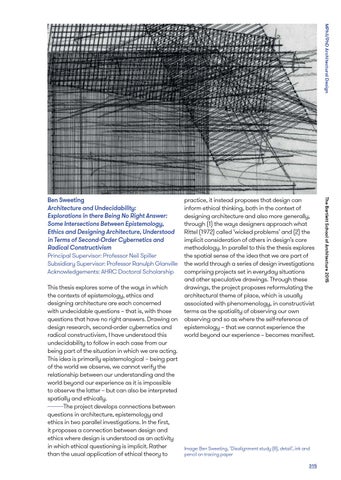
Image: Ben Sweeting, ‘Disalignment study (8), detail’, ink and pencil on tracing paper 315
The Bartlett School of Architecture 2015
Ben Sweeting Architecture and Undecidability: Explorations in there Being No Right Answer: Some Intersections Between Epistemology, Ethics and Designing Architecture, Understood in Terms of Second-Order Cybernetics and Radical Constructivism Principal Supervisor: Professor Neil Spiller Subsidiary Supervisor: Professor Ranulph Glanville Acknowledgements: AHRC Doctoral Scholarship