82
J
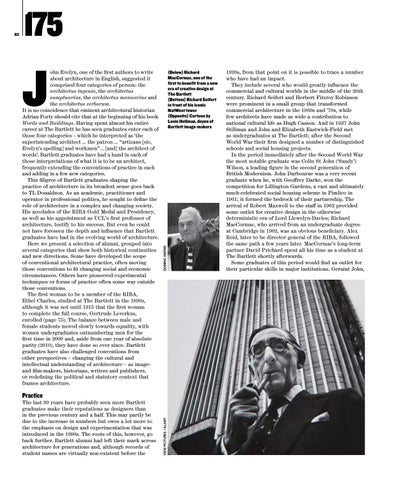
(Below) Richard MacCormac, one of the first to benefit from a new era of creative design at The Bartlett (Bottom) Richard Seifert in front of his iconic NatWest tower (Opposite) Cartoon by Louis Hellman, doyen of Bartlett image-makers
DOMINIC HARRIS
ohn Evelyn, one of the first authors to write about architecture in English, suggested it comprised four categories of person: the architectus ingenio, the architectus sumptuarius, the architectus manuarius and the architectus verborum. It is no coincidence that eminent architectural historian Adrian Forty should cite that at the beginning of his book Words and Buildings. Having spent almost his entire career at The Bartlett he has seen graduates enter each of those four categories – which he interpreted as ‘the superintending architect ... the patron ... “artizans [sic, Evelyn’s spelling] and workmen”... [and] the architect of words’. Bartlett graduates have had a hand in each of those interpretations of what it is to be an architect, frequently extending the conventions of practice in each and adding in a few new categories. This filigree of Bartlett graduates shaping the practice of architecture in its broadest sense goes back to TL Donaldson. As an academic, practitioner and operator in professional politics, he sought to define the role of architecture in a complex and changing society. His accolades of the RIBA Gold Medal and Presidency, as well as his appointment as UCL’s first professor of architecture, testify to his success. But even he could not have foreseen the depth and influence that Bartlett graduates have had in the evolving world of architecture. Here we present a selection of alumni, grouped into several categories that show both historical continuities and new directions. Some have developed the scope of conventional architectural practice, often moving those conventions to fit changing social and economic circumstances. Others have pioneered experimental techniques or forms of practice often some way outside those conventions. The first woman to be a member of the RIBA, Ethel Charles, studied at The Bartlett in the 1890s, although it was not until 1915 that the first woman to complete the full course, Gertrude Leverkus, enrolled (page 75). The balance between male and female students moved slowly towards equality, with women undergraduates outnumbering men for the first time in 2009 and, aside from one year of absolute parity (2010), they have done so ever since. Bartlett graduates have also challenged conventions from other perspectives – changing the cultural and intellectual understanding of architecture – as imageand film-makers, historians, writers and publishers, or redefining the political and statutory context that frames architecture.
The last 30 years have probably seen more Bartlett graduates make their reputations as designers than in the previous century and a half. This may partly be due to the increase in numbers but owes a lot more to the emphasis on design and experimentation that was introduced in the 1990s. The roots of this, however, go back further. Bartlett alumni had left their mark across architecture for generations and, although records of student names are virtually non-existent before the
VIEW PICTURES / ALAMY
Practice
1920s, from that point on it is possible to trace a number who have had an impact. They include several who would greatly influence the commercial and cultural worlds in the middle of the 20th century. Richard Seifert and Herbert Fitzroy Robinson were prominent in a small group that transformed commercial architecture in the 1960s and ’70s, while few architects have made as wide a contribution to national cultural life as Hugh Casson. And in 1937 John Stillman and John and Elizabeth Eastwick-Field met as undergraduates at The Bartlett; after the Second World War their firm designed a number of distinguished schools and social housing projects. In the period immediately after the Second World War the most notable graduate was Colin St John (‘Sandy’) Wilson, a leading figure in the second generation of British Modernism. John Darbourne was a very recent graduate when he, with Geoffrey Darke, won the competition for Lillington Gardens, a vast and ultimately much-celebrated social housing scheme in Pimlico in 1961; it formed the bedrock of their partnership. The arrival of Robert Maxwell to the staff in 1962 provided some outlet for creative design in the otherwise deterministic era of Lord Llewelyn-Davies; Richard MacCormac, who arrived from an undergraduate degree at Cambridge in 1962, was an obvious beneficiary. Alex Reid, later to be director general of the RIBA, followed the same path a few years later. MacCormac’s long-term partner David Prichard spent all his time as a student at The Bartlett shortly afterwards. Some graduates of this period would find an outlet for their particular skills in major institutions. Geraint John,