BiotA Lab Research Cluster 7
2.14
The Bartlett School of Architecture 2015
2.15
2.16
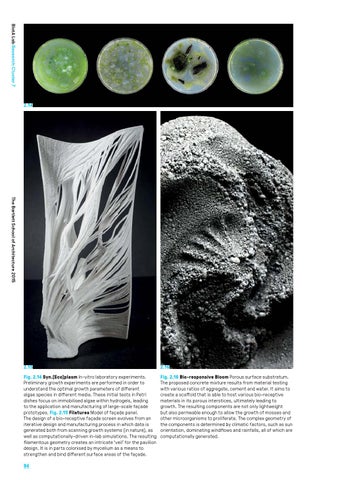
Fig. 2.14 Syn.[Eco]plasm In-vitro laboratory experiments. Preliminary growth experiments are performed in order to understand the optimal growth parameters of different algae species in different media. These initial tests in Petri dishes focus on immobilised algae within hydrogels, leading to the application and manufacturing of large-scale façade prototypes. Fig. 2.15 Filatures Model of façade panel. The design of a bio-receptive façade screen evolves from an iterative design and manufacturing process in which data is generated both from scanning growth systems (in nature), as well as computationally-driven in-lab simulations. The resulting filamentous geometry creates an intricate ‘veil’ for the pavilion design. It is in parts colonised by mycelium as a means to strengthen and bind different surface areas of the façade.
Fig. 2.16 Bio-responsive Bloom Porous surface substratum. The proposed concrete mixture results from material testing with various ratios of aggregate, cement and water. It aims to create a scaffold that is able to host various bio-receptive materials in its porous interstices, ultimately leading to growth. The resulting components are not only lightweight but also permeable enough to allow the growth of mosses and other microorganisms to proliferate. The complex geometry of the components is determined by climatic factors, such as sun orientation, dominating windflows and rainfalls, all of which are computationally generated.
84