Wonderlab Research Cluster 4
1.44 The Bartlett School of Architecture 2015
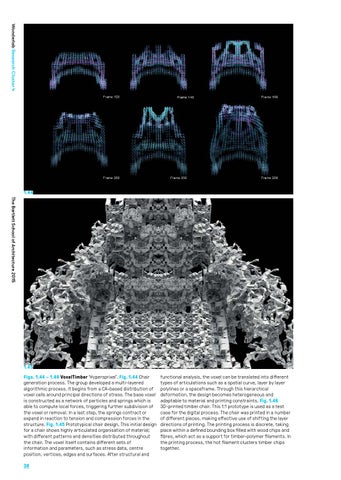
1.45 Figs. 1.44 – 1.46 VoxelTimber ‘Hypersprixel’. Fig. 1.44 Chair generation process. The group developed a multi-layered algorithmic process. It begins from a CA-based distribution of voxel cells around principal directions of stress. The base voxel is constructed as a network of particles and springs which is able to compute local forces, triggering further subdivision of the voxel or removal. In a last step, the springs contract or expand in reaction to tension and compression forces in the structure. Fig. 1.45 Prototypical chair design. This initial design for a chair shows highly articulated organisation of material; with different patterns and densities distributed throughout the chair. The voxel itself contains different sets of information and parameters, such as stress data, centre position, vertices, edges and surfaces. After structural and 38
functional analysis, the voxel can be translated into different types of articulations such as a spatial curve, layer by layer polylines or a spaceframe. Through this hierarchical deformation, the design becomes heterogeneous and adaptable to material and printing constraints. Fig. 1.46 3D-printed timber chair. This 1:1 prototype is used as a test case for the digital process. The chair was printed in a number of different pieces, making effective use of shifting the layer directions of printing. The printing process is discrete, taking place within a defined bounding box filled with wood chips and fibres, which act as a support for timber-polymer filaments. In the printing process, the hot filament clusters timber chips together.