Wonderlab Research Cluster 4 The Bartlett School of Architecture 2015
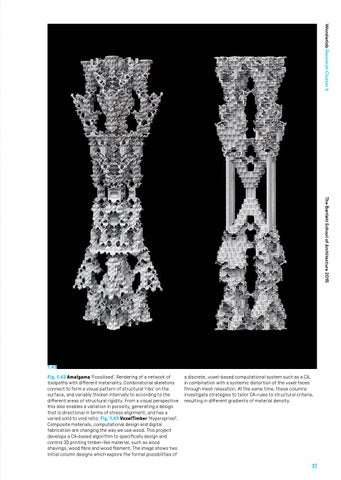
1.43 Fig. 1.42 Amalgama ‘Fossilised’. Rendering of a network of toolpaths with different materiality. Combinatorial skeletons connect to form a visual pattern of structural ‘ribs’ on the surface, and variably thicken internally to according to the different areas of structural rigidity. From a visual perspective this also enables a variation in porosity, generating a design that is directional in terms of stress alignment, and has a varied solid to void ratio. Fig. 1.43 VoxelTimber ‘Hypersprixel’. Composite materials, computational design and digital fabrication are changing the way we use wood. This project develops a CA-based algorithm to specifically design and control 3D printing timber-like material, such as wood shavings, wood fibre and wood filament. The image shows two initial column designs which explore the formal possibilities of
a discrete, voxel-based computational system such as a CA, in combination with a systemic distortion of the voxel faces through mesh relaxation. At the same time, these columns investigate strategies to tailor CA-rules to structural criteria, resulting in different gradients of material density.
37