498
PARTICIPATION
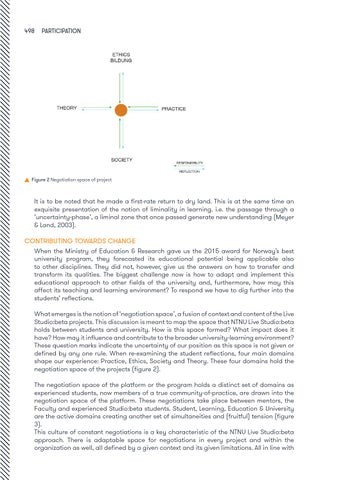
Figure 2 Negotiation space of project
It is to be noted that he made a first-rate return to dry land. This is at the same time an exquisite presentation of the notion of liminality in learning. i.e. the passage through a ‘uncertainty-phase’, a liminal zone that once passed generate new understanding (Meyer & Land, 2003).
CONTRIBUTING TOWARDS CHANGE When the Ministry of Education & Research gave us the 2015 award for Norway’s best university program, they forecasted its educational potential being applicable also to other disciplines. They did not, however, give us the answers on how to transfer and transform its qualities. The biggest challenge now is how to adapt and implement this educational approach to other fields of the university and, furthermore, how may this affect its teaching and learning environment? To respond we have to dig further into the students’ reflections. What emerges is the notion of ‘negotiation space’, a fusion of context and content of the Live Studio:beta projects. This discussion is meant to map the space that NTNU Live Studio:beta holds between students and university. How is this space formed? What impact does it have? How may it influence and contribute to the broader university-learning environment? These question marks indicate the uncertainty of our position as this space is not given or defined by any one rule. When re-examining the student reflections, four main domains shape our experience: Practice, Ethics, Society and Theory. These four domains hold the negotiation space of the projects (figure 2). The negotiation space of the platform or the program holds a distinct set of domains as experienced students, now members of a true community-of-practice, are drawn into the negotiation space of the platform. These negotiations take place between mentors, the Faculty and experienced Studio:beta students. Student, Learning, Education & University are the active domains creating another set of simultaneities and (fruitful) tension (figure 3). This culture of constant negotiations is a key characteristic of the NTNU Live Studio:beta approach. There is adaptable space for negotiations in every project and within the organization as well, all defined by a given context and its given limitations. All in line with