aae2016 Research Based Education - Volume Two
451
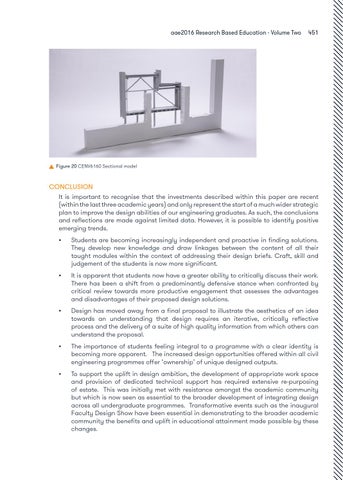
Figure 20 CENV6160 Sectional model
CONCLUSION It is important to recognise that the investments described within this paper are recent (within the last three academic years) and only represent the start of a much wider strategic plan to improve the design abilities of our engineering graduates. As such, the conclusions and reflections are made against limited data. However, it is possible to identify positive emerging trends. •
Students are becoming increasingly independent and proactive in finding solutions. They develop new knowledge and draw linkages between the content of all their taught modules within the context of addressing their design briefs. Craft, skill and judgement of the students is now more significant.
•
It is apparent that students now have a greater ability to critically discuss their work. There has been a shift from a predominantly defensive stance when confronted by critical review towards more productive engagement that assesses the advantages and disadvantages of their proposed design solutions.
•
Design has moved away from a final proposal to illustrate the aesthetics of an idea towards an understanding that design requires an iterative, critically reflective process and the delivery of a suite of high quality information from which others can understand the proposal.
•
The importance of students feeling integral to a programme with a clear identity is becoming more apparent. The increased design opportunities offered within all civil engineering programmes offer ‘ownership’ of unique designed outputs.
•
To support the uplift in design ambition, the development of appropriate work space and provision of dedicated technical support has required extensive re-purposing of estate. This was initially met with resistance amongst the academic community but which is now seen as essential to the broader development of integrating design across all undergraduate programmes. Transformative events such as the inaugural Faculty Design Show have been essential in demonstrating to the broader academic community the benefits and uplift in educational attainment made possible by these changes.