374
RISK
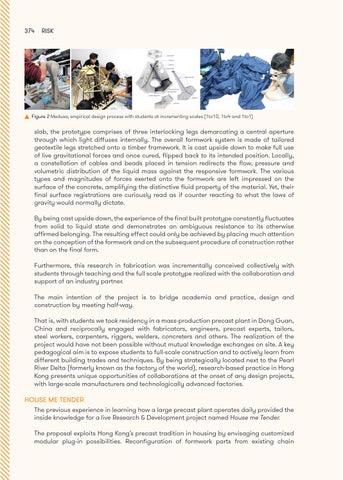
Figure 2 Medusa; empirical design process with students at incrementing scales (1to10, 1to4 and 1to1)
slab, the prototype comprises of three interlocking legs demarcating a central aperture through which light diffuses internally. The overall formwork system is made of tailored geotextile legs stretched onto a timber framework. It is cast upside down to make full use of live gravitational forces and once cured, flipped back to its intended position. Locally, a constellation of cables and beads placed in tension redirects the flow, pressure and volumetric distribution of the liquid mass against the responsive formwork. The various types and magnitudes of forces exerted onto the formwork are left impressed on the surface of the concrete, amplifying the distinctive fluid property of the material. Yet, their final surface registrations are curiously read as if counter reacting to what the laws of gravity would normally dictate. By being cast upside down, the experience of the final built prototype constantly fluctuates from solid to liquid state and demonstrates an ambiguous resistance to its otherwise affirmed belonging. The resulting effect could only be achieved by placing much attention on the conception of the formwork and on the subsequent procedure of construction rather than on the final form. Furthermore, this research in fabrication was incrementally conceived collectively with students through teaching and the full scale prototype realized with the collaboration and support of an industry partner. The main intention of the project is to bridge academia and practice, design and construction by meeting half-way. That is, with students we took residency in a mass-production precast plant in Dong Guan, China and reciprocally engaged with fabricators, engineers, precast experts, tailors, steel workers, carpenters, riggers, welders, concreters and others. The realization of the project would have not been possible without mutual knowledge exchanges on site. A key pedagogical aim is to expose students to full-scale construction and to actively learn from different building trades and techniques. By being strategically located next to the Pearl River Delta (formerly known as the factory of the world), research-based practice in Hong Kong presents unique opportunities of collaborations at the onset of any design projects, with large-scale manufacturers and technologically advanced factories.
HOUSE ME TENDER The previous experience in learning how a large precast plant operates daily provided the inside knowledge for a live Research & Development project named House me Tender. The proposal exploits Hong Kong’s precast tradition in housing by envisaging customized modular plug-in possibilities. Reconfiguration of formwork parts from existing chain