368
RISK
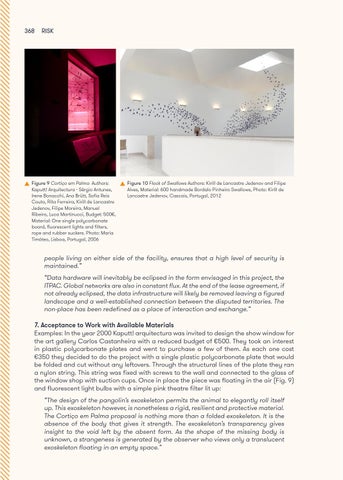
Figure 9 Cortiço em Palma Authors: Kaputt! Arquitectura - Sérgio Antunes, Irene Bonacchi, Ana Brütt, Sofia Reis Couto, Rita Ferreira, Kirill de Lancastre Jedenov, Filipe Moreira, Manuel Ribeiro, Luca Martinucci, Budget: 500€, Material: One single polycarbonate board, fluorescent lights and filters, rope and rubber suckers. Photo: Maria Timóteo, Lisboa, Portugal, 2006
Figure 10 Flock of Swallows Authors: Kirill de Lancastre Jedenov and Filipe Alves, Material: 600 handmade Bordalo Pinheiro Swallows, Photo: Kirill de Lancastre Jedenov, Cascais, Portugal, 2012
people living on either side of the facility, ensures that a high level of security is maintained.” “Data hardware will inevitably be eclipsed in the form envisaged in this project, the ITPAC. Global networks are also in constant flux. At the end of the lease agreement, if not already eclipsed, the data infrastructure will likely be removed leaving a figured landscape and a well-established connection between the disputed territories. The non-place has been redefined as a place of interaction and exchange.” 7. Acceptance to Work with Available Materials Examples: In the year 2000 Kaputt! arquitectura was invited to design the show window for the art gallery Carlos Castanheira with a reduced budget of €500. They took an interest in plastic polycarbonate plates and went to purchase a few of them. As each one cost €350 they decided to do the project with a single plastic polycarbonate plate that would be folded and cut without any leftovers. Through the structural lines of the plate they ran a nylon string. This string was fixed with screws to the wall and connected to the glass of the window shop with suction cups. Once in place the piece was floating in the air (Fig. 9) and fluorescent light bulbs with a simple pink theatre filter lit up: “The design of the pangolin’s exoskeleton permits the animal to elegantly roll itself up. This exoskeleton however, is nonetheless a rigid, resilient and protective material. The Cortiço em Palma proposal is nothing more than a folded exoskeleton. It is the absence of the body that gives it strength. The exoskeleton’s transparency gives insight to the void left by the absent form. As the shape of the missing body is unknown, a strangeness is generated by the observer who views only a translucent exoskeleton floating in an empty space.”