ENVIRONMENT
What’s In a Lake? The Purpose Behind Bartlesville’s Local Reservoirs by Abigail Singrey The lakes surrounding Bartlesville contain depths of purpose that may elude boaters skimming the surface of the waters. Treasures of the community, Copan, Hulah, and Hudson provide more than a scenic escape. These lakes are instrumental to the water supply and flood control for the city of Bartlesville and the surrounding areas, a purpose that makes them key to local residents’ quality of life.
Boulevard completely underwater. The Bartlesville Examiner-Enterprise reported that “raging rivers sent rooftop high water churning across Northeastern Oklahoma.” Thanks to early warnings, the homes in the flooded areas were evacuated to avoid any injuries to people. However, the Bartlesville Examiner-Enterprise reported that when it was all over, 1,500 homes and 200 businesses suffered damage with a total cost of millions of dollars.
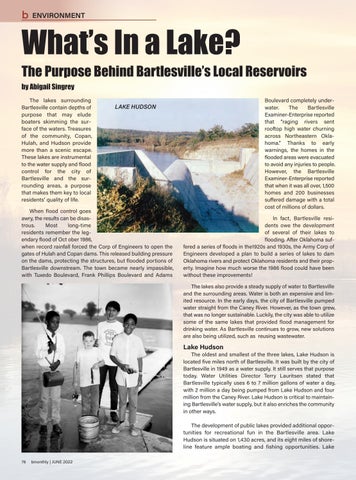
LAKE HUDSON
When flood control goes awry, the results can be disastrous. Most long-time residents remember the legendary flood of Oct ober 1986, when record rainfall forced the Corp of Engineers to open the gates of Hulah and Copan dams. This released building pressure on the dams, protecting the structures, but flooded portions of Bartlesville downstream. The town became nearly impassible, with Tuxedo Boulevard, Frank Phillips Boulevard and Adams
In fact, Bartlesville residents owe the development of several of their lakes to flooding. After Oklahoma suffered a series of floods in the1920s and 1930s, the Army Corp of Engineers developed a plan to build a series of lakes to dam Oklahoma rivers and protect Oklahoma residents and their property. Imagine how much worse the 1986 flood could have been without these improvements! The lakes also provide a steady supply of water to Bartlesville and the surrounding areas. Water is both an expensive and limited resource. In the early days, the city of Bartlesville pumped water straight from the Caney River. However, as the town grew, that was no longer sustainable. Luckily, the city was able to utilize some of the same lakes that provided flood management for drinking water. As Bartlesville continues to grow, new solutions are also being utilized, such as reusing wastewater.
Lake Hudson The oldest and smallest of the three lakes, Lake Hudson is located five miles north of Bartlesville. It was built by the city of Bartlesville in 1949 as a water supply. It still serves that purpose today. Water Utilities Director Terry Lauritsen stated that Bartlesville typically uses 6 to 7 million gallons of water a day, with 2 million a day being pumped from Lake Hudson and four million from the Caney River. Lake Hudson is critical to maintaining Bartlesville’s water supply, but it also enriches the community in other ways. The development of public lakes provided additional opportunities for recreational fun in the Bartlesville area. Lake Hudson is situated on 1,430 acres, and its eight miles of shoreline feature ample boating and fishing opportunities. Lake 76
bmonthly | JUNE 2022