ISSUE 13 NOV/DEC 2013
&
Beauty, Strength Power
$8.95 AUD
$9.95NZD
€7.95
£6.95
Classical v’s Modern Dressage by Barrie Stratton| Endanged and Rare horse breeds - The Sorraia and Przewalski’s Horse. w w w. bar o q u e hors e m ag az i nE.com
1.
info@akaquality.com.au
2.
www.akaquality.com.au
w ww.ba r oque hors e m a g a z in E . com
AKA Quality PO Box 202 Belmont, Vic 3216 AUSTRALIA
w w w. bar o q u e hors e m ag az i nE.com
3.
wh F e ou n y (val RE o E u rB u oo pu ed a DV th rc t $ D 31 ha 25 * 5 se .0 at yo 0) Eq ur ui ti ta ck na et Sy s dn ey fro
m
FOUR OF AUSTRALIA’S PREMIER HORSEMEN IN ONE PLACE FOR TWO FULL DAYS
COLLEEN BROOK
Legendary Showjumper
ROB LAWSON
Reining Champion
JOSE MENDEZ
TONY LANDER
Classical Dressage Master
Horse-Human Relationship Specialist
Sydney International Equestrian Centre
22 & 23 March 2014
TICKETS NOW AVAILABLE VIA TICKETEK Seats are Limited SPECIAL OFFER* Purchase your tickets at our Booth 315 at Equitana Sydney and receive a FREE copy of the IHI Getting Started DVD valued at $25.00 Proudly brought to you by International Horsemans Institute
4.
w ww.ba r oque hors e m a g a z in E . com
www.facebook.com/Dexelim w w w. bar o q u e hors e m ag az i nE.com
5.
CONTENTS
w h a t ’ s
i n s i d e
I ss u e 1 3 no v / d ec 2 0 1 3
10.
Dressage A comparison of Modern and Classical by Barrie Stratton
22.
Trainers’ Directory
24.
Hot Topics - Backing horses
26.
KFPS Friesian Week
30.
Riders Wear
38.
Baroque Pinto
44.
The Peruvian Paso
48.
Przewalski’s Horse
54.
“Nico”
58.
Jenny Rolfe Let the horse become our teacher
63.
Horses of Interest
64.
Yeguada Las Arenas
68.
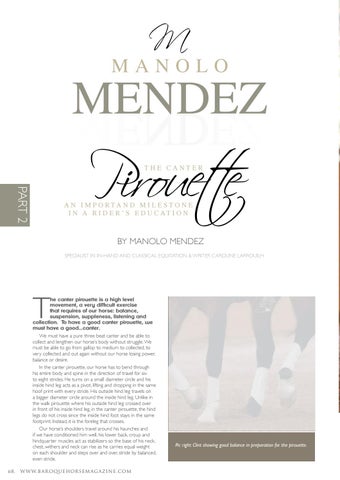
Manolo Mendez Pirouette Pt 2
74. 82.
The Sorraia Horse
88.
Wimer 461 Sport
93.
Horse Care
The Power of Liberty with Martin Contreras
On the Cover: “Centauro” and Katrin Haddon. Katrin is dressed by Ariat Australia (www.justcountry.com.au) Photo by Danielle Skerman
E d i t o r s
O
ur front cover is a shoot I did with the lovely Kat, modelling some of the Ariat clothing range. Also in this edition we look at fashion and the riders clothing. We hope you enjoy it as we often we focus on our four legged friends and forget that many riders out there that love to dress up too! I enjoyed putting on my photographer’s cap again and will bring more fashion wear in future issues. I am often asked by many what is classical dressage? So I thought that it was about time that we put some information together for you to explain what it is all about. I asked contributor Barrie Stratton if he was interested in
doing up this article. Barrie so generously jumped at it as he said he has over 20+ years of research on this subject. For those who want to know more of what it is all about, I highly recommend this fascinating read complied by Barrie. I also want to thank Barrie for the absolute hours and hours he has put into writing this article. I hope you all enjoy this read as much as I did. Recently I had the pleasure to attend a Liberty Clinic with Martín Contreras. It was a fantastic experience and I invited Martín to talk to the readers of BH on what it is really about. I know that this sort of horsemanship can be classed as a little more
N o t e
hippy, however it’s really a fantastic way to learn and bond with your horse. It’s amazing to see that trust develop, and the horse want to work and play with you. The best part about this is that you don’t have to stop riding the sport you want to ride - it won’t change what you can do with your horse, but it will change how your horse will respond to you. It will change what they’ll be able to communicate with you and visa versa. With the festive season upon us we would like to wish you all a very happy and safe holidays. We’ll be back in 2014!
erman Danielle Sk Editor in Chief
6.
w ww.ba r oque hors e m a g a z in E . com
07
In photo: Ruby Goodsell and “Serio” w w w. bar o q u e hors e m ag az i nE.com
7.
SUBSCRIBE
TODAY
and SAVE! 6 issues (1 year) for only $39.95* *Australian residence only. Shelf price of $53.70
EDITORIAL
Editor-In-Chief Danielle Skerman editor@baroquehorse.com.au editing: Mel Hughes/ Michaela Wake
ART & PRODUCTION
Design & Production Manager: Danielle Skerman Designers: Eric Lopez, Shane Cunningham, Cristian Prutescu
ADMIN & MARKETING
Patty Taylor Patty@baroquehorse.com.au
Advertising enquiries
For international subscriptions prices please contact us for view the web link below Please tick the appropriate boxes and fill out the payment details below
Advertising@baroquehorse.com.au +61 419 363 635 Sales@baroquehorse.com.au +61 404 843 636
For Subscription enquiries: Subscriptions@baroquehorse.com.au
Name:
General Enquiries:
Phone:
enquiry@baroquehorse.com.au
Photographers:
Address:
Cátia Castro, Danielle Skerman, Nadeen Davis, Cally Matherly, Joan Sankey
Contributors:
Postcode/Zip: Email Address: Payment:
Credit Card
Please send me a pay pal invoice
Nadeen Davis, Cátia Castro, Danielle Skerman, Patty Taylor, Gigha Steinman, Jose Luis Duarte, Tabitha Jones, Elizabeth Schmehl, Michaela Wake, Caroline Larrouilh, Manolo Mendez, Jenny Rolfe, Barrie Stratton, Joan Sankey.
Cardholder no: CCV______
Cardholder name: Expiry date:
Total due:
Signature: Enquiries To: subscriptions@baroquehorse.com.au ph+61 419 363 635 POST SUBSCRIPTION TO: Baroque Horse Magazine PO Box 18002, Clifford Gardens, Toowoomba, QLD Australia 4350
8.
go online at www.baroquehorse.com.au/buy-magzine
w ww.ba r oque hors e m a g a z in E . com
Publisher: Baroque Horse PTY LTD ACN: 159 279 848 PO Box 18002 Clifford Gardens, Toowoomba QLD, Australia 4350 ©Baroque Horse Magazine AU. 2011 All Rigths Reserved. No part of this publication, editorial or advertisement, may be reproduced without the written consent of the publisher. The content of the advertisements within this publication is the responsibility of the advertiser. Although due care is taken in the preparation and publication for all advertising material, the publisher cannot be held responsible for any errors or for any consequential effects. Opinions and statements made by others in submitted text may not be the same as those held by either the publisher or the editor.
w w w. bar o q u e hors e m ag az i nE.com
9.
Dressage A Comparison of Modern and Classical By Barrie Stratton - National ‘A’ level dressage judge-international trainer and coach
This article looks at the differences between today’s 21st century competitive dressage and the art of classical dressage, which evolved from the beginning of the Renaissance period to the early 20th century.
The history of modern competitive dressage
I
n 1914 the German Committee for Equestrian Games proposed to the International Congress for the Olympic Games that a memorised test be introduced, with movements to be included in a particular order, in a given manner, and within a specific space of time. This was to replace an old freestyle test which included specified movements, but without a time limitation. The proposal was submitted by Germany’s Inspector General of Cavalry, von der Marwitz, and Secretary General Gustav Rau. The purpose of the new test was to indicate that the horse was well-schooled and suitable as a campaign mount, rather than one suited to the haute e’cole, or high school style of riding, which included airs above the ground such as courbette or capriole.
The rules of modern dressage were formulated by a committee in the early 1930s. (The committee members included General Decarpentry, an ecuyer from the Cadre Noir in Saumur, best known today for his book Academic Equitation. He was later President of the FEI Dressage Committee.) The intention was to prepare for the first internationally recognised dressage competitions for the 1932 Olympic Games. Prior to this period, the French and Germanic schools tended to ignore each other, but to the credit of the FEI, they were brought together and given the opportunity to challenge each other from time to time in its competitions. The masters of the Germanic school tended to apply direct forces of opposition to a horse’s resistance. They required unconditional surrender of the horse, rather than seeking their general cooperation towards perfection of the common task. Although the Germanic horses were a little constrained, their impression of submission was superior to that of the French, whose riders appeared to avoid difficulties, rather than solving them. However, the competitors themselves soon took advantage of the opportunity for mutual observation. Without rejecting what was working well in their own method, they adopted some of the ways of their neighbours which had proven successful. As the years progressed, the differences became less pronounced, until by the 1960’s, 1 0.
ww w. ba r oquehors e m a g a z in E . com
there was no difference between either French or Germanic equitation being displayed in the dressage competition arena. A definition of modern competitive dressage:
A
fully trained competitive dressage horse of today performs movements in a timed and structured test, which includes piaffe, passage, half pass at trot and canter, canter pirouettes, extensions in trot, canter and walk, tempi changes and rein back. Included in the 2013 FEI dressage rules, Article 401 gives the following description of modern dressage. “The object of dressage is the development of the horse into a happy athlete through harmonious education. As a result, it makes the horse calm, supple, loose and flexible, but also confident, attentive and keen, thus achieving perfect understanding with the rider.” The above definition represents the rewording in 2010 of a previous definition. The former definition had a similar message, but it stated that FEI dressage should be based upon the ‘Classical Principles’.
I
‘The Training Scale’
n addition to the modern definition of competitive dressage, trainers, coaches and judges are directed to use the 6 elements of the Training Scale to train, coach and judge dressage horses at all levels. That scale requires the horse to display qualities of rhythm, suppleness, accepting the contact of reins and other aids given by the rider, impulsion in trot and canter, straightness and collection. Modern dressage tests These tests range from a fundamental level of schooling in the Preliminary test. The purpose of this test is to confirm that the horse’s muscles are supple and loose, and that it moves freely forward in a clear and steady rhythm, accepting contact with the bit. These qualities are required to be maintained and enhanced, as the horse progresses with its schooling through the higher levels of ever increasing degree of difficulty. Novice level requires the horse to progress with the added qualities of developing an improved thrust from the hindquarters, together with
Novice level introduces leg yield. This exercise develops suppleness and responsiveness to the aids. The tests that follow from Novice level adhere to a well-
structured system of preparing the horses for movements which are progressively of higher degrees of difficulty. Elementary, Medium and Advanced level tests follow. During these levels, collection is introduced, with the horse being required to carry proportionately more weight on the hindquarters, and so less on the forehand. At Elementary level collection and the shoulder-in exercise is introduced. The FEI rules state that the shoulder-in is the best means of making a horse supple, loose and unconstrained
dressage
a degree of balance and throughness. The quality of throughness indicates that the horse is supple and has a swinging back. This is called a ‘back mover’, as compared to an incorrectly trained horse which may display extravagant action, but has a stiff back. That horse is termed a ‘leg mover’, and is usually uncomfortable for the rider to sit trot on.
Photo © Catia Castro w w w. bar o q u e hors e m ag azi nE.com
11.
for the benefit of the freedom, elasticity and regularity of its paces, and the harmony, lightness and ease of its movements. There is a clear requirement that the qualities of looseness, throughness, suppleness and rhythm are further enhanced as the horse progresses through these levels. A well-defined distinction between the paces also develops as the level of the tests advance. The tests are designed to assist the horse’s mental and physical development through systematic education, rather than by forcing or over-challenging them. Before walk pirouettes are introduced, half turns on the haunches are used. These require less collection than a pirouette and so help in the horse’s progressive education. Similarly, the working canter pirouette is introduced in the Advanced level, prior to the more collected canter pirouette. Through employing this structured, systematic method of education, the horse is more likely to retain quality paces used in the movements as the degree of difficulty increases.
B
FEI tests used in international competitions.
ased on the previous summary we can conclude that the first 5 levels of dressage tests are designed to systematically develop the horse’s ability to confidently progress onto the FEI levels of Prix St George, Intermediate 1, Intermediate 2 and Grand Prix. The test displaying the highest degree of difficulty is the Grand Prix, where a horse should excel in the qualities such as self-carriage, suppleness, thoroughness and cadence, together with the swing of its back and elastic suspension of its steps. A horse competing at this level is expected to have enhanced all of these qualities as it progressed through the levels, as well as showing a clear indication that it has been trained in accordance with the previously mentioned Training Scale. As a result of employing this progressive method of schooling, the Grand Prix horse should perform the difficult Grand Prix movements with apparent ease, projecting an air of calm confidence.
dressage
Observations of what Modern Dressage has been designed to achieve. The Ideal: The intention of the progressive design of modern dressage tests is to produce a ‘happy equine athlete’. This would be a supple and confident horse, elastic in its free flowing paces and performing movements with effortless ease. It is refreshing that we do occasionally witness this. The reality:
T
he FEI Code of Conduct states that the: •“Welfare of the horse must never be subordinated to competitive or commercial influences”.
• “Horses must only undergo training that matches their physical abilities and level of maturity for their respective disciplines. They must not be subjected to methods which are abusive or cause fear.” Because of internet access today, we are able to observe far more than in the past. We may easily see videos of horses being schooled in harsh ways, clearly not in keeping with the FEI Code of Conduct requirements. In some areas of Europe today, statistics indicate that 70% of all sport horses are euthanised by the time they are 8 years old, due to inappropriate training methods. It is common practice for coaches and riders today to either look for a ‘quick fix’ for their horse’s problems, or force the horse into submission and ‘make’ it do a movement, overlooking the fundamental principles. This is the path too
1 2.
ww w. ba r oquehors e m a g a z in E . com
Photo © Catia Castro often taken, rather than adhering to what the FEI and its training scale and progressive exercises and movements have intended. An example is a rider who is dissatisfied with their canter pirouettes, and rather than adjusting to the horse’s needs and modifying the exercise to preserve the quality of the canter and instil confidence in their horse, they relentlessly repeat the pirouette in an attempt to ‘make’ the horse do it properly. This is a typical example of what then results in a stressed horse, which lacks suppleness and displays a poor quality canter, at least during the pirouette. The judge has a critical role to play. It is largely their job to ensure horses are rewarded when displaying a way of going that adheres to the rules, and not be drawn in to giving high marks to horses, which might display extravagant leg movement but also show signs of stress and/or stiffness. The Uniqueness of Modern Dressage…
T
here is a Time-Line for Tests and Age Related Competitions
Coaches and riders are given a time line in modern day Young Horse dressage classes to school and show their horses at ages 4, 5 and 6 to perform specific movements, including flying changes in the 6 year old class. It is the responsibility of the coaches and riders to adhere once again to the two FEI Code of Conduct rules quoted previously, and not prematurely school a horse that is
Classical Dressage rider/trainer and Olympican Gonçalo Carvalho
During the Renaissance Period, Italian academies for music, painting, fencing, dancing and riding were established. A new and enlightened approach to riding was developed. This was in line with the general cultivation of the classical arts. Indoor riding became a sophisticated art. In the late 16th century Cesar Fiaschy and his pupil Pignatelli, who directed the Ferrara School where Antoine de Pluvinel studied, laid the foundations of equestrian art. There also existed a Naples School, where La Broue was the head. During the 17th century, Frenchman de Pluvinel took the Italian school to Paris. There he formed the Grande Eurie Royale in the Place des Pyramid under Henry IV. The school was later moved to Versailles and de Pluvinel wrote a treatise entitled “Instruction of The King, Louis XIII.” He developed work in the pillars, one for a circle and two for piaffe, etc. Riders also rode between the pillars. Antoine de Pluvinel is credited with the sayings, “Sweetness in the horse is like a flower on a fruit tree. If you take it away, will it ever return?” and “Be chary of blows, and large of caresses.” This was the time of Austrian Kaiser Charles 1, who founded the Austrian riding school. At the same time the Duke of Newcastle (1593-1676) established a ménage in Holland, in an old pavilion belonging to artist Ruben. He developed work on circles. As did de Pluvinel’s school, he used strong bits and long spurs, but did not develop the same idea of softness. His works are published in English. This brings us to the period of Francois Robichon de la Gueriniere, who is recognised as the father of what is termed Classical Equitation. A definition of Classical Dressage:
S
ome of the movements which are performed in classical dressage include piaffe, passage, flying changes, rein back, shoulder-in, half pass and pirouettes. The high school or ‘haute ecole’ level of ‘finished’ riding may include ‘airs above the ground’ such as courbette, capriole, levade and ballotade. Classical dressage is the search for understanding and the perfection of the three natural gaits of the horse. Its true essence is not the performance of difficult movements, but to make the horse Photo © SRS
physically not ready, or mentally unprepared for that work. Unfortunately, the thoughtful preparation and decision-making required to decide whether a horse should or should not be schooled for these types of classes is sometimes overruled by the owner’s or rider’s competitive or commercial interests. Once again, it becomes the responsibility of the judge to determine if the horse displays a calm confidence, together with a manner of performance, which indicates its training has resulted in a horse showing the qualities of a ‘happy athlete’. Now let us examine the evolution of classical dressage, and then draw a comparison to modern dressage. The Art of Classical Dressage.
T
he evolution of thoughtful horsemanship commenced
with Xenophon (427-355 BC). His documented work ‘On Horsemanship’ is still published today. He initially based his work on Simon of Athens, and stated “Something forced, or not properly understood, can never be beautiful”. In the Dark or Middle Ages, the art of horsemanship did not appear to progress, and so the next documented works came from the 16th century.
Photo of a levade at the Spanish Riding School Vienna w w w. bar o q u e hors e m ag azi nE.com
13.
Photo © Catia Castro more gentle and supple, and to improve its balance. It is not primarily for the rider to seek public acclaim, but it is a personal conversation with the horse. Classical dressage is the art of riding in harmony with, rather than in conflict with, the horse. Classical dressage also developed the use of gymnastic exercises to supple the horse and improve the quality of paces. Those exercises include travers and renvers on circles in all gaits. Work in hand is part of the exercise and educational process employed in classical dressage. It is employed to prepare the horse prior to mounting by ‘de-constraining’ him, teaching response and suppleness and helping the horse to better understand the lateral work of shoulder-in or half pass in its early stages of schooling. It is also useful to school piaffe, which may then lead to airs above the ground such as the levade.
PRE Tasidor, an example of a horse whose type has been traditionally used in Classical Equitation. He also has the movement and temperament that would successfully adapt to the requirements of Modern Competitive dressage.
1 4.
Author’s Note: • The movements of classical dressage differ from modern, as the latter does not include ‘airs above the ground’. • Many of the gymnastic exercises used to improve the horse in classical dressage are not commonly used in the schooling of modern dressage competition horses. Classical riding masters and their contributions to the art.
F
rancois Robichon de la Gueriniere (16881751) used gymnastic exercises to work the whole horse. He was director of the Manege des Tuileries at the Rue de Rivoli. He developed shoulder-in, stating that it was “the alpha and omega of dressage”. He adopted and changed The Duke of Newcastle’s work on circles, and developed the idea of
Sheer Etiquette ridden by Susan Paix performing extended trot at Grand Prix
ww w. ba r oquehors e m a g a z in E . com
descent de main. This is best understood as a momentary giving of the reins during selfcarriage of the well engaged horse. This was to help the horse relax its jaw and subsequently its whole top line, enabling the horse to exhibit a moment of unconstrained brilliance, during for example, a pirouette or piaffe. He published Ecole de Cavalerie in two volumes, and it became the basis for all serious equestrian students. The Spanish Riding School have always based their principles on this work. He did less pillar work and mainly used Lusitano types. Author’s Note: 1. Just as the FEI states today, de la Gueriniere found that shoulder-in made a horse supple and unconstrained. 2. De la Gueriniere’s idea of ‘descente de main’ differs to Modern dressage as the
Hervey Bay ridden by Ruth Schneeberger in a canter pirouette
Francois Baucher (1796-1873) wrote ‘Methods de Equitation’ and worked the horse by parts. He relaxed the jaw of the horse by using flexions of the jaw which created mobility in the mouth, as opposed to a tensely set jaw. This procedure was used to subsequently help de-constrain the horse’s poll, neck and body. He relaxed the croup by using lateral movements like travers. He was not a particularly good writer, so it was not possible to read his work and readily train a horse.
Steinbrecht’s idea was to develop the latent strength of the hindquarters through impulsion and straightness. He would improve the horse’s suppleness, responsiveness and engagement by travelling from shoulder-in at trot, to counter shoulder-in, alternating the two. He also taught a celebrated circus rider, Elisa Petzold. Author’s Note: Just as de la Gueriniere, as well as today’s FEI doctrine, Steibrecht utilised the shoulder-in to supple the horse, improve its freedom, regularity, and ease of movement.
He developed flying changes every stride, an idea he adopted after visiting his uncle, who managed the Prince Burghese’s stables in Italy.
The Conte D’Aure 1799-1863 was also an opponent of Baucher. He called himself ‘the man who maintained traditional riding’. He was also the Frenchman who used the horse for sport, developing full gallop and extended trot. He worked with Thoroughbreds, focused on outdoor riding, and became the Ecuyer en Chef at Versailles. He attacked Baucher over his beliefs in total domination and his work on flexions. He did not want to break the will of the horse, but to have him “frank and in front of the rider”, and not to have the curb chain overly tight. He thought Baucher’s horses were broken in their paces and unsure in their walk. Despite his criticism, he regretted the death of the “clever artist Baucher”, in an article he wrote in 1855. He wrote ‘Traite d’ Equitation’, or ‘The horse out hacking’.
Baucher used the idea of total domination of the horse, discouraging any initiative or use of natural instincts, from the animal. He continually modified
Author’s Note: Due to these personal conflicts, Baucher was never admitted as an ecuyer of the Cadre Noir, and he was bitter about that. Conte D’ Aure
During this time, Thoroughbreds appeared and were used for racing. Baucher found that the training methods used for Lusitano types were unsuitable for the Thoroughbred, such as the work in the pillars. He therefore adopted a new approach.
Francois Baucher
Fillis
his work during his lifetime. The Germanic school preserved and modified some of his progressive schooling methods. This was in stark contrast to the School of Vienna, the equestrian metropolis of central Europe, which claimed that Baucher “was the grave digger of French equitation”. Baucher used his equestrian talent by riding in the circus, because at that time there were no shows or competitions. He won a bet made to many artists and aristocrats by presenting a horse in a circus, which he had schooled from a green horse to fully trained in just 30 days. Author’s Note: A direct comparison can be drawn here to modern-day riders and trainers who, for competitive or commercial reasons, school their horses in hurried and inappropriate ways, causing them stress and physical harm. During this same period, Gustav Steinbrecht (18081885) wrote ‘Gymnasium of the Horse’. His principle objective was to “ride your horse forward and make him straight”. This was the golden rule for German instructors of the cavalry until 1937. He based his work on de la Gueriniere, as did Baucher, but he was Baucher’s great rival.
dressage
modern rules require a soft contact to be maintained at all times during all movements. However, there are some exceptions recently introduced, when the horse may be given a loose rein. They include competing at medium level in the collected canter, as well as in free walk at the lower levels. At all other times, including piaffe and canter pirouettes, the soft contact is to be maintained as proof to the judge that the horse is accepting the contact and exhibiting thoroughness.
Fancois Robichon de la Gueriniere and Steinbrecht were similar in their philosophies, both highlighting the necessity of the horse to have a clear willingness to go forwards. That requirement is paramount in today’s modern dressage environment as well. Three disciples of Baucher were General Faverot de Kerberech, Capitaine Raabe and General L’Hotte. It is said that on Baucher’s death bed, when he was asked why he could ride horses better than anyone else, he took L’Hotte’s hand and said “like this, not like this”, and indicated never to pull the reins in a backwards manner, a principle stressed by the 20th century classical riding master, Nuno Oliveira. Author’s Note: A cornerstone developed in classical dressage was lightness and self-carriage. Today’s modern dressage rules similarly stipulate the use of soft reins. In reality, it is rare today to see riders following that requirement, as they do not understand how to prepare and school their horses, or correctly use their pelvic and lower back regions to precede a rein aid, half halt or re-balancing aid. In modern dressage it is common to see a rider pulling backwards, with one or both hands, on the reins. General de Kerberech was a great exponent of Baucher’s ideas and employed the use of ‘l’effet de w w w. bar o q u e hors e m ag azi nE.com
15.
ensemble’. The rider uses the combined effect of a steady rein contact in addition to the calf or spur. Using this exercise, the horse learns to focus intently on the rider, while remaining soft in the mouth and gently chewing on his bit as he rounds his neck and softens at the poll. Author’s Note: l’effet de ensemble is a form of the half halt that is used today in modern dressage. Both applications bring the horse to a mental state of added attention to the rider, and when correctly executed, result in enhancement of the horse’s suppleness. In its true classical application it is used to halt the horse while the spurs are placed at the girth. Capitaine Raabe wrote a thesis on a method of positioning and balancing the shoulders of the horse while developing the piaffe. It involved a refined and precise moving of the hands to left and right, both hands being located just above the withers. General Decarpentry gives a version of this method in his book, ‘Academic Equitation’. There he describes the loading of a shoulder to enhance the lift of the opposite front leg. Author’s Note: Today in modern dressage, it would be rare to use such an exercise. Instead, the balance, correct elevation of the front and back legs and lowering of the hocks in piaffe, would be developed as a result of schooling the suppleness, impulsion, collection, self-carriage and the progressively increased loading of the hind quarters. General L’Hotte was referred to as the greatest ecuyer of the Cadre Noir, Saumur. His teacher had been a pupil of the Marquis de Marialva, one of Europe’s most brilliant horsemen, at the Queen of Portugal’s School. He used a philosophy similar to that of D’Aure and Steinbrecht, that the horse should be “straight and forward”. He also helped to evolve the idea of the calm horse.
1 6.
ww w. ba r oquehors e m a g a z in E . com
Author’s Note: By now we are seeing a multitude of both similar, as well as differing, opinions in relation to the method of schooling horses. In addition to this, many masters have varying priorities relating to the qualities the horses should possess. It is from this interesting array of differences that the art of classical dressage evolved into the 20th century. Towards the end of the 19th century, a Saumur pupil named Capitaine Beudant schooled horses during his military career in North Africa. Unlike many past masters, he mainly rode the horse in a snaffle bridle. He said, “The greatest difficulty in equitation is to have the horse straight in the haunches and in the shoulders”. When asked how he rode so brilliantly he said, “hands without legs, legs without hands”, and he obtained extreme lightness. He wrote ‘Hands without Legs’ and ‘Exterior and Haute Ecole’. He believed there should be no brutality, but the horse should be transformed to be balanced under the rider and thereby rendered light. There are accounts of him using l’effet de ensemble to halt and calm his horse while Arabs wielding cutlasses rode wildly nearby. Once they had passed, he would remove his spurs from the girth and proceed with the dressage on his calm horse. He said, “The horse should be obedient to the spur as the son is to his father”. Author’s Note: Again we have the approach of developing a balanced and straight horse, and placing emphasis on calmness and lightness; familiar qualities we seek in today’s competitive arena. James Fillis (1834-1913) performed flexions at the walk (unlike Baucher who did them at the halt), l’effet d’ensemble and collected horses using Baucher’s method. He criticised Baucher though, saying that it was a very dangerous method for those who were not advanced in equitation, and working under a great master. He wrote ‘Principles of Dressage and
CRYSTANBY Michele Meijer Qualified Senior Instructor Horse Safety Australia and Trainer Working Equitation Australasia.
Performance through Practical Horsemanship
DVD Private Lessons Series Download and begin immediately
Train Your Own Horse
Join the Kandoo Online Video Training Club
Kate Fenner
+ 61 (0)458 298 338 kate@kandooequine.com.au www.kandooequine.com.au
Clinics – Foundation Courses – Working Equitation
School horses available - Breeding quality Sport Morgans - Located in Adelaide Hills. Classical Dressage - Working Equitation Instruction - Horse training to advanced levels, Inc FEI movements.
crystanby@westnet.com.au / 0432821348
Classical Dressage Australia Presents REBECCA DESMOND Classical Dressage Trainer and FEI level Competitor Clinics available throughout Australia and Internationally Teaching the best of the French Riding Culture, and philosophies of Philippe Karl.
WORKING EQUITATION CLINICS AUSTRALIA With 2013 European Team Gold Winner NUNO AVELAR Nuno will be in Australia in Feb 2014 to conduct a series of clinics. To register your interest or to organise a clinic in your state, Contact Nuno’s Australian Agent, Rebecca Desmond
ph: 043 558 2636 | e: classicaldressage@live.com.au
www.classicaldressageaustralia.com w w w. bar o q u e hors e m ag azi nE.com
17.
dressage
Equitation’ which in English is incorrectly called ‘Breaking and Training’. Although critical of Baucher during the book, he finally calls him the master at the conclusion. Marquis de St Phalle and Fillis corresponded on the subjects of canter to the rear and on three legs, both being expert at these exercises (as was Beudant). Fillis commented that equestrian art begins with the perfection of simple things. This comment related to his observation that people searching for the secret of riding seek information in the latter pages of a book, in the complicated or advanced airs, rather than where they should look for the basics: in the first few pages. Author’s Note: Here we find an insightful remark from a classical master that riders should look to the fundamentals of riding and thereby establish a solid foundation upon which to further school a horse. That approach is in keeping with today’s understanding that the six elements of the training scale should be the basis of dressage training. Classical dressage now approaches the time when it is transformed into modern competition. It is the period of General Decarpentry, and the formation of the FEI. Structured and timed dressage tests become popular, allowing riders and countries to compete and seek recognition for excellence, and ultimately, Olympic gold medals.
Photo by Jessica La Pia
Tasidor
Tasidor is a 7 year old PRE 160cm bay gelding being trained by Barrie Stratton with a view to placing him with a knowledgeable rider who is capable of continuing his education. He is an outstanding horse with beautiful movement and enormous potential for further development. His temperament cannot be faulted, he learns quickly and in the time he has been with Barrie, has demonstrated the potential to perform in both classical and modern competitive dressage. If you are looking for a horse who has proven ability and loads of potential
contact Barrie Stratton on 0400-639-909. 1 8.
ww w. ba r oquehors e m a g a z in E . com
Dressage Australia Pty Ltd Classical Dressage Training
"Dressage With Soul" Š
(Meditation, One-Pointedness, Position, Confidence, Ease & Harmony)
Shahron Ameer 315 Fisher Road, Drouin West 3818 www.dressage.au.com
Spanish Cavesson $185 The Balanced Horse - Sylvia Loch $55 Breathe Life Into Your Riding - Jenny Rolfe $39.95 Joy of Dressage - Uta Graf DVD 3 Vols $59.95 Each
Also available plain black Zaldi Spanish Cavesson $99
69 Main Street, Garfield, Victoria, 3814 Phone 03 5629 1010 Email shop@dancinghorse.com.au
www.dancinghorse.com.au
Yeguada Picachos Andalusian Lusitano Azteca
Horses available in USA
www.yeguadapicachos.com
w w w. bar o q u e hors e m ag azi nE.com
19.
dressage
A summary
Raquel Falcão, Photo © Catia Castro horse’s health and happiness.” In today’s world of
I
t is clear that the requirements of both the modern FEI dressage of today and the art of classical dressage have basic similarities. Calmness, suppleness, balance, and straightness are some of the common goals when schooling horses. The structured, timed tests and agerelated classes of today are significant changes, however, to the era of classical riding when the time element was less significant, and so gave the rider perhaps a better opportunity to adapt to each individual horse’s needs. Perhaps we can again think back to Xenephon’s statement of almost 2,400 years ago, “Something forced, or not properly understood, can never be beautiful.” His message still stands today. Besides developing our skill as riders, we should prioritise the well-being of our horse. This is, of course, the code of the FEI as well. In conclusion
H
erman Heyer was a master rider from the Vienna School, who retired near Adelaide, South Australia during the 1970’s. He summarised the difference between modern and classical, which I believe warrants repeating.
modern competitive dressage, to avoid situations occurring as mentioned in the last paragraph of Heyer’s statement, it comes back to the responsibility of welleducated judges to up hold the admirable standards set by the FEI. It is only then that well-executed classical and modern dressage have much in common, and we may observe true harmony between horse and rider, resulting in a ‘happy equine athlete’. a The above text is © Barrie Stratton 2013
www.academyofdressage.com.au
“The difference between classical training and schooling is that in training, the horse ridden in accordance with the laws of nature will offer in its own time, as by-products as it were, classical movements. The closer these movements resemble the foal’s frolicking jumps and airs, or a youngster’s moody expressions in poise and gait, the better is the training. In today’s world of unnatural movements—no matter how impressive they may look—are outside the laws of nature, inferior in efficiency and detrimental to the
Daniel Pinto, Photo © Catia Castro
Dulce Vida, PRE filly sire Jaleador de JC III Dam: Gazela B Bred and owned by Olivia Cartier-Graves, Auckland NZ, Photos taken by Olivia
2 0.
ww w. ba r oquehors e m a g a z in E . com
GRAND PRIX COLLECTION
GRAND PRIX COLLECTION
GRAND PRIX COLLECTION
GRAND PRIX COLLECTION
Designed for the stylish competitive rider using high quality materials, technical fabrics and finished to a superb standard. A classic & luxurious collection of versatile rugs & accessories that caters for all disciplines.
W
NE G&S Horserug Pty Ltd | 465 Hume Hwy Craigieburn VIC 3064 | Australian Distributor for Horseware Ireland www.horserug.com.au | sales@horserug.com.au | (03) 9832 0800 w w w. bar o q u e hors e m ag azi nE.com
21.
Trainers’ Directory Classical training and long reining through to high school, Medieval skill at arms and working equitation.
• • •
Available for lessons and clinics throughout Australia (located in Tasmania)
Foundation Courses Working Equitation Clinics
Kate Fenner + 61 (0)458 298 338 kate@kandooequine.com.au
Mobile 0418524196 Email ferralkidz@activ8.net.au
www.kandooequine.com.au
Barrie Stratton • • •
Harmonious Horse
INSTRUCTION
International Dressage Coach and Trainer National ‘A’ Level Dressage Judge Classical / Competetive students and horses at all levels
Author of the 3Cs of Dressage….’Calm Confident and Connected’
harmonioushorsemanship.com.au
SPECIALISING IN CREATING HARMONY FOR HORSE & RIDER THROUGH LIGHTNESS & BALANCE armonious Horse BC-1.indd 1
M: 0400 639 909 P: +61 8 8370 9809 E: barrie@thestrattonfamily.com W: www.academyofdressage.com.au
23/6/12 3:48:11 PM
Dressage Australia Pty Ltd
Classical Dressage Training
Classical Equitation Tweed Valley A Centre for Classical Riding and Working Equitation
Dianne Baxter
"Dressage With Soul" © (Meditation, One-Pointedness, Position, Confidence, Ease & Harmony) Shahron Ameer 315 Fisher Road, Drouin West 3818
www.dressage.au.com
Working Equitation Australasia Accredited Trainer
(02) 6679 2238 707 Limpinwood Road, Limpinwood, NSW
ddbaxter@bigpond.com www.omarustud.com.au www.facebook.com/dianne.baxter.5
Woodend
Dedicated to the teachings of Nuno Oliveira
CRYSTANBY Michele Meijer Qualified Senior Instructor Horse Safety Australia and Trainer Working Equitation Australasia. Jane and Nuno Oliveira 0413 014 393 classicaldressage@jaynehowley.id.au
2 2.
Jayne Howley Pure Classical Dressage
ww w. ba r oquehors e m a g a z in E . com
School horses available - Breeding quality Sport Morgans - Located in Adelaide Hills.
Michele Meijer 0432821348 crystanby@westnet.com.au
Trainers’ Directory Winmallee Classical Riding
Classical Dressage Australia Presents REBECCA DESMOND •
Learn and Experience the Art of ‘Classical Riding’
Classical Dressage Trainer and FEI level Competitor Clinics available throughout Australia and Internationally . Teaching the best of the French Riding Culture, and philosophies of Philippe Karl.
• •
Amanda Evins 0438 085 066 or +61 8 8388 8397
p: 043 558 2636 | e: classicaldressage@live.com.au
www.winmallee.com.au
www.classicaldressageaustralia.com
He will steal International Horsemans Institute your heart... Ali Baba
Tony Lander
Puro Sangue Lusitano 16.2hh Bay Stallion
•
People and HorseTraining
•
•
DVD's,
•
Courses
Lessons in Australia & world wide
Personal Coaching
Australia contact Danielle 0404843636 Danielle@baroquehorse.com.au
1300 664 269 | +61 417 688 644 | ihi@bordernet.com.au
www.internationalhorsemansinstitute.com.au
Jody Hartstone
Temperament * Versatility * Power * Versatility * Collection * Versatility Height, presence and paces. Intelligence and courage.
www.goncalocarvalho.com
Makara Park Morgans
Ali Baba is sired by one of Portugal's best breeding stallions - the Grand Prix trained Hostil. His dam lines are famed in the bullfighting ring.
A Lusitano is a horse like no other.
• Training • coaching • Mentoring
hartstone equestrian
Hartstone Equestrian Ltd Raglan, New Zealand www.HartstoneEquestrian.com
‘the fun way to train seriously’
Working Equitation Australia
Located in Victoria 0427 375 302 | 03 5360 8369
Matt & Beccara Lloyd Beccara.lloyd@activ8.net.au
www.makaraparkmorgans.com
Brent Eastwell • Dressage horses for sale • Dressage coaching (available for clinics) • Dressage training for horses and riders (limited spaces available)
Art of Classical Dressage A. Appreciation S. Sincere K. Kindness
José Mendez
José Mendez NCAS Level II Dressage Coach
EFA NCAS Coach Assessor Coach NCAS Level II Dressage EFA NCAS Coach Mobile. 0412 597 Assessor 316 Mobile. 0412 597 316
ndez BCard07 v8.indd 1
176 Badgerys Lookout Road Tallong NSW Australia 176 Badgerys Lookout2579 Road
TallongTel. NSW 2579 +61Australia 2 4841 0069 Tel. +61 2 4841 0069 E. mendezeqcentre@ozemail.com.au
mendezeqcentre@bigpond.com
4/7/07 9:10:11 AM
w w w. bar o q u e hors e m ag azi nE.com
23.
HOT Topics Backing a horse, at what age and why ?
Gonçalo Cavalo 2012 Olympican
MIGUEL RALÃO 2008 Olympican
BH: At what age do you back (start a horse under saddle) and why ? Gonçalo:. Here in Portugal and in the most part of the word we start horse at 3 years, keeping in mind the individual horses ability both mentally and physically. This would be the absolute minimum age to start the backing process. The horse has to have the body in both physical strength and mental maturity to be able to accept and understand what is being asked. They need to be able to accept the work without harm to their physical development as the horse continues to mature which can continue to 6-8 years of age.
Traditionally training a young horse can commence at the end of three years of age or at the beginning of the four years. Nowadays with the evolution of the breeding methods and with greater investment in the horse, the handling/training is done more carefully. There are people who begin the training of the Lusitano at the onset of three years. But, in my opinion and from my experience, training should begin in the second half of their third year.
BH Some people like to back a horse at a younger age (2.5yrs) and then spell the horse (give horse a 6 month break) for the horse to ‘think about it’ Do you think this helps in the horses younger years training ? Gonçalo:. No, I do not agree that this has any benefit. I do not advised to interfere with a young horse of this age and it is not worth the possible harm of the physical development of the animal. I do agree that when they are younger that separation from his mother (mare), from about 6 months of age is good. You teach the Colt to clean the hooves and pick up the feet, grooming, leading with halter and teach move on the lunge, but no more than that! BH How much work or how much do you ride a young horse? Gonçalo: 3 about times a week with only about 30 minutes more or less
2 4.
ww w. ba r oquehors e m a g a z in E . com
It is commonsense to me that each animal has its own character and this must be taken into account. Some horses will have to walk 2 to 3 weeks on the lunge with only the saddle, and there are other horses that in the first week can be the ridden. It is the history of the horse, its handling, and characteristics that must be taken into account before we design its training. The FEI (Fédération Equestre Internationale) sets the sequences of concepts and objectives from an academic and sports riding point of view. If you have a 4 year old horse, we have the 4 year old FEI test as a reference to what level he should be trained at. However, the 2nd level test, which is the 6rys old one, I find particle difficult for the lusitano. The Lusitano has a delayed muscular development in comparison to other horses, so we have to build the top line for a much longer time. Therefore it is difficult in most horses to perform what is required in this test at that time.
I never have a set age that I start a young horse at. It depends on so many things: * The height of the horse - if it is going to grow over 17hh I like to back them a little earlier. * The temperament of the horse - if it is particularly difficult it may need to be started early to give more time to turn it JODY HARTSTONE - away for a few months, bring it back in for more work then turn FEI NZ Rider/Trainer it away again * Its current conformation - maybe it is so high behind that riding it would be uncomfortable for you and the horse * How closed the knee joints are - I don’t want to put unnecessary strain on young joints. * The breed of the horse - some breeds mature slower than others. So its not like I say - oh it turned three today we must back it. I have a very clear system to back the young horses starting with teaching them signals on the ground to go and stop so I have control of them. Then we lay all over them bareback to get them used to the feel of a human all over them. Next we teach them to step left and right (turn) from rein aids of the rider, and to go from a leg aid and stop from a rein aid. This is a very simple process and they normally are being ridden around bareback quiet happily within two or three sessions. Once the horse is confident bareback we introduce the saddle and make sure he is well habituated to girth pressure. Then it is just about teaching him the commands to change his rhythm, change his gait, and steer. We include activities like kicking a horse ball, walking over bridges and beach riding to give the young horse an overall education I think one of the biggest mistakes people make with horses is that they teach the horse roundness of frame from a rein aid before they ever teach him to stop or slow his legs from the rein. The horse always diverts back to the very first things he learns about pressure - so for the rest of his life he may be tense and hard to control if he thinks the rein means be round rather than slow down!
Vasco Amaro Lopes { VET to Olympic horse ‘Rubi AR’ } BH: At what age do you recommend a horse start under saddle and why? Vasco: I recommend a horse start under saddle not before 3 years old. The main reason is that at this age even still growing sometimes they have already a structure to support rider. BH: If a horse is started to young, what can this to do a horse’s body ? Vasco: A horse started too young can have future problems in joints and ligaments as an example. The horse is not completely developed to start working and most most of the muscle skeletal structures are not mature yet to undergo the stress of training like ligaments and joints. BH:: How much work/riding would you recommend a young horse can do ? Vasco: The best should be every two days. Works one day rests the other. Avoid too much lounging. Work specially the movements of the horse forward on walk trot and canter. But in our days everyone wants everything fast... No more than half an hour work, the horse should finish every time without signs of being tired.
w w w. bar o q u e hors e m ag azi nE.com
25.
KFPS
Friesian
Week
Photos and article by Nadeen Davis
It’s mid-July 2013, and it seems that airports all over the world have an excessive amount of Friesian loving people waiting to board a plane bound for Holland. Why you ask? To attend the KFPS Information and Education week. From the 15th to the 19th of July the clinic for foreign members took place in Friesland. KFPS members from the USA, Croatia, Brazil, Finland, Germany, Sweden, Slovenia, Poland, Paraguay, Romania, South Africa and of course Australia came together to information gather and learn everything and anything Friesian. Eight Australians ventured off and certainly made a big impression, not only for our passion, but also for our commitment to this magic breed. From the beginner to experienced owners/ breeders/riders, everyone made new friends, learnt valuable information and got to see amazing, good and not so good examples of the breed.
2 6.
ww w. ba r oquehors e m a g a z in E . com
Each day provided something new and exciting, as well as something a little different to entertain us. We were treated to a beautiful sailing trip at sunset on the Wadden Sea, carriage drives in the forest, village tours and a dressage clinic with Peter Span, driving clinic with Sybren Minkema and Jolanda Schreuder, just to name a few. We also had the opportunity to visit many stallion stations and training stables. We were warmly welcomed to these beautiful facilities to partake in clinics, horse assessments and of course view studbook stallions. We were taught all aspects of judging the Friesian horse including the racial aspects, the conformation, structure of the legs, lameness and leg defects and of course, movement. We also had a guide to the order of inspections as well as presentations from vets sharing information about breeding, fertility and conformation. We even tested out our knowledge with two exams, which I have to say the Aussies did extremely well in! These exams included completing linear
scoring of four horses and placing them in order of quality. We were issued our certificates of completion at the amazing facility (Stoeterij Bommelsteijn), where we were treated to a lovely show during our lunch break. In the afternoon the KFPS president, Ids Hellinger, gave a presentation about the breeding goals of the KFPS. Some of these goals consist of maintaining the breed’s characteristics, maintaining character, improve sport aptitude and fitness in the forms of longevity, fertility and overall health. We looked at genetic trends and breeding values, as well as stallion selection and inbreeding. Of course new friends and great memories were made and I can honestly say that everyone thoroughly enjoyed themselves. What was also a huge benefit to us was that we had an
opportunity to attend local keurings. This was fantastic and a great initiative from the organisers was to have KFPS judges available to us to discuss each horse as it was presented. It was a super chance to hone your newly acquired Friesian eye and maybe see things that you did not see before. Thanks to the KFPS for putting this together, in particular Annet Wouda. The judges that participated were Luciel Ellens, Sjouke de Groot, Jan Hendriks, Jan Hellinx, Louise Hompe and Wil Thijssen, needless to say a powerhouse group of Friesian knowledge, and of course a huge thanks to the property owners who shared their time, knowledge, horses and homes with us. a
Focus
w w w. bar o q u e hors e m ag azi nE.com
27.
WIDE R
a
n
g
Bates WIDE Dressage
E
Bates WIDE (All Purpose)
Finally, a range of WIDE Saddles brought to you by Bates Saddles, the leaders in innovation. Riders will experience a truly high performance seat that delivers a level of comfort and contact never previously experienced in WIDE Saddles. A deeper seat and ultra narrow waist enable the rider to sit deeper ‘into’ the saddle for a well balanced and central position. Your horse will demonstrate a marked improvement in it’s comfort and freedom of movement, as they benefit from world leading performance systems, the CAIR® Cushion System and revolutionary EASY-CHANGE® Fit Solution, ensuring your horse’s ongoing comfort and your peace of mind.
GE CH AN EA SY- T SYS TEM GU LLE
WIDE
À N FACILE LARGE DE D'ARÇO EXTRAE D'ARCA EM WIDE SYSTÈM EASY-C HANGE ER ENSYST CHANG KOPFEIS HANGE EASY-C
The Bates WIDE Saddle Range features the EASY-CHANGE® Gullet System WIDE offering you the choice of four interchangeable gullet plates (1XW to 4 XW).
Available from Horseland and other leading saddleries. View the complete range of Bates Saddles at batessaddles.com
ENG AGING 2 8.
ww w. ba r oquehors e m a g a z in E . com
INNOVATION
@batessaddles
A D V E R T O R i A l
Now there’s a fitting solution for WIDE horses too! The EASY-CHANGE® Fit Solution is the first total saddle fitting solution ensuring your horses absolute comfort and your peace of mind. Every rider nurtures a unique and special connection with their horse where their horse’s welfare and comfort always comes first. Too many of us know the frustration that comes from our horses saddle no longer fitting, and we do everything we can to improve our horse’s comfort by using pads under the saddle to compensate for a poor fit, or even worse, we buy another saddle, only to have the same thing happen again months later. As every horse regularly changes shape with their level of fitness, diet and maturity, when it comes to their saddle, it too should be able to adapt to meet their changing needs. The EASY-CHANGE® Fit Solution is the first total saddle fitting solution that enables full adjustment enabling your saddle to be custom fitted to your horses changing shape. The EASY-CHANGE® Fit Solution is available exclusively in high performance Bates leather saddles and easy care Wintec saddles which both offer a range of saddles suited to horses with a wide conformation. Adjusting the fit of the saddle is as simple as selecting the optimal tree width for the horse’s current shape and muscling with the EASY-CHANGE® Gullet System WiDE, and making adjustments within the saddle panel for optimal balance and clearance with the EASY-CHANGE® Riser System.
Together, these systems offer unparalleled scope of adjustment for a total fitting solution that is easy, measurable, and completely reversible. Riders can feel confident in their saddle’s ability to be custom fitted to even the most challenging of conformations.
= Select the optimal tree width for your horse’s current shape and muscling.
+
Make adjustments within the saddle panel for optimal balance and clearance.
Whether you are a serious competitor, or simply ride horses for the joy of it, choose a saddle with the EASY-CHANGE® Fit Solution that puts your horse’s comfort first. Enjoy the peace of mind in knowing that your saddle offers full adjustability and is able to meet the changing needs of your horse. Bates and Wintec saddles featuring the EASY-CHANGE® Fit Solution are available through Horseland and other leading saddleries. For more information visit easychangefitsolution.com
N.B whilst the innovative EASY-CHANGE® Fit Solution offers unsurpassed flexibility in achieving an optimal fit, no one saddle can claim to fit every horse. it is always recommended ongoing professional advice is sought on the fit and in meeting the unique needs of each horse/rider combination. Global patents and design registrations apply. w w w. bar o q u e hors e m ag azi nE.com
29.
Above and top right: Model: Katrin Haddon with “Centauro�. Above: Katrin is wearing clothing supplied by Ariat Australia www.justcountry.com.au 3 0.
ww w. ba r oquehors e m a g a z in E . com
r a e W
Riders
All Photos by Danielle Skerman
High fashion in riders gear can go back for centuries. If we look back to the 17th century in France, we can see a devantiere skirt was worn that had a split up the back to enable astride riding. Fast-forward to the 19th century, and a devantiere was used to describe the whole costume or any part of the riding gear; be it the riding coat, the skirt, or the apron. Many of these outfits are still worn today either for fun or in costume competition.
Nowadays the riders gear depends on whether you are competing, and then it is more like a uniform that must be worn according to regulations of the specific discipline. This has been held for many, many decades and it is unlikely to change. Whether you are competing or just riding for pleasure, there is a plethora of clothing outlets for you to be able to complete your whole look.... horse and rider image combined!!
Model: Ruby Goodsell with “Serio� wearing stock by Equisstyle Stock www.equistylestocks.com.au Ruby also wears Pinstripe Underbust Victorian corset $190 with Pinstripe Double-breasted Tail Coat, $170 by Gallery Serpentine www.galleryserpentine.com w w w. bar o q u e hors e m ag azi nE.com
31.
Model: Ruby Goodsell and “Serio”. Ruby wears Eliza shirt $150, Silver Underbust Victorian corset $195 and Duchess skirt $275 by Gallery Serpentine www.galleryserpentine.com 3 2.
ww w. ba r oquehors e m a g a z in E . com
Jessica wears Eliza shirt $150 and Double-breasted Tail Coat $170 by Gallery Serpentine www.galleryserpentine.com
w w w. bar o q u e hors e m ag azi nE.com
33.
Katrin Haddon with “Centauro�. Katrin is wearing clothing supplied by Ariat Australia www.justcountry.com.au
3 4.
ww w. ba r oquehors e m a g a z in E . com
Model: Ruby Goodsell with “Serio” wearing stock by Equisstyle Stock www.equistylestocks.com.au Ruby also wears Pinstripe Underbust Victorian corset $190 with Pinstripe Double-breasted Tail Coat, $170 by Gallery Serpentine www.galleryserpentine.com w w w. bar o q u e hors e m ag azi nE.com
35.
Ruby wears Eliza shirt $150, Silver Underbust Victorian corset $195 and Duchess skirt $275 by Gallery Serpentine www.galleryserpentine.com.
Pics bottom left and right: Model: Jessica Aichinger with “Gideon P.J � , Jessica wears Eliza shirt $150, Double-breasted Tail Coat $170 and Draped Kirtle Skirt set $205 by Gallery Serpentine www.galleryserpentine.com
3 6.
ww w. ba r oquehors e m a g a z in E . com
Jessica wears Eliza shirt $150 and Double-breasted Tail Coat $170 by Gallery Serpentine www.galleryserpentine.com
equestrian H O M E
w w w. bar o q u e hors e m ag azi nE.com
37.
s
n
esia Fri air
G
am y rl
re
D
of C kit iz tos
B
he
at
yM all
o
Ph
in
t
o
Š
3 8.
ww w. ba r oquehors e m a g a z in E . com
P
en
ritt
W
icha
by
M
e
ela
ak W
o
T
he term ‘Baroque Pinto’ can be loosely used to describe any baroque breed of horse that is of a broken colour, however there are some breeds that are consistently being crossed with coloured horses to produce ‘new’ standalone breeds, and they are increasing in popularity.
W
hen we think of ‘pinto’ horses, most people will form an image in their mind of either a black and white, or a brown and white horse, with large areas of colour broken up by splashes of white. Some people may also see the smaller, sturdy mounts that the Native Americans ride, or perhaps stout children’s ponies with tiny ears lost in fuzzy manes and a pair of large dark eyes peering out from beneath an all-too-fluffy forelock! When we think of ‘baroque’ horses, we generally think of strong-looking horses, with broad chests and deep barrels, well-sprung ribs, and good, broad loins. More often than not, people will also include an arched neck in their image, and an impressive amount of lift and impulsion through the gaits. Generally, in the mind’s picture, the horse will also be of a solid colour, perhaps a grey, a black, or even a bay. So how does a baroque pinto come about? If you’re suddenly having thoughts of a coloured Thelwell pony stallion desperately trying to cover a sleek, jet-black Friesian mare, then you may need to think again! Baroque Pintos are usually a combination of a coloured warmblood, such as a Dutch Warmblood, and a high percentage of either: Friesian, Knabstrup, Lippizaner, Lusitano, Andalusion or Noriker. The result of such a cross can be quite spectacular, with virtually all of the baroque traits breeding through, and with the added pizzazz of such striking colour.
The Baroque Pinto can trace its lineage back to one particularly influential stallion, by the name of Bonte Nico, although he was also later known by the name Nico van Friesland (Nico of Friesland). He was born in 1957, bred by Albert Offringa and later purchased by Pieter Hellinga as a five year old. Out of a Friesian mare, and by a Bovenlandse (Oldenburg East-Friesland) stallion called Godemar, Nico was taken to various inspections around The Netherlands, but was repeatedly refused approval to breed. The Friesian Studbook was not closed to crossbreds until the late seventies, and thus horses of any Friesian parentage were keured (inspected) at regular breed inspections around the country, with the stallions undergoing rigorous testing before being given approval rights for breeding.
I
n January of 1964, Nico arrived at the farm ‘Lunia State’ and stood at stud for the first time, his owners proudly claiming him to be the first coloured stallion to be used for Warmblood breeding. He repeatedly threw his colour and his popularity soared as breeders clamoured to have a piece of the ‘wild stallion’. Unlike today however, there were heavy fines imposed on mare owners for breeding with an unapproved stallion, and in 1965, all mare owners that had bred to Nico received a penalty notice in the mail. Nico’s owners quickly wrote an urgent letter to HRH Prince Bernard, who passed the letter onto a Mr Biesheuvel, the then Minister of Agriculture. Twice he personally intervened in the matter, in accordance with Article 13 of the current Equine Laws of the day. The first intervention allowed Nico to keep breeding until March 1966, and then he was to be re-inspected at the stallion show. The inspection took place in the famous hall at Leeuwarden in Friesland (where Friesian horse keurings and the stallion show still happen today!) and a huge crowd turned out to see what the outcome would be.
Hellinga Sr. was alive and well. Nico travelled around Holland to continue covering mares, and in 1973 he returned to Friesland to stand with Mr Hellinga’s grandson. His popularity continued to increase, not only regionally, but nationally as well. He was often featured in print media throughout the country and this only served to increase the value of his offspring. Coloured foals commanded much higher prices (in the vicinity of several hundred gilders more!) than their solid brothers and sisters. Such was the desire to breed from him, that at the height of his popularity, Nico is said to have covered over a hundred and fifty mares in one season! This was no mean feat considering it was all live cover ‘back then’ without the convenience of being able to ship semen and artificially inseminate.
N
ico’s celebrity status grew, and children who came to visit him would often ask to pluck tail hairs to keep as souvenirs of their idol. In September 1966, Nico was the star attraction during a large coloured horse festival, where he stole the show with nineteen of his offspring. His babies were talented in many different disciplines, and several were sold as performance horses in various circuses due to their tractable nature and loud colour. It is said that the Baroque Pinto (particularly the Friesian Baroque Pinto) owes its right to exist in no small part to the perseverance of Mr Biesheuvel over fifty years ago, by refusing to give up on Nico, and continuing to fight for his right to breed. There are still grandsons and granddaughters of Nico around today that are producing some stunning offspring, so his legend will continue to live on.
Unfortunately for Nico and his owners, the Inspectors were still unhappy with what they saw; in particular, the Inspection Committee commented on his weak back, sloping and muscular thighs, and too little class in the legs. A national survey was conducted, and this also returned a negative result. Again, Biesheuvel intervened and ensured that Nico would not be sent to the slaughterhouse, and his word remained as law as long as Mr w w w. bar o q u e hors e m ag azi nE.com
39.
P ©Photos Cally Matherly
in
t
o colour, so much so that they would not let a pinto or dilute horse into their camps, for fear that it would corrupt the breed. This has remained true even until today, with the Arabian horse being one of the few pure breeds that has neither coloured nor dilute genes within the gene pool. Going back even further in time, we can see paintings of pinto horses in tombs in Ancient Egypt, dating around 4 B.C, so the desire to have coloured horses is certainly nothing new. Given that many of the baroque breeds are some of the oldest breeds around today, it is almost fitting that we should seek to combine these two ancients and produce something that meets the needs of the modern horse person seeking a talented, trainable, impressivelooking, high-level dressage or sporting mount.
M
any Baroque Pintos are registered with the ECHA (European Coloured Horse Association) and they define the following breed characteristics/breeding goals for the Baroque Pinto: ©Photo Nadeen Davis
I
f we continue to look at other baroque breeds and their influence on the Baroque Pinto, we come to the Andalusian. Portraits dating as far back as the sixteenth century have surprisingly shown what appear to be pinto Andalusians, despite usually only having the colours of black, brown, bay and grey in modern times. These (or others like them, perhaps Barb stock?) are thought to have been exported by the Spanish Conquistador Hernan Cortes, who apparently bought ‘thousands’ of pintos with him to the New World. The name ‘pinto’ comes from the Spanish word ‘pintado’, meaning ‘painted’. Many of these were set free, and were caught by Native Americans, who liked them for their toughness and their colour, which blended in with the environment and made a great natural camouflage. The Arabian is thought to have had a degree of influence over many of the breeds that are around today, yet interestingly the Bedouins were said to be dead against any horse of 4 0.
ww w. ba r oquehors e m a g a z in E . com
Breeds allowed: Friesian, Knabstrup, Kladruber, Noriker, Andalusian, Lusitano, Lippizaner. Ideal height: 145cm – 167cm (14hh – 16.2hh) Colour: Tobiano/Overo. White and one colour. For all colour options, the secondary colour features desired are spots on the muzzle, coloured genitals, white outline around the eye, vertically striped hooves. Head: Strong head, light roman nose permitted, large bright eye. Neck: Strong, well-muscled neck with a relatively high neckset, proportionate to the body. Body: Strong and compact riding horse with a broad chest, not too long in the back, rounded rump, strong hind quarters and gaskin muscles. Legs: Strong, dry, with strong joints and well-shaped, hard hooves.
w w w. bar o q u e hors e m ag azi nE.com
41.
Movement: The desired movement has good cadence and rhythm, with good over tracking at the walk and trot, and should be light and easy with elevated knee action. Applications: The Baroque Pinto is particularly suited to riding/driving, and for classical or high school dressage. Of note: Friendly and sociable temperament, good willingness to work and picks up new concepts quickly. There are also other registries around the world in which the Baroque Pinto can be registered, and some of these include (but are not limited to): the Friesian Blood Horse Registry (horse must be minimum 25% Friesian), the Australian Friesian Warmblood Horse Society (horse must be minimum 25% Friesian), KWPN (Royal Warmblood Studbook of the Netherlands, Barock Pinto Stamboek (parent Studbook in The Netherlands) etc. Provided the horse’s parentage can be verified, and either one or both parents are registered with the relevant studbook, the process is fairly straightforward.
In more recent times, the introduction of the pinto pattern in combination with the baroque horse has produced some outstanding horses that continue to prove successful across all levels of competition. Discerning breeders are blending the best of both worlds and ensuring that conformation and temperament are bred true to type, with the added bonus of having that flash of colour and excitement wherever they go. There is an old saying that a ‘good horse is never a bad colour’ and that’s very true, but surely it’s great to have our baroque horses come in a variety of different colours to suit almost every taste?! a
The Barock Pinto Stamboek (BPS) has separate registers for horses with different percentages of Friesian blood, and this is noted on the registration paper. There is type BP for horses with less than 75% non-Friesian blood, there is type XX for more than 75% nonFriesian blood and there is type FB for stallions with less than 75% non-Friesian blood. Blind judgings are carried out when the horses are inspected, hence the inspection panel has no knowledge of who or what they are looking at, and DNA is collected for each horse and placed in a central database. The BPS now has a local registry ‘arm’ established in the USA as the population of the Baroque Pinto has grown, and no doubt in years to come, there will be many more local registries appearing around the world.
L
ooking back through history, the Pinto or coloured horse has played various roles across the ages, from sturdy native ponies, to colourful war horses and brightly patterned circus mounts. Interestingly, the pinto pattern was so greatly prized that in battles long since past, the Royal Marshall was entitled to every black and white horse captured on a battle campaign. The exact reason as to why this was has been lost over the years, but the distinctive markings were no doubt a large part.
©Photo Nadeen Davis
4 2.
ww w. ba r oquehors e m a g a z in E . com
Dion
-
Studbook Friesian Gelding DOB 26.12.2009 Feitse 293 X Wicher 334.
Smart, friendly, forward moving. Definite dressage potential.
youtu.be/1_NTqihcwIg
Very tall, elastic & athletic movements, modern/sport horse style Friesian. 2 more years to maturity, expected to achieve 16:3 hands. Professionally started ‘naturally’. Training report and DVD available.
For more details: marianne.robinson@bigpond.com
$30,000
Clarendon Forest Retreat is a scenic, luxury retreat. Our eight cottages are spread over the 1000 acre property, offering unique and stunning country accommodation in NSW. We are pleased to be pet friendly and offer gorgeous horse back rides through the property or into the neighbouring national state forest. Bring your horse or ride one of ours! Clarendon Forest Retreat 02 6554 3162 150 Coates Road Possum Brush NSW www.cfr.com.au
w w w. bar o q u e hors e m ag azi nE.com
43.
PHHorse The Peruvian Paso
By Elizabeth Schmehl
ORIGIN Before the 1600’s, most of the riding horses in the world were naturally gaited breeds. Trotting horses were used as pack animals or servants’ mounts. Most people knew very little about riding, and most traveling was done by horseback, making a smooth riding horse a necessity. Even the knights—who rode huge trotting-type horses for battle—often kept an easy-gaited horse to ride when traveling, leading his trotting horse along behind. As roads were built, and people began to travel by horse-drawn vehicles rather than on horseback, a decreased need and use for gaited horses resulted since trotting horses were more suitable for pulling wheeled vehicles. At about the same time, horses became important for working cattle as great expanses of land were devoted to cattle-raising, and horse racing gained in worldwide popularity, placing even more emphasis on breeding trotting horses. As the seventeenth century opened, it was unusual to see a horse that trotted, but at the close of the same century, it was unusual to see a horse that did not trot. It was one of the most unusual transformations seen in horse breeding history. ISOLATION As horsemen of the world were making the transition from gaited horses to trotting breeds, on the other side of the world, in the country of Peru, the Peruvian horsemen continued breeding their naturally gaited “Caballo Peruano de Paso.” The Peruvian horse descended from foundation bloodstock that was brought to Peru directly from Spain by Spanish noblemen and political authorities during Peru’s colonial period when Lima was the center of Hispanic America. The Spanish were recognized as foremost horse breeders 4 4.
ww w. ba r oquehors e m a g a z in E . com
in the world. They took to Peru the horses that were an ancient form of the Andalusian horse—primarily Spanish Jennets of Cartujano (Carthusian) blood. These horses bought to Peru are said to have been a blend of several breeds. The Barb gave the ancient Spanish horse a tendency to amble, contributed to its conformation, striking colors, and energetic but tractable temperament; high action and head carriage, proud but cooperative temperament, low-set tail and abundant mane and tail. The Spanish Jennet gave the Peruvian horse an even nature, its lateral gait, extremely smooth ride, and sloping shoulders. It is said that the Peruvian Paso breed actually began about 1530 A.D. as the modern Jennet. The 450 years of isolation, selective breeding, and such factors as climate and forage served to modify succeeding generations. A new breed was created which possesses characteristics different from those of any other horse. The Peruvian Paso has evolved as one of the purest breeds in the world and as a unique entity in the horse kingdom. The existence of this breed has been called “the greatest triumph of genetic selection ever achieved by a group of breeders.” The Peruvian breed has the unique characteristic of being the only natural laterally gaited breed in the world that can guarantee its
inherited trademark gait to 100% of its offspring.
in Australia and New Zealand used as a trial riding, and as a good all-rounder riding horse.
REDISCOVERY In recent years, horsemen have begun to rediscover the pleasures of natural, easy-gaited horses. Horse fanciers of all ages from many nations are turning to the Peruvian Paso as an ideal mount for the Twentieth Century horseman. A longstanding Peruvian practice of not breeding animals that have unsuitable dispositions has made the tractable temperament of the Peruvian Paso one of the world’s best. He is also one of the showiest horses because of the beauty, arrogance with inner pride and energy that makes him travel with a style and carriage as if he is always “on parade.” And individuals who thought they would never ride again due to injuries and age are riding today with the greatest of pleasure.
LOOKS The average height of the Peruvian Paso is between 13 hands and 15.2 hands, and the weight is commonly between 900 and 1,100 pounds, about the same as Morgans and Arabians. The head shows power and vigor, with a straight line or slightly concave profile, strong at the bottom with outthrust jaw, and is carried steady and firmly. The ears are alert, of medium length, graceful, mobile with fine tips curved slightly inwards; the eyes are expressive, dark, elongated, and wide-set; the nostrils are long, sensitively dilated. The neck is of medium length with a gracefully arched crest. It is set high and runs well back into discretely marked withers. The mane and forelock are naturally fine, long
TRADEMARK The trademark of the Peruvian Paso is a special, inherited, completely natural, four-beat lateral gait. Called Paso Llano, it is a type of broken pace that makes the Peruvian Paso the smoothest riding horse in the world. A unique, spectacular and beautiful natural action of the front legs that is highly desired and universal in the Peruvian breed is called “Termino.” Put simply, Termino is similar to the arm motions of a swimmer: the foreleg rolls forward and toward the outside before stepping down, which also allows the hind foot to advance sooner and farther than would otherwise be possible. The gait can be as slow as a walk or as fast as an extended trot or slow canter and is completely natural—the gait is not induced or aided in any way by artificial training or devices. Naturalness of the Peruvian Paso is so emphasized that competitions in Peru, Ecuador, Argentina, Europe, Canada, and the United States require the Peruvian Paso be shown without shoes and with a short, natural hoof. The Peruvian Paso can now be found and lustrous. The body is well-proportioned, length-to-height, medium-size, with a strong, well-developed, deep and wide thorax, a well-arched rib cage with a short, wide girth, and the joining of the shoulder blades being smooth and level with the croup. The chest is well-proportioned, strong, wide and well-muscled. The back is short to medium in length, strong and rounded. The bottom line of the barrel runs nearly horizontal. The limbs are solid and firm and stand in proper alignment. The shoulder is long and well-inclined, with an open angle at the elbow, giving the front limbs free and graceful movement. Proper joining is the basis of the animal’s correct alignment and poise, and the width and strength of the joints are indispensable for proper movement of all these parts. The arms are normally short and muscular. The forearm is long and muscular at the top, and slimmer below. The knees should be well-modeled, with slightly convex rear face. The cannon bone is short with well-defined sinew. At the hindquarters, the thigh should be well-joined to the croup and rump, showing powerful but not excessive contraction. The leg muscles should be outstanding, the rump rounded down to the thigh, but not too low. The hocks should be well-formed and defined, tending inwards, with strong, lean bone structure, and well-balanced proportions. The tail should start low, carried quietly, close to the rump, and should be long and fine. The leg bone and shanks, called the gaskin, should form a sufficient angle to give it support, leaning towards the center of gravity most of the time. The shanks are short, strong, with good bones and strong tendons, well-implanted w w w. bar o q u e hors e m ag azi nE.com
45.
and defined, the fetlocks strong and lean, well-outlined with precise contours and sharply angled, the pasterns strong, medium length, fine and clearly defined, and springy with a slope equal to that of the shoulder. The hooves should be hard and well-rounded, with a concave inner sole and a long, wide and prominent frog, and of good size proportionate to the horse, with sloping walls and sufficient high heels to permit the proper projection of the angle of the pasterns. The Peruvian Paso Horse, because of its direct link to the Barb horse, comes in an array of striking color tones and shades, coming in all basic solid colors and all dilute colors as well as grey and roan. This wonderful breed can now be found all over the world, with more people becoming aware of it and after one ride, wanting one, as there is no other ride like a Peruvian Paso. It is used as the ultimate riding horse in its native country now, and a rising star all over the world. a
4 6.
ww w. ba r oquehors e m a g a z in E . com
Hanui Farm Australia Boutique Breeder of Peruvian Paso “PVF Amanecer de Jaime�
Barefoot Australia Give your horse the freedom to perform
Contour Bridle: shaped headpiece takes pressure off the nuchal ligament
Australian & New Zealand Distributor for all Shapleys products & Wattle Lane Stables mineral mixes.
Check out the website to view the full range of products, and also to ďŹ nd your local stockist Treeless saddles, bitless bridles and much more... Visit our website
www.barefootaus.com
Ph: 0407 471 816 | Email: mtf@outlook.com.au
www.mane-tail-feather.com
Jindabyne Equestrian Resort
w w w. bar o q u e hors e m ag azi nE.com
47.
P r z ew a lski ’ s horse R Interview by Danielle Skerman
ecently I had the pleasure of chatting to Todd Jenkinson, Unit Supervisor in Life Sciences Department at Taronga Western Plains Zoo about the Przewalski’s horse (pronounced shə-val-skee or zə-vahl-skee ). Yes, not baroque I know, however this breed is too important not to cover. When you think of the old horse cave paintings, well, you’d more than likely be picturing the Przewalski’s horse who is one of the main ancestors of the domestic horses of today. In evolutionary terms, they are classed as Equus fernus – the original horse!
4 8.
ww w. ba r oquehors e m a g a z in E . com
What is a Przewalski’s horse, you may ask? Well they are the only true wild horse left in the world, and to this day they have not been tamed. (Other ‘wild’ horses in the world are a result of domestic/feral horses being released or that have escaped and can be domesticated if caught). Their genetic history dates back as far as 160,000 years ago and they are still very much the same today. They are of pony size, about thirteen hands or 132cm at the wither. They weigh around 300 kilograms (660 lbs).The coat is generally dun in colour with pangare features, varying from dark brown around the mane (which stands erect) to pale brown on the flanks and yellowish-white on the belly and around the muzzle.The legs of Przewalski’s
horse are often faintly striped or barred, also typical of primitive markings. The Przewalski’s Horse was declared extinct in the 1960’s, and the small number of horses that reside in zoos around the world have become pivotal in ensuring their ongoing survival.The re-establishment of Przewalski’s Horse in the wild relies on the sound management of zoo-based herds. In their native homeland of Mongolia, where they are called Takhi, the first reintroductions occurred between 1992 and 2004. While hunting caused the Przewalski Horse’s extinction, the main threats to the reintroduced animals are hybridisation with domestic horses and competition for food and water with livestock
BH: How did the Taronga Western Plains Zoo actually become involved? When and how did all this start? TJ: In 1982 we got our first horses here at the Taronga Western Plains Zoo, however they were first imported in the early 1900’s to Australia as part of the program, and we were the first to get them. Our official breeding program here didn’t start until the 1980’s. In the mid-90’s, we actually released animals that were bred here back into Mongolia, back to the Gobi Desert. The last one of those females died in 2010 after a really severe snowstorm, but there are still five descendants of those animals in the Gobi Desert.
BH: How are they surviving now in the wild? Are they re-establishing well? TJ: Well, actually in 1969, they were classified as extinct in the wild, and then in 2008 because of the Breed and Release Programs for these animals, they were reclassified from extinct in the wild to critically endangered, so they are going the right way. It’s the only conservation program that I know of in the world where an animal has been extinct in the wild and been reintroduced and they’re now going in the right direction. Normally you see it in the other direction, where they become more and more endangered until they get to the point of being critically endangered. There are about 325 in the wild now. BH: Oh, really! That’s pretty good, isn’t it? TJ: And there are about 1,500 in zoos around the world, as well. There are 43 [Przewalski] horses in our region (Australia) at the moment. There are five different places that hold Przewalski horses, five different institutions. We’ve got eleven here. We’re part of a managed program. The Zoo and Aquarium Association have a number of managed programs, and a lot of species you will see in the zoo. I’m the Species Coordinator for this particular species, so what we do each year is we put any births and deaths in a studbook. We then transfer this data to a software program called PMx and this software tells us
w w w. bar o q u e hors e m ag azi nE.com
49.
to release more? How many do you have to breed before you look at releasing more overseas? What’s the plan? TJ: Well, we probably won’t be releasing any more in the near future. But what we more than likely will do is to supply bloodlines to those zoos that can, and they’ll continue to release them back into the wild again. BH: It would be a bit more feasible for them as they are much closer then we are here. TJ: Much closer, and the Europeans have been very good with us, because they’re very passionate about it over there. They love the Przewalski’s Horse, and they’ve put a lot of money into making sure these release programs happen. BH: Prague is one of the main ones, isn’t it?
the effect on the genetics if we breed with any particular animal.
TJ: Yes. Prague’s probably the most famous zoo.
BH: How are your inbreeding lines with them all? Do you have a percentage that these guys are sitting on?
[Since 2011, Prague Zoo has transported 12 horses to Mongolia in three rounds, in cooperation with partners (Czech Air Force, European Breeding Programme
TJ: Yes, we do. We like a threshold of about 90% genetic diversity over a hundred years with our managed programs. Unfortunately because all the captive animals you see across the world now come from only thirteen descendants, the genetic diversity with these horses in our region is 77%. Despite this, I think it is unreal given the numbers of animals that they had to start with. They have been a very wellmanaged species from the very early stages. BH: How do you maintain the genetic diversity of the bloodlines with the stallions? TJ: We rotate them. This particular stallion that we’ve got here came from Monarto Zoo originally in South Australia. We’ve got one of his offspring, [Bataai] is his name. He is going to Monarto in the next few months, and we’re going to get another male from them to start a young breeding group as well. So we do, we swap them around for the greater good of the genetics. BH: And what’s the future? Do you guys plan 5 0.
ww w. ba r oquehors e m a g a z in E . com
for Przewalski´s Horses, Association pour de cheval du Przewalski : Takh, Czech Development Agency, Czech Embassy in Mongolia and others) and it plans to continue to return horses to the wild in future. In the framework of the project ‘Return of the Wild Horses’, it sustains its activities by supporting local inhabitants. The Zoo has the longest uninterrupted history of breeding of Przewalski´s Horses in the world and keeps the studbook of this species. ] BH: It is said that the Przewalski’s horse can’t be domesticated. Why is this? TJ: Well, they’re a true wild horse. They’re the only wild horse left on the planet after the Tarpan became extinct in the late 1990s. The Mongolians have tried to domesticate them, but they can’t do it. We all know that Mongolians are very good horsemen. I have heard though, (and this is a story I like to tell from a woman from the States), that if people do try and ride them, they just sit down. BH: Oh, wow that’s amazing! That’s very smart of them! BH: Cave paintings have depicted horses that look similar to Przewalski’s horse and they look very recognisable from the horses of today, have they changed much over the years? What’s the history behind them? TJ: These guys pretty much haven’t changed a lot. They used to be found throughout Europe, and you’ve likely seen the cave paintings in France. They date back about 40,000 years, and that’s at least what we’ve found throughout Europe. However, human encroachment (the same old story you always hear) pushed them into harsher and harsher areas and they were hunted for their meat and their pelts as well. In the late 1800’s, there were a number of very affluent people that wanted to add them to their collections. They would travel to the steppes of Mongolia and as they couldn’t capture the adults, they separated the foals out and captured them, then they’d get foster mares to bring them back to
Photos on this page were all taken at Tarongo Western Plains Zoo by Danielle Skerman where they were in places like Europe. But what they actually did is it split up harems and it basically fragmented what was already a very depleted population. Then in the late 1950s, they had a number of severe frosts, where it got to -50C, and a lot of these animals that were already suffering from lack of food and water, just perished.
bred amongst these, but that was it. So the rest of them, there’s a little bit of domestic blood in every single one of them, a tiny little bit, an absolute tiny little bit. They’re trying to breed it out as best they can.
BH: So, where do they sit in today’s bloodlines? Has there been any domesticated horse influences in the breeding?
TJ: Yeah. Anyone that loves horses should look at these guys and go, “These are the ancestors of my horses.” If you love horses, you should love these guys as well, because they’re their wild cousins.
TJ: There has been some, but it hasn’t really affected the wild population. In fact, in Mongolia, you see a lot of nomadic people who go through the areas where these horses are protected. The Mongolians, when they go through the horses’ habitat with their stock and their horses, they are only allowed geldings. If they had a stallion, they’d hybridise with a Przewalski’s horse; if they had mares, they might have a Przewalski stallion hybridising with that mare. They are very, very strict about having any kind of domestic horses around that could potentially hybridise with them. BH: They also have the primal markings, too, the dorsal stripe. TJ: Yes. In the past they’ve tried to avoid breeding the fox gene. The fox gene is from when they used to catch those young foals up and they’d have a foster mother, (a domestic foster mother unfortunately). One of the young boys ended up breeding with his foster mother, their domestic female. So, out of the thirteen horses, (fourteen including the domestic horses), there is domestic blood in them, and anything that has a dark dorsal stripe or a really pronounced dark dorsal stripe, I think, has got a problem fox gene, which they’ve discouraged in the past BH: In the... TJ: In the Przewalski’s Horse, they discourage that. But over the years, I’ve realised they can’t be too much of a purist, because we only have limited animals to breed with. BH: Pretty well, the genetics is pure, or as pure as it can possibly be. TJ:
There was only one domestic horse that was ever
BH: It’s the original horse that’s never changed, never evolved.
BH: They’re like the foundation. TJ: Yeah, that’s right. What you’ve basically seen is, you’ve seen wild go in this direction and the domestic go in this direction, but the wild stayed the same, you know, and over the years domestic changed. So have a look at those wild cousins and realise how incredibly special they are as a species. My background is native New Zealand and Australian, and that was my forte, that was it. No one was going to tell me anything. As a kid, I had a pony and a retired pacing horse when I was growing up. My interest was always native fauna, but when I came to this zoo I was put on the section that had the Przewalski’s horse. The little buggers stole my heart and ruined my whole life’s spectrum of what I wanted to do and I’ve been addicted to them ever since. That’s the reason why I’ve gone to Mongolia and followed these guys around and monitored what they were doing from 5:30 in the morning until the afternoon. BH: Is there any genetic health issues that is a concern? TJ: Not that we’re aware of, they seem to be really healthy. They do live a long life, and they do seem to be strong and they are able to breed, and they do all the things that you would expect of a wild horse. So no, not at this stage. We do get a little bit of hoof-splitting, but I don’t think it’s a genetic thing. It’s more that they’re on soft ground whereas if you walked through the Steppes of Mongolia, there’s this very fine granite that they’re walking on all day, and it wears their hooves down so they don’t have the same sort of issues.
w w w. bar o q u e hors e m ag azi nE.com
51.
BH: What’s the lifespan expectancy comparison from the wild to in captivity? TJ: In the wild you’d be lucky to have a horse that lives through twenty years. You can imagine, in Mongolia the harsh conditions in the winter, if you’re a little bit weak or a little bit hungry, in minus 30, 40, or 50, you will struggle to survive . We get animals up over 30 years of age, but the average is mid-twenties. BH: What’s your goal? What do you want to achieve? What legacy do you want to pass on with them? TJ: My biggest goal is to try and get the message across just how incredibly special they are. I mean, we’ve released them, we’ve got them from extinct in the wild to critically endangered, so we’re going in the right direction. But I just want people to know the story. I think they need to know the story,
because every single species that’s endangered needs us to help it, and this is a story that tells us that we can actually do it. We always hear this doom and gloom and all the bad stuff, but we never hear about the good stuff. So people need to know that we’ve done a good thing… all of us have done a good thing, as humans, but also how incredibly special these animals are. I want people to not just drive past the horses and think, “Oh, a pony….” then go around the corner and see the bison, but I’d rather they’d stop and have a bit of time to read about them and find out exactly how special they are. BH: Is there anything that you think is important for people to know about them?” TJ: I think it’s important to know that they are the only truly wild horse left on the planet, so it’s incredibly important that we
keep this species alive. It’s really sad to think that we’ve lost all those wild horses and now we only have this one horse species left. I think it’s important that they know about that sort of stuff and decide if they want to support them. If people want to help, they sponsor an animal at the zoo or take a trip to Mongolia and see them in the wild, because that’s how a lot of Mongolians make their money - by tourism, by people coming to see them in the wild. BH: And how do you sponsor a horse, an animal here? TJ: You go onto our website, there’s information on how to sponsor an animal. You can call the zoo and they’ll put you through to the appropriate people. a
Above photos in Mongola By Todd Jenkins (except for the one he is in! ) Interesting Facts box • The Przewalski’s Horse has 66 chromosomes, compared to 64 in modern-day horse species. • The Przewalski’s Horse was the first horse in the world to receive a vasectomy reversal by Dr. Silber at the Smithsonian National Zoo in October 2007. • By the end of the 1950s, only 12 individual Przewalski’s Horses were left in the world. • Named after Russian Colonel Nikolai Przhevalsky (1839–1888) (the name is of Polish origin and “Przewalski” is the Polish spelling). He was the explorer and naturalist who first described the horse in 1881. • The Przewalski Horse is a rare and endangered subspecies of wild horse (Equus ferus), native to the steppes of central Asia, specifically Mongolia. •
At one time the Przewalski’s Horse was extinct in the wild.
• In 1977, the Foundation for the Preservation and Protection of the Przewalski Horse was founded in Rotterdam, the Netherlands, by Jan and Inge Bouman. • In 2005 they were reclassified from “extinct in the wild” to “critically endangered” after a reassessment in 2008 and from “critically endangered” to “endangered” after a 2011 reassessment. • The world’s largest captive breeding program for Przewalski’s Horses is at the Askania Nova preserve in Ukraine. • The Przewalski’s Horse Reintroduction Project of China was initiated in 1985 when 11 wild horses were imported from overseas. After more than two decades of effort, the Xinjiang Wild Horse Breeding Centre has bred a large number of the horses, of which 55 were released into the Kalamely Mountain area. The animals quickly adapted to their new environment. In 1988, six foals were born and survived, and by 2001 there were over 100 horses at the centre.
5 2.
ww w. ba r oquehors e m a g a z in E . com
For a wild night like no other, stay overnight at Taronga Western Plains Zoo in Dubbo. You’ll go on behind-the-scenes tours and see what the animals get up to after hours, then sleep in your own African-inspired Zoofari Lodge. Or for an Australian bush camping experience, a tent awaits you at the all-new Billabong Camp.
Wake up in the wild. Family packages available. To plan your expedition call (02) 6881 1488 or visit taronga.org.au
w w w. bar o q u e hors e m ag azi nE.com
53.
Nico poses with owner Sherry Koella and trainer Jim Koford in 2001
The One and Only Legendary
by Gigha Steinman
Photos Susan McAdoo
When Sherry Koella decided to accompany her husband on an emergency vet call more than a decade ago, she never would have guessed the path her life would soon take. It was then that she was first introduced to the grace and beauty of the Friesian. She began an unusual journey which led her to own one of the most famous Friesian crossbred stallions in the world. Little did she know she would become a pioneer in pinto Friesian Sporthorse breeding, and her unique stallion would become a legend. She also never could have predicted how tragically their journey together would end. From Arabs to Friesians
S
herry Koella remembers loving horses her entire life. When she first moved from Las Vegas to Tennessee in 1997, she had three Arabians. She mostly did trail riding and some endurance, and even dabbled in team penning and working cows with one of them. She met and eventually married veterinarian Jon Koella. One day she happened to join him on an emergency veterinary call. This particular patient was a Friesian, a breed Sherry was not familiar with. Jon had always wanted to stand a
5 4.
Warmblood stallion, but Sherry was immediately enamored with the Friesian breed. As fate would have it, the Friesian had come from importer Harry Witteveen in Ontario, Canada, not far from where Sherry’s own parents lived. On her next trip to visit her parents, she decided to also visit Witteveen Friesians. She wasn’t ready or able yet to purchase one, but she continued to stop by to see Harry and the horses whenever she saw her parents in Canada, and she took advantage of the opportunity to learn as much as she could about the breed.
ww w. ba r oquehors e m a g a z in E . com
Meanwhile, Sherry had a friend with a Warmblood in Tennessee with a Warmblood who wanted to buy another horse. Sherry’s recommendation was “Let’s go to Canada!” because she wanted her friend to see Harry’s Friesians before she bought anything. So in early 2000 they made the trip to Canada together. That trip was when Sherry first noticed Nico. Friesians are bred to be solid black horses with no white markings. Sherry remembers, “Harry had a long row of them lined up in standing stalls, and there among all the black faces, I saw this beautiful pinto face.” Unlike the others,
Nico was not a purebred -- —he was a Friesian/ Dutch Warmblood cross, by Tamme out of Cindy by Samber. He was a black and white pinto and only three years old and still a stallion. He was immediately her favorite, but when she asked Harry about him his response was, “He is not for sale!” Her friend ended up buying a Friesian from Harry, but since they had no trailer with them,
was beginning to act like a stallion. Harry felt he was too nice to castrate, but he didn’t want to deal with standing him as a stallion himself. So Sherry and Jon returned to Canada, pulling their horse trailer. Seeing Nico again, Sherry remembers thinking he was “the most incredible thing I’d laid eyes on.” Jon saw him for the first time and said, “Put him oin the trailer!” Her A few months later, Sherry was surprised to husband was concerned that Harry might get a call from Harry. Nico was turning four and change his mind. He could see that Nico was they had to return to Tennessee and then make another trip to Canada. Arriving with truck and trailer to pick up her friend’s new Friesian, Sherry again inquired about Nico, but Harry still would not sell him. A subsequent inquiry yielded the same result. “Sorry, but Nico is not for sale.”
w w w. bar o q u e hors e m ag azi nE.com
55.
After approximately a month with Jim, heJim recommended that he show Nico at Dressage at Devon, and she and Jon agreed. The trip did not go smoothly. Their truck broke down, and Sherry remembers questioning the whole trip and wondering how people would react to Nico. Standing 17 hands at age five, and with his pinto coloring and the long mane and feathers of the Friesian, Nico was clearly impressive and unforgettable. At that time, Friesians weren’t nearly as common as they are now. People weren’t really familiar with Friesians, much less a flashy pinto Friesian Sporthorse. Some people were appalled, as crossbreeding of Friesians was strictly forbidden, but Sherry remembers most people seemed genuinely interested in him. “Nico received so much attention,” she remembers. “We didn’t expect that, and I can remember Jim joking ‘I can’t even adjust my underwear because everyone is watching us!’”
Breeding Career
S
oon Sherry began getting calls from people wanting a “horse like Nico” and inquiring about breeding to him. Meanwhile Nico was seven hours away at Jim’s farm in training. Sherry missed him and was having trouble sorting out how to juggle breeding and training with him so far from home.
Jim Koford and Nico. something special. “I remember I didn’t have a big Warmblood trailer back then since I’d only ever had Arabians. Nico lowered his head and went on anyhow, and we took him back with us to Tennessee,” recalls Sherry.
Nico’s New Life
W
hen they first purchased Nico in 2000, the Koellas weren’t planning to stand and promote him as a stallion. Word traveled that Sherry had a unique Friesian cross. She remarks, “I took some flack for it because Nico was technically half Friesian, and FHANA especially was very opposed to crossbreeding.” She can even recall one 5 6.
person telling her he should be castrated. It would be seven more years before the Friesian Sporthorse was officially recognized as a breed, but Sherry had faith in her beautiful stallion and had no desire to geld him. Still fairly new to dressage, she took Nico to a clinic with FEI trainer Jim Koford to get a professional’s opinion. At that point, Sherry says, “I was just having fun -- —I didn’t realize what I really had, or what he really was.” Nico was just five years old then and still fairly green, but after riding him for only about twenty minutes, Jim was already impressed with his talent and his train-ability. He felt that Nico had FEI potential. Afterwards, Sherry and Jon decided to send Nico to Jim for training.
ww w. ba r oquehors e m a g a z in E . com
Ultimately she took Nico out of training and brought him back to their farm, Hidden Promise Sporthorses, in Tennessee. “One of my biggest regrets is that I didn’t leave him with Jim and focus more on his training,” admits Sherry, “but the phone was ringing off the hook with people interested in him, and Jim’s farm was seven hours away. Yet he was so talented. It’s a shame we never got to prove how far he could go.” Another big regret was that she didn’t take more time to ride him herself. “So many years were ‘busy-ness’ and were lost. I’ll never get that time back,” she adds. Nico was also taught to drive, and did a couple of combined driving shows too, but the main focus became breeding. Nico’s first foal was born in 2001, a filly out of a Thoroughbred mare. “That foal was so nice, people started wanting one,” recalls Sherry. At first Nico was bred primarily to Arabs and some Thoroughbreds and even a couple of Quarter Horses. The Koellas were thrilled with all of his foals and his prepotency, but began to move more towards an emphasis on sport within their own breeding program. Dressage was becoming Sherry’s passion, and she began to learn more about biomechanics, the value of a good mind and developing her eye. Their breeding goals became fine-tuned. She and Jon agreed they wanted to breed horses with talent for the upper levels but “with a brain amateurs
could enjoy.” This also meant they would focus on quality and performance even if that meant selling fewer breedings. “We didn’t want to overbreed Nico; we wanted to create a legacy,” she remarks. Sherry began collecting what she jokingly referred to as a “small but hand-selected harem” for Nico. This harem included imported and domestically bred Hanoverian, Dutch Warmblood, Trakehner and Ster Friesian mares. Nico went on to become the first pinto Friesian Sporthorse to be fully approved for breeding by the Friesian Sporthorse Association in 2008. (To date he is still the only pinto Friesian Sporthorse to have been fully approved for breeding.) He was one of the most highly recognized Friesian Sporthorses in the world. The Koellas became pioneers in pinto Friesian Sporthorse breeding, and Nico became a prime ambassador for the breed. Sherry admits, “Nico spurred on the popularity of Friesian crossbreeding and really brought attention to it. I felt so privileged to own him.”
Crisis at Christmas
A
nd then, in the early hours of Christmas morning 2010, a tragic barn fire turned their world upside down. One of Sherry’s last memories before the fire was of her and her husband leading two of the mares in for the night. “The snow was beginning to fall, and it was so peaceful that Christmas eEve,” she says. That peacefulness was shattered hours later, when they awoke to a neighbour (who was also a volunteer fireman) honking his horn and flashing his lights wildly in the yard. A neighbour had called 911 to report a fire -- —it was one of the Koella’s barns. “My husband has always been my hero. He is the strongest person I know. He can fix anything, but I heard something in his voice as he looked out and yelled ‘no!’ and I knew it was terrible, and it was too late.” One of their barns was engulfed in flames and the fire was spreading quickly. Sherry and Jon frantically rushed to the barns, but she recalls “The fire was horrible, the flames were everywhere, 100 feet in the air. I’ll never forget the popping sounds - —the fire was so huge and horrible. I knew my animals were dying, and I couldn’t do anything.” There was tragically no way to get to Nico. Sherry was able to save one of the mares and her foal, but two other mares and their foals were also lost. The fire had also spread to the second barn which housed Adonai, one of the
special. My heart is broken to realize what we lost.” only stallion sons of Nico. They could only see flames where Adonai’s stall was, and the halter hanging outside the stall was too burning hot to touch. Her husband ran in with literally a piece of string and was miraculously able to lead him out to safety. The fire quickly engulfed the second barn as well, destroying all of their tack and nearly all of their farm equipment. In the end five horses died in the blaze, including which included their beloved Nico.
Recovery was a slow process, and the flooding in late February and early March of 2011 in that area of Tennessee only added to the difficult clean- up.
It’s now been nearly three years since that fateful night, and Nico’s legacy lives on. Nico’s son Adonai was added to the stallion roster, and was followed by his son King of Kings who currently stands at Hidden Promise Sporthorses. Their area is serviced by a volunteer fire King is a third generation Friesian Sporthorse department which had only a small crew that who is 7/8 Friesian and takes after his grandsire night, most likely due to the holiday. They Nico very much, including the flashy pinto fought the fire through the night with the help coloring. Another Nico son, a gelding named of neighbours and friends while the Koellas Elijah, is currently competing at the FEI level prayed it wouldn’t spread to the house. By and earned his Gold Elite status from the 6:00 a.m. the firefighters began to leave. For the Friesian Sporthorse Association in 2013 after next four days, the Koellas, along with friends, successfully debuting at Grand Prix. (Elijah is family, and neighbours, stayed up in rotating one of only three Friesian Sporthorses to have shifts 24 hours a day watching as the fire earned the prestigious status of Gold Elite.) smouldered, hoping it wouldn’t re-ignite. Even after his tragic death at the age of 14, seeing Nico’s progeny on a daily basis is aare Painful Recovery daily gentle reminders of Nico’s majesty and presence which still reigns at Hidden Promise herry says the fire was a nightmare they Sporthorses. a can’t ever wake up from, but says that her faith in God has helped her to find peace. Although her heart still aches, she has to trust God. “I am so blessed to have had Nico. He had a wonderful life, and he knew he was
S
w w w. bar o q u e hors e m ag azi nE.com
57.
Photo by Rafael Lemos
by Jenny Rolfe
Let the Horse become Our Teacher My
journey
A
friend gave me a saying, which read ‘ Do not go where the path may lead, go instead where there is no path and leave a trail’. I gave no more than a listening ear to the messages given to me from my stallion. Some days I found it hard to believe that with love in my heart and awareness of my breathing that a horse would tune in with such a deep connection. Was this my imagination or would this bond lead to more profound revelations, as time passed by? I was leaving the conventional path of my training technique and launching on an expansive voyage of discovery. I believe personal empowerment gives a sense of freedom of spirit and adventure. If we do not feel empowered from within, we often are fearful, of the reaction of others, to what we may do or say. A spirit of self belief and empowerment gives you the courage to be ‘uniquely you’ and God made us all as individuals.
5 8.
ww w. ba r oquehors e m a g a z in E . com
Delfin - The
early days
O
nce gin a life time a horse may come into your life as a profound teacher and this horse for me, was an ex bullfighting Spanish stallion, Delfin. Over many years now he has become my very special friend and teacher, revealing to me many deeper aspects of the horse’s mind. I have been taught by several great teachers, who have shown me insights into methods of training the horse. However, my greatest teacher is Delfin, who has won the affection of everyone that meets him. They have come to respect and love his infinite wisdom, supreme intelligence and talent. I teach internationally with my stallions, of the power of breath energy awareness as a potent connection with the horse. This potent energy connection IS part of natural herd language and is so often overlooked. So how did this journey begin for me? I bought Delfin back to the Uk and he was very high in tension and energy, unable to relax
producing passage and piaffe, within his stable. I slowly tried to win his confidence by sitting outside his stable, often just peeling vegetables, reading books , just to while away time. I wanted him to feel secure and calm in his mind. His inquisitive nature began to take over and he would come and peer over the stable door. We put the radio on during the day, in an attempt to calm him. We also began to introduce him to grass. Delfin did not understand freedom or space so it would have been unwise to just turn him out in the field. If you have a human who has suffered imprisonment or a suppressed lifestyle for many years, there would be major problems to overcome for him to gain the confidence to deal with new situations. There is a strange type of security which can be built up from a restricted and confined environment. Each day I led Delfin, as quietly as possible, into a field and I just stood or sat with him. He would snatch violently at the grass, always more curious about his surroundings. It was quite a while before I could take off the rope and leave him alone in the field. Freedom and space were new concepts for Delfin who would always position himself in the field so that he could watch me. Delfin was to become my teacher who would show me the importance of listening and tuning in to my horse, not in a logical or mechanical way but with feeling and emotion. A truly amazing and revealing empathy was to develop between us. We were becoming kindred spirits both searching to learn from each other.
Early
I
in our thinking, to encourage the horse to be ‘on our side’. Frequently I changed exercises or re-evaluated my ideas, to bring about a more positive response from Delfin.
Breath Awareness The beginning of my journey
O
n one particular day, Delfin appeared to be ignoring my usual aids as there were mares galloping around in the next field. He was much more tuned in to their behavior and his whole body was a quivering mass of energy. He felt as if he could launch anywhere. Almost without a thought I took a deep breath inwards, I suppose in exasperation as my communications were having no impact on Delfin! Slowly, I remember breathing quite strongly outwards and I began to feel a more attentive response. The air released, with the outward breath, caused a flow of relaxation
would move from halt to walk or walk to trot with every deep breath out and then respond by coming back down the transitions, with my deeper inward breath. I was amazed. He was concentrating much more on my breathing and not so much on the mares and the other external influences. Could these techniques work again? The following day I was eager to repeat these techniques to see if I could gain a similar response. Yes, I was delighted, as the lessons were repeated, remembered and understood. Could they help me to communicate with any other horses, or was this a connection, just between Delfin and myself? He is an extremely sensitive horse and maybe other horses would not pick up such subtle changes in the breathing patterns of the rider. I wanted to explore further, so I used these techniques with my bay stallion, Maestu. He has a totally different outlook on life, being very laid back but quite assertive and dominant in nature.
training
learnt so much from our early days training in England. Delfin was very tense with highly charged, nervous reactions and his trot was almost on the spot and bunched up. The trot did not improve at first, even with walk and trot transitions. This highly charged tension controlled all his movements but he did seem to settle more in the canter. A bull-fighter works in canter for a great deal of the time and it appeared that work in trot was a foreign language for Delfin. The most testing lessons for me have been to maintain Delfin’s trust and confidence. He would often test my patience and I would be forced to feel that a strong tap with the whip would be in order to gain his attention. The problem was, that after such a reprimand, Delfin would become extremely agitated and the chance of any relaxed work would totally disappear.
Photo by Rafael Lemos
This is one of the reasons why Delfin has become my greatest teacher, as whenever I have felt that I had the answers, he would produce another aspect of behaviour for me to work through. If I chose the route of patience and more patience we did reap rewards in our communications.
and energy through my body. My seat relaxed and my legs became lighter around his rib cage. Delfin responded immediately. I felt a slight lifting and loosening of his back. He began to concentrate and walk forwards more calmly. I leant forward, stroked his neck and took a breath inwards, Delfin came back to halt. I had not planned this and felt it happen as an instinctive response.
We have to assess the reason for difficult behaviour and if the cause is anxiety or fear then we have to become thoughtful and clever
I was extremely curious about the effect of my breathing on Delfin, and so I began to repeat these exercises over and over again. He
Although Maestu is so very different in his nature from Delfin, he quickly understood and responded to the same breathing patterns. This was a breakthrough in my communications. I had realized the significance of the rider’s seat, but I had not thought deeply about the importance of breathing. I now realize that our understanding of breathing is fundamental to control and balance of both our body and seat!
w w w. bar o q u e hors e m ag azi nE.com
59.
The science of breath energy
M
y teacher has been the horse and my learning continues to evolve. When I am teaching we always begin with the horse at liberty and finding a breath energy connection before any tack or ridden work. Techniques of core breathing now instigate the first aid for all basic work and also for more advanced collected work including lateral exercises, pirouettes and passage. I have more recently been studying Groundbreaking Scientific research which gives clarity to the importance of breath-heart-energy within the interaction and communication between humans and horse. To delve more fully, this energy or electromagnetic signals are waves propagated through space or matter by the oscilating electric and magnetic fields generated by an oscilating electrical charge. In the human body, the heart has been proven to be the most powerful source of electromagnetic energy. This is the scientific description given to the power of breath-heart- energy connection. The breath can control the heart rate and this will change the energy surrounding the heart. The fear flight response to stress activates the sympathetic nervous system causing a
confusion. In physics when two or more wave forms are phase- locked together, to form constructive energy, this is known as coherence. Heart coherence enables the emergence of new levels of creativity, co-operation and quality at all levels. When a person is calm we have heart coherence which ensures there is no energy wasted and the body is in harmony. Awareness of heart coherence will enable the rider to influence the horse in a more profound way, creating co-operation, positive flowing energy which enhances a connection. Traditionally riders use arms and legs and a more mechanical approach from the outside so how would subtle energy changes from within, affect the horse? The Institute of Heartmath in California (www.heartmath.org. ) was founded to research the emotional intelligence of the heart which it is believed has everything to do with the way the human brain functions. The heart would appear to be a window to a further domain of human intelligence. Developing our own emotional intelligence involves self awareness – becoming aware of our mood and emotions and how we express our feelings, for instance in a relationship.
I give clinics with my Iberian stallions and where my words may be helpful, the feeling between the student and stallion can be much deeper. They leave with an experience they will never forget- the beginning of a new journey. With this deeper bond, tuning into breath- energy they can progress with their own horses, in a language which is natural to the equine spirit. I feel so privileged to be part of Delfin’s life. He is truly a ‘soul friend’ and my equine professor who is so generous and wise. When a student works with him, I can interpret what he is saying and in this way assist the student to find a mindful place of connection, from within. The key to my teaching are: 1- Top to Toe’ posture awareness 2- Focus on core breathing for breathheart-energy connection and personal empowerment 3- Visualization – to capture the essence of the moment 4- Become the Mirror – for the horse to reflect.
Without the guiding influence of the heart, we can easily fall prey to reactive emotions such as insecurity, fear, anger and blame as well as any other energy draining reactions and behaviours. (from The HeartMath Solution) These responses can change our energy field and the horse will quickly tune in to these signals, before we are aware of it. Science now has the evidence, from experiments with individuals that emotional distress causes chaos in the rhythm of the heart. The natural steady rhythm becomes distorted through changes in emotion which have a profound effect on the heart. The horse will immediately tune into our emotions and heart rhythm and if it is steady he will feel more calm. If we allow our emotions to create chaos in our heart rhythm, the horse will demonstrate anxiety and fear. His leader is giving him messages to fuel his natural fear and flight instinct! When the rider builds more self awareness mentally, physically and emotionally, these symptoms of heart chaos, giving messages of fear and flight, can be altered, from chaos to calmness.
constriction of blood vessels and a rise in heart rate. This state is known as chaos in heart rhythm which demonstrates disorder, incoherence and
6 0.
Delfin the equine professor
F
ww w. ba r oquehors e m a g a z in E . com
or many years now, Delfin has been willingly teaching the art of connection for riders and trainers around the world.
When we can give to the horse, patience, love and wisdom together with humility and honesty, we will receive the greatest friendship, trust and courage from the horse. Together, we can build a quiet place for mutual calm where truth from the heart may be nurtured. It is difficult to describe the depth of friendship which the horse can offer, but it has the potential to become both life changing and life enhancing. The way we ride the horse will be a reflection of the whole relationship which will weave a path to oneness and harmony.
Secrets of the horse will be given clarity as you go not where the path may lead, but follow in the trail of his hoof prints. a Jenny’s book ‘Ride From the Heart’ is to be re-launched in the autumn, with a companion DVD . Jenny is author of ‘Breathe Life into Your Riding’- see
www.naturallyclassical.com
M
alem is a glass artist, more precisely a flameworker. A high temperature torch is used to melt glass rods to produce original and unique glass art jewellery and glass sculptures. Malem’s love of horses is reflected in her beautiful glass horse sculptures, expressing the art of motion, freedom and sometimes emotions and her personal thoughts on life. Her glass art is also strongly inspired by nature, animals and a touch of imagination! She makes glass jewellery and art using an oxygen and propane torch. Malem needs to work fast and constantly keep the piece hot enough during all the flame-working period. During this step Malem literally draws with molten glass, adding, sculpting and moving the glass creating an exclusive piece of art. Some bigger sculptures will be created over several days, annealed, reheated and flame-worked. Once the piece is completely finished, it is placed into a kiln at 960°F or 1050°F or ramped up to this temperature depending on the glass used and its complexity for a minimum of 60 minutes (time is based on the size of the piece) and then a digital controller will make the temperature drop slowly during a period of about 7 hours, it can be longer for larger pieces. This procedure called annealing removes stresses in the glass, therefore, ensuring durability of the piece. Different techniques are used to create patterns, colours and small sculptures. Some metals like gold or silver or opals can be included as well. All glass pieces are cautiously handmade and unique. If you would like a special horse, pose, colours or anything else, Malem would be very happy to create it for you. Malem can also create a horse sculpture or pendant inspired by a photo, it may not be picture perfect but it’s created especially for you and as close as possible to your image.
The glass horses are all born out of love, passion and fire!
Unique Glass Horses – Jewellery or Sculptures
w w w. bar o q u e hors e m ag azi nE.com
61.
HOT Products Great Christmas Gift Ideas!!
Pemberley Equestrian Jewellery>> www.pemberleryequestrianjewellery.com.au Gidgee-Eyes >> gidgee-eyes.com The Dancing horse>> www.dancinghorse.com.au
Equestrian homes>> www.equestrianhomes.com.au
Reiterm>> www.reiterm.com
Malem Glass Art >>
www.malemglassart.com
6 2.
ww w. ba r oquehors e m a g a z in E . com
63
Horses of
Interest WENCESLAS SQUARE (PRAGUE) e have all sung along W with the Christmas carol “Good King Wenceslas”, but
did you know that he actually existed? He lived from 907 to 929 or 935 (935 is favoured by historians): a well-educated, devout Christian and extremely modest and unassuming man. During his lifetime he was first a Duke of Bohemia and overthrew his pagan and cruel mother, to became prince in 924. He was revered by the people as the “righteous king,” due to his generosity to the poor, infirmed, orphaned, widowed, and those in unfortunate circumstances. He did not discern between rich or poor and even took a personal vow of poverty. After his murder by a group of nobles, including his pagan brother Boleslav, he was posthumously elevated to King and Sainthood. The nobles had invited him to a feast and then cruelly murdered him on the steps of the church. Almost immediately after his death, the people mourned and martyred him. He is now the patron saint of the Czech Republic. Visitors to Prague will see a beautiful statue in his honour in Wenceslas Square. Situated in New Town area, the statue depicts him sitting proudly on his horse. Interestingly, this part of this area was formerly known as the “Horse Market” due to it being used as a horse market during the Middle Ages. It was the largest square and heart of New Town. At the southern end of the market was the Horse Gate, which was one of several gates in the walls that surrounded New Town. The area was renamed Saint Wenceslas Square in 1848, when it was decided that it needed a more “noble” name.
by Joan Sankey
In 1894 a competition was held to create a statue in honour of St Wenceslas to replace the original one in Vyšehrad in Prague. The winner was the Czech sculptor Josef Myslbek. He commenced his work in 1887 and over twenty years later, his bronze statue was finally unveiled in 1912. St. Wenceslas is surrounded by four saints: St. Ludmilla (his grandmother who raised him), St. Agnes, St. Procopius and St. Adalbert. Myslbek took great pains to accomplish the details of his work. From the treasures of St. Wenceslas (which are on display in Prague Castle), he faithfully recreated his headpiece, sword and hauberk (chain mail tunic). In order to authentically show the muscles of the horse as they appear in movement, he would go to the riding hall and have the horses pass over the top of him. It is believed that the horse was modelled on a seven-year-old stallion named Ardo who belonged to the army. A statue, “Stallion Ardo,” also by Myslbek, is exhibited in Košice, Slovakia. A legend of St. Wenceslas says he will command a huge sleeping army of knights. When the Czech Republic is in danger or close to ruin, the equestrian statue of St. Wenceslas will come to life and awaken the knights from their slumber deep within Blaník (a mountain in the Czech Republic). He will lead them across the Charles Bridge (the historic bridge of Prague), at which point his horse will stumble over a stone and the legendary sword of Bruncvík will be revealed. Claiming the sword, King Wenceslas and his army will defeat the enemies of the Czech people and the country will return to peace and prosperity. So remember his story the next time you sing along with the carol. Tell us what breed you believe the horse to be at………………… a w w w. bar o q u e hors e m ag azi nE.com
63.
yeguada
Las Arenas
Interview with D.Sergio González Conde, Administrator and public relations of Yeguada las Arenas Caballos de Pura Raza Española. (Pure Spanish Horse) By PREAA director Jose Luis Duarte
Yeguada Las Arenas is located in the picturesque town of Lebrija, a city in the province of Seville. Lebrija is a jewel in heartland of old Andalusia, situated 65km southeast of the city of Seville on the banks of the Guadalquivir River. Breeder Profile Yeguada Las Arenas is home to Las Arenas Duque CXIII. The stud was founded in 2000 by Don. Julian Gomez. It all started with the purchase of 2 lots of foundation mares in foal, from one of the oldest Spanish Purebred Spanish lines in Spain such as Romero Benitez, Guardiola and Bohorquez. Their lines are the most traditional and prized in Spain, known for their true-totype temperament and movement. Las Arenas Duque CXIII is the progeny of famous Qualified Stallion Educado X from Salvador Guadiola Fantoni stud, described as excellent in temperament, functionality and conformation, proven to pass on his genetics to his offspring. He is undoubtedly one of the best PRE Horses. Duque CXIIII has been awarded in numerous national competitions in morphology, functionality and movement. He is the winner of the prestigious SICAB Young Champion in 2008 and Champion of Andalusia 2010. Also he has obtained the National breeding stock category of both Jóven Reproductor Recomendado (Recommended Young Breeding Stock) and Reproductive Mejorante (Best Breeding Stock).
6 4.
ww w. ba r oquehors e m a g a z in E . com
JLD: What do you considered a normal day at Yeguada Las Arenas? SG: To understand is to describe the day-to-day operation as “effort,” “passion,” and hard “work.” From very early in the mornings our horses are fed, the stables are cleaned and the horses prepared. Our rider begins by handling and training the young horses in the early mornings. Due to the summer heat in Andalusia, we avoid working our horses in the high temperatures. After working, the horses are taken to the wash areas, washed down and put back into the stables to rest. During the course of the day, the Stud manager and the technical team will oversee all tasks. Also during the day, they are selecting horses to be retained as part of the breeding livestock, and horses that we believe may be good for competition.
Of course, all our facilities are fully equipped for horse breeding, and our staffs, from the Stud manager to the groom, are lovers of this beautiful animal. Our mares are divided into various groups. One group of young mares is left grazing in the paddocks, while other groups of recently new mothers and their foals are kept in other paddocks away from the old mares to protect everyone from harm. We also have other areas set aside for the mares that are about to give birth and are subjected to more rigorous monitoring controls. Our vet, ferrier, and physical therapist are perfectly coordinated, and working together with the team at Las Arenas. JLD: I would ask if you have any particular selection criteria when comparing stallions and mares; if so, whether you would be willing to share your secrets.
SG: Since we began raising Purebred Spanish horses, our criteria have been very clear. The idea was to base our breeding on two very important lines: “Guardiola” and “Bohorquez”. We love the lines of Guardiola because they are very beautiful have the racial prototype, and morphologically, we believe they are the way forward; however, our brood mares are mostly originated and sourced from Bohorquez because they are more functional. Back when we started, we crossed stallions with mares from Guardiola and Bohorquez, and it seems that this formula has worked, at least, we like the results. We did not consider the importance of any particular colour. Our goal was more towards breeding quality horses, regardless of colour of their coats; nevertheless, if we look back, we can see that most Champions of Spain were greys.
w w w. bar o q u e hors e m ag azi nE.com
65.
Some time ago we did not incorporate or allow into our farms any outside influence from other mares or stallions outside our stud; currently we have about 80 horses, and that’s what we base our breeding program on: a rigorous selection system. We have been fortunate that in Stud Las Arenas in 2005 one of the best stallions of the moment was born; we refer of course to Duque CXIII, a stallion who was Junior Champion of Spain in 2008, Champion of Andalusia in 2010, National Breeding Stock category of both Jóven Reproductor Recomendado (Recomended Young Breeding Stock) Improver and Reproductive Mejorante. by ANCCE and by the Spanish Ministry Our system is based on breeding Duque CXIII, although other carefully selected champion stallions from Guardiola lines are used from time to time to refresh our bloodline. The secret is in the passion in horse breeding. This greatly influences fate, but when working with highquality horses, luck takes our side. We tried to get a horse that is complete in every way, but we really like good heads faces and necks. Our horses are very true to type, with good backs and good croup and good bone; they also have good movement. Luckily, these are features that our Duque CXIII is bringing us. JLD: If you could use any stallion in Spain who would it be? SG: I think we’re using the best stallion in Spain. Our stallion is an example of the Spanish horse. He won dozens of awards in top-level competitions throughout Spain. As we said before, Duque CXIII was
Champion of Spain and Andalusia, but also, he was Champion of the province of Seville, Catalonia Champion, and Champion of Eastern Andalusia, He has a multitude of impressive titles. At a reproductive level he is also highly valued because it is the Breeder Improver No. M-00001. All this is fine, but it would not help if the horse does not serve as a stallion. Besides being a good horse, you also have to show that it is a good stallion and CXIII DUKE is demonstrating that despite being only eight years old, he already has progeny who have won important competitions. The horse transmits good heads, faces, and necks, good backs and rumps, good temperament and excellent movement. Those are the reasons why we believe we are using the best stallion of Spain. There are many important stud farms in Spain that are using our horses; there are many overseas stud farms that are realizing the breeding stallion transmits genetics as well. Gratefully, through the artificial insemination technique using frozen semen, we have made it possible to export Duque CXIII’s semen to clients in Honduras, El Salvador, California, Texas, Belgium, etc.... JLD: What do you think are important lines of the breed in the future? SG: I think Guardiola is the line to follow, especially EDUCADO X lines, in fact all the competitions held in Spain always have EDUCADO X descendants.
JLD: What is your direction with your breeding? Is it more traditional, or modern? And why? SG: Our idea is to breed horses with versatility: horses that are beautiful, true to type, good morphology, good temperament, with movement and functionality…but mainly our breeding principle is aimed at breeding horses with a lot of beauty.
6 6.
ww w. ba r oquehors e m a g a z in E . com
JLD:
Are the coefficients important to take into account?
SG: In breeding, that is a factor to take into account. At our farm we do not breed horses that are related. Many years ago it was common practice to breed horses between progeny or even covers mares with their own progeny. We believe that this practice is to step back in improving the breed; we always try to lower inbreeding coefficients. That is the reason why we introduce stallions sometimes different from ours. JLD: team?
Handmade imported Bronze Cast Statues
How many horses do you have in your competition
SG: Our team changes from year to year, but always we have eight or nine horses ready to compete in various competitions. Our goal is to take only the best horses to competitions, and sometime it is very difficult to do. That’s why our competition horses are few, but of a higher quality. We always count on two or three horses that meet a very high standard. In time we would surely expand our team, but you have to plan and prepare with time, and have your wits about you. JLD:
Do you have several horses for most categories?
SG: No, not normally. Most of our horses do not compete in all the categories; usually the colts and fillies are in two- and three-year-old classes, stallions and mares. JLD: Do the stallions of the Yeguada Las Arenas cover many outside mares? SG: Yes, we are fortunate that there are many farms looking to Las Arenas when choosing a stallion. In Spain we have clients such as Ayala Stud, Mater Christi, Stud Moran, Larios Stud, Stud El Caldero, Juan Jose Montes, Los Castañones...we currently have our main frozen semen stallion Duque CXIII in three breeding centers: Madrid (Spain), California (USA) and Tegucigalpa (Honduras). Duque CXIII’s.frozen semen is available to be shipped around the world.
Custom horse designs are avaiblable on request Ph 0423 799 996 Email: aus@bronzehorse.com.au
JLD: What do they put a greater emphasis on— morphology or functionality? SG: First we put more effort into the morphology, but always bearing in mind the importance of functionality because if one is dedicated to breeding horses with only good morphology then you run the risk of breeding horses that are not much use. JLD: Is there an age at which the horses are selected for breeding or competition? SG: From a very young age our horses are special. Some foals begin to show very interesting features from an early age, but there are others who begin to emphasize features for two or three years. Our policy is not to sell any foals before they are a year-and-a-half old. It would be very annoying to sell a foal before knowing whether it can become a champion; that’s why we like to see how they develop. Normally our colts are not sold until they are about 18 or 20 months old at least. Sergio, I would like to thank you for your time. I appreciate your experience and the knowledge you shared and the insight into the world that is La Yeguada Las Arenas. a
w w w. bar o q u e hors e m ag azi nE.com
67.
MANOLO
MENDEZ
Pirouette The Canter
PART 2
A n i m p o rta n d m i l e s t o n e i n a r i d e r ’ s e d u c at i o n
by Manolo Mendez
specialist in in-hand and classical Equitation & writer Caroline Larrouilh
T
he canter pirouette is a high level movement, a very difficult exercise that requires of our horse: balance, suspension, suppleness, listening and collection. To have a good canter pirouette, we must have a good...canter. We must have a pure three beat canter and be able to collect and lengthen our horse’s body without struggle. We must be able to go from gallop to medium to collected, to very collected and out again without our horse losing power, balance or desire. In the canter pirouette, our horse has to bend through his entire body and spine in the direction of travel for six to eight strides. He turns on a small diameter circle and his inside hind leg acts as a pivot, lifting and dropping in the same hoof print with every stride. His outside hind leg travels on a bigger diameter circle around the inside hind leg. Unlike in the walk pirouette where his outside hind leg crossed over in front of his inside hind leg, in the canter pirouette, the hind legs do not cross since the inside hind foot stays in the same footprint. Instead, it is the foreleg that crosses. Our horse’s shoulders travel around his haunches and if we have conditioned him well, his lower back, croup and hindquarter muscles act as stabilizers so the base of his neck, chest, withers and neck can rise as he carries equal weight on each shoulder and steps over and over, stride by balanced, even stride.
6 8.
ww w. ba r oquehors e m a g a z in E . com
Pic right: Clint showing good balance in preparation for the pirouette.
69
M
ananolo Mendez was the first Head Rider, and one of six founding members of the Royal Andalusian School of Equestrian Art. Based in Jerez, Spain, the school is one of the four classical schools which also include the Cadre Noir in Saumur, the Spanish Riding School in Vienna and the Portuguese School of Equestrian Art in Lisbon. A master horseman with over forty years of experience spanning classical dressage, doma vaquera and jumping, Manolo is dedicated to a soft, sympathetic and thorough training method which prepares horses physically and psychologically for each stage of training from training to Grand Prix and Haute Ecole.
w w w. bar o q u e hors e m ag azi nE.com
69.
Our horse must be very fit and strong by the time we begin canter pirouette work to execute the pirouette with cadence, in a slow rhythm which must remain unchanged throughout the whole pirouette. This demands great coordination and strength to perform without getting crooked or loosing balance. Our horse has to be able to collect, flex his hind joints deeply and evenly so that his canter strides, which have slowed down, show a clear bend through his entire body. He must be able to turn in place, and maintain his regularity of stride. We should consider the great control of his body this asks of our horse especially as he carries us. The pirouette from entrance to exit should be fluid and seamless, a thing of beauty. but is also a test of strength and balance. This effortless beauty cannot happen without understanding the role of conditioning and the role of a rider’s balance in his ability to prepare and aid the pirouette without blocking his horse. More often than not, I see pirouettes that are asked of horses that are not fit enough, not straight, not supple and whose canter is bordering on four beat or is three beat but uneven or irregular. With no good preparation, horses do their best to please which compromises their bodies. They loose balance and cadence. The pirouettes are halting and struggling, the horses hop around stiffly, they travel chest down and collapse on the inside shoulder. They cannot carry their shifting mass while performing the movement and they become unstable, their hocks wobble and the inside hind leg steps wide, steps back or becomes rooted in place unable to lift and drop. Or the horse does a “bunny hop” where both hind legs join together for one or two strides. The result is that the rider starts trying to do the pirouette themselves. Sometimes, they look like they are carrying the neck with the reins over step by step. Sometimes they contort their bodies, spurring forcefully on one end while pulling hard on the other. These pirouettes are four beat, the horses look frazzled and their bodies become disconnected. When the rider twists the horse’s body it affects his ability to straighten him in time to exit the pirouette where it was entered. Sometimes, a horse will simply run out of power, and walk or even stop, or it will shuffle in place. The least that happens is the pirouette is simply too big which is not good, but not so bad for the horse. This is why the pirouette is such an important milestone in a rider’s journey. Learn to ride and train it properly and it will create a relationship and dynamic between you and your horse that can take you to Grand Prix. If our balance is imperfect, if our torso does not rise without tension and turn lightly to mirror our horse, if our arms and hands, our seat and legs are not tension free, if our neck is stiff and our head sits crooked on our shoulder - then we are blocking our horse instead of being his dance partner, one that gently guides him without grabbing, holding and unbalancing him. Blocking, overbending, overflexing, show clearly a rider does not have independent balance and has not prepared and conditioned the horse properly. These are the most common mistakes I have seen prevent riders from obtaining beautiful pirouettes. When is our horse ready for the canter pirouette?
H
e is balanced, supple, strong and able to shift his weight onto his haunches, he can flex his hind joints deeply and equally and push off the ground and carry himself without faltering. He is listening to our aids and he can collect without strain for several strides and lengthen his frame again seamlessly. To attain this degree of fitness, suppleness and balance requires that we work progressively and always with the awareness that asking for pirouettes incorrectly or too early can cause extremely serious, sidelining injuries to his musculo-skeletal mass, tendons and ligaments. In particular, he can develop painful cramps from bad pirouettes. There is enormous strain placed upon the legs, pelvis and topline of the horse when the mass of the horse’s body is not balanced properly and his inside hind has to carry more than it can support. His back and pelvis have to exert a disproportionate amount of force to remain stable and lift the front end over and over again.
7 0.
ww w. ba r oquehors e m a g a z in E . com
Schooling the canter pirouette by riding 1/4, 1/2 and 3/4 corner turns. Manolo works on keeping the canter pure and regular with every stride.
Conditioning: A lifetime pursuit
I
n Part I of our two part of series on pirouettes, we explained the role of schooling very correct square and circle turns, travers, and 1/4, 1/3, 3/4 pirouette to progressively develop balanced and regular half and full walk pirouettes. These walk pirouettes and the work leading up to them are in turn preparation for canter pirouettes. We continue preparing our horse, suppling and straightening him with correct gymnastic exercises. We use basic work together with more physically demanding lateral work to ensure he is confident and comfortable with training for his entire lifetime. What are the exercises that I use to prepare my horse?
T
o develop strength and suppleness, I like to use the same philosophy I used for walk pirouettes but using canter. I begin to prepare my horse by riding large around the arena asking for travers, here and there. When my horse feels ready, I pick up the canter counter, cross the diagonal and ask for a change, now and again. I do not drill. When I am in true canter, I come to the 3/4 line and ride a short diagonal in canter half pass. I go straight and alternate between working canter, medium canter and collected canter. When I feel my horse is straight AND flexible I will then ride a canter square and ask my horse to slow down, slow down and then turn, turn, turn. Then I come out of the bend and go straight again...The preparation is a progression. If my horse can give me 1/4 steps easily, then I ask for 1/2 over days and weeks. We aim to build up to 3/4 and a full pirouette. I ask for only a couple of strides at a time to instill confidence and keep my horse straight and regular in his stride. In between asking for pirouettes, whether training from quarter to full pirouette I mix the training exercises so that my horse does not get overwhelmed. I make sure that my horse is in independent balance and he is not leaning on either my inside or outside leg. My legs are gently wrapped around him, without tension, supporting him in the same manner we discussed in the walk pirouette article. My outside leg is slightly behind the girth, encouraging his outside hind leg to step and his hindquarter to stay in place. In the beginning, and in the schooling of pirouettes, I make it easy for my horse, I go a little larger and I go to the direction that is easiest for him. This is true when he is learning the pirouette, but it is also true when he is confirmed, and I am schooling. My daily goal is to achieve suppleness and straightness, which will lead to balance and fitness and build strength. Think of it as this: a pianist practicing his scale, warming up slowly and using the familiar work to loosen his fingers and prepare his body and central nervous system for the more complex music which will require far more concentration and dexterity. It is the same for our horse. I work calmly because when I do, I avoid mistakes that sabotage my horse’s confidence. I want to build not just his fitness but his confidence and his ability to focus. And because of
Clint is collecting, his inside hind foot is lifted and will drop in its footprint. His poll is at the highest point and his hindquarters are lowering as his hind joints flex. Manolo is sitting balanced and quiet, supporting without blocking. His inside hand is flexing Clint and guiding with the outside hand. this, I keep our canter pirouette working sessions very short inside our lessons because I do not want my horse to feel overwhelmed and to feel sore. When my horse is doing 1/4 canter pirouettes, I build up to 1/2 and 3/4 pirouettes as I did with the walk pirouette. I am very aware of the geometry of the pirouette, of the placement of my horse’s feet and the alignment of his spine and the angle of his body. This is of the upmost importance. I pay attention to where I start and where I come out of my pirouette. I am careful not to overbend the body or over flexion the poll. I work WITH my horse, not against him. I assist him instead of insisting. I ask for the balance and collection he is able to offer at his stage of training so that he will continue to develop self carriage and lightness without a forced frame. Schooling full pirouettes
W
hen my horse is ready to begin schooling the full pirouette, I ride my horse on a bigger circle, the size of which will vary as my horse learns. It will keep varying throughout his training because I do not want to develop only one pirouette in my horse, just like I do not want to develop only one canter or one trot. To create a healthy body, I know I need to vary the amplitude, angles and diameter of the movements. Just like I need to vary the gaits I work in, and the variations within the gaits. To only ask for the same workout day in, day out, in the same way makes horses stiff and robotic. A good posture becomes a bad posture if it is fixed. The body of a horse needs to lengthen and gather to function optimally without tension. In the case of the canter pirouette, if a horse is stiff or tense, he will try to resist executing the pirouette. In order to avoid it, he will begin to anticipate and take over by rushing the movement. To make the pirouette safe for the body of my horse, I have to ensure his body is strong and supple so that he will not torque or concuss his joints. If my horse is able to maintain the schooling pirouette, now I begin playing with its size. Here and there, and not so many times in a ride, I ask for a smaller pirouette and then out again. I canter and collect a couple of strides and out again, canter nice and simple to rest the body, collect again a little and send him out. Now I slow down, slow, down, slow down, turn, w w w. bar o q u e hors e m ag azi nE.com
71.
MANOLO
MENDEZ turn, turn. I am looking for a soft, good quality canter, with relaxation, a canter that is pleasurable for him. I slow down, slow down, turn, turn, and come out to go straight in a few steps of travers to loosen his body if I feel him stiffen. I am assisting the horse to him keep relaxed. Once we are back on track then I can ask for half pass in canter to provide a change from the pirouette so when I ask for one again, it will be nice and fresh. I enjoy using the entire arena when I train, I visualize it as a grid on which I can create a multitude and combination of figures. Having many figures to rely on allows me to work in the middle of the arena away from walls. My horse is neither supported not blocked by them. It also keeps his mind fresh and makes it impossible for him to anticipate. I always try to find what the simplest way to teach my horse is, and I remember to make the work a pleasure for him too. What aids?
I
n the pirouette, I have to be extremely careful with my aids as without my support and guidance my horse may loose his hindquarters. I ride with my inside leg at the girth, my outside leg behind the girth aware that its purpose is to encourage my horse’s hind leg to step over and the quarters to stay in place. My weight is ever so slightly on the inside of the bend and I lean slightly in the direction of travel. Not back or to the outside of the bend. For the same reason, just like in the walk pirouette, I am aware that my horse’s ability to stay straight and balanced in the pirouette depends on my own balance. I mirror his body stride for stride. My torso rotates ever so slightly so my chest is as my horse’s chest, our sternum one line. My shoulders mirror my horse’s, my outside shoulder is slightly ahead of my inside shoulder to accommodate the outside of the bend and the longer arc of my horse’s neck. My contact is equal, my inside hand is maintaining the flexion while my outside hand guides and supports my horse. Where my horse’s head goes, so will his body and so with every
Manolo Mendez wishes to thank Alex and Sandra Wolfe
for their friendship and patronage; and Wolfe Civil for its support and sponsorship. Featured in this article is stallion Clint. Cliint is part of the WolfeMen Stallions stable and is owned by the Wolfes. For more information on Clini and Dinamico and other WolfeMen stallions visit www.manolomendezdressage.com
7 2.
ww w. ba r oquehors e m a g a z in E . com
single stride my body very carefully tells my horse how much sit I am asking for, how much lateral bend, what rhythm to adopt, and when to come out of the pirouette as smoothly as it went into it. Common rider errors to be aware off 1. Coming into the pirouette crooked. The horse does not have the chance to carry his weight on his inside hind leg. His quarters have no choice but to swing out. If a horse swings his hindquarters then he is doing a ‘turn in the middle’ not a pirouette. If the horse falls on his inside shoulder, he will putter out of the pirouette, out of balance and poorly prepared for the next step. 2. Over bending the horse. The horse will fall on his inside shoulder and he will not be able to come out of the pirouette where he came in, therefore the rider won’t have his horse straight for the exit of the pirouette. 3. Riding the neck very short and the nose behind the vertical. Not only does this destroy the purity of the canter but combined with forcing the horse to sit it destroys horse’s long back muscles, their pelvic attachments, the joints, tendons and suspensory ligaments. The entire body is subject to such hard demands that the pelvis and lumbo-sacral junctions can be pulled out of alignment as can vertebras over time. In conclusion, the success of a good pirouette results from the refinement of the rider’s feel, timing and training ability. A pirouette can only be as good as the preparation that went into it. It is a reflection of the skills of the rider asking for it. It is well worth for a rider to develop the timing, feel and skill required to execute a good pirouette as a beautiful pirouette is one of the highlights of the dressage riding experience. Done poorly, it is one of the most potentially physically damaging we can ask of our horse. But done well, a canter pirouette is Art. a
To Read about in-hand word and Manolo’s training philosophy, inquire and order the dvd please visit
WWW.MANOLOMENDEZDRESSAGE.COM
WOLFEMEN STALLIONS Dinamico XII
Dinamico XII
Imported PRE Andalusian - Grey - 2000 - 16.2h Enojado II
Baturro VII Enojada II
Salina
Jenson Animosa IV
Salinero XV
Celesto Dinamic IX Obstinada II
Jenson Nema Barquillero X Animosa IV
Clint Eastwood(imp) Imported Oldenburg - Bay - 2000 - 16.3h Caretino
Caletto II Isidor
Orchidee
Come On Odine
Clintino
Cordial Merdoc
Fair Lady Fabienne
Coriolan Taxila Friesturm Bambola
Clint Eastwood (imp)
For more information on WolfeMen Stallions please contact:
W www.manolomendezdressage@gmail.com F www.facebook.com/ManoloMendezDressage M 0412028330 w w w. bar o q u e hors e m ag azi nE.com
73.
Photos and Article by Cátia Castro
SORRAIA: the Oldest Ancestral
Breedof Horses on the Iberia Peninsula.
The Sorraia breed is considered a “primitive” horse and most likely the most ancient ancestor of the current living baroque horse breeds of the Iberian Peninsula (Portugal and Spain). With about 200 individuals, it is considered a rare breed in endanger of extintion. BHM went to one of the few Sorraia units, this one belonging to and protected by the Portuguese government, placed in the Alter Real Stud Farm, in Alter do Chão—Portugal.
7 4.
ww w. ba r oquehors e m a g a z in E . com
75
The Lusitano and the PRE are distantly descended from the Sorraia Origin
T
he name of this equine breed comes from its discovery by Dr. Ruy d’Andrade in the region of Coruche—Portugal, in the valley of the River Sorraia. The animals of this breed are commonly called Sorraias. It is admitted that in the past they have been known as “Zebros.” In Spain they correspond to “Marismeños” for having existed in the marshes of the River Guadalquivir.
PALEOLITHIC PERIOD
T
his primitive breed was one of the original horse breeds of the southern Iberian Peninsula. The Lusitano and the PRE are distantly descended from the Sorraia, as well equine breeds in South America (particularly the Argentine and Brazilian Creole) are descendants of animals from the Guadalquivir Valley. The Sorraia breed also gave rise
to the Mustang in North America, although evident, can be explained by the impact that the Iberian horses, in general, had in the horses existing in that continent. Animals matching to the morphological type which currently corresponds to Sorraia—convex profile and zebra type—are often represented in the cave paintings of horses that appear on the walls of “cueva La Pileta” in Granada, Spain These paintings are from 30,000 to 20,000 years BC—in the Paleolithic period, demonstrating the ancestral characteristics of this breed. The Portuguese biologist Maria do Mar Oom, horse expert and professor at the Faculty of Sciences of the University of Lisbon, says “We were able to prove that the DNA of this horse is associated with primitive breeds. Sorraia is the current representative of this version.” Maria do Mar Oom studied not only the genetic variation of the current Sorraia breed but also their origin. “The
w w w. bar o q u e hors e m ag azi nE.com
75.
7 6.
ww w. ba r oquehors e m a g a z in E . com
that about twenty of the animals were distinguished by homogeneous colors and markings: bay and “mouse-color” coat, with stipes of a mule and zebra-type legs. They had convex heads with dark edges, and exhibited the general appearance and character of primitive horses. These characteristics led him to believe it was a wild breed, a residue of the prehistorical horse of the Iberian Peninsula, with little chance of crossovers occurring with most other horse breeds. In fact, the weak management that the horses were subjected in these regions made that only the indigenous animals, the most primitive and perfectly suited to the roughness could survive.
Iberian Peninsula was considered a horse refuge from the Ice Age,” said the researcher. Her 2007 study compared DNA from fossil horses with the current Sorraia, Mustangs and Przewalsky (the last representatives of wild horses): the result reinforces the idea that the Iberian Peninsula horses were domesticated from the populations that existed here.
RECOVERING THE SORRAIA In 1920, while Dr. Ruy d’Andradewas hunting in the valley of the River Sorraia near Coruche, he noticed a horse herd belonging to a Mr. Anselmo He saw
Upon the death of the owner, the herd dispersed, and d’Andrade made a great effort to gather a significant number of animals of the breed type seen in that herd. He managed to acquire seven mares and three males of the same type from different farmers in the area. It was this core herd, installed in 1937 at Herdade da Agolada (in Coruche, Portugal), that that formed the Sorraia breed, and descendants from those horses form the current makeup. In 1948, d’Andrade acquired a stallion from Argentina, today represented in Sorraia horses, although with a low representation of about 11%.
The following table is a list of the animals that were adquired to be founders of the today’s Sorraia breed: Name
Gender
Coat
Breeder - Place
Cigana
F
Dun
Gaivota
F
Mouse color
Casa Alberto Cunhal Patrício—Coruche
Pomba (Pintassilga)
F
Mouse color
Casa A. C. Patrício — Coruche, Portugal
Garrana (Tolosa)
F
Dun
Azambuja
F
Mouse color
Lima Monteiro — Azambuja, Portugal
Freire
F
Dun
Casa Freire — S. de Magos, Portugal
Anselma
F
Dun
António Anselmo — Coruche, Portugal
Cunhal
M
Mouse color
Casa A. C. Patrício — Coruche, Portuga
Raposo
M
Mouse color
Teles Branco — Coruche, Portugal
Baio
M
Dun
Montemor-o-Novo, Portugal
Tata Dios Cardal
M
Dun
Emilio Solanet, Argentina
“Unknown”
M
-----
-----
Couço
Tolosa
SORRAIA POPULATION
T
he horses were hot-branded on the right thigh with an iron mark and a number on the right shoulder. In 1975, the mares were housed at Alter Real Stud Farm. Some time later, the mares were moved to Font’Alva Farm (in Elvas, Portugal), having them been returned to their former owners. In the Alter Real Stud there remained four foals, two males and two females, giving rise to a sub-population of the breed, held since then under the tutelage of the Portuguese government. In 1976, Professor Schäfer sold three mares (one bay and two mouse coloured) and three stallions (two bays and one mouse coloured)to Germany. These animals gave rise to a sub-population of the Sorraia breed in Munich, Germany, who lived there until the 1997, when some other breeders acquired more Sorraia horses in Portugal. In 1985, four mares were sold to the Portuguese breeder Dr. Manuel Abecassis, originating a third nucleus breed in Portugal.
The photographed Sorrais at the Alter Real Stud
T
he photographed stallion was a very playful youngester, running around the arena, always curious about the camera. When waiting to be released into the arena, the stallion made a good imprension, but once he started to show his gaits, it was magical, and all we wanted to do was try to bring to the BHM readers the images of such a wonderful private performance of a different kind of beauty. Going out to the pastures, we search for the mares and foals. When we reached them, the foals were curious and wanted to be
w w w. bar o q u e hors e m ag azi nE.com
77.
near us. The fields themselves were resplendent in yellow and purple, which only enhanced the exotic morphological lines of this herd. In the midst of the mares and foals a single stallion was always waching us, protecting his herd.
Where can the Sorrai be found?
O
f the 200 animals left in this breed, more than half are in Portugal, scattered across ten farms and stud farms, according to the website of the International Association of Iberian Horse Breeders Primitive Type — Sorraia. Germany has about 60 individuals spread over eight stables, with the initial core installed in 1976 in Schäfer Stud Farm, in the southeast, near Munich.
Characteristics of the Breed
T
he Sorraia is distinguished by its ability to endure extreme climates, especially the dry and warm weather, surviving in areas with little grass without losing its health. Its robustness, as well as its extraordinary vertical and lateral flexibility, allows this breed to have the great skills and agility in the limbs that made the Sorraia horse ideal for the field work.
HIGHT, COAT COLOUR
T
he Sorraia is a horse of small stature measuring, on average, 1.48m for stallions and 1.45m for mares. It has a long convex-profile head, or subconvex type, with
eyes positioned well above the ears. The ears are long, but not particularly curved. Its coat is bay or “mouse” colored, with a black mask on its face. There is one black stripe on the back that connects the mane to tail similar to a donkey, also darkened ears. There may be a few horizontal stripes like those of zebras on the legs, forearms and occasionally the shoulder. Most common are the stripes on the legs near the hooves. These characteristics are considered “zebruras” and are considereted ancient.The mane and
tail are black streaked with a lighter color, typically white. The Sorraia has no white markings on its body.
FUNTIONALITY
T
hese horses have been used over the years as a field horses for herdsmen and forest guards. Nowadays, some are trained to compete in dressage, carriage competitions, or just used for leisure riding, riding lessons and hippotherapy.
Country Number of Breeders Breeders PORTUGAL – Coimbra, Chamusca, Santarém, Coruche, Alter do Chão, Portalegre, Elvas, Beja.
GERMANY – Seth, Gnarrenburg, Twistringen, Spring, Prentzlau, Stuttgard, Oberdingermoss USA – Eagle Creek, Oregon BRAZIL – Monte Alegre do Sul – São Paulo
7 8.
ww w. ba r oquehors e m a g a z in E . com
10
Alter Real Stud Farm - Coudelaria Nacional; Herdade de Font’Alva; Monte de Santo Adrião; Herdade do Azinhal; Esc. Sup. Agrária de Santarém; Quinta da Boa Vista; Reserva Natural do Cavalo Sorraia; Quinta do Arripiado de Baixo; Esc. Sup. Agrária de Coimbra.
8
Michael Schäfer; F. Weiss; Ehrenfried Hasenfuss; Wisentgehehe Springe; Skylark Stud; Sven Sczyhiel; Rudiger Basilowski; Seth Stud.
1
Erin Gray - Nature’s Baroque Farm
1
Fernando Prado Ferreira - Coudelaria do Verde Prado
Of the 200 animals left in this breed, more than half are in Portugal
w w w. bar o q u e hors e m ag azi nE.com
79.
Stud Book
T
he Stud Book was published in 2004, officially presenting the breed standard and inscribed with all the horses from the foundation of the Sorraia population in 1937.
The International Association of Iberian Horse Breeders Primitive Type—Sorraia is tasked with the mission is to insure the safeguarding and maintenence of the Sorraia Studbook, being responsible for its implementation, breeder regulation, and aplying measures contained in the breeding program. They define the population by their Technical Department, and help in breed preservation, study and promotion. The Sorraia Studbook includes all animals born that are descendants of the initial founding group. This book has three levels of registration—Book of Births, Book of Reproductive Animals, and Book of Reproductive Complementary animals—in which are added only animals whose characteristics satisfy the eligibility criteria laid down in the respective regulations. The inclusion of an individual in the Book of Births is only made after the DNA confirmation of paternity.
The Sorraia StudBook presents the following breed pattern:
8 0.
•
TYPE—Subconvex profile, middleweight. Animals with bones a bit bulky but with a very good texture. Poor musculature. When lean take the form of a “mule” type and when fatty their share is round.
•
AVERAGE HEIGHT TO WITHERS in adult animals—Males: 1.48 m; Females : 1.44 m
•
COAT—Varies from light bay ( brown-yellow) to roasted buckskin, or “mouse color” (mixed brown), or light to dark “mouse color”, always with a mule-type stripe. It is more or less “cat or zebra” striped on the legs, and sometimes on other parts of the body. Many manes are in bicolor with dark bristles on the middle line and body color on the outer . Tails are also bicolor, forming a tassel at its base. Ends (tips of ears, nose , and members) are always dark-toned.
•
NECK—Well set in place, slender, medium-length, inverted in lean animals. Stores fat for the famine season, causing it to become round on the fat animal.
•
WITHERS—Well-defined and extensive; binds almost half of the back by a smooth line.
•
RIBCAGE—Extensive and consists of flat and long ribs which line the right flank .
•
CHEST—Muscular but not too wide. The chest is deep and not very wide .
•
SHOULDERS—Medium length, are dry and relatively oblique.
•
BACK—Short and straight.
•
CROUP—Medium length and width with elliptical shape.
•
LOINS—Short, broad and convex and finds the croup with harmony without rebound.
•
PREVIOUS MEMBERS—Light bone, but well upright. Hooves well-formed and neat-looking, light and good quality.
•
HINDQUARTERS—Light of bone and muscle, but well formed.
Sorraia breed an thereatened specie?
T
he Sorraia Horse constitutes a small number of individuals displaying extremely in low diversity rates. Its diminshed number, just over 200 animals, of which less than 100 are mares, makes it considered to be at “critical state” in risk of extinction. |Although maintained through a conservation program (critical-maintained), it is the only Portuguese equine breed classified as rare (particularly threatened). It is important to give knowleage about this rare and ancient breed that gave rise to the Baroque breeds like the Lusitano and PRE, to prevent its extintion. Sorraia breed is a part of a world genetic cultural heritage that must be preserved and enjoyed.
Credits: We would like to thank the Alter Real Stud for receiving us for this photo shoot.
•
TEMPERAMENT—It becomes gentle and tolerant at work. Reacts with agility and finesse to the rider’s aids. The stallions, although gentle, have much vivacity .
•
GAITS—are correct, not too long or skipped. Rounded but not high. They may maintain a remarkable speed for a long period.
•
FUNTIONALITY—Saddle horse and small farm work.
Find out more about this wounderful breed:
•
HEAD—Rectangular and dried subconvex profile, skull sharply inclined to the face, which is long . Expressive eyes, inserted into an elliptical orbit truncated posteriorly and situated above the occipito-incisive line. The ears are long, dry and mobile, placement set back due to the inclination of the skull.
•
Portuguese book: “O Cavalo do Sorraia — Um Património histórico e genético a preservar” by Maria do Mar Oom and João M. Serrano
•
Cientific article in English: http://jhered.oxfordjournals.org/ content/98/3/232.full.pdf+html a
ww w. ba r oquehors e m a g a z in E . com
•
This article was based on the informations of the International Association of the Iberian Horse P. T.—Sorraia (www.aicsorraia. fc.ul.pt)
Tel: (02) 4228 6804 Email: info@pemberleyequestrianjewellery.com.au
Crispin Bennett International Horse Transport
Fine Equestrian Jewellery For Yourself or the Horse lover in your Life Rings, Necklaces, Earrings, Pendants & Bracelets
we fly horses worldwide We specialise in transport From Europe to Australia Tel +61 3 9740 5311 Fax +61 3 9740 5322 info@crispinbennett.com
www.crispinbennett.com
Perfect Christmas gift for your loved one
Can also have made to order
www.pemberleyequestrianjewellery.com.au
w w w. bar o q u e hors e m ag azi nE.com
81.
the
p ower oF
Libert y
With Martín Contreras
Article/Interview by Danielle Skerman
Martín Contreras With “Centauro”
Liberty horse training: it is a language and a series of behaviours that you can learn in order to communicate with your horses, shape their character, and develop their desire to learn, all the while deepening the bond between you. Eventually, you develop a magnetic connection with your horse, which enables you to teach them movements at liberty, both at your side and away from you.
www.horsetrainingatliberty.com 8 2.
ww w. ba r oquehors e m a g a z in E . com
Martín Saying hello to “Centauro” as one of the Waterhole Rituals.
L
iberty is one of those things that has fascinated me for some time. I’ve watched in awe Youtube clips of Frédéric Pignon with his numerous horses following after him on a beach with such an incredible and inspiring connection that felt there had to be some sort of an invisible rope on them. It seems so special; however, at the same time can feeling it was something that an everyday person wouldn’t be able to do. It is actually very possible with some time and dedication. When you think of Liberty work
it is very easy to get carried away with the thought of, “Oh yes, it’s lovely...but I’m not a tree-hugger type person.” Well believe it or not, you don’t have to be an extremist to benefit from what Liberty work can do for you and your horse. In fact you can still maintain your normal work and training with your horse, and by adding some Liberty work you might just find you and your horse can develop a better understanding of each other. You can still do competitive dressage, working equitation, pleasure riding or whatever it is that you do. You can do both—and you might just find that the Liberty training might help
your other riding and confidence in working together tenfold! Recently I attended a weekend clinic with Martín Contreras from Colombia. He practices and trains in the Carolyn Resnick Waterhole Rituals.
T
he smell of horses brings Martín Contreras back to his earliest memories. They go back to the days where he would improvise songs about a horse and his exploits around the countryside. Yet he did not dare ride a horse at more than a trot until he was eleven. This fear stemmed from several “ugly, though physically harmless” falls that
You might just find that the Liberty training might help your other riding and confidence in working together tenfold
Martín Contreras and Carolyn Resnick
w w w. bar o q u e hors e m ag azi nE.com
83.
~ Libert y ~ he had through his childhood. He eventually declined going along with his family on their trail rides, and would instead linger around the stables or explore the pastures, where he would seek closeness with the horses, rarely using tack, and never riding them. This was his first school on their rhythms and their sense of personal space. “A nine-year-old who tries to get close to cautious horses in a large pasture will learn volumes about how a horse likes to be approached.” After overcoming his fear of the canter, he went from cross-country mavericks through a few years of jumping and dressage...to studying languages. He left the arena and the riding lessons: “The teachers would focus on my posture, my movements, those of the horse… but paid very little attention to how either of us felt. That was one thing that bored me about those lessons.” After finishing his studies in Europe, Martín decided to return to his childhood dream. “Ever since I can remember, I just wanted
to be around horses, to communicate with them. The best way to spend time with horses was to work with them, so I began by taking horsemanship clinics and carefully studying books and videos about horse training, choosing those that spoke the most to me.” I learnt a lot from this weekend at Martín’s clinic; after it I met up with Martín and had a chat with him about his passion for Liberty training. BH: What is the most misconceived perception of Liberty work? MC: There must be quite a few! Many people label their work or shows as Liberty, when in reality they have trained a series of movements in tack and then progressively removed it. That’s not what I call Liberty. We start off at Liberty, then add the tack when
it aids in a subtle communication. This simple definition from Carolyn might help: Liberty training is a method of training a horse, without tack, from the ground in a free environment. It must be a wide open space large enough for a horse to avoid his training if he wants to. I should also point out that the goal of Liberty is not movement; it is connection. What you seek is to develop a sophisticated communication through a harmonious, balanced bond with your horse. You do not seek to develop the bond so you can train the movements. You perform the movements to develop the bond. Horses communicate and educate each other mainly through movement, so when you practice the Waterhole Rituals, you are educating your horse in their own language, just as their mother did. As the bond between you deepens, the movements become more sophisticated, more subtle, and you just get in this virtuous cycle, where you can
In these series of photos you’ll see “Centauro” coming to the stop after some companion walking, In the first photo you see, Martín has taken several spots forward and then invite Tauro to join him. You’ll see this thought process in Tauros where he thinks about it and then decides that he does want to walk forward and join Martín . Through his actions and movements showing his willingness to comminicate with Martín. 8 4.
ww w. ba r oquehors e m a g a z in E . com
this not only brings out your intuition and your ability to tune in with the horse; the horse tunes in with you as well!
shape your horse’s character so he becomes a better student. This saves you a lot of training. BH: Why is that? MC: Just as we already figured out that children learn better and faster when they are emotionally engaged in a positive way, so do horses become eagerto-please students, once they understand you can communicate with them just as a lead horse would. Their realizing that you will not impose the training on them and that you will actively nurture the connection between you makes them enjoy following your direction. BH: Does this method help with young horses? And if so, why? MC: Would you like to be able to teach your young horse to find its balance and rhythm from the ground, to do turns, transitions, halts and half-halts before you even put a rope on them? How would you like it if your first ride took place at Liberty and was easy and peaceful? Most importantly, would you like to be able to build your horse’s focus in such a way that they would follow your directions joyfully in a full sizedarena, without you having to touch them?
train your horse in any discipline building from this deep foundation. I find this immensely stimulating. Whenever I start a colt or work with an older horse, I always start at Liberty. It just affords me such a deeper understanding of how I need to communicate with them. BH: What was it that drove you to the Carolyn Resnick (CR) method? MC: After having studied and applied several other people’s work on communicating with horses (and not just training them through conditioning), I came upon Carolyn’s videos on the Net. I remember thinking “The horses are doing it all right...but she’s doing it all wrong!” My trainer’s mind was getting in the way of my understanding, but the horses were performing with gusto, full of fire, and still were absolutely respectful of her personal space and heeding her subtle indications. Her gestures seemed wanton and vague, but those horses were moving in the way I had only dreamed a horse would move for me. Later, I realized that Carolyn moved exactly as she needed to in order to communicate. She wasn’t moving as a trainer, but as a lead horse!
BH: What about old, set-in-their ways horses? Is this method unsuitable for any type of horse? MC: Besides being the best foundation for a young colt, this method is the best complement I have found for any type of training, for any kind of horse. BH: If you’re a dressage rider how can Liberty work actually help? MC: As a rider, you will develop leadership and communication skills in your partner’s own language, which go beyond what you can do with tack. Eventually,
BH: What part of this method resonates the most with you? What do you find so effective? MC: When you approach the training of a horse from a Liberty basis—that is, letting the horse know that they may leave your company if they are not interested in the program that you bring—this not only brings out your intuition and your ability to tune in with the horse; the horse tunes in with you as well. In other words, the practice of The Waterhole Rituals helps you turn into a better teacher, and this enables you to
w w w. bar o q u e hors e m ag azi nE.com
85.
Libert y
As a rider, you will develop leadership and communication skills in your partner’s own language, which go beyond what you can do with tack. Eventually, you are able to communicate with your horse through mirroring movements close to you and movements away from you, where they follow your lead at any gait
This is Martin and Neru, a 3-1/2 years old Holsteiner. This is the third ride, notice ears forward and how the horse is relaxed and perfectly focused at the same time. This is the result of a backing process that takes place at liberty.
photos on this page by Liliana Sanchez
you are able to communicate with your horse through mirroring movements close to you and movements away from you, where they follow your lead at any gait. This develops your horse’s desire to follow your lead and perform brilliantly, displaying concentration, willingness, and joy. A dressage rider who is not familiar with the method, when she first started training a colt that I had broken, said he seemed much older than he was, that despite his flamboyant personality, he was focused and stable in an unusual degree for his age. BH: How long or how often would someone need to do this training/bonding for it to be effective? MC: As a rule of thumb, three sessions a week, at least one hour per session at the beginning. Eventually, you can use the Waterhole Rituals as a warm-up before training. When you have a strong bond with your horse, it can take as little as ten minutes to make sure that your bond is in a good place to start riding or any other form of training. It will also let you know what mood your horse is in today, and so you can adapt your training program to make the most of that mood. BH: Is there a different approach for stallions to mares/ geldings? MC: Horses are as complex and varied as we are. Any horse may display several different attitudes over even a few minutes. The Waterhole Rituals afford us
A pause time of Martin and ‘Hope’
Martin doing a stop from the trot with “Tiro al blanco”
many different approaches, so we can adapt our leadership to each attitude from our horse, so the bond gets what it needs to grow harmoniously.
or constructive to unload your sorrows on your horse.
BH: Can horses really sense your mood? If you’re in a cranky mood, should you still attempt to do Liberty?
MC: The way we teach it, none at all. Sometimes, it’s even better, because you don’t have a trainer’s mind to re-educate. Believe me, I’ve been there!
MC: I prefer to assume that horses sense everything a thousand times more intensely than we do. It helps me stay in a good emotional place. They will show you clearly when they feel attracted to—or, on the contrary, intimidated by—you. If you come to your horse with your mind buzzing about problems, you won’t be attractive as a leader. There are several tricks for leaving your luggage at the gate, but if you can’t, it’s best to come some other time. It’s not fair
BH: Do you need a lot of previous horse experience to do Liberty?
BH: If I have a horse in full or medium work, do I need to reduce that work load to do Liberty? MC: Not at all. Since at Liberty you’re working on the bond, not on the muscles; you’re actually affording your horse a time for socializing and being a horse with you. It will only improve the performance you ask of them at other times. a
www.horsetrainingatliberty.com 8 6.
ww w. ba r oquehors e m a g a z in E . com
Wash Bay Mat Was $218.00 Now $174.00 Save $44.00
5’ x 7’ x½” (1524 x 2133 x 12mm) Was $218.00 Now $174.00 Save $44.00
Stable Matting
5’ x 7’ (2100 x 1500mm) Was $264.61 Now $211.69 Save $52.92 4’ x 6’ (1800 x 1200mm)Was $165.91 Now $132.73 Save $33.18
Discount validtoto3131st January all purchases made priordate. this date. Discount valid January 2013 2014 for allfor purchases made prior to this
Portable Dressage Arenas High quality PVC Light weight and easy to assemble
HORSE ASSOCIATIONStacks OF AUSTRALASIA & stores easily Maintenance-‐free
THE LUSITANO HORSE ASSOCIATION OF AUSTRALASIA UV Protection WAS FOUNDED TO PROMOTE ALL ASPECTS OF THE LUSITANO BREED can be fully IN AUSTRALIA AND NEWArena ZEALAND
enclosed, or set up with a 2m opening Help is available in abynumber As used many of areas
dressage clubs, pony clubs & adult riding clubs * INFORMATION ON PAPERS AND REGISTRATION AND MEMBERSHIP throughout Australia. * LISTS OF BREEDERS INTERNATIONALLY IN PORTUGAL, BRAZIL, U.S.A, AND GREAT BRITAIN * ADVICE FOR PROSPECTIVE OWNERS ON FINDING A SUITABLE LUSITANO
* IMPORT RESTRICTIONS AND INTERNATIONAL TRANSPORT
www.platinumequine.com.au Visit our website for more info & prices! Ph AUSTRALIASIA 03 5824 3760 129 Hogan St, Tatura 3616 LUSITANO HORSE ASSOCIATION OF E-MAIL: info@lusitano.com.au PH: +61 2 4887 1042 PO Box 1857, Bowral NSW 2576 Australia
lusitano.com.au
1392-jan13 Artwork Supplied
artwork supplied 509-jan13
property improvements
Lusitano Float Flooring
facebook.com/lusitanohorseassociation NBHB[JOF r WJEFP r XFCTJUF Horse Deals |
379
w w w. bar o q u e hors e m ag azi nE.com
87.
Wimer 461
Wimer 461 Sport
Photos and information by Nadeen Davis
Approved Friesian Stallion Hinne 427 x Heinse 354
W
8 8.
Previous Name
Winifried
DOB
27/04/07
Height
164
Racial type score
103
Frame
105
Feet & Legs
103
Walk
102
Trot
106
Stam Line
22
Total
104
imer's grand-dam is a star preferent mare sired by Tjimme 275. He exhibits correct conformation and more than enough trueness to breed. Both in harness and under the saddle, Wimer displays a powerful use of his hind legs which is an asset for dressage ability. This ultimately contributed to a score of more than 80 points in all three disciplines – a score few stallions have matched.
W T
imer 461 is standing at stud at the Henswoude stud station.
his year, Wimer received his sport Pedicate in Lunteren with his rider, Hergen van Hall. A credit to both Wimer’s ability and the training of Hergen.
ww w. ba r oquehors e m a g a z in E . com
I A
n his first breeding year 2011 Wimer 461 was bred to 110 mares. t the Stallion show this year, Wimer showed excellent use of his hind legs and made it to the final round of the Younger stallions Championship. The battle was now between last years Champion Norbert 444 and the elegant Maurits 437, this years surprise Maeije 440, Anders 451, Tsjalle 454 and young Wimer 461. Norbert won, with Tsjalle reserve, but Wimer put on a super performance to be very proud of. a
Wimer 461 Sport w w w. bar o q u e hors e m ag azi nE.com
89.
ypsy Cob" boy for stud "Mo Annamhs Samba"
Why
Cross-breed Ponies with smaller Gypsy Cob By Tabitha Jones
C
ross breeding various pony types with smaller sized Gypsy Cobs are gaining popularity in Australia with the desire to produce particular traits Carol Knudsen Photography in pleasure and competition mounts for children and small adults. The call for a medium size animal that shares the versatility of other pony breeds but also exhibits a sensible and gentle nature means bringing into the blood stock quality Gypsy Cob stallions that exhibit these traits.
Artist economical to longer reaching strides. They should demonstrate a steady forward walk with impulsion.
+ GST (terms) flick of feather at the point of extension” is a “trademark” of the horse’s powerful fancy image. The Gypsy Cob’s conformation allows them to trot willingly and freely under a load and at liberty.
www.wattlelanestables.com
Gypsy Cob partbred ponies can be registered with the APSB and AGHS and exhibited under either registration. A smaller sized Gypsy Cob must be muscular hence useful for pleasure driving with exceptional strength in their smaller frame thus creating a popular mount for varying disciplines including hacking, endurance, pony club and jumping. Globally therapy centres often seek these ‘gentle and sensible’ animals for treatment of troubled or sick children to ride and bond with. The Gypsy horse should be a strong, kind and very intelligent partner that works willingly and harmoniously with its handler. They are described as mannerly and manageable, eager to please, confident, courageous, alert, and loyal with a genuine sociable outlook. The Gypsy Cob is renowned for its gentle, tractable nature and sensible disposition. Any one intending to breed with a Gypsy Cob stallion should always ensure they exhibit each of these traits. A good example of a Gypsy Cob will have powerful muscling, correct leg conformation of a pulling horse and flashy action. The Gypsy horse has distinct gaits. The stride should be correct, supple and powerful. Showing good impulsion from behind demonstrating powerful drive. Flowing effortless in appearance. The horse’s movement should be natural not artificial. Some have higher knee action than others, it can vary from short and
9 0.
Movement at the Walk
The walk for the Gypsy Cob is a natural forward flowing four beat gait.
The length of stride reflects the power of impulsion from the muscular hindquarters with a slight over step of stride. The shoulder must move forward in a free unrestricted reach with this motion carried down the entire length of the limb. The knee and hock action must be balanced in elevation and reach as the horse moves forward with pride. The pride in the breed is expressed in the head and neck carriage, being elevated in the movement, alert with presence, naturally shifting the centre of gravity toward the hindquarters keeping the horse in balance and form. The walk is the initial gait for a draft type of horse to move their load therefore the Gypsy Cob must move with deliberate forward powerful strides. Movement at the Trot The trot for the Gypsy Vanner is a natural forward free-flowing two beat diagonal gait. The pride of the breed is best expressed in watching these horses trot with a snappy animated style of movement yet with the natural ability to extend the gait when requested. The knee and hock are synchronized in their elevated, flexed and extension movement. The horse will travel with its head up flexed at the poll and neck carried with a natural arch. The shoulders are supple and the hocks are engaged. The animated trot of the Gypsy Cob “a slight
ww w. ba r oquehors e m a g a z in E . com
+
GST
(terms)
Movement at the Canter The canter for the Gypsy Cob is a natural flowing three beat gait. The Gypsy Cob is very capable of performing a natural three beat canter when the pony is collected and ridden in a balanced frame. Nutrition for ponies Basic equine nutrition principles can be applied to smaller Gypsy Cobs as to ponies of other breeds. Because a pony’s digestive system is the same as that of any other equine the basis of the diet should be hay or grass. Ponies also need vitamins and minerals, so it may be necessary to provide supplementation in areas where the soil has known deficiencies. Water and salt should be provided free choice. The largest ponies can be fed on much the same basis as other horses taking into account their size, workload, stage of growth and reproductive status. Because small and medium ponies tend to be easy keepers, maintaining or even gaining weight on a grass-only diet, feeding grain must be done with great care if at all. Small measures of a lowenergy vitamin and mineral product can safely supply proper levels of nutrients without risking carbohydrate overload from grain meals. Care must be taken to prevent heavy cresty ponies from overgrazing lush pastures. a
"Gypsy Cob" boy for stud "Mo Annamhs Samba"
Carol Knudsen Photography Artist
+ GST (terms)
www.wattlelanestables.com
+
GST
(terms)
GIDGEE EYES See the difference
www.gidgee-eyes.com w w w. bar o q u e hors e m ag azi nE.com
91.
9 2.
ww w. ba r oquehors e m a g a z in E . com
Horse
‘ask not what your horse can do for you – ask what you can do for your horse’
C
aring for your horse’s health is important to ensure its welfare and to keep your costs down. But where do we begin? As any veterinarian will tell you this list is endless, however it important to know what to do and where to go when you have a problem. A vet is not needed in all cases and a simple practice of keeping a well supplied first-aid kit will always be a wise move. In this issue we bring to you a range of products you will find useful from your horse diet and supplements, hoof ’s cracking, wounds and different methods of circulation therapy. Let’s not forget the hair product too as this is all important when we want our horse to look the best! In each issue we will bring to you the products that maybe new or you just needed to be reminded about.
PROUD-AID
PROUDFLESH WOUNDCARE TREATMENT FOR HORSES
Uniquely formulated to aid the prevention and elimination of PROUD-FLESH · Minimizes scarring and · Aids in the Treatment of promotes healing in the wounds,scratches,wire cuts treatment of cuts and wounds. & other horse disorders · Helps protect from gross contamination and invasive dirt from entering the wound. TRADE ENQUIRIES AIRR - Phone: 0358210922 ANIMAL SUPPLIES
Before
After
Phone: 02 8868 8600
· Bandaging is not necessary but recommended. AVAILABLE FROM MOST PRODUCE STORES, SADDLERIES & VETERINARIANS www.proud-aid.com.au
w w w. bar o q u e hors e m ag azi nE.com
93.
VERTICAL CRACKING (ALSO KNOWN AS SAND CRACKS)
CRACK REPAIR SPECIAL Hoofstik - 40gms
Specifically formulated to be used on a damaged hoof. Use for; •F illing minor to severe chips or cracks • White line and thrush treatment •P roviding a barrier on the hoof wall, frog, sole and heel • Cosmetic application Colour: Neutral and Black
Crack Repair - 250ml
Designed to nourish deep within the keratin cells of the hoof. Reduces the potential for stressing and cracking to appear in the outer wall layer. Ideal for treating vertical cracking, sand/ minor cracking or dry brittle hooves.
SPECIAL Price $22.95 Use this promotional Code – CRS13 to receive a further discount. Order online at www.donnybrookhoof.com.au Offer available Nov/Dec only.
There are cracks that run in a vertical line from the base of the hoof and usually follow the direction of the keratin tubules. These vertical cracks most often occur in the area of the toe. (cover the distance between the centre front around to each quarter side point) Possible Causes Imbalance in the hoof conformation, often flares Brittleness causing the cell bonds to breakdown Poor nutrition Fungal Infections and excess moisture Very dry, scaly hooves Wounds, scars, genetics TREATMENT - Firstly seek professional advice from your farrier/trimmer, in relation to possible causes or other underlying issues. Secondly use a good quality hoof oil once a day for a week, then 3-4 times a week there after to provide the hoof with nutrients to feed the damaged cells and help them repair. This will encourage healthy hoof growth and in time with correct trimming or shoeing the cracks will grow down and out, not up towards the coronet band where permanent damage may result. You can fill any large cracks with a hoofstik, this will create a breathable barrier protecting the cracks from environmental debris entering. We recommend our Crack Repair ‘SPECIAL’ Pack that includes: Hoofstik 40g & Crack Repair 250ml (also available for purchase in larger sizes) Our packs comes with full instructions of how to use the products.
Saving time and keeping plaits tight Holding hair in place, whether sewing or banding
It has to be PROPLAITS . . . for an all round professional finish So simple to PLAIT with PROPLAITS 1. Spray on maine, divide hair into plaits. 2. Quick spray on each plait 3. Now plait into baubles, sew or band. 4. Final spray and the jobs done
PROPLAITS . . . My friend when plaiting
Photo of “Dexelim” pure Lusitano Stallion
Find out more at nrgteam.com.au All nrg products available from your local horse shop
9 4.
Proplaits_1/2_Ad.indd 1
ww w. ba r oquehors e m a g a z in E . com
NEWS
Follow us on
f
8/08/13 12:35 PM
in a Bucket Jasper Van Gelder has grown his mane from 100cm to 105cm after using his first 3kg bucket of chair in a bucket feed supplement
Successful hair growth is achieved easily in a healthy horse feed the necessary building blocks for rapid hair metabolism. Hair growth is further supported by being kept clean, maintaining natural oils and being richly conditioned to protect the hair from breakage. The feather shots are of Lord Callum of the Owlish Fortress and they are taken 'some months' apart.
mane-tail-feather@hotmail.com main-tail-feather@hotmail.com
mane-tail-feather.com main-tail-feather.com w w w. bar o q u e hors e m ag azi nE.com
95.
JOINT
Are New Zealand’s Green-Lipped HEALTH: Mussels the Answer?
T
he use of New Zealand green lipped mussel powder for the treatment and prevention of arthritis has become very popular in recent years, but does it work? A recent clinical trial conducted by Massey University in New Zealand came up with the strongest evidence yet that this mollusc from the oceans around New Zealand really has something really special. The clinical trial was a double blind placebo controlled trial, which is the best design for any trial and considered the gold standard in clinical tests. The trial was conducted on 20 placebo and 19 treatment horses, all horses had some degree of lameness in the fetlock joint. Lameness was measured; of the placebo horses 3 improved, 11 were unchanged and 6 got worse, of the treatment group 12 improved, 7 were unchanged and none got worse. Researchers found this result significant proof that New Zealand Green Lipped mussel powder helps improve
lameness. Australian international dressage rider Heath Ryan uses New Zealand green lipped mussel powder on his champion dressage stallion Regardez Moi. “Regardez Moi is now 18 years old and we know he won’t go forever but he is going well now, he’s still beating these flash imported horses. We give him Canterflex and he is going great. I even take it myself and it definitely helps!” Heath explains. Copabella Visage is another champion in his own right, a star on the show jumping stage he was injured while jumping in Europe. He was off for 2 years due to the injury but is now back jumping World Cups. Rider Brooke Campbell says “Visage improved almost immediately we started him on green lipped mussel powder. We are really happy with his progress, so much so that we are now sponsored by Canterflex.” Then if it works when do I start my horse on it? Veterinarian; Dr Darren Gibbins sheds some light on that question. “We believe that the omega 3 and 6 fatty acids in
New Zealand green lipped mussels are what give it anti-inflammatory properties. The unique phospholipids have significant anti-inflammatory activity. Green lipped mussels also contain chondroitin that is a building block of cartilage. Arthritis that is the cause of most joint pain and lameness as horse’s age is caused by micro-fractures in cartilage over years. These become inflamed and repair imperfectly with bone; this bone slowly grows into the joint and causing arthritis and pain. By reducing inflammation around these micro-fractures and providing the chondroitin for the cartilage to repair better the microfracture should heal better and in theory cause less arthritis as years go by. There is also evidence to suggest that New Zealand green lipped mussel powder can help reduce the formation of OCD lesions
Canterflex ad
9 6.
ww w. ba r oquehors e m a g a z in E . com
in yearlings. So, some horses should start green lipped mussel powder at weaning. I believe that if an adult horse is in work it will most likely have a longer competition career if it is given green lipped mussel powder from an early age.
G&S Horserug Pty Ltd 465 Hume Hwy Craigieburn VIC 3064 | Australian Distributor for Horseware Ireland | sales@horserug.com.au www.horserug.com.au (03) 9832 0800 w w w. bar o q u e hors e m ag azi nE.com
97.
Pure Iberian Stallion P/SP 003 Chapelhouse CENTAURO. Dk bay/brown black, 16.2hh DOB: 19.01.07 Sire: Irreal (imp Portugal & competed at Grand Prix Dressage) Dam: La Querencia Pamperita.
$880 LFG DANIELLE PH 0404843636 DANIELLE@DIRECTSHOTS.COM.AU
facebook.com/ChapelhouseCentauro 9 8.
ww w. ba r oquehors e m a g a z in E . com
w w w. bar o q u e hors e m ag azi nE.com
99.
Enchanting
e at h h t to all
. ets. e m
Chateaubriant
do Passargada ( Othello do Retiro
Bred by Murillo Ferro Sao Paolo,Brazil
x
Maricota das Videiras )
Born 09/23/06 • Buckskin • EVA / CEM Negative Stud Fee $1,500 LFG
Offered for Sale $60,000 uSD See more info anD Show reSultS online www.ChateauStallion.Com standing at:
Selwood Park Gareth A. Selwood
Owned by Gareth A. Selwood • 840 Lake Rd • Youngstown, NY 14174 selwoodp@idcnet.com • 262-325-0283 • chateaustallion.com
Photos by Christina Hyke and Classical Equine Photography 1 00 .
ww w.ba r oquehors e m a g a z in E . com
design by