more about her father’s interest in them. But since David Orzeck had passed away in 1983, questions about why and how he came to collect them would go unanswered. “I don’t know how he had pieces from World War I,” says Orzeck. “He was a teenager then. This wasn’t a kid who was interested in art, I’m sure of it. That’s the question I’m so sorry I didn’t get an answer to.” 32
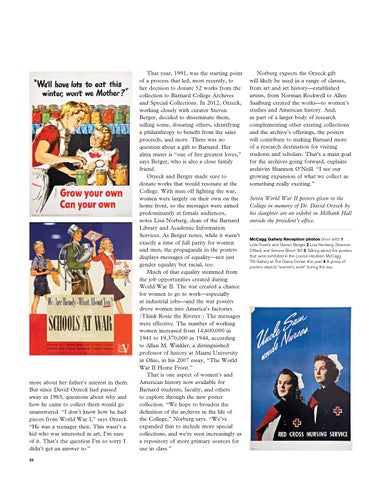
That year, 1991, was the starting point of a process that led, most recently, to her decision to donate 52 works from the collection to Barnard College Archives and Special Collections. In 2012, Orzeck, working closely with curator Steven Berger, decided to disseminate them, selling some, donating others, identifying a philanthropy to benefit from the sales proceeds, and more. There was no question about a gift to Barnard. Her alma mater is “one of her greatest loves,” says Berger, who is also a close family friend. Orzeck and Berger made sure to donate works that would resonate at the College. With men off fighting the war, women were largely on their own on the home front, so the messages were aimed predominantly at female audiences, notes Lisa Norberg, dean of the Barnard Library and Academic Information Services. As Berger notes, while it wasn’t exactly a time of full parity for women and men, the propaganda in the posters displays messages of equality—not just gender equality but racial, too. Much of that equality stemmed from the job opportunities created during World War II. The war created a chance for women to go to work—especially at industrial jobs—and the war posters drove women into America’s factories. (Think Rosie the Riveter.) The messages were effective. The number of working women increased from 14,600,000 in 1941 to 19,370,000 in 1944, according to Allan M. Winkler, a distinguished professor of history at Miami University in Ohio, in his 2007 essay, “The World War II Home Front.” That is one aspect of women’s and American history now available for Barnard students, faculty, and others to explore through the new poster collection. “We hope to broaden the definition of the archives in the life of the College,” Norberg says. “We’ve expanded that to include more special collections, and we’re seen increasingly as a repository of more primary sources for use in class.”
Norberg expects the Orzeck gift will likely be used in a range of classes, from art and art history—established artists, from Norman Rockwell to Allen Saalburg created the works—to women’s studies and American history. And, as part of a larger body of research complementing other existing collections and the archive’s offerings, the posters will contribute to making Barnard more of a research destination for visiting students and scholars. That’s a main goal for the archives going forward, explains archivist Shannon O’Neill. “I see our growing expansion of what we collect as something really exciting.” Seven World War II posters given to the College in memory of Dr. David Orzeck by his daughter are on exhibit in Milbank Hall outside the president’s office. McCagg Gallery Reception photos (from left): 1 Lida Orzeck and Steven Berger 2 Lisa Norberg, Shannon O’Neill, and Simone Bloch ’80 3 Talking about the posters that were exhibited in the Louise Heublein McCagg ’59 Gallery at The Diana Center this year 4 A group of posters depicts “women’s work” during the war.