THE WORLD
Getting Your
AFFAIRS in Order Wednesday, February 7, 2PM Dayton Metro Library Main Branch (215 E. Third St. 45402) L. John Hartmann, author of Getting Your Affairs in Order: An Owner’s Manual, joins us to explain various financial, legal and logistical components in order to help you develop a purposeful, coordinated and cohesive plan to address your future financial needs. Light noshes. No cost.
RSVP at jewishdayton.org or 937-610-1555.
Jewish Family Services OF GREATER DAYTON
&
Jewish Foundation OF GREATER DAYTON
PAGE 6
Israel Bardugo
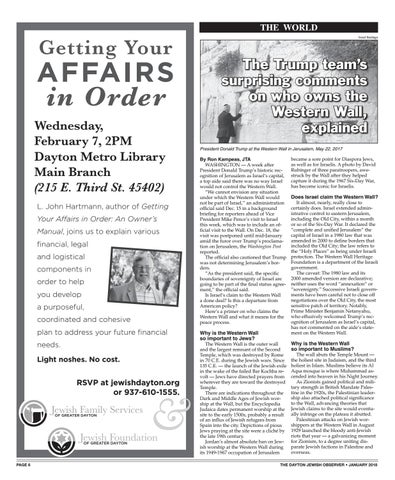
The Trump team’s surprising comments on who owns the Western Wall, explained President Donald Trump at the Western Wall in Jerusalem, May 22, 2017
By Ron Kampeas, JTA WASHINGTON — A week after President Donald Trump’s historic recognition of Jerusalem as Israel’s capital, a top aide said there was no way Israel would not control the Western Wall. “We cannot envision any situation under which the Western Wall would not be part of Israel,” an administration official said Dec. 15 in a background briefing for reporters ahead of Vice President Mike Pence’s visit to Israel this week, which was to include an official visit to the Wall. On Dec. 18, the visit was postponed until mid-January amid the furor over Trump’s proclamation on Jerusalem, the Washington Post reported. The official also cautioned that Trump was not determining Jerusalem’s borders. “As the president said, the specific boundaries of sovereignty of Israel are going to be part of the final status agreement,” the official said. Is Israel’s claim to the Western Wall a done deal? Is this a departure from American policy? Here’s a primer on who claims the Western Wall and what it means for the peace process.
Why is the Western Wall so important to Jews?
The Western Wall is the outer wall and the largest remnant of the Second Temple, which was destroyed by Rome in 70 C.E. during the Jewish wars. Since 135 C.E. — the launch of the Jewish exile in the wake of the failed Bar Kochba revolt — Jews have directed prayers from wherever they are toward the destroyed Temple. There are indications throughout the Dark and Middle Ages of Jewish worship at the Wall, but the Encyclopedia Judaica dates permanent worship at the site to the early 1500s, probably a result of an influx of Jewish refugees from Spain into the city. Depictions of pious Jews praying at the site were a cliché by the late 19th century. Jordan’s almost absolute ban on Jewish worship at the Western Wall during its 1949-1967 occupation of Jerusalem
became a sore point for Diaspora Jews, as well as for Israelis. A photo by David Rubinger of three paratroopers, awestruck by the Wall after they helped capture it during the 1967 Six-Day War, has become iconic for Israelis.
Does Israel claim the Western Wall? It almost, nearly, really close to certainly does. Israel extended administrative control to eastern Jerusalem, including the Old City, within a month or so of the Six-Day War. It declared the “complete and unified Jerusalem” the capital of Israel in a 1980 law that was amended in 2000 to define borders that included the Old City; the law refers to the “Holy Places” as being under Israeli protection. The Western Wall Heritage Foundation is a department of the Israeli government. The caveat: The 1980 law and its 2000 amended version are declarative; neither uses the word “annexation” or “sovereignty.” Successive Israeli governments have been careful not to close off negotiations over the Old City, the most sensitive patch of territory. Notably, Prime Minister Benjamin Netanyahu, who effusively welcomed Trump’s recognition of Jerusalem as Israel’s capital, has not commented on the aide’s statement on the Western Wall.
Why is the Western Wall so important to Muslims?
The wall abuts the Temple Mount — the holiest site in Judaism, and the third holiest in Islam. Muslims believe its Al Aqsa mosque is where Muhammad ascended into heaven in his Night Journey. As Zionists gained political and military strength in British Mandate Palestine in the 1920s, the Palestinian leadership also attached political significance to the Wall, advancing theories that Jewish claims to the site would eventually infringe on the plateau it abutted. Palestinian attacks on Jewish worshippers at the Western Wall in August 1929 launched the bloody anti-Jewish riots that year — a galvanizing moment for Zionism, to a degree uniting disparate Jewish factions in Palestine and overseas.
THE DAYTON JEWISH OBSERVER • JANUARY 2018