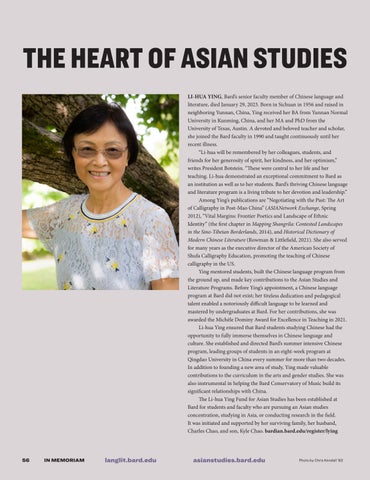
THE HEART OF ASIAN STUDIES LI-HUA YING, Bard’s senior faculty member of Chinese language and literature, died January 29, 2023. Born in Sichuan in 1956 and raised in neighboring Yunnan, China, Ying received her BA from Yunnan Normal University in Kunming, China, and her MA and PhD from the University of Texas, Austin. A devoted and beloved teacher and scholar, she joined the Bard faculty in 1990 and taught continuously until her recent illness. “Li-hua will be remembered by her colleagues, students, and friends for her generosity of spirit, her kindness, and her optimism,” writes President Botstein. “These were central to her life and her teaching. Li-hua demonstrated an exceptional commitment to Bard as an institution as well as to her students. Bard’s thriving Chinese language and literature program is a living tribute to her devotion and leadership.” Among Ying’s publications are “Negotiating with the Past: The Art of Calligraphy in Post-Mao China” (ASIANetwork Exchange, Spring 2012), “Vital Margins: Frontier Poetics and Landscape of Ethnic Identity” (the first chapter in Mapping Shangrila: Contested Landscapes in the Sino-Tibetan Borderlands, 2014), and Historical Dictionary of Modern Chinese Literature (Rowman & Littlefield, 2021). She also served for many years as the executive director of the American Society of Shufa Calligraphy Education, promoting the teaching of Chinese calligraphy in the US. Ying mentored students, built the Chinese language program from the ground up, and made key contributions to the Asian Studies and Literature Programs. Before Ying’s appointment, a Chinese language program at Bard did not exist; her tireless dedication and pedagogical talent enabled a notoriously difficult language to be learned and mastered by undergraduates at Bard. For her contributions, she was awarded the Michèle Dominy Award for Excellence in Teaching in 2021. Li-hua Ying ensured that Bard students studying Chinese had the opportunity to fully immerse themselves in Chinese language and culture. She established and directed Bard’s summer intensive Chinese program, leading groups of students in an eight-week program at Qingdao University in China every summer for more than two decades. In addition to founding a new area of study, Ying made valuable contributions to the curriculum in the arts and gender studies. She was also instrumental in helping the Bard Conservatory of Music build its significant relationships with China. The Li-hua Ying Fund for Asian Studies has been established at Bard for students and faculty who are pursuing an Asian studies concentration, studying in Asia, or conducting research in the field. It was initiated and supported by her surviving family, her husband, Charles Chao, and son, Kyle Chao. bardian.bard.edu/register/lying
56
IN MEMORIAM
alums.bard.edu langlit.bard.edu
asianstudies.bard.edu
Photo by Chris Kendall ’82