Arendt Fall Conference on Presidency Aiming to address the predicaments of leadership in our time and to encourage creative thinking about what place, if any, the role of a strong president must have in our future, the Hannah Arendt Center for Politics and Humanities at Bard College brought together artists, politicians, businesspeople, academics, and public intellectuals for its fifth international conference, “Does the President Matter?” (www.bard.edu/hannaharendtcenter). Speakers at the September 21–22 event included political activist Ralph Nader, former presidential candidate; Bernard Kouchner, former foreign minister of France and cofounder of Doctors Without Borders; John Zogby, founder of the Zogby Poll and author of The Way We’ll Be: The Zogby Report on the Transformation of the American Dream; Rick Falkvinge, founder of the Swedish Pirate Party; Eric Liu, CEO of the Guiding Lights Foundation and domestic policy adviser to President Clinton; and Jeffrey Tulis, author of The Rhetorical Presidency. Also speaking were Walter Russell Mead, James Clarke Chace Professor of Foreign Affairs and the Humanities, blogger at the American Interest, and author of Special Providence: American Foreign Policy and How it Changed the World; Ann Norton, author of 95 Theses on Politics, Culture & Method; Richard Aldous, Eugene Meyer Professor of British History and Literature and author of Reagan and Thatcher; Tracy Strong, author of Politics Without Vision; Cornell Law School Professor Bernadette Meyler; and Todd Gitlin, author of Occupy Nation. The conference offered the opportunity to examine the fear of and the need for political leadership. Participants explored a number of questions, including: Is political leadership still possible in a time of splintered polities? Have focus groups and hyper-scrutiny brought about an end to inspired political leadership? What do we make of the demand for leaderless politics coming from Occupy Wall Street? And does the fracturing of the media and of the populace reduce the power of the presidency? Hannah Arendt did not always speak kindly of politicians, but she did praise political people, those who act and speak in the public realm. She believed political freedom requires the courage to risk one’s reputation and life in the public pursuit of the common good. Political actors, Arendt saw, are those citizens who act in unexpected ways and whose actions are so surprising and yet meaningful as to inspire citizens to envision a common purpose.
No Winners in “Just War” The concept of “just war” preoccupied the Bard College Debate Union team last spring. Team members and their counterparts from the U.S. Military Academy at West Point took on the question of whether war can be just in a public debate at Bertelsmann Campus Center. No winner was declared, because the “idea of just war was too serious for the eristic component of voting to be appropriate,” said Bard Professor of Classics William Mullen, the debate’s moderator. Each debate team consisted of two Bard students and two West Point cadets. Bardian Jesse Barlow ’14, who took the position that war cannot be just, said, “This is a choiceless choice, and I do not suggest that, if this country were ever to be suddenly attacked, that we should all stand by and let it happen. But nor should we say that in the murder of those who are attacking us we are justified, for they are our fellow humans, and as fellow humans, they carry an equality of life. We assert that the meaning of justice is the equality of all human life, and to take a human life for the preservation of a particular people, for the interests of one over another, is an assertion of inequality, and therefore an injustice, which is why war can never be just.” Bard student Tekendrajeet Parmar ’15 countered, saying, “When all means of humane intervention are exhausted, war becomes the only means to a greater peace. Although it may be idyllic to think of war as ‘a fossil of our human past,’ we must acknowledge bluntly its existence as a human phenomenon and
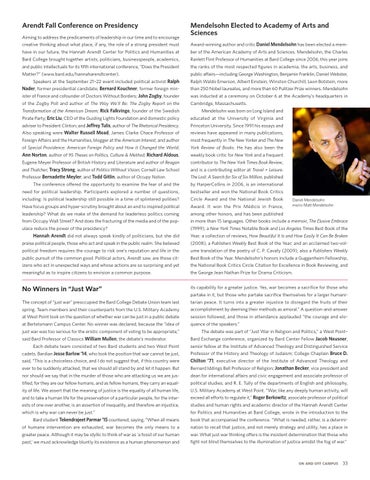
Mendelsohn Elected to Academy of Arts and Sciences Award-winning author and critic Daniel Mendelsohn has been elected a member of the American Academy of Arts and Sciences. Mendelsohn, the Charles Ranlett Flint Professor of Humanities at Bard College since 2006, this year joins the ranks of the most respected figures in academia, the arts, business, and public affairs—including George Washington, Benjamin Franklin, Daniel Webster, Ralph Waldo Emerson, Albert Einstein, Winston Churchill, Leon Botstein, more than 250 Nobel laureates, and more than 60 Pulitzer Prize winners. Mendelsohn was inducted at a ceremony on October 6 at the Academy’s headquarters in Cambridge, Massachusetts. Mendelsohn was born on Long Island and educated at the University of Virginia and Princeton University. Since 1991 his essays and reviews have appeared in many publications, most frequently in The New Yorker and The New York Review of Books. He has also been the weekly book critic for New York and a frequent contributor to The New York Times Book Review, and is a contributing editor at Travel + Leisure. The Lost: A Search for Six of Six Million, published by HarperCollins in 2006, is an international bestseller and won the National Book Critics Circle Award and the National Jewish Book Daniel Mendelsohn photo Matt Mendelsohn Award. It won the Prix Médicis in France, among other honors, and has been published in more than 15 languages. Other books include a memoir, The Elusive Embrace (1999), a New York Times Notable Book and Los Angeles Times Best Book of the Year; a collection of reviews, How Beautiful It Is and How Easily It Can Be Broken (2008), a Publishers Weekly Best Book of the Year; and an acclaimed two-volume translation of the poetry of C. P. Cavafy (2009), also a Publishers Weekly Best Book of the Year. Mendelsohn’s honors include a Guggenheim Fellowship, the National Book Critics Circle Citation for Excellence in Book Reviewing, and the George Jean Nathan Prize for Drama Criticism. its capability for a greater justice. Yes, war becomes a sacrifice for those who partake in it, but those who partake sacrifice themselves for a larger humanitarian peace. It turns into a greater injustice to disregard the fruits of their accomplishment by deeming their methods as amoral.” A question-and-answer session followed, and those in attendance applauded “the courage and eloquence of the speakers.” The debate was part of “Just War in Religion and Politics,” a West Point– Bard Exchange conference, organized by Bard Center Fellow Jacob Neusner, senior fellow at the Institute of Advanced Theology and Distinguished Service Professor of the History and Theology of Judaism; College Chaplain Bruce D. Chilton ’71, executive director of the Institute of Advanced Theology and Bernard Iddings Bell Professor of Religion; Jonathan Becker, vice president and dean for international affairs and civic engagement and associate professor of political studies; and R. E. Tully of the departments of English and philosophy, U.S. Military Academy at West Point. “War, like any deeply human activity, will exceed all efforts to regulate it,” Roger Berkowitz, associate professor of political studies and human rights and academic director of the Hannah Arendt Center for Politics and Humanities at Bard College, wrote in the introduction to the book that accompanied the conference. “What is needed, rather, is a determination to recall that justice, and not merely strategy and utility, has a place in war. What just war thinking offers is the insistent determination that those who fight not blind themselves to the illumination of justice amidst the fog of war.”
on and off campus 33