Ad Hoc body, swearing nevel: to return again. "This group will never face up to the situation and its painful necessities," sighed one faculty member. At 5:00 p.m. promptly about 250 :\1ajority Coalition members formed a line in front of the faculty line around Low. They were led by 20 marshals, who urged everyone to be non-violent at all costs, and directed by College seniors Paul Vilardi and Frank Dann, both of whom were premedical students, athletes, and Roman Catholics. \Vithin an hour they were joined by 100 other students. Coffee carts were brought up, and blankets were sent so that the vigil could go on indefinitely. Looking alternately grim and amiable,
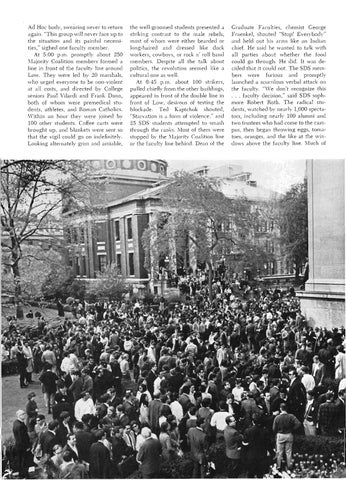
the well-groomed students presented a striking contrast to the male rebels, most of whom were either bearded or long-haired and dressed like dock workers, cowboys, or rock n' roll band members. Despite all the talk about politics, the revolution seemed like a cultural one as well. At 6:45 p.m. about 100 strikers, pulled chiefly from the other buildings, appeared in front of the double line in front of Low, desirous of testing the blockade. Ted Kaptchuk shouted, "Starvation is a form of violence," and 25 SDS students attempted to smash through the ranks. Most of them were stopped by the Majority Coalition line or the faculty line behind. Dean of the
Graduate Faculties, chemist George Fraenkel, shouted "Stop! Evervbody" and held out his arms like an Indian chief. He said he wanted to talk with all parties about whether the food could go through. He did. It was decided that it could not. The SDS members were furious and promptly launched a scurrilous verbal attack on the faculty. "We don't recognize this ... faculty decision," said SDS sophmore Robert Roth. The radical students, watched by nearly 1,000 spectators, including nearly 100 alumni and two trustees who had come to the campus, then began throwing eggs, tomatoes, oranges, and the like at the windows above the faculty line. Much of