wanted, and subtly compelling them to transform themselves into University reconstructionists as a way out of the dilemma. Philosophy Professor Arthur Danto seconded Professor Anderson's remarks. "If we shift suddenly from being a mediating body to being a revolutionary one, we shall need a new mediating group to mediate between the Administration and us." The Saturday afternoon sunshine seemed to inspire some students to add more color to the campus. By 3:00 several hundred students had put on green arm bands, signifying their desire to grant amnesty. "It's not that I agree with the SDS tactics," one green-banded student told us, "but they have shaken things up around here and anything is better than a police raid." Also, the SDS rebels pasted bright red adhesive tapes on their left arms, and planted large red flags on the roofs of Fayerweather Hall and the :'.1athematics building. The green, red, light blue, and white (faculty) armbands made Columbia look something like the inside of a color-coded computer. Two important meetings took place at 4:00 on Saturday. One was a session between Vice President David Truman and the SDS leaders. The SDS chiefs treated Dr. Truman as a totally discredited official though, and the meeting only reinforced further the Administration's conviction that SDS would compromise on nothing whatever. (Earlier, at 3:45 p.m., two SDS students appeared at the Ad Hoc Faculty Committee meeting to ask if some faculty members would help mediate the growing split within the Strike between the liberal reformers and the revolutionaries!) The other meeting was one called by several dozen leading professors in ,,vollman Auditorium. The teachers, mostly all moderates who were fiercely dedicated to a defense of the University, its scholarly enterprise, its independence, and its freedoms, but convinced also of the need for changes and reforms, had two purposes in mind: one, to inform the students of the actual, factual state of the situation (as neither the Administration, nor the SDS, nor the Ad Hoc faculty group was doing), and two, to inject some perspective and reason and proposals for feasible reforms into the emotionally worked up students. Nearly 1,000 students showed up, from SDS s)'mpaSPRING, 1968
thizers to angry counterrevolutionaries. There were 15 professors on the stage and another 40 to 50 in the audience. Professor of Chinese and Japanese William Theodore de Bary '41, who organized the meeting, gave a terse objective summary of attempts to solve the crisis, and then said, "You will now hear numerous of my colleagues express their feelings about the strike." One by one, the learned men expressed their sadness; reaffirmed the importance of free, intellectual inquiry and the trust and respect that such inquiry requires; granted that Columbia, along with all modern universities, needed changes; and asked everyone to use every ounce of reason they could muster. The most prolonged applause came when a Graduate Business School professor said that most professors, and he himself, strongly believed in "no amnesty." Later, physics professor Henry Foley drew heavy applause also for his statement, "The SDS should be treated just as the Ku Klux Klan would if they tried to take over Columbia." But not all were that firm. Professors Arthur Danto and Orest Ranum were poignant and compassionate. Russian scholar Robert Belknap was funny, describing the event as a modern-day version of a
"Roman Saturnalia," an anCIent celebration that allowed unrestrained behavior, outrageous speech, and gay playacting among the citizens. The most eloquent and touching talk, however, was given by Dr. Donald Keene '42, one of the world's greatest authorities on Japanese life and literature. He described how student strikes were prevalent in Japan. "Scarcely a Japanese university exists that has not had a strike from two weeks to two years. Many students no longer attend classes or learn very much. Professors are badgered and blackmailed by student bullies. At Tokyo University, one of Japan's best, no medical degrees will be awarded this year. Hundreds of Japan's most brilliant professors have gone abroad to other countries or stopped teaching, and so have the more serious students. If you think this could not happen in America, you are mistaken. I beg you: do not let it." As the students left ,,vollman, many of them visibly sobered by the powerful display of eloquence, reason, world perspective, and commitment to both learning and reform that they had witnessed, they saw a crowd gathered at the Sundial around several half-naked
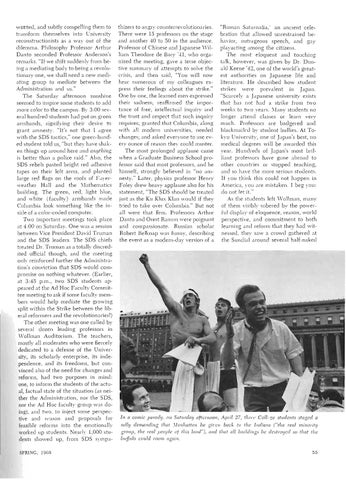
In a comic parody, on Saturday afternoon, April 27, three College students staged a mlly denU/nding that Manhattan be given back to the Indians ("the real minority grOltp, the real people of this land"), and that all bUildings be destroyed so that the buffalo could roam again. 55