bv William Peterson '31, a prominent ew York banker and the newly-elected chairman of the board. After commending the "restraint" of the administration, and the huge majority of faculty and students in the face of disruption and illegal acts, the Trustees took positions on three issues. One, they said they "wholeheartedly support the administration position that there shall be no amnesty." Two, in response to the suggestion that all disciplinary power at Columbia be delegated to a tri-partite board, they said they "affirmatively direct that [the president] shall maintain the ultimate disciplinary power over the conduct of the university, as required by the charter and statutes of the university." Three, they felt that "the attempt to depict the construction of [the gymnasium] as a matter involving a racial issue or discrimination is an attempt to create an entirely false issue by individuals who are either not conversant with or who disregard the facts." They said, however, that they approved of President Kirk's action to halt gym construction pending further discussions. (The third point was interpreted by some as a slap at Dr. Kirk's baffling unwillingness to refute publicly the factual errors and wild charges surrounding the gvmnasium issue.) The Trustees' statement hoped for a peaceful solution, but authorized President Kirk "to take all further steps which he may deem necessary or advisable to enable the University to resume its normal activities." Many students and alumni, and some faculty were pleased by the board's strong stand. But a majority of the Ad Hoc Faculty Committee were furious at what they felt was the Trustees' untimely stiffness "right in the middle of our negotiations," as Professor Dallin put it. And, of course, the student leftists to a man howled with indignation at what thev considered "a reactionary, fascist document such as one would expect from fat capitalists unacquainted with the Columbia scene," as one student told us. At 1:30 the Ad Hoc group reconvened, with the biggest crowd so far in attendance. Not only did manv of the most illustrious scholars from the graduate and professional schools appear for the first time, but two dozen additional young preceptors and instructors 54
{iiiiiii••~" !
g.
I
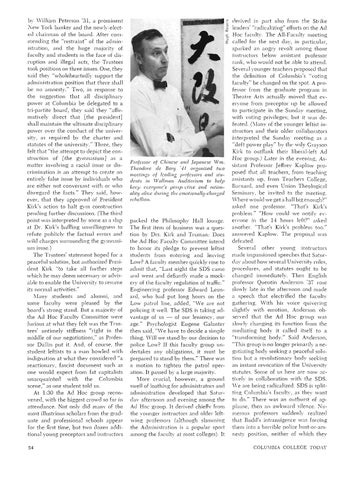
Professor of Chinese and Japanese "Vm. Theodore de Bary '41 organized ttCO meetings of leading professors and students in Wollman Auditorium to help keep everyone's perspective and rationality alive during the emotionally-charged rebellion.
packed the Philosophy Hall lounge. The first item of business was a question by Drs. Kirk and Truman: Does the Ad Hoc Faculty Committee intend to honor its pledge to prevent leftist students from entering and leaving Low? A faculty member quickly rose to admit that, "Last night the SDS came and went and defiantly made a mockery of the faculty regulation of traffic." Engineering professor Edward Leonard, who had put long hours on the Low patrol line, added, "We are not policing it well. The SDS is taking advantage of us - of our leniency, our age." Psychologist Eugene Galanter then said, "We have to decide a simple thing. Will we stand by our decision to police Low? If this faculty group undertakes any obligations, it must be prepared to stand by them." There was a motion to tighten the patrol operation. It passed by a large majority. More crucial, however, a ground swell of loathing for administrators and administration developed that Saturdav afternoon and evening among the Ad Hoc group. It derived chiefly from the vounger instructors and older leftwing professors (although slamming the Administration is a popular sport among the faculty at most colleges). It
derived in part also from the Strike leaders' "radicalizing" efforts on the Ad Hoc faculty. The All-Faculty meeting called for the next day, in particular, sparked an angry revolt among those instructors below assistant professor rank, who would not be able to attend. Several younger teachers proposed that the definition of Columbia's "voting facultv" be changed on the spot. A professor from the graduate program in Theatre Arts actually moved that everyone from preceptor up be allowed to participate in the Sunday meeting, with voting privileges; but it was defeated. (:\1any of the younger leftist instructors and their older collaborators interpreted the Sunday meeting as a "deft power play" by the wily Grayson Kirk to outflank their liberal-left Ad Hoc group.) Later in the evening, Assistant Professor Jeffrey Kaplow proposed that all teachers, from teaching assistants up, from Teachers College, Barnard, and even Union Theological Seminary, be invited to the meeting. Where would we get ahall big enough?" asked one professor. "That's Kirk's problem." "How could we notify everyone in the 14 hours left?" asked another. "That's Kirk's problem too," answered Kaplow. The proposal was defeated. Several other young instructors made impassioned speeches that Saturday about how several University rules, procedures, and statutes ought to be changed immediately. Then English professor Quentin Anderson '37 rose slowly late in the afternoon and made a speech that electrified the faculty gathering. With his voice quivering slightly with emotion, Anderson observed that the Ad Hoc group was slowly changing its function from the mediating body it called itself to a "transforming body." Said Anderson, 'This group is no longer primarily a negotiating body seeking a peaceful solution but a revolutionary body seeking an instant revocation of the University statutes. Some of us here are now activelv in collaboration with the SDS. We are being radicalized. SDS is splitting Columbia's faculty, as they want to do." There was an outburst of applause, then an awkward silence. Numerous professors suddenlv realized that Rudd's intransigence was forcing them into a horrible police bust-or-amnesty position, neither of which they COLU~1BIA
COLLEGE TODAY