College Alumni Association president Henry King '48 and the Association's Board of Di-recto-rs sent a telegmm to Dr. Kirk reaffi-rming thei'r "unremitting commitment to the fundamental rights of free speech and assembly" and condemning SDS "anarchy and mob rule."
vandalized.... Students must understand that with student power there must always be student responsibility, and when one abuses his rights and power, he must accept the consequences." From a rabbi, College '44: "Do not be intimidated by the criminal behavior of a minority of students and faculty." From a housewife in Long Island. "If you don't have the guts to get those revolutionaries out of the buildings, resign and get someone who can." One of the telegrams was from the College's Alumni Association whose four top officers, authorized by their Board of Directors and prodded by hundreds of puzzled, or angry alumni, sent a message to the President reafRrming the "basic principle" of "unremitting commitment to the fundamental rights of free speech and assembly," which they felt had yielded to SDS "anarchy and mob rule." Alumni President Henry King'48 and his fellow elected leaders urged Dr. Kirk to reject any SDS ultimatums, retain the Rnal right to discipline, and not shy away from discipline that is "swift, strong, and appropriate to the circumstances." Any action short of that, they said, "will result in an invitation for further trouble of a higher order; further, the affection and support which you have from the alumni will be lost." SPRING, 1968
Thousands of other Columbia alumni, including many who were critical of President Kirk and the faculty, were to express their dismay in the ensuing weeks over what they considered an SDS foray depriving several thousand scholars and 15,000 students of their freedom to learn; and over what they thought was the Administration's, and especially the Ad Hoc Faculty Committee's, silence and spinelessness in attacking the clear breach of academic freedom. As one College alumnus said to us, "How will Kirk and the faculty ever be able to ask the alumni to help them against any attacks on their academic freedom in the future? They have lost our allegiance with their unprincipled 'no enemies to the Left' politicking." The most noteworthy of all the suggestions of Rrmness came from Columbia's Trustees, who on Saturday around noon delivered a statement to the President. It was the Rrst official action by the Trustees, who had met on Friday afternoon for the Rrst time since the protest started. (By law, three days' notice must be given before any Trustees' meeting.) It was mimeographed by the News Office and disb'ibuted widely, It landed like a crippled jet plane on the campus. A word about the Trustees of Columbia University. Since World War II
Columbia's Board has been criticized numerous times on several counts. Some alumni and faculty have complained of its "lack of national stature," that is, its sluggishness in convincing some of the nation's most distinguished persons to serve on the board. "They are all Rnanciers, corporation executives, and lawyers from New York City," said one long-time critic in the College's Class of 1925. Others have charged that the Trustees lack variety. "Not one Ralph Bunche, or David Riesman, or vValter Reuther sits on that board. Nor does a large city mayor or a great city planner to lend expertise in these critical areas," objected one professor. Still others have alleged that Columbia's trustees have been too easygoing with President Kirk, allowing him to have a weak executive staff, almost no public information program, mediocre architecture, and an insufficiently aggressive Rnancial development operation. The purpose of Trustees, it has been said, is to give three things: "brains, hard work, and money." Columbia has numerous members that have worked extremely hard, and a few who have given intellectual counsel or generous gifts; but it is widely agreed that the board as a whole has seldom risen to heights of brilliant direction or exemplary generosity. The Trustees' statement was given
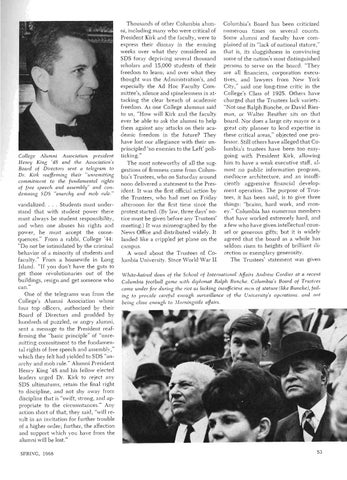
White-haired dean of the School of International AffairS Andrew Co-rdier at a recent Columbia football game with diplomat Ralph Bunche. Columbia's Board of Trustees came under fire during the riot as lacking insufficient men of stature (like Bunche), failing to prooide careful enough surveillance of the University's operations. and nnt being close enough to Morningside affairs.
""'"
53