Remember the Soph-Frosh Rush? Well, it's gone. So are nickel beers, and very low faculty salaries; fraternity hazing, and feeble scholarship funds. College today is a different world. And, many claim, a better worldfor the students, the faculty, the nation. One of the things that made it all possible is the loyalty and generosity of Coiumbia alumni. The College needed your help and you gave it. The College continues to need your help. So do the faculty and the undergraduates. More than ever.
Columbia College Annual Fund
Columbia College Today Volume XV, No.3
Within the Family
Spring 1968
Published by Columbia College Columbia University New York, N.Y. 10027
This publication is printed for alumni and friends of Columbia College u;ilh the support of The Association of the Alumni
Thomas M. .\tacioce '39, President Eugene Rossides '49, Vice President John H. Mathis '31, Secretary Carl "V. Desch '37, Treasurer Max J. Lovell '23, ExeC1ltive Director
EDITOR George Charles Keller '51 ASSISTANT EDITOR
Peter Salzberg '64 EDITORIAL ASSISTANT
l\'lalinda Teel
ALUMNI ADVISORY COMlYUTTEE
Ray Robinson '41, Chairman Arthur Rothstein '35 Edward Rice '40 Edward Hamilton '42 Kermit Lansner '42 Walter Wager '44 Byron Dobell '47 John McDermott '54
IN THIS ISSUE Six Weeks That Shook Morningside: A Special Report
Address all editorial communications to: COLUMBIA COLLEGE TODAY
400 West H8th Street路 New York, N.Y. 10027. Telephone (212) 280-3701
COLUMBIA COLLEGE founded in 1754 is the undergraduate liberal arts college of 2,700 men in COI.:UMBIA UNIVERSITY
Red flags, gr-een ivy, and the Light Blue This magazine has a well-deserved reputation for being tardy in its publication schedule. But it has never been this late. We beg forgiveness. The news from the College, however, has been far from routine recently. Normally, Columbia is a busy, exb'aordinary place, of course. But last spring was tumult, real tumult, That was not the greatest difficulty though. What really slowed us was the small torrent of letters, chiefly (but not exclusively) from College alumni, urging us to forget sports, class notes, alumni reunions, and tell them what actually happened during the revolution, including lots of whys and hows. For example, alumnus Gerald Berkowitz '63, an English instructor at the University of Southern California, wrote us on May 24: "It is obvious that the news media are doing a very incomplete and sometimes obviously biased job of reporting the developments and significance of the current revolution. GGT has shown itself in the past to be a reliably objective and frequently critical observer of University events and policies. You are in a perfect position to prOVide the necessary balanced account of the past few weeks. . . . I strongly recommend that you junk whatever features you had planned for the next issue, and replace them with as complete a coverage of the revolt as you can muster. . . . It will be tragic if the true story is never known. You are the only one I would trust to tell it." Imagine that! We were Hattered, naturally, but also frightened by these letters. How does one capture the "true story" of a hurricane? And, how does one do so rationally, when nearly everyone is impassioned? Still, we had certain advantages. We were in the occupied buildings; were allowed to visit Low Library's innermost offices, even at the most crucial moments; were privileged to sit in the faculty meetings; talked with alumni, trustees, and community residents; were friendly with numerous students; and generally were
acquainted with Columbia's past and present. We had collected documents and photographs like squirrels, and had taken notes-all three of us-like diligent graduate students. No one could possibly tell the whole story, even in 20 volumes. But we could attempt to be more reasonable, comprehensive, and non-partisan than most. This was our aim. As anyone who reads our chronicle will know, we have fallen short of total objectivity and empathy for all. But there are, at least, no heroes and villains in this piece. Nor is there phony melodrama, angry blame-placing, or righteousness. God! There was enough righteousness on campus last spring to launch a new crusade to Jerusalem. Weare sorry to have scrapped everything else normally printed in our magazine. We hope to be back to better fullness in the nex1: issue. V-Ie are sorry also for the profanity in this issue. We have never printed profanity before-we find it too imprecise-but we felt some parties last spring wore their obscenity proudly, as a badge of honor, and to leave it out would have meant losing the peculiar cayenne pepper Havor of some of the personalities and incidents. A word about the College alumni reaction to the spring riot. (Incidentally, there were 101 campus riots last spring. Columbia merely got the best publicity.) While numerous alumni rushed from their offices sputtering vindictiveness and some others blithely condoned the violence as a good thing, like a laxative, many graduates displayed a remarkable desire to get all the evidence, a salutary skepticism, and a sense of humor. Like Hemingway's bullfighters, they had poise in the presence of disaster. In a crisis, men are often unmasked. A surprising portion of Columbia's alumni revealed themselves as cool, curious, and concerned. The College ought to be proud of having produced men like that. CCK
.Cover photo by Alan Epstein; photo on pp. 2路3 by George Gardner
1
At 10 minutes past noon on Tuesday,
April 23, 1968, an intense, lean six-foot junior in Columbia College, the historic all-male undergraduate school at Columbia University, began walking toward the Sundial, the unofficial University soapbox on College Walk, at the center of the campus. The student walked rather fast, with long strides, through the sunny spring air. His prominent jaw, the sandy waves of hair that spilled over the right side of his forehead, and his narrowed eyes gave him a look of determined belligerency. 'Wearing blue jeans, boots, and an unironed shirt open at the neck, he seemed rather like an angry farmer headed for a brawl at the local saloon. Several voices mUl"murad, "Here he comes now!" As he stepped up on the six-footround pink granite podium, with five of his fellow students, the gathered crowd of approximately 300 persons grew silent. There was a curious mixture of quiet good humor and dread foreboding among the listeners, as if they were about to witness a traditional spring panty raid in which the spirited students as a novelty had decided to carry knives. The undergraduate about to speak, Mark Rudd, was a bright. passionate young man who had suddenly emerged as a dramatic and fiercewilled leader of a small group of Columbia students who were totally fed up with the American "system" of life, with the "power structure" that was imposing that system on the masses and the young, with the leading universities that were acting in "complicity" with the system and its "imperialist wars," and with the University's president, Dr. Grayson Kirk. The student group also was disillusioned about "the careerist, hopelessly middle-class professors" who were acquiescing in the complicity instead of fighting actively to "liberate" the masses and the young from "the system." ~lost of these students belonged to a campus clique known as the Students for a Democratic Society, or SDS, though the true believers were not limited to membership in that organization. SDS, and Mark Rudd, had been talking and writing openly for several 4
months of a "spring offensive" at Columbia, the fifth oldest institution 0f higher learning in America. The Students for a Democratic Society was founded at Port Huron, Michigan in June 1962, the product chiefly of University of 'lichigan undergraduates like Albert Haber, Paul Potter, and Thomas Hayden, who was elected its first president. It was an offshoot of the League for Industrial Democracy, a tiny organization of socialists and quasi-socialists who were also passionate democrats-men like orman Thomas, Michael Harrington, Harold Taylor, and Bayard Rustin. (Albert Haber was president of the Student League for Industrial Democracy in 1961-62.) Like Columbia philosopher John Dewey, the SDS wanted to democratize American society more fully; that is, make every institution in the United States a participatory democratic cell in an almost Athenian way. 'iV'orkers should have a voice in running their factories, Negroes their ghetto schools and welfare programs, and students their universities, SDS contended. In September 1963 a Columbia chapter was formed. Initially, SDS spent most of its energy aiding the Negroes in civil rights actions. The SDS at first saw itself largely as a campus-based, middle class, northern counterpart to the Student Nonviolent Coordinating Committee, or SNCC, which was active on behalf of Jegro equality in the South. Civil rights activity led SDS quickly into community organization, or the stirring up of various underprivileged groups into collective action against the authorities in their area in order to gain better jobs, housing, schools, welfare programs, equal treatment, and the like. As the United States became more and more mired in the Vietnam war, however, SDS shifted its emphasis to anti-war publicity and activities in 1964. This shift was prompted by two other developments: the increasing desire of Negroes to have the civil rights movement largely a black-directed affair rather than a white-dominated one, and the failure of SDS to find allies among the working class, especially in the trade unions. (One labor leader told us in 1965 that he regarded the SDS radicals as "screwball, un-American, rich kids." The same
month one undergraduate activist ~t Columbia said to us that he found most of "the American proletariat" to be "surprisingly conservative, materialistic, home-loving, patriotic, and even racist.") By late 1966 SDS felt it necessary to move again, "from dissent to resistance." The Johnson administration seemed incredibly stiff and hawkish about the Vietnam situation, and the nation appeared to them reluctant to undertake a massive effort to help the egroes and America's poor. umerous SDS members began to question seriously the validity of America's whole economic and political system. SDS from its beginnings had had a vague anti-capitalist stance. As early as 1963, in their national policy document, America and the New Era, SDS leaders condemned the "corporatist" nature of the Kennedy administration and the "reactionary Congressional oligarchy." But in 1966 SDS members began to speak of capitalist warmongers, U.S. imperialism, rotten bureaucracies, the silliness and sameness of the twoparty system, the spinelessness and selfishness of the middle classes, and the slow, unresponsive, committee-infested procedures of liberal democracy. Talk became more frequent of "overthrowing the power structure" and smashing the entire U.S. "system" as it is presently constituted. In an interview with reporter Paul Hofmann, printed in the ew York Times on May 7, 1967, SDS national secretary Gregory Calvert said, "We are working to build a guerilla force in an urban environment. ... 'iV'e are actively organizing sedition." Calvert, who calls himself "a post-Communist revolutionary," said that students had to become more like the guerilla warriors of Vietnam and pro-Castro Cuba. Ernesto "Che" Guevara was the new hero. "Che sure lives in our hearts," said Calvert. As the SDS mood shifted from reform to revolution, the SDS members began to search for two things. One was a core of dedicated, serious radicals to spark things; the other was a mass base for the overthrow. To develop the former, they teamed up with the most radical students and professional agitators on the revolutionary leftthe Peking-oriented Progressive Labor Party; the Leninist-Trotskyite Young COLUMBIA COLLEGE TODAY
Socialist Alliance, the junior branch of the Socialist Workers Party; the proCuban, pro-Viet Cong May 2 1ovement; and the violently anti-American Youth Against War and Fascism. By late 1966, some SDS leaders spoke of their "non-exclusionary policy"-their willingness to form a popular front with everyone from liberals to Maoists to achieve radical changes. SDS's openness and new revolutionary mood attracted an increasing number of other middle-class youths: young Bohemians, or hippies, who loathed bourgeois life; apocalyptic religious idealists; anarchists who despised authority, largescale organizations, and power in any form; and the psychologically Jppressed, those who felt that they were being "brainwashed" by the ubiquitous influence of television, advertising, the capitalist press, and government propaganda. To develop a mass base for the revolution was a harder problem. But the Berkeley upheaval of 1964 led a few SDS actives to think that such a base could be found in America among college and high school students and young alumni and drop-outs, especially since 35 per cent of American youth now go on to higher education of some sort. The traditional Marxian revolutionary proletariat could be replaced by a new middle-class army of exploited "workers." (Of note is that several studies have shown that the overwhelming majority of revolutionary guerilla leaders, in Latin America
and elsewhere, are of middle-class or upper-class origins.) The indispensable document for the new SDS position is Carl Davidson's remarkable 18-page The Multiversity: Crucible of the New Working Class ( 1967), which sells for 15 cents at SDS literature tables. Davidson, a national secretary of SDS, an ex-philosophy major at Penn State, and an admirer of Marx, Lenin, Che Guevara, C. Wright Mills, and Andre Gorz, argues that students are "the new working class" who can and will usher in a new age. (What the new age will be like, concretely, is something that Davidson, like nearly all other campus radicals does not bother to say. The New Left "movement" is a movement away from present forms, not a movement toward any better order that has been conceived. "We must be life-affirming," says Davidson, which is about as close as he comes to specifying positive new goals.) In The Multiversity, which is written like a term paper, complete with a contents page and 42 footnotes, Davidson contends that modern universities are little more than the training and research branches of the capitalistimperialist system. They are "knowledge factories" that absorb young people and prepare them for obedience and bureaucratic tasks through objective, value - free, technique - oriented courses. The senior professors spend most of their time as well-paid ~'eearchers for the "innovation industry,"
SDS political rally at the Sundial on College Walk in April 1966. David Gilbert '66, then chairman of Columbia's SDS chapter, holds aloft a sign. The group drifted from dissent to resistance to rewlutian in the last two years.
an "aspect of corporate capitalism," ::>r for the government leaders Or the military. What little teaching, intellectual discussion, and joint inquiry there is left in the insti tutions is done by fledgling instructors and teaching assistants. Proof of the fact that U.S. universities have shifted their purpose from helping young people become independent, creative, sensitive intellectuals to turning out cogs in the system is manifold: liberal education is collapsing everywhere; professors hate to teach and prefer to "produce"; the undergraduate college is more and more considered to be "the intellectual slum of the campus"; and, "throughout the educational apparatus, the bureaucratic mentality prevails." "What is the reality of American education?" asks Davidson. "Contrary to our commitment to individualism, we find that the day-to-day practice of our schools is authoritarian, conformist, and almost entirely status-oriented." For college students, present-day higher education produces boredom, a feeling of alienation, and a sense of irrelevance. They feel powerless, manipulated. Students are like the exploited factory-hands of the 19th century sweatshops. "The core of the university, with its frills removed," says Davidson, "has become the crucible for the production, formation, and socialization of the new working class." The choices open to students are conformity, dropping out, or rebellion. According to Davidson, more and more students are choosing rebellion. "What we are witnessing and participating in is an important historical phenomenon: the revolt of the trainees of the new working class against the alienated and oppressive conditions of production and consumption within COl'pOl'ate capitalism." In another place Davidson asserts, echoing Karl Marx's Communist Manifesto: "A spectre is haunting our universities-the spectre of a radical and militant nationally co-ordinated movement for studen t power." In order to "liberate" the modern university, however, an overthrow of the entire U.S. government and economy is necessary. "'We should always remember that we cannot liberate the university without radically changing the rest of society." Therefore, says Davidson, "Every attempt should be made 5
to connect campus issues with ofF-campus questions." The M ultivel'sity recommends a whole array of strategies and tactics for campus revolutions, from the use of jug bands and rock 'n' roll groups to "the formation of a Student Strike Coordinating Committee." Among them: avoiding reform groups like the Democratic Party, which is so "obviously bankrupt that we need not waste our time"; infiltrating extracurricular activities ("Try to gain control of as much of the established campus cultural apparatus as possible.... \Ve need our people on the staff of the school news- E papers, radio stations, etc."); and sabo- ~ taging courses by signing up for "the Carl Davidson, inter-organizational secreworst profs" and for striltegic courses, tary of the national SDS and author of and then disrupting things. the influential popel', The Multiversity. Of particular importance are three Says Davidson, "The only constructive other strategies. One is the refusal to way to deal with an inherently destrucaccept reforms instead of revolution. tiue a/,paratus is to destroy it." "\Ve should avoid all of the 'co-management' kinds of reforms. These usually come in the form of giving certain 'responsible' student leaders a voice deal with an inherently destructive apor influence in certain decision-making paratus is to destroy it." A third strategy pertains to profesprocesses, rather than abolishing or winning control over those parts of tile sors. Under a section called "The governing apparatus." If any SDS Faculty Question: Allies or Finks," Damembers do win election to any posi- vidson believes that SDS should do tions of influence, says Davidson, they everything possible to ally themselves should use the position to denounce with the younger, teaching faculty. "As and destroy. "A seat should be seen for the research and administrative facas a soap-box," asserts Davidson. "\Ve ulty, we should set both olll'selves and the teaching faculty against them." are not trying to liberalize the existing order, but trying to win our liberation Also, SDS should encourage the splinfrom it." tering off of the more progressive inAnother strategy is to use every issue structors into a separate, independent not as a matter by itself but as a means faculty group. "\Ve should encourage of smashing all college and university the potentially radical sectors of the authority. "The purpose of de-sanctifi- faculty to organize among themselves cation is to strip institutions of their around their own grievances," says D'llegitimizing authority, to have them vidson. The long-range goal in Carl Davidreveal themselves to the people under them for what they are-raw, Coerci\le son's mind is a world-wide organization power. This is the purpose of singing of revolutionary students and young the 1ickey Mouse Club jingle at stu- faculty and alumni. "Hopefully, in the dent government meetings, of ridicul- not too distant future, we may be ining and harrassing student disciplinary strumental in forming a new Internahearings and tribunals, of burning the tional Union of Revolutionary Youth," Dean of Men and/or 'Nomen in effigy, he writes. Mark Rudd entered Columbia Coletc. People will not move against institutions of power until the legitimizing lege in the fall of 1965, just when the authority has been stripped away." Da- Students for a Democratic Society were vidson is conscious that such disruption beginning to drift further leftward. Tn and negativism may backfire. "\Vhile his high school days, he had been a we may be criticized for not offering hard-working, broadly active student. 'constructive' criticisms, we should re- He was a ham radio operator, a goalie ply that the only constructive way to on the school soccer team, a troop 6
leader in the Boy Scouts, and president of the high school's Political Club. His College Board test scores were all in the 700s (800 is perfect) and he graduated sixth in a class of 704 boys and girls. His community, Maplewood, l'\ ew Jersey, was a snugly upper-middle class one with a large minority of successful Jewish businessmen and professionals. Rudd's father, a Polish emigre whose name originally was Rudnitskv, is a former Army lieutenantcolonel and now a fairly well-off real estate dealer. The Rudds' only other son, David, is already a practicing lawvel'. A Columbia admissions officer who interviewed Rudd early in 1965 remembers him as "a somewhat tense, rather introspective fellow with high ideals who seemed to be searching hard for something important to do in life." He recalls also that he was "a bit sullen, but engagingly straightforward." Rudd had a respectable freshman year. He studied fairly hard and collected a mixture of A's and B's for grades, just missing the Dean's list. F,Jl' extracurricular work, he volunteer~d for the College's Citizenship Program, the remarkable student-run activity in which over 500 of the College's 2,700 students annually work in prisons, ghetto areas, psychiatric and rehabilitation stations, and the like as a social service. Rudd tutored youngsters in Harlem. The next academic year, as a sophomore, Rudd, disturbed about the Vietnam war, discovered radical politics and switched his extracuricular interests primarily to anti-war activities. He joined the Independent Committee on Vietnam, a vociferous campus group that opposes not only the Vietnam involvement but all U.S. involvements in foreign situations. Since many of the 100 or so students associated with the I.C.V., as it is called, had an overlapping affiliation with the Students for Democratic Society, Rudd also plugged into that group. (Student organizations, especially the political organizations, are extremeIv loose and shifting these days. Officers, dues, committees, formal meetings, official policies, and all that are regarded as ".'dickey :\Iouse"-childish, overly formal stuff to be avoided. Organizations form and collapse quickly, mostly when specific issues appear that need attack. For the bigger, tougnCOLUMBIA COLLEGE TODAY
er issues, like racism in America or the Vietnam war, organizations gather together and mix, like finger paintings, to form a "movement.") Friends say that as a sophomore in 1966-67, Rudd became increasingly impatient, irascible, and action-oriented. The refusal of U.S. leaders to pull out of Vietnam really bugged him. "By the end of the spring term, he was almost a Maoist," recalls one classmate. His disgust mounted for President Johnson, for President Kirk, who refused to come out against the United States' involvement in Vietnam publiclv (although Kirk privately had grave reservations about the conAict), and for the "stupid" middle class in America who sheepishly went along with the "senseless slaughter" of Asians. He had to be rebuked by the College's Dean's Office in the spring of 1967 for sitting in a lavy R.O.T.C. class on March 1 with the purpose of disrupting it. 'Vhen he came back to the Morningside campus in September 1967, Rudd frequently appeared as furious and energetic as a newly-caged lion. He was convinced that drastic action- not just talk and picketing-has to be undertaken. In early October Rudd drew up a bold "Position Paper on Strategy for the Rest of the Year." In it he stated that SDS students had to move beyond a mere "posture of radical action." A carefully prepared, direct assault on the University was now necessary "to end university complicity with the war: I.D.A. (Institute for Defense Analyses), N.R.O.T.C., C.I.A. contracts, recruiting, etc." Said Rudd, "We're going to have to develop the two things which we lack now-a coherent strategy and an effective organization." Rudd proposed a timetable of action, from the formulation of strategy for the campaign in early November, 1967, to "Phase V, Mass Action" in April, 1968, when there was to be "A sit-in at Low Library which, after one dav, turns into a general strike. University capitulates." To pull the assaults off, Rudd argued, SDS had to succeed in one vital area: "The radicalization of studentsshowing people the connections in the liberal structure, showing them how our lives are unfree in this society (and at Columbia), getting them to act in their own interest." W'ithout this the SPRING, 1968
take-over would fail. ""'e can never force the University to submit to our demands unless we have behind us the strength of the majority of students on campus." To mobilize student support, Rudd urged "a steady stream of propaganda and exposures," as well as a series of limited actions such as "harrassments of recruiters and N.R.O.T.C.
classes" and spontaneous demonstr:ltions was imperative. '''hat was evident in the position paper was Rudd's single-mindedness about striking a blow at the Government's war effort through actions at Columbia, and his confidence in the manipulability of Columbia's students. Conspicuously absent in the document
Mark Rudd, chairman of the Columbia SDS chapter, addressing a rally on Low Plaza. To strike a blow at the U.S. war effort, he felt the students and faCt/lty had to be "radicalized," the Administration wrecked.
7
were such traditional SDS concerns as help for the poor, for egroes, and for student power in running the universities. Rudd recently told a New York Times reporter, "I was never really attracted to civil rights. There was too much idealization of Negroes and they didn't seem too effective. I've always felt a tremendous barrier between me and blacks." Mark Rudd, and those few others who supported him were not able to muster much enthusiastic support for the position paper. One of the things that his plan required was much tighter organization and, as he put it," "commitment to the work necessary to win." But the SDS has from its beginnings prided itself on its egalitarian and ÂŁIoating structure, its absence of strong internal discipline. In 1966 SDS even voted to abolish its own offices of President and Executive Secretary on the grounds that such positions allowed too much authority and replaced them with three National Secretaries and an 11man National Council. To some, Rudd's ideas seemed like an alien Leninist imposition of party control. Also, many SDS followers are fine young scholars, and they balked at the suggestion of curtailing their studies to work night and day for a university takeover. Then too, Rudd's proposals had a methodical quality, a smell of probable violence in them, that scared off students who preferred to stay loose and non-violent. Lastly, the SDS group had as its chairman College senior Ted Kaptchuk '68, an effective speaker and authoritybaiter but a personally amiable and not entirely dedicated radical. He and SDS's chief Sundial orator, Ted Gold, a former classmate of Kaptchuk's at ew York's Stuyvesant High School, both came out of a background of intellectual radicalism of a Trotskyite bent. It is a background that is rather ideological in its anti-capitalism and anti-imperialism, one unaccustomed to the new trend toward swift action and brawling, guerilla-like street fighting. Though Rudd's approach remained a minority one within SDS, he and his colleagues decided to put portions of their action-oriented program in operation anyway. He lashed out at everything at Columbia even remotely connected with military and government activities, and he fought off-campus,
too. He was arrested for a virulent attack against Secretary of State Dean Rusk outside a midtown hotel in New York on November 15, 1967. On February 24 he helped stage an illegal sitin inside Dodge Hall, blocking the door of the campus job interviewer from Dow Chemical Corporation, a leading manufacturer of napalm. Earlier President Kirk had stated that picketing inside University buildings was improper because such action makes noise and hampers the movement of persons in a way that directly interferes with classroom instruction and work in the buildings, and is hard to keep non-violent. (Peaceful outdoor picketing, rallies, and demonstrations have long been an accepted practice at Columbia.) The February 24 sit-in was done despite an undergraduate student referendum on Jovember 1 in which 67.3 per cent of the students voted to continue open recruiting, despite a College Faculty vote on November 14 also backing free campus visits by corporations, and despite the objections of some SDS members. But Mark Rudd had become a revolutionary and had risen above majority rule. Five weeks before the illegal February 24 sit-in (which the College's Associate Dean for Students Alexander Platt decided, to many people's surprise, not to punish as an illegal act), Rudd had requested permission to leave the College brieÂŁly to visit Cuba in January. He came back with enthusiastic reports of how marvelous everything was in that state. (His reports, printed in Spectator, the College's caustically liberal daily newspaper, drew the fury of others at the University who had other knowledge of life in Fidel Castro's territory. One of the respondents, a Mr. Perez, wrote in a letter to the Spectator editor, "As a Cuban citizen born in that beautiful country, I am disgusted and outraged at the pack of lies, distortions, and absurdities that a Ml'. Mark Rudd has been trying to pass as facts . . .") Additionally, fired with the guerilla spirit of Ernesto "Che" Guevara, Rudd was more than ever convinced of the necessity, the morality, even the beauty of a liberating upheaval. Only two weeks before the illegal February 24 sit-in, after Rudd had returned from Cuba, several Columbia students attended a weekend regional
SDS conference at New York University's Weinstein Residence Hall en February 10-11. The purpose of the meeting was to figure out ways of locally implementing a decision reached by the SDS's National Council during the Christmas holiday of 1967-68 at the University of Indiana. Basically, the decision was that SDS members had to enter a new third stage of political theory and practice. Begun in dissent and reform, SDS had moved into resistance and sabotage; now it was time to move into revolution and head-on clashes. As stated in Firebomb, the SDS newsletter, in early February, SDS was taking a "major step forward" in their struggle, one that was a matter of Ijfeand-death for SDS. Said the editorial: "A serious organization consciously seeking to develop a revolutionary practice creates a life-or-death dynamic within the society it is trying to destroy and recreate." What the SDS ational Council decided in Bloomington was to adopt the so-called "Ten Days in April" plan, whereby SDS members and their allies would spark 10 days of disruption and violent confrontations at leading American colleges and universities between Sunday, April 21 and Tuesday, April 30. As reported in The Chronicle of Higher Education, January 15, 1968, by an on-the-scene observer, Greg Calvert, one of the SDS national leaders, declared the last 10 days in April "a time to shake the empire." Another one of the 200 students in attendance called the period, "a time for aggression."
The SDS plan, in keeping with the organization's looseness and centrifugal tendencies, urged that each campus chapter select its own methods and targets. The SDS national leaders cautioned, however, against getting too hung up on specific issues or particular reforms. The report said, "SDS does not attack university complicity with the war, but the university as an integral part of the corporate structure which necessitates and wages imperialist wars." The SDS newsletter Firebomh pointed to the need for greater discipline within its ranks and told readers of the plan "for pulling our organization together as a real political force in America." One SDS writer from New York
urged: "\Ve've got from now until April to organize the hell out of this citv. Then we open up and confront the power structure and the people, an:.! if we survive the confrontation we organize some more." Accord;ng to one person who attended the .Y. U. conference, there were about 175 people, mostly students, there. The general feeling was that the overthrow of American society was not possible yet, but SDS had to begin "pre - revolutionary" activities. These activities were to be of a provoking sort, designed to force numerous levels of authority into violent police or National Guard action against students and Negroes. The purpose of these activities was "educational"; they were to instruct and "radicalize" people. By unmasking what they believed was the fundamentally brutal, "fascist" nature of the supposedly tolerant, democratic leaders and thus stirring hatred for government figures, military authorities, university leaders, and the police (and earning svmpathy and strcngth for the SDS leaders), it was hoped that the stage could be set for an ultimate SDS-led confrontation, which would smash the system and its power structure and usher in a saner, more peaceful, more genuinely free era. During the pre-revolutionary period, SDS members had to keep up a steady demand for more and more control over all the institutions in society, it was suggested. At the SDS Radical Education Project conference at Princeton University a year earlier, organizer Jerry Tenney argued that SDS members should work for "control over the universities." In the subcellar games room of N.Y.U.'s Weinstein Hall Tenney again insisted, "The thing we have to ask for all the time is control." Columbia graduate student Steve Halliwell, who had been writing blistering articles for the New Left News, "The Journal of the Columbia Univer~i ty Students for a Democratic Society," offered the N.Y.U. conference group a written proposal to highlight the "Ten Days in April" program in ew York: a "Financial District Festival." The paper proposed that the SDS students lead a temporary seizure of the whole Wall Street area, with each of the local SDS chapters and special discontent groups choosing their own places of 10
attack and occupation. "Columbia could burn Grayson Kirk in effigy in front of Socony Mobil (or IB"\I or Chase Manhattan, for that matter), TÂĽU could go to First Jational City Bank Or any other target they find appropriate. . . . Artists and writers ,,"ould have no problem finding their own targets in the nerve center of imperialism. The South African people could do their thing at Chase Manhattan . . . ." Halliwell suggested: "Our aim is not to close down one entrance to one building, but rather to occupy the area and exploit its manv wonders. The intricate little cross-streets of lower Manhattan can work for us in that context, not against (vi;::;. Paris workers during the last lhree Republics)." What about the cops? "Probably there will be some fighting, and we will have to be prepared to deal with that. But a highly mobile demonstration with more than enough ugliness to attack need not attempt to hold its ground in any particular spot." Halliwell's imaginative piece de 1'IisistQnce was not accepted; it was thought to be too audacious given SDS strength and support at that moment. The NY Conference that February 10-11 also helped steel Rudd in his determination to conduct revolutionary activities. In mid-~Iarch the SDS members at Columbia met to elect new officers. Rudd ran for chairman and won in a close election. As the new chairman, Rudd wasted no time in installing new vigor, discipline, and determination into the 125 or so students in SDS. On ~Iarch 27, he led about 110 students into Low Library during the noon hour in a protest against both the ban 0n indoor demonstrations and the University's membership in the Institute of Defense Analyses, or IDA. Carrving placards and chanting slogans, the group rushed to the door outside the offices of President Kirk and Vice President Truman. Rudd demanded that Dr. Truman come out and meet with the group in the domed Rotunda. Someone shouted, "Tell him no pies in the face." (The previous week the director of New York City's Selective Service was struck in the face with a lemon meringue pie while speaking at Columbia.) Dr. Truman said he woalt! meet onlv with three representatives,
not with an angrv mob. The SDS crowd then stalked off to the office \Jf Vice President for Business Thomas McGoey, who said he had seen theIr petition of 1,400 names urging disaffiliation with IDA, but declined to argue with them in the hallway. Rudd then shouted, "There's one more uf these swine around," and the demonstrators dashed down to the office of Dr. Warren Goodell, the third of Columbia's vice presidents. Dr. Goodell, however, was out to lunch. Just before one o'clock Dr. Davd Truman left his office for an appointment with Dr. George Fraenkel, dean of Graduate Faculties, in Philosophy Hall. Rudd and his fellow students rushed out in front of him and locked arms in front of the door to prohibit him from entering the Philosophy building. When the Academic Vice President tried to open the door, the SDS group pushed him away. "I have an appointment," said Dr. Truman. "\Iark Rudd retorted, "Adolf Eichmann had appointments too." The University's popular and scrupulously fair Proctor William Kahn, finally persuaded the ~tudents to let Dr. Truman into the building. This noon-hour rush on \Vednesday, ~Iarch 27 was important in sever,11 ways. It revealed to Columbia's administrators, who were unaware of SDS's recent escalation of tactics and struggle, the new mood of the SDS grOLlpsportively truculent and belligerent!v profane. It made further transparent the desperate itch of SDS for a roughhouse confrontation, an incident to catapault them into bigger things, a thing the deans and administrators had become aware of earlier in the year. 'They again appear to be daring us to clamp down on them roughly," said one University official. That March 27th afternoon thev demanded in a letter to President Kirk that Columbia resign from the IDA consortium and that any professor working on IDA projects be fired from the Universit!,. " ntil Columbia University ends all connections with IDA we must disrupt the functioning of those involved in the daily disruption of people's lives around the world." (This letter wus circulated to all faculty, with Dr. Kirk's reply, in the Columbia University Newsletter, April 15, 1968,) And, the Low inciclent obliged the COLUMBIA COLLEGE TODAY
Dr. Moran Weston '30 speaking at the Martin Luther King Memorial Seruice in Columbia's St. Paul's Chapel on April 9, 1968. Et;eryone held hands and sang "We Shall Ot;ercome." But SDS leaders (white) shocked the mourners by disrupting the service to make wild allegations.
Universitv and College officials to enforce the rule against indoor demonstrations. It did. Shortly after, Rudd, SDS vice-chairman Nick Freudenberg, and four members of the SDS steering committee (John Jacobs, Ted Gold, Ed Hyman, and :\10rris Grossner) were asked to come to the College Dean's office to discuss their role in leading the illegal demonstrations. In a brazen move, they refused to do so, and demanded instead "open hearings" of their cases. On April 17, six days before the fateful Tuesday on which the SPRI:-,TG, 1968
turbulence began, and after weeks of attempted talks and an April 12 meeting with SDS leaders on the "neutral" South Field grass, Associate Dean Platt wrote a terse letter to the leaders informing each one that if he did not respond to the Dean's letter and corne to the College office, each would be suspended from Columbia. What really brought ,vIark Rudd to the attention of the University community, though, was his electrifying stunt at Columbia's memorial service for the Rev. Dr. :\'Imtin Luther King, Jr. in St. Paul's chapel on April 9. The University chapel was overflowing with mourners - facultv, administration, and students, including nearly 100 of Columbia's black students. An additional 1,000 professors and students huddled outside the chapel's decorative doors. The feelings of sorrow,
of the stupidity of prejudice and violence were so perv;::sive and profoUJl(J. that hardly anvone spoke. Heads were bowed and eyes moist. The service was somber and stately. After the Rev. Dr. Moran \Veston '30, a Negro and a noted Episcopalian minister in Harlem, read moving passages from Dr. King's writings, everyone in the Chapel, some 1,300 strong, held hands (except Dr. Kirk, who was seated at the rear of ,he chancel) and sang all the verses of "We Shall Overcome." It was an unprecedented act for Columbia's intellectual, unsentimental, non-hymn-singing population. Slowly, Vice President Truman rose to deliver a somber eulogy. Suddenly Mark Rudd, seated in one of the front rows, leapt to his feet. He walked up and seized the microphone, and denounced Dr. Truman's forthcoming speech as "an obscenity," and 11
the whole service as "morallv outra~e足 ous" since, he said, Columbia had followed a long and consistent "racist policy." About 20 of his fellow SDS members applauded loudly, then got up and followed Mark Rudd out of the chapel. The mourners were stunned and appalled. Whispers of "Shame," "Blasphemy," and "Incredible bad taste" (ould be heard. One person at the rear of the Chapel, who watched Rudd storm out-quivering, transfixed, and eyes bulging-said, "He's gone mad." Many of Columbia's students said after the service that they were outraged,
President Gmyson Kirk speaking to College sttldents at a 1"ecent Dorm Councilsponsored Fh'eside Chat. For two how's, ttvice a year, the President and 'undergraduates have an informal question-andanswer session. At the University of Virginia this Aplil 12, Dr. Kirk said, "We should not be afraid to remember Jefferson's counsel that each generation should be prepared to examine its political institutions 011d to reshape them as might be necessary in order to meet more adequately the needs of the time."
especiallv since :\Iark Rudd and the SDS leadership had been largelv antiwar in their concerns and had plaved down Negro problems in the past vear. \Vhen the mourners left the Chapel, they were handed a mimeographed sheet from the Columbia SDS that had an entirely new thrust. It demanded, among other things: "an immediate halt to the construction of the gymnasium in Morningside Park, with reparations for damaged park land"; redefinition of the concept of the \11liversity community' to include local residents, neighbors, and university workers"; and "total community control over the [Ford Foundation's] $10 million Urban Affairs grant." It also asked for "the incorporation of Black arts and culture in the regular College curriculum," something that was already in effect in some measure at Columbia and which recently had been added to by the announcement of a new course in Negro history beginning fall, 1968. Even the IDA was given a new twist in the leaflet. Now it was no longer a body engaged in war research but "an organization which produces weapons and control systems for the suppression of ghetto upriSings."
Said one professor, "Shockinglv opportunistic." One student commented, "Holy cow, SDS has re-discovered the Negro!" The reactions were not entirely accurate because in late March and April Rudd and the SDS had begun to seek revolutionary support from outside the student population, because the students were not responding as well as SDS had hoped. SDS had begun including Harlem blacks, workers at or around Columbia, and Morningside dissidents in their literature. Revolutions do not live by young intellectuals alone, it had been decided. Three days later, on Friday, April 12, President Grayson Kirk was scheduled to give a Founder's Day address on the occasion of the 225th birthday of Thomas Jefferson, at the University of Virginia in Charlottesville. He had completed the text the previous Thursday morning, several hours before Dr. ~Iartin Luther King was shot on April 4. For Dr. Kirk, the speech was a very important one. He had become convinced that there were several new trends that were dangerous for American society, and he had stayed up several nights laboring over each paragraph of the talk, writing and rewrit-
ing in longhand on a legal pad. It turned out to be an extraordinarily prescient speech. At the University of Virginia, following some laudatory remarks abo~lt Jefferson, President Kirk said: In many ways our society is in a more perilous condition than at ailY time since the convulsive conflict between the states a century ago. . . . Our nation is in trouble. The enumeration of our present difficulties and dangers would ruffle even the calm temperament of a Jefferson. At home, disrespect for law and authority has reached such a level of acceptance that its natural concomitant, resort to violence, has almost achieved respectability. . . . Our young people, in disturbing numbers, appear to reject all forms of authority, from whatever source derived, and they have taken refuge in a turbulent and inchoate nihilism whose sole objectives are destructive. I know of no time in our history when the gap between the generations has been wider or more potentially dangerous.... Youth protest movements erupt from time to time even in authoritarian communist states. One senses in the countries of \Vestern Europe, as here, a general unease, a feeling of drift and uncertainty as social systems lose their traditional rigidity and as political leaders struggle to cope with the bewildering problems of governing an urban, technologically advanced, industrial society. Dr. Kirk went on to say that while youth too often tends toward facile criticism and no concrete suggestions for improvement, the adult world also has too little inventiveness and lacks constructive ideas. "The plain fact is that we do not know how to solve the new problems that confront our society. They are too new, too complex, too immense in magnitude, and neither our experience nor that of other peoples is of much help to us as we g;'o~e for answers." He cited the nation's cities as an example of our seeming helplessness. Look for a moment at one single fact of this problem of the metropolis, the matter of public welfare. The mass migration of largely indigent people to great metropolitan ce~ters Ins created an administrative and fituncial nightmare for welfare agencies. In New York City alone we have today almost twice as many people on relief as during the depths of the depression. \Ve have more dependent children than the entire population of Omaha or Akron. The cost of our city welfare programs now exceeds a billion dollars a year. 10 one knows how much of this SPRING, 1968
burden properly should be carried out by the city, the state, or the Federal government. No one knows whether dependent mothers of large families, when there is no father present, should be left at home on relief to rear their children or whether it would be better to encourage the mothers to become employed and to provide for the children during work hours at Day Care Centers. No one knows how the vicious cycle of dependency, which threatens to go on generation after generation, can be broken. \~Te do know that the present, improvised system is hopelessly inadequate, and that is almost all we know. And yet ours is certainly the most affluent and perhaps the best educated society in history. In the midst of this brooding analysis, Columbia's president made two startling suggestions. One was "the need for this country to extricate itself as quickly as pOSSible from its current involvement in Vietnam. 10 other item on the national agenda can be dealt with effectively until this has been done. Not one of our great social, economic, or political problems can be made manageable until this conflict can be brought to an end." Said Dr. Kirk, the Vietnam engagement has produced "more bitter dissension than any issue since the tragic "Var Between the States," and has tended "to elevate civil disobedience into a civic virtue." The strong stand made President Kirk one of the first American university presidents to take a public position on this burning matter. Even more surprising was his other suggestion-that Americans consider a radical re-casting of the nation's entire political structure and system of institutions. Our problems, urban, industrial and social, are so great in magnitude and so complex in nature that they can be dealt with efficiently only by a greater concentration of governmental authority than our democracy has been constructed to provide or our people are prepared to support. \Ve have always said proudly that though our democracy may be a clumsy form of government, we accept this inefficiency as a reasonable price for the protection of our liberties. But today, though we cling to our liberties with appropriate passion, we demand from our government a degree of efficiency that our system was designed to make almost impossible. I do not conclude that we should now abandon our liberties in the interest of efficiency. The price would be too great. But we cannot forever have
our cake and eat it too. \Ve should not be afraid to remember Jefferson's counsel that each generation should be prepared to examine its political institutions and to re-shape them as might be necessary in order to meet more adequately the needs of the time. Later on, Dr. Kirk, a former professor of government and international relations, added, "We are trying to operate a complicated and sensitive society with mechanisms devised for the needs of a simpler day." There is a distinct danger, argued Dr. Kirk, of "drift further into sterile and divisive conflict." In his concluding paragraph he explained how he had taken the title of his address, "The Umpirage of Reason," from Thomas Jefferson's Third Annual Message to Congress. "There he spoke eloquently of 'cultivating general friendship, and of bringing collisions of interest to the umpirage of reason rather than of force.' In the years ahead we shall have to remember this counsel." Hardly anyone in society today pays much attention to the speeches of university presidents. So almost none of the faculty or students at Columbia were aware of the contents of the University of Virginia talk, except the announcement in some newspapers that President Kirk had come out against the Vietnam war, and taken a swipe at student "nihilism." (President Kirk so avoids chest-thumping ballyhoo that Columbia is probably the only major university in America without a vice president for public relations.) But at least Mark Rudd and his SDS colleagues might have been amazed to discover that the Columbia official who had become in their eyes the most hated representative on campus of the capitalist-imperialist Establishment agreed with them that the Vietnam engagement ought to be concluded as rapidly as possible and that American society needed to "re-examine its political institutions and re-shape them," as Dr. Kirk put it. Mark Rudd was not unaware of President Kirk's Charlottesville speech. He had read the brief review of it in The New York Times of the next day. Rudd was stung by Dr. Kirk's reference to the "turbulent and inchoate nihilism" of an increasing proportion of the young, which the newspaper mentioned. He and a few of his fellow SDS students decided to respond in their own news13
paper, the first issue during his chairmanship, Volume III, number 1. (The new SDS incumbents decided to change the name of the paper from New Left News to Up Against the Wall. The dateline read "April 22, 1968-The year of the heroic guerilla" and one full page inside the eight-page sheet was given over to a double portrait of Ernesto Guevara above the signature, "Che." Underneath the portraits was the sentence, "The duty of every revolutionary is to make the revolution.") Rudd's response was titled "Reply to Uncle Grayson." It read in part: Dear Grayson, Your charge of nihilism is indeed ominous ... Though it is not true, your charge does represent something: you call it the generation gap. I see it as a real conflict between those who run things now-you Grayson Kirk-and those who feel oppressed by, and disgusted with, the society you rule--we, the young people. You might want to know what is wrong with this society since, after all, you live in a very tight, self-created drcam world. 'vVe can point to the war in Vietnam as an example of the unimaginable wars of aggression you are prepared to fight to maintain control over your empire. (Now you've been beaten by the Vietnamese, so you call for a tactical retreat.) . . . ''''e can point to this university, your university, which trains us to be lawyers and engineers, and managers for your IBM, your Socony Mobil, your IDA, your Con Edison (or else to be scholars and teachers in more universities like this one). Vie can point, in short, to our own meaningless studies, om identity crises, and our revulsion with being cogs in your corporate machines as a product of a reaction to a basically sick society. Your cry of nihilism represents your inability to understand our positive values ... 'Ve do have a vision of the way things could be: how the tremendous resources of our economy could bc used to eliminate want, how people in other countries could be free from your domination, how a university could produce knowledge for progress, and not waste consumption and destruction (IDA), how men could be free to keep what they produce, to enjoy peaceful lives, to create. These are positive values-but since they mean the destruction of your order, you call them "nihilism." In the movement we me . be~!nning to call this vision "socJahsm. . .. You are quite right in feeling that the situation is "potentially dangerous." For if we win, we will take control of your world, your corporations, your university and attempt to mold a world in which we and other people can live 14
"If we win, we will take control of ,),our world, ,),our corporations, ,),our universit')', and attempt to mold a world in which we and other people can live as human beings." MARK RUDD
as human beings.... We will have to destroy at times, even violently, in order to end your power and your system-but that is a far cry from nihilism.... There is only one thing left to say. It may sound nihilistic to you, since it is the opening shot in a war of liberation. I'll use thc words of Leroi Jones, whom I'm sure you don't like a whole lot: "Up against the wall, motherfuckcr, this is a stickup." Yours for freedom, tllark In another article in Up Agqinst the Wall, by student Bob Feldman, "The King Memorial-Why We Disrupted," the author said, "In pursuit of Justice the revolutionary is compelled to act at all appropriate times." One other piece, "McKennedy or Sabotage?", by College sophomore John Jacobs (who withdrew from Columbia in early 'larch) blasted both Eugene M.cCarthy and Robert Kennedy as Presidential candidates, and contended: There is only one way to save America and that is by revolutionary upheaval. Our tasks can then be specified. ''''hen America's rulers fight wars like Vietnam, our task is disruption, obstruction, and sabotage. ''''hen the army invades the ghetto, our task is counter-terror, directed against the symbols of oppression, the state and the capitalists, and against their repressive apparatus, according to the revolutionary principle of Three for One. For ourselves our task is to mobilize our generation ...
The day after Up Against the Wall was distributed, Associate Dean Alexander Platt finally received a visit from Rudd and the four other SDS leaders (one had dropped out of school) who had been charged with actively participating in the Low Library indoor demonstration on March 27. When they arrived on M.onday, April 22, Dean Platt asked them if they wanted to admit guilt or plead innocence, and if they would explain their side of the Low Library affair. They refused to answer, so the dean of students, because they had not denied their role, placed them on disciplinary probation for the rest of the semester (five weeks), with the warning that one more disruption of University life would cause him to ask for their suspension or dismissal from the College. The SDS students, who regarded the rule against indoor demonstrations as a politically motivated rule to "stifle dissent" and hamper their confrontations on the campus, left Hamilton Hall in a huff. A few days earlier, Rudd and SDS had already announced that they intended to seek another "confrontation" in Low Library, the University's chief administrative building. The move angered a great number of Columbia students, who had begun to grow weary of SDS's incessant demands, slashing accusations, and disruptions; and a group called the Students for a Free Campus was re-activated. It was an ad hoc group that had formed the previous October to promote open recruiting and the continuance of free speech at the University. On Monday morning, April 22, the Students for a Free Campus distributed a mimeographed sheet throughout the campus. It read: Tired? Tired of an organization that claims to represent you and doesn't? Tired of a two-standard university that gives virtual immunity to SDS agitators while you are subject to immediate suspension if you toss a paper airplane out a window? Tired of an environment where you cannot listen to a guest speaker and be sure he won't be physically harassed by SDS? Of an environment where your sacred privacy of worship is allowed to degenerate into political showmanship? Must one group be allowed to dictate this university's future? On Tuesday, April 23, SDS plans another disruption against IDA. The most distasteful aspect of this demonstration is that SDS plans to embarrass our deans through physical coercion, COLUMBIA COLLEGE TODAY
and force the deans to add more names to those of the "infamous seven" up for suspension. The question is not one of liberalism vs. moderation. It is a question of whether democracy can survive on a campus dominated by one faction victorious only through physical coercion. Be there.... Can democracy survive at Columbia University? Will Mark Rudd be our next dean? Be there on the 23d-prepared. STUDENTS FOR A FREE CAMPUS
That Monday night, April 22, the SDS called an emergency meeting in Fayerweather Hall. According to Robert Stulberg, a Spectator reporter who apparently was there but did not report about the meeting until the May 10 issue of his paper. "A sense of urgency seemed to pervade the meeting room." Said Stulberg: "During the course of the meeting the body passed a broad outline of future plans entitled, 'Proposal for a Spring Offensive Against Columbia Racism.' The outline, which was intended 'for internal circulation' only, was passed almost whimsically by a unanimous vote of the general assembly. Most SDS members at the meeting laughed when Steve Komm '70 read off a list of militant actions planned for April and May. The biggest laugh came, however, when Komm announced that on May 7 SDS will 'occupy and blockade' Low Library 'until the University capitulates on our demands.' " Tuesday, April 23, was a cool but sunny day. There was a usual amount of milling around on campus by students late that morning. Acting Dean Coleman of the College had asked dozens of faculty members to be present at the SDS Sundial Rally that noon to help prevent violence, so some of the instructors without an 11:00 a.m. class had arrived early and were talking outdoors with students on College "Valk. Among the students there was debate about the sudden abandonment of the source readings and the use of original documents in the famous required Contemporary Civilization at the College. The change to the use of paperback secondary sources next year had been announced the day before. There was talk also of the new course in AfroAmerican history that was to begin next fall, and argument about whether it was acceptable to have a white, Eric Foner '63, teach it. Also discussed were such topics as SPRING, 1968
"The question is not one of liberalism vs. moderation. It is a question of whether democracy can survwe on a campus dominated b~y one faction victorious only through physical . " coercwn. STUDENTS FOR A FREE CAMPUS
the new "black power" mood of the Negroes; the shift of the Citizenship Council's leaders into the business of encouraging racial violence, especially against Columbia's proposed gymnasium, and aiding the SDS's "spring offensive"; the pros and cons of Spectator, the student paper, siding for the most part with the student radicals (''I'm glad they're committed," "No, they should be objective."); the size and composition of the opposition to SDS, especially the rejuvenated Students for a Free Campus; and the degree of ineptitude of the Administration and the unconcern of Columbia's professors. The mood was expectant but relatively light, even mocking. One College senior quipped, "You are about to watch the real sexual revolution. Instead of attacking Barnard girls in a panty raid, the students will attack their father images in a new kind of raid." Another, alluding to the scheduled luncheon-talk sponsored by the Menorah and Jewish Graduate Societies on "The Alienation of the Jewish Intellectual" that very same noon hour in Earl Hall, said, "I guess the meeting will be shifted to the Sundial." ( early all the leaders and many of the members of Columbia's SDS chapter are of Jewish faith. ) But most of the conversation was, of course, about SDS, and the possible violent showdown that early afternoon.
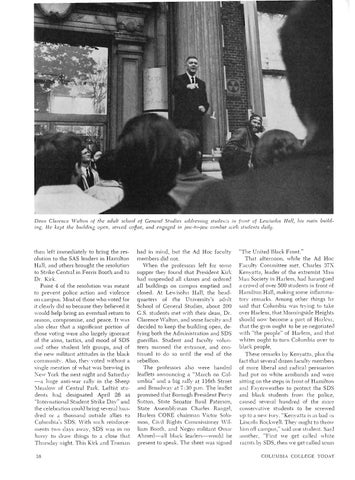
The Students for a Free Campus had issued another flyer called "Cool It for Victory." It said, "We will have as many students as possible on Low Plaza and the steps," in an attempt to halt the SDS invasion of Low Library by having a protective picket line in front of the building. It continued, "We are going to be on TV and in the national press, but instead of a blurry film of flying fists, we are going to give them a real show. SDS will have to wade through our picket line to break the rules, to trample our rights; and Am~r足 ica will watch them. So cool it. This time we are going to win by making SDS look like dirt." The SDS radicals had published their rationale for the noon hour rally in that Tuesday morning's Spectator. "The two questions at issue are: shall the University continue to support materially the U.S. Government's imperialist policies at home and abroad? Shall the University repress political activity against it? Join us today in demanding: 1) An end to Columbia's ties with IDA. 2) That no one will be punished for opposing Columbia's unjust policies, 3) That all accused [the six who were put on probation for the Low demonstration] be granted their rights to open public hearings before students and faculty with full rights of due process." Surprisingly and conspicuously missing was any reference to Columbia's new gymnasium in the three demands. Hence, when the lanky, 20-year-old Mark Rudd stepped up on the Sundial podium at 10 minutes past noon on Tuesday, April 23, the crowd of 300 listeners, two-thirds of them curious onlookers, grew quiet to hear his words. Rudd began rather matter-of-bctIy. Behind him, on the long mall from the base of the Sundial to the entrance of Butler Library, was a brilliant blaze of tulips of various colors in full bloom. South Field was bright green from the early spring rains and the care of the University's gifted horticulturist, James Beckley, and his staff. Directly behind Rudd, on the podium with him, were several of the aides. One held a large poster saying: "Open hearings for the IDA Six. End University Racism. End University ties with IDA." Another held up a white cardboard on a stick reading "Kirk is illegitimate." Rudd spoke facing toward Low Library. Up on the Low steps, behind the 15
statue of Alma Mater, about 200 students had formed a moving, narrow oval of picketeers with signs also. Theirs read: "Is the Rule Book a Joke Book?" "It's Our Campus Too!" "Persuasion, Si, Coercion, No." "Send Rudd Back to Cuba" and "SDS Must Go." Rudd glanced up at them occasionally but his eyes were directed most of the time at the members of the crowd around him, particularly his 100 or so supporters in the front rows. He told the crowd that President Kirk and the Trustees, "who run this school completely," are part of the small ruling group, with connections in business, the military, and the government, that runs America and oppresses the people, especially the young, the poor, and the Negroes. Through agencies like IDA, Rudd alleged, Dr. Kirk also helped the forces of imperialism. Rudd hammered away at IDA and Vietnam, special grievances of his. He also denounced "Kirk's ban" on indoor demonstrations and Associate Dean Platt's decision to put the SDS leaders on probation as a "reprisal," "a ruthless attempt to suppress dissent," a naked move to "get us." His audience grew, as additional onlookers and SDS sympathizers swelled the crowd to nearly 600. There was surprisingly little applause for Rudd's remarks, but almost no heckling either. Some in the crowd seemed to think that Rudd and SDS were being melodramatic and peevish. Student comments like "This rally is silly," "Both sides are idiots," and "Rudd's push for no punishment for himself and his buddies is blatantly self-serving," were frequen t. One faculty member at the crowd's edge said, "Real middle-class stuff. They want their rowdy brawls, but they also want to go scot-free so they can make it into law school or medical school." At one point the crowd broke into laughter, to the annoyance of another SDS speaker, when a student with an angelic grin waded through the listeners with a placard "Warmth Picnic, Sunday 1 P.M." Few of the faculty members seemed to take Rudd's rhetoric very seriously, After two or three other speakers had harangued, Rudd mounted the podium again. He held high a letter he had received from "that son of a bitch Dave Truman" a few hours earlier. He read it aloud. In it, Dr. Truman had offered 16
to meet with the SDS leaders and any others in Mc~Iillin Theater "immediately" to discuss any and all University matters they wanted to challenge. After he finished reading, Rudd asked his constituency around him what they fe!t SDS should do. Should they meet with Truman? There followed four minutes of "participatory democracy." The technique is a fascinating one, and one used regularly by the New Left. At any juncture in a course of action where a decision is required, the leader consults his followers by presenting what he regards as the choices open. (The participation is thus restricted narrowly to the matter at hand.) Individuals among the group offer ideas and tactics, some wild, some shrewd, some cautionary, some comical. Other individuals often offer objections to the previous suggestions. Occasionally, the leader inserts a suggestion of his own. This usually happens fairly fast; the consultations generally take from three to twenty minutes, depending on the importance of the decision. As the suggestions dwindle, the leader sums up what he senses is the majority opinion. If he senses no prevailing view, he usually picks the two or three best tactics as he sees it and asks for opinions. The group indicates whether the leader has grasped the majority view correctly, or decides upon the best of the two or three tactics noted, and a decision is reached. All this is normally done by voice, although on rare occasions a hand vote is taken. The device is a form of consensus politics for the small group. During the next few weeks at Columbia, the SDS leaders and their colleagues used the quick democratic consultation several thousand times. It is imperative to understand this "participatory democracy" device. It presupposes several things and makes difficult the carrying out of certain oldtime revolutionary sb'ategies. Participatory democratic decision-making in the midst of important actions assumes a remarkable degree of equality among the radical participants. Anyone in the group may determine the next piece of action if he or she convinces the group quickly of its worth. It assumes, too, a high degree of inventiveness and intelligence among the group. And, it presupposes virtual unanimity among the group about goals and a fair amount of openness about tactics. Lastly, it as-
sumes that all actions should have the assent of most of the participants, The "participatory democracy" device of constant stock-taking means that somewhat reasoned discussions take place at all turning points in left-Wing action. The discussions, however, are frequently grounded in rumor and surmis.c; their hurried nature precludes fact-gathering of an accurate sort. Mob psychology is often present, even though the groups are relatively small, and stampeding by forceful zealots is a problem. The position of the leader is a vague one. If he is strong-willed, witty, and clever, he can manipulate the group in its discussions; but if he is truly democratic and wide open, the leader may be little more than a frontrunner and discussion leader. What m:1l1Y old.cr persons fail to grasp is that the central business of frequent caucuses gives ew Left youth movements three special ingredients. One is an improvisational quality, which adults label erraticism, emotionalism, or confusion. Another is the local nature of decision-making and leadership. Adults like J. Edgar Hoover or the editors of the New York Daily News may still talk about outside Communist direction and control, but the idea is laughable to the constantly caucusing radicals. (The young egalitarian radicals, though, often fail to understand the extent to which their aims and behavior coincide unwittingly with outside Marxist strategies, or the degree to which they can surreptitiously be led along certain courses of action by Progressive Labor Party (Maoist) or other outside party adherents who infiltrate the voung radical groups and throw out ideas for "spontaneous" courses of action at the caucus with a camouRaged cunning and pattern behind them.) Third, contradictions and lack of clarity about goals and tactics are evident freJquently in radical actions. This is particularly the case in coalition movements of some size, since there are numerous loci of direction from the several different groups, each improvising as it goes along. Coordination and coherency is a huge headache br radical movements once they rise above small-scale, brief attacks. The Jew Left encourages each special group, and even individuals, to do "their own thing;" yet they also seek "solidarity," both in purpose and maneuvers, COLUMBIA COLLEGE TODAY
Columbiana Collection
The Sundial, 1914 The Sundial on College 'Valk is known today as a convenient meeting place, a pulpit for student evangelists of all stripes, and a launching pad for campus protests. '''hat is less well known is that something else stood atop the fiat, round podium until 1946, before most of today's undergraduate orators were born. For 32 years a 15-ton, 7-foot, granite "Sunball" conducted a silent filibuster there. On the surviving pedestal of the Sundial is an ominous prophesy: Horam expecta veniet ("Await the hour, it will come"). The hour came for the Sunball on December 12, 1946, when University officials, fearing that two thin cracks in the large ball would split it into malevolent chunks, removed it. It was rudely retired to a Bronx stoneyard. "Columbia Junks Famous Sundial" headlined the New York Times. Spectator editorialized: "Somehow, we never attached any sentimentality to the globular mass. None of us are astronomy majors, and we never could quite figure out what time it was by referring to the dial." The Sundial was a gift of the College's Class of 1885 to Columbia on the occasion of its 25th reunion. It was designed by a member of the class, astronomy professor Harold Jacoby '85. The sunball served as a stylus for the timepiece that was accurate only one minute a day-at 12
Anyway, Rudd and the group of nearly 200 SDS members and sympathizers went into a caucus about Dr. Truman's proposal to meet with them in Mc:\IiIIin. While 400 onlookers watched and listened, a swift, confused exchange took place about what tactics to use next. One student thought SDS should go to McMillin and demand that SPRING, 1968
noon. The noon hom was marked by the sphere casting its shadow on the bronze plates that are still present on the pedestal, and by notches on the plates corresponding to the days of the year. The Fortnightly Bulletin of Columbia's Institute of Arts and Sciences said on ~larch 26, 1915, "This is the only sundial of its kind in the world, and the granite ball used as the dial is the largest ball in the world turned from one piece of stone." Originally the Class of 1885 proposed that the Sundial be placed smack in the center of 116th Street, the predecessor to College Walk. IVlanhattan political officials would not allow it because they felt it would be a hazard to the "fast-moving" traffic of 1910. University comptroller Frederick Goetze '95 suggested the present site, where he felt the Sundial "would be equally conspicuous and equally free from any danger of being overshadowed by adjacent buildings." The Sundial was built atop the steps next to South Field, then an athletic field used for the College's football, baseball, and other games. It was offiCially presented to the University on May 26, 1914, at a large ceremony attended by professors, administrators, the Class of 1885 in academic dress, leading citizens, and numerous ladies in the finery of the day.
Truman let "the students" decide the fate of "the IDA six" instead of Dean Platt. Rudd himself suggested that if SDS met with Truman it ought to be on their terms, with chanting and discussion of demands that they wanted. A student quickly agreed, "We should tell Truman what we want to do." Another said he thought that "no deals, no
compromises" should be made. Suddenly, one person shouted, "What about the plan to grab Low?" With that, a student dressed in a denim suit and sporting a red bandana jumped up on the Sundial. He was Tom Hurwitz, a College junior currently making a film on the hippies. Hurwitz said, "Yeah, let's go to Low." Whereupon the crowd of
17
from Song 3 In the midst of plenty, as close to
~wlk
be~re.
In the fewe of sweetness, p~ss.
In the time of goodness, go side, go smashing, beat them, go as (e~s nee~1- as you can tear. In the lcmd of plenty, hewe nothing to do with it. Take the way of the lowest, including your legs, go cont1-ary, go sing. CHARLES OLSO "Me~ximus
onlookers parted as if a decision had been made, and the SDS members in front of Rudd turned about-face and began walking toward Low Library. Rudd and the other SDS leaders had to jump off the Sundial and race around the perimeter of the crowd in order to take a place at the front of their SDS constituency. The group of 200 radicals looked as if they were headed for a fight with the 200 members of the Free Campus group, who were still circling on the flat areas above Alma Mater. Said one of the 1,000 observers, "It's like showdown time in a corny grade B 'Western movie." The 40 or so professors who had been observing the scene rushed to a position in front of the Students for a Free Campus, where they might prevent fisticuffs between the two forces. Since Low Library had been officially closed for the day by President Kirk to prevent a brawl inside its halls, 18
Poems"
where a priceless collection of Oriental art and sculpture is displayed, Rudd and the other SDS leaders veered to the right as they approached the student defenders of Low and headed for thf. southeast entrance of Low on the ground floor, the only open entrance. It was guarded by several members of the campus security police. Rudd stoppeJ his group, then climbed up on a window ledge and asked, "O.K. What do we do now?" This time the participatory democracy session was even more brief and confused than the one on the Sundial 15 minutes earlier. Someone suggested that the group go down to the gym site on Morningside Drive and 113th Street. That caught the fancy of about half of the SDS gang, who walked off in that direction, Rudd among them. The othcr half went back to the Sundial. At the gym site, nearly 100 students stormed the cyclone fence surrounding
the building site, while eight New York City policemen tried to keep them from ripping up the wire fence. The students rushed like buffalo; the police pushed off and pulled away. The students succeeded in tearing down several sections of fence. As they did so, the police arrested Fred vVilson '70, who was particularly aggressive. Numerous of the radical students then kicked antI punched a few of the police, especially one who had been knocked to the ground while trying to hold on to Wilson. Three policemen had to be taken to Columbia-Presbyterian Hospital. No students were hurt. After 10 minutes of battle, the SDS combatants decided to quit the gym site. There was a third quick democratic discussion at Morningside Drive and 116th Street, led by Rudd and senior Ted Gold, at which the group decided to go back to the Sundial for the purpose of regrouping and "taking some real action this time," as one student leftist put it. As the splinter group of activists were walking back to the Sundial, Ted Kaptchuk, the former SDS chairman, said to the crowd of perhaps 300 persons on College Walk, who had been listening to more speeches, "Let's all go down to the gym site. Stay away from the cops though. Be carefuL" About 75 students surrounding Kaptchuk started to go, but they took no more than 30 steps when they saw Rudd and the others mtuming to the Sundial. There ,"vas some muted laughter among the onlookers. "This thing's getting to be a farce," said one student. Said another, wearing a "Stop the \Var ~Iadness" button, ''I've lost faith in the SDS." Then a black student named Cicero Wilson took the podium. Wilson, though only a sophomore, was such an effective advocate of black power that he had won election as president of Columbia's Student Afro-American Society. The bull-necked Wilson, a formcr captain of his high school football team and president of its honor society, and the graduate voted "most likely to succeed" by his class, appeared to be both pleased and disgusted with the thrashing about of the SDS whites. After expressing an appreciation for SDS' concern for black problems, he said, "but we black students are no longer going to stand for this kind of COLUMBIA COLLEGE TODAY
action. From now on we are going to be in the vanguard, and SDS and its council can support us. You guys are not much better than Columbia. What do you know about whether the black people in Harlem want this gym or not?" One other person spoke on the Sundial. Then Mark Rudd, panting, got up to talk. He told the crowd that "the cops got one of our men," and that now SDS had to get some Columbia official. "A hostage for a hostage," Rudd said. He ended, "We're going to close down this goddam university. We'll need more help, and we'll get it. Everybody to Hamilton Hall!" It was 1:45 in the afternoon when the SDS members supported by a group from the Citizenship Council and joined by many members of the Student Afro-American Society, or SAS, marched into Hamilton Hall, the College's chief classroom building and the home of the Dean's office and the Admissions Office. The group, numbering approxin1ately 200 students, hoped to confront Acting Dean Henry Coleman '46, but he was out. They decided to stay, chanting, "\,ye want Coleman." Ten minutes later, Dean Coleman entered the building, accompanied by University Proctor William Kahn. The crowd of demonstrators parted to let him walk to his door, then quickly surrounded him in front of the door. They demanded that the decision to put the "IDA six" on disciplinary probation for defying the Dean's Office be rescinded immediately, that the charge against the student arrested at the gym site be dropped, that the President's rule against demonstrating inside classroom buildings be dropped. The students were exceedingly angry, and some shouted obscenties. When Dean Coleman informed them that only the Uni-ersity's president had authority to do what they were demanding, they yelled that he should "bring Kirk and Truman here." Dean Coleman replied, "I do not intend to meet any demands during a situation like this, and I will not request that Dr. Kirk or Dr. Truman come here either." He then turned and went into his office, closing the door. Mark Rudd then told the group, "\,ye're not going to leave, and we're not going to let Coleman leave, till our demands are met.''' The group sat down in the Hamilton Hall lobby and SPRING, 1968
opened a meeting to decide what they should do next. While they were meeting, Associate Dean Platt and several faculty members coming and going to their offices in the building talked with the students, trying to convince them of the impropriety of their sit-in. Rudd and the other leaders were adamant. They set up a steering committee, which included several black students, to prepare for a long stay. Meanwhile, two burly undergraduates from the Students for a Free Campus placed themselves in front of Dean Coleman's door, and a dozen oth~rs stationed themselves on either side of the Dean's Office entrance "to protect the Dean." Numerous other students at the edge of the cluster of seated demonstrators and outside Hamilton Hall began demanding that the campus guards "or somebody" remove "the pukes" from Hamilton Hall and free the dean. (One student explained the appellation "pukes": "Just looking at
The Idea
those dirty, bearded twerps with their sneers and their sloppy girl-friends is enough to make a guy vomit.") A crowd of approximately 600 spectators now gathered around the 200 protestors. An hour later, shortly after 3:00, Dean Coleman came out of the Dean's office to plead again that the demonstrators clear the hall and allow him to leave. A sharp debate followed. Many of the protestors seemed to possess a deep, generalized hatred directed at no one person or no particular issue, although they were profanely abusive toward their dean and especially insistent on receiving no punishment from any source for any of their acts. In a test to find out whether the sit-in was an honest, conscionable act of civil disobedience (which accepts legal consequences for unlawful actions) or an insurrection (which does not recognize the legitimacy of prevailing rules), Dean Coleman asked, "Are those stu-
0/ a University
To have even a portion of you is the highest State to which a good article can aspire. It puts me beyond chance, necessity, anxiety, Suspense, and Supe1'stition, the lot of nwny. VCLulters, whose hours are possessed by one pole, Take excLggemted views of the importance of height, Are feverish in the morning, cmd are Startled cmd depressed when they happen to fall. When I am in difficulties, I originate VCLSt ideas Or dazzling projects equal to any emergencies. I can remembe1' to whom I am speaking. This is genius. Something recLlly luminous, Something really large. The earth smiles. The 1'ocks an demnged over the sequence of ideas, Too violent to last before this giant fascination. And the hand opens its ten thousand holds. DAVID SHAPIRO '68 in the Columbia Review
19
[; earning comes I
only .from action-.
What apout our J 1$hts? 1
Stop repre5Sin~ on-p natural instincts.
'ta,tionome! eanih1a]s
ide.
T 1.. We'll if' vp agains t -th~ negotia.te
waJJ.homo sa~lcns.
. YOL('re
. SY1.UpUhetk enoujh. \J~ peJieV0 in strong non-vJoJent
If only] could -talk to the a_nimqJs,
{orC8.
~
~I!!~ Hancl~o./12{2 JS as handsOIlle does.
dents who refuse to let me lea\'e my office willing to sign a statement to that effect?" The students shouted, "No, never!" The dean re-entered his office. He called Vice President for Academic Affairs David Truman and informed him that he was virtually being held a prisoner by 200 student rebels, mainly from the College and Barnard. Dean Coleman's question caused considerable apprehension among some of the young scholars, who were not entirely sure that seizing hostages was their cup of tea. There was another meeting, but the stronger wills prevailed. The apprehension was a sign, however, to the steering committee that it had to formalize its protest a bit more and seek additional support around the campus for their daring enterprise. The steering committee collected itself. It took over the Citizenship Council's office in 311 Ferris Booth Hall for headquarters, started calling friends and SDS units at other colleges, and mimeographed a statement for campus distribution. The statement contained the first formulation of the later-famous "six demands." It read: Join us! In Hamilton Hall now (Tuesday). \Ve're staying until the following demands are met: 1. All disciplinary probation against the six originally charged must be lifted with no reprisals. 2. Kirk's Edict on Indoor Demonstrations must be dropped. 3. All judical decisions should be made in an open hearing. 4. All relations with IDA must be severed. 5. Construction of the Columbia gym must stop. 6. The University must see that all charges against persons arrested for participating at demonstrations at the gym site are dropped. Already there or coming are: Columbia Band, Soul Syndicate, extensive news media, Prof. Shenton, Prof. Collins, Prof. H. Brown, Prof. Larson, Prof. Zavin, Prof. Danto, and more! Plus group participation by hundreds of students. You wouldn't want to miss it! ! ! SDS & SAS It was hardly a revolutionary document. At this point SDS still seemed more concerned about freeing their leaders and top activists from discipline, and about being allo\\'ed to practice their confrontation politics via indoor jaw-to-jaw sessions and open hearings where the press would be present. The document did capture
22
nicely the combination of gay prankishness and angry rigidity of most of the protestors in front of the Dean's door at this time. Shortly after 4:00 Dean Henry Colelllan came out of his office for the third time. He informed the crowd th'lt Vice President Truman had offered to meet with them for a no-holds-barred dialogue in Wollman Auditorium. Although a few of the demonstrators thought it might be a good idea, the majority, especiallv the SDS leaders, rejected the offer promptly. Shouted one student, "\Ve don't h'ust him. No meeting unless he gives us a show of good faith. Amnesty for everyone first!" Many of the others shouted approval. Dean Coleman went back into his office. One undergraduate demonstrator left Hamilton Hall, saying, "This mob isn't interested in resolving anything with anyone." Another, who stayed, said, looking deliciously naughty, "Why should we leave? This is so much fun." Following the dismissal of Vice President Truman's offer to discuss the issues, there began a long tug-of-war between the faculty and deans and the revolutionary SDS leaders for the allegiance of the 200 protestors. Mark Rudd by now had become exhilarated, some witnesses say intoxicated, by the idea of a crippling blow against Columbia. Someone had secured a bullhorn and he and his colleagues began addressing the crowd in a magnified voice. To pump up morale and solidarity Rudd and the others read telegrams of support (which they h:ld solicited), delivered harangues about the IDA and President Kirk, reported faculty support, "O.K. Listen. vVe just heard that Eric Bentley of the English Department and Serge Lang of Math are with us!"), promised visits from Dr. Spock, Harlem leaders, other celebrities, and the TV reporters, and discussed tactics. After 5: 30 food, notably hambmgers and ice cream bars, were sent in by the armfuls. About 6:00, large posters of Lenin, Castro, Guevara, and Stokelv Carmichael and several anti-war posters were hung up, and later red balloons and streamers of reel crepe paper were tied to the seats and large white columns of the Hamilton lobby. The College building looked festive, as if it were the town hall in an
Albanian village during Lenin's bb:thday celebration. Also around 6: 00, Rudd announced that a delegation from the City College SDS had arrived to join the group. (Applause.) Shortly after, the arrival from l\ewark, N. J. of Thomas Hayden, the former national chairman of SDS, was announced and cheered. Hayden spoke brieRy. While Rudd and the others were working to give the sit-in an importance and a revolutionary mystique, professors and College officials were pleading and arguing with the protestors. Historv professor Orest Ranum told them that a number of professors had petitioned for an emergency College facultv meeting the next night to discuss the six demands, and asked the group to disperse and allow classes to go on until that meeting. Four philosophy professors, led by Dr. Arthur Danto said, "\Ve're here to convince you to dissolve." They proposed that the group select a delegation to meet with the faculty as soon as possible. The suggestion was debated by the protestors until one student said "\Ve don't want to meet with the faculty, but with the Administration." "But you turned down a meeting with Vice President Truman," replied one College instructor. "~[aybe we don't want talk but action," snapped a student. Not a single faculty member appeared to support their sit-in, which worried some of the SDS supporters. Only the University's Protestant counselor, the Rev. \iVilliarn Starr, an Episcopalian and a Christian revolutionary with a deep hatred for all authority and middle class life, fully approved. "I give you all sanctuary," he offered beneficently. Admissions director John 'iVellington and Associate Dean Alexander Platt circulated among the protestors too, urging them to disband. Their tone was one of reason, advice, and amiability. On several occasions Dean Platt exchanged pointed jokes with M:ll'k Rudd. Dean Platt's tone helped make the SDS venomous statements seem a bit overwrought, even silly; but it also contributed to the feeling that neither the College nor the University authorities were prepared to get tough alld evict the protestors. About 7:00 some students started bringing in blankets to spend the night. The top two floors COLUMBIA COLLEGE TODAY
Acting dean Henry Coleman '46 speaking to_ students outside Hamilton I-Iall. He was held captive in his office for 26 hours by band of student protestors.
were designated as the sleeping areas. Outside Hamilton HaH word of the sit-in spread, causing indignation, jokes, and puzzlement. By 4:30 the Students for a Free Campus were distributing a mimeographed flyer which read, in large part: Had enough? Had enough of SDS insolence and contempt for your rights? Let's close the Authority Gap on the Columbia University campus. WHAT WE WANT SDS seeks a minority role in thE Guise of Student Power. They do not shrink from the use of force, such as imprisoning Dean Coleman, even when the legitimate authority or the vast student majority . . . refuses to bow to their wilL Therefore, the Students for a Free Campus calls on the University authorities to: 1. Stop yielding to SDS blackmaiL 2. End the demonstration in Hamilton Hall. 3. Punish the demonstration's instigators effectively. 4. Enforce all the rules all the time. WHAT TO DO \Ve must do something immediately, but at the same time we must auoid SPRING, 1968
violence ourselues. Make your voice heard, especially if you haven't yet done so.... THE CURRENT SITUATIOI vVe can save the University from SDS violence and from the increasing number of outsiders in the Hamilton demonstration. We have already defeated SDS on the open recruiting issue in last fall's referendum. Today we stopped them non-violently from storming Low Library. V>le can win. vVe have the great majority of students on our side ...
Numerous professors began to wonder why the University officials permitted the sit-in to continue, especiallv since the College's dean was being held captive. A member of the government department said, "This is outrageous. Why doesn't Kirk act before this thing gets out of hand?" Actually, President Kirk was out of town on that first day of the revolution. Dr. Truman, who was thus left in charge of Columbia, and was in telephone communication with the President, was receiving conflicting advice from several faculty members. President Kirk, is reported to have favored firm action but Dean Coleman did not. Around 9:30 p.m. Vice President
Truman did visit Hamilton Hall, but did not go in to argue with the sit-in leaders. Instead he held an impromptu fireside chat in Hartley Hall, such as he and President Kirk do several times each year with undergraduates in the dorms. He told nearly 500 bafBed, angry students that "amnesty was out of the question," and that Columbia would not make any key changes without prior discussion and thought. Swift, basic changes because of pressure', blackmail, or "coercion" from a tiny minority were unthinkable, he said. Dr. Truman remained on the scene until 2:00 a.m. In the Hamilton Hall lobby two things were happening. Mark Rudd was continuing to have trouble with some of the demonstrators. Despite some soul music by the Soul Syndicate, and frequent announcements of support, every now and then a student or three would get up and leave the demonsh-ation, which until the early evening had packed the lobby of Hamilton. Some speakers helped the process. For instance, Victor Crichton '53, a egro alumnus who lives on Morningside Heights and is a vigorous opponent of 23
Black stlldents, teho eeicted SDS whites with help from olltside militants and occllpied Hamilton Hall themselt;es, look alit on thz crated below on 'Vednesday morning, April 24. ShOltly after, they released Dean Coleman and mged the Harlem Olltsiders to depart.
the new gymnasium, told the group: "You've won your point. You have gotten the faculty to have a meeting and discuss the gym and IDA seriously. You can't twist Kirk's arm any further. If you don't want charges made against you, go home. The demonstration is now pointless." Most of the demonstrators merely chanted in response, "Hell no. we won't go." Rudd told the group that blacks and whites should stick together. He aLo brought up the possibility of the police coming in to bring them out. But, h0 said, "Stick around. The University will capitulate. Don't leave. Forget vour mothers. Stav tough." Bv 9:00, howe\'er, the dcmons~rators were down to 125 in number. The ambiyalence of some students was nicely illustrated by a statement of Ted Kaptchuk, last vear's SDS chairman: "1 think that keeping Coleman in his office is a bad tactic. But of course he and Kirk are morally wrong, so we're entitled to do anvthing we want with the dean." The other development was the gradual assertion of authority within the demonstration by the black students of SAS and the:r outside friends. During the evening, while Rudd and the other leaders were calling their 24
friends (including an older man around 40 years old who kept saying to the Hamilton Hall crowd, "This is a practical laboratory in revolution."), the black students started calling their friends in Harlem, nearly all of them militant black power advocates. Dy 10:00 at least a dozen older Negroes from CORE, SNCC, the Uuited Black Front, and the Mau Mau Society were inside Hamilton Hall. Black students had replaced the white students in front of Dean Coleman's door, and separate caucuses - one white, the other black - had been initiated. At ] 0: 30 several blacks announced that the two side doors of Hamilton Hall were being locked and barricaded and passage through the central door was being restricted. This caused another 10 or 15 white protestors to leave. Said one, "This comedy of the absurd is turning grim." As the night wore on, some persons, mostly white, went to the sixth and se\'enth floors to sleep, but the majority of the crowd, black and white, stayed up, caucusing, devising schemes of action in case the cops came, and holding meetings. By 1:00 a.m. it had become obvious to many white students that the black students and their older Harlem colleagues were dissatisfied \\'ith the way the whites were running the show ("They're just kids playing around with this revolution bull."), were growing distrustful of "Whitey's" intensity of purpose ("Every hour another 10 of them leave."), and were doubtful whether there should be a
coalition unless the blacks were running it. (Today's young i\egroes prefer to be called blacks, not Negroes.) The sentiment that coalitions between blacks and whites are no longer valid unless the whites are willing to work under black direction is an increasing and widespread one among blacks, especially black college students. "Let black people organize themselves first, define their interests and goals, and then see what kind of allies are available," write Stokely C,1.rmichael and Charles Hamilton in Black Power: the Politics of Liberation in ~America (1967), a book that one black 1 student in Hamilton Hall called "almost ~a bible for us." The authors contend: ~ It is our position that black organiza-' tions should be black-led and essentially black-staffed, with policy being made by black people. White people can and do play very important supportive roles in those organizations. \\'here they come with specific skills and techniques, they will be evaluated in those terms. All too frequently, however, many young middle-class white Americans, like some sort of Pepsi generation, have wanted to "come alive" through the black community and black groups. They have wanted to be where the action is-and the action has been in those places. They have sought refuge among blacks from a sterile, meaningless irrelevant life in middle-class America. ... ~[any have come seeing "no difference in color," they have come "color blind." But at this time and in this land, color is a factor and we should not overlook or deny this. The black organizations do not need this kind of idealism, which borders on paternalism. By 3:30 in the morning the blacks had pretty much decided that in order to halt construction of Columbia's new gymnasium, and to do it their way, the white students had to be moved aside. An hour later the blacks sent messages to the white caucus in 717 Hamilton to tell the whites they had to leave Hamilton Hall. Rudd met with the black caucus, to no avail. A young government instructor commented the next day, "It was like the 19.67 New Politics Convention in Chicago last summer, where the whites, including many Jews, were forced to accept a black caucus resolution condemning Israel for its "aggression" against its Arab neighbors.) SDS leaders woke up the sleeping students and spread the word that they had been urged to get out. COLU'.lBIA COLLEGE TODAY
Dean Coleman, locked in his office with Proctor William Kahn and the College's director of College Relations Daniel Carlinsky '65, found out about the embarrassing split through the iron bars on his window, which opened onto College Walk. A few protestors, who had left Hamilton immediately after they had been informed of the divorce, rushed around to the window and dis-
Early morning (Wednesday, April 24) crowd of pu::,zled, curious, and angry students in front of Hamilton, chief building of the 1111dergmduate College, which was blockaded the night before.
played a sudden concern for the dean since, they reported, there were about two dozen older men wearing sunglasses in Hamilton with "guns and knives." (The guns-and-knives charge was never proven conclusively, though numerous students have attested to their presence.) Fearful, dazed, the SDS leaders and their 120 or so remaining troops filed out of Hamilton Hall at 5:45 that morning, looking haggard and carrying blankets and books. As shldent reporter .\Iichael Stern wrote in Spectator: "Rhetoric of solidarity soon covered up the disappointment of being asked to leave. SDS's retreat became a tactical
move to open a 'second front.' But fear -of violence, of guns-and inexperience and naivete in the face of superior organization and tactics was principally responsible for SDS's move." After the whites left Hamilton, the SAS students and outsiders took chairs, tables, ladders, and file cabinets and blockaded all three doors of the building. They tore down the red balloons and crepe paper that SDS whites had put up, and they ripped the pictures of IVlarx, Lenin, and Castro off the walls. They left hanging the posters of Chc Guevara and Stokely Carmichael and added one of Malcolm X. They later hung a huge banner of Stokely Carmichael from the front of Hamilton Hall, and put up a sign in the building's doorway, ".\/Ialcolm X University. Established 1968." Mark Rudd and his revolutionaries sat for awhile, looking forlorn, on the steps outside Hamilton Hall. What to do? Obviously, another participatory, democratic meeting was called for. A handful said they had had enough "action," and went home to bed. vVhile in Hamilton Hall, both Rudd and some SAS members had considered "liberating" another University building. low it was seriously debated, and Low Library, which SDS had attempted to enter 17 hours earlier, was chosen. The group of 100 stalwarts dropped their blankets and headed for the southeast, or security entrance. The entrance had two wide glass doors, the outer one locked and the inner one locked with a single greyuniformed guard behind it. Rudd and his colleagues broke the glass with a wooden sign and opened the first door, then smashed the second door too, badly cutting the hand of the guard. They rushed up into the building and broke their way into President Kirk's office suite on the main or second floor. Only 30 or so stud'ents entered the President's office. The others held back by older notions of privacy: civil liberties, and respect for the University, remained in the hallway or in the Rotunda outside. Those who entered Dr. Kirk's office came out quickly to join the others in a discussion about what to do next. Opinion ran the gamut, from leaving the building altogether to turning the whole of Low Library into a fortress. Finallv, Mark Rudd suggest25
SDS students, gaily defiant, in President Kirk's office during the first day ot their occupation. In top picture, rebellion leader Tony Papert '67 call be seen in a tchite shift. Papert, littleknown, Maoist-oriented tactician who shuns publicity, teas one ot the most infl/lentinl figures in the uprising.
26
COLUMBIA COLLEGE TODAY
. >-
. .J
ed a compromise that the group barricade themselves only in the President's and Vice President's suite of eight offices. The idea was accepted, and all 100 of the protestors went into the second floor offices on west side of the architecturally famous edifice. Said Rudd, "My academic career is ruined anyhow. 1 might as well stay here and win this fight." It was as if fraternity members had broken into Brigitte Bardot's bedroom. The radicals sat at the President's desk, lit up his cigars, drank his sherry, studied his library, and went through his files. Occasionally, when they found what they thought was a particularly juicy letter to some Establishment figure or Government agency they Xeroxed it. They hoped to find firm evi, dence of complicity in the Vietnam war or examples of University racism, but to their dismay found very little. early all the protestors expected the police to come to clear them out within a few hours. There were plenty of discussions but little agreement about what to do when the cops arrived. The police, about 10 of them, did show up at approximately 7:30 a.m. Panicked, about 75 of the demonstrators, including 1ark Rudd, climbed out the windows to escape, while 25 remained in the President's suite. Surprisingly, the police merely removed one of the barricades, inspected the scene, rescued a priceless Rembrandt painting, and left! Why did the police take no action? Why were there so few? On Tuesday, when the students first sat in Hamilton Hall, and President Kirk was out of town, the police were not called in instantly chiefly because Vice President Truman held the traditional view that a university is a preserve somewhat apart, a place that should be governed by reason, mutual respect, speCial sympathy for young thinkers, and its own rules, and not only by the municipal laws and the police. He was supported by Dean Coleman of the College. Dr. Truman hoped also that the protestors would discuss their grievances openly; and he wanted a chance to consult the faculty before acting. But when the black students and the Harlem militants evicted the white SDS students in the early morning hours of Wednesday morning, the situation took a new turn. By early SPRI:\'G, 1968
vVednesday morning the chief concern had become the safety of acting Dean Harry Coleman, a prisoner in his office along with Proctor William Kahn and College Relations officer Daniel Carlinsky. The numerous reports from students that there were guns and knives in Hamilton Hall was a very disturbing and key factor. Then too, since there were representatives of the more radical Harlem groups in the building, it was felt that police actions against the occupiers of Hamilton Hall could conceivably expand into a racial riot of grave proportions. When New York City's Mayor Lindsay was told of the situation, he expressed a similar concern about a possible expansion of the Columbia revolt, and sent a few of his sidekicks up to see if they could help work out a solution before police action was required. Actually, the seizure of the President's office was almost incidental in the minds of most Colum~ia officials on Wednesday morning, including the mind of President Kirk, who had returned, using 109 Low, the suite of the Dean of Graduate Faculties, as his temporary headquarters. Hence, the police who came to Columbia early \iVednesday morning were few; they confined themselves to an exploratory visit to the President's office; and they were on hand principally to see that no serious violence took place. Following their visit inside Low, they stationed themselves outside Low in front of the windows of the Presiden t's office. The threat of counteraction was a real one. Tuesday night until 3:00 a.m. a group of students varying at times from 100 to 500 stood outside and inside Hamilton Hall, angry at the seizure of the lobby and Dean Coleman. Some wanted to clear the rebels out of Haalilton, but Dr. Truman, Dean Platt, and others worked to prevent such action. The next morning, \Vednesday, the threat was even greater. The remainder of the College's 2,700 young men and numerous graduate students, arriving for classes at Hamilton Hall, were shocked to find the building barricaded, with furniture, ladders, and file cabinets, with the faces of solemn, menacing blacks behind the glass of the doors. Tumerous faculty members, who had offices in Hamilton, and were unaware of the seizure, were equally surprised and puzzled. "What on earth is
going on?" was the ubiquitous query. The morning newspapers told of the previous evening's activities but did not tell of the eviction of the whites from Hamilton or the subsequent seizure of President Kirk's office. The general reaction was one of astonishment, though anger, fear, and resentment, amusement, and even admiration were not missing. Among the comments: "Those guys are fascist hoodlums;" "You've got to admire their nerve;" "Now we'll see what kind of a man Dr. Kirk is;" "What about oLir rights?" "I hope they don't hurt Harry Coleman;" and "It's a double love-in, Southern style, you know, segregated." The displaced faculty drifted together in the large lobby of Philosophy Hall. (The majority of the faculty in the Graduate Faculties, General Studies, and Engineering, and nearly all the faculty in the various professional schools held classes almost as if nothing had happened.) Associate Dean for Academic Affairs Thomas Colahan '51 explained to the 80 professors there what had happened step by step and informed them that a meeting of ~he College Faculty had been called for 3:00 p.m. Sociologist Daniel Bell got up to suggest that several senior prohsSOl'S go into both buildings to talk to the students. A young faculty member said that he had been with the radicals most of the night and that control had passed to older outside black militants. "They have anTIS and gasoline," he said. Chemist George Fraenkel, the newlyappointed Dean of the Graduate Faculties, reported that he, Dr. Kirk, and Dr. Truman had been talking about clearing the buildings but that all were worried about Dean Coleman's safety. He said that administration leaders were in frequent telephone conversation with the rebel leaders in both buildings. Professor Bell called Vice President Truman, who said he welcomed faculty visits to the buildings, but discouraged the offering of any personal deals Or unauthorized compromises. Shortly before lunch time, New York's Human Rights Commissioner, a tall, dapper Negro named William Booth, climbed into Hamilton Hall. Outside, rock 'n roll music was throbbing out of a window in Hartley Hall on the crowd below. About 40 members of the press were on the scene. At Low 27
Library, some of the student rebels were sitting on the window sill, alternately grim and gay. The crowd below stared up at them as if they were captive orangutans. Around 1: 00 Commissioner Booth came out of Hamilton. Soon after, about a dozen older blacks climbed out one at a time. Wearing leather jackets, or skull caps, or colorful necklaces, they walked silently, emotionlessly, through the undergraduates and off the campus. No one tried to stop them or talk to them. Later in the day, Booth accompanied by three Harlem politicians, Manhatt,m Borough President Percy Sutton, State Senator Basil Paterson, and Assemblyman Charles Rangel, met with President Kirk to convey their concern about repercussions in Harlem and to ask the University to reconsider its gymnasium plans. Dr. Kirk promised to call a meeting of the Board of Trustees the next day. At 2:00 Psychology Professor Eugene Galanter, Assistant Dean Irwin Glikes, and several others decided to put out a fact sheet to tell the faculty and students what had happened. Rumor and confusion were rife. Spectator had not come out yet. The campus radio station, W'KCR, had not yet started reporting the action promptly. Only SDS was grinding out mimeographed material, of an obviously self-serving sort. But the College Faculty meeting was imminent, so the professors and deans postponed the idea. The communications gap between the administration, faculty and majority of students, and the student rebels was a wide one. With astonishing speed and electronic sophistication, the SDSled whites, much less so the SAS blach, had acquired thousands of dollars worth of loudspeakers, 35mm. cameras, moving picture equipment, mimeograph equipment and supplies, Xerox machines, and dozens of walkie-talkie radios. They had a public relations officer, Jonathan Shils '68, and frequent press conferences. They were in constant touch with the Liberation News Service, a revolutionary-hippy news agency, founded last year by Marshall Bloom, a 23-year old Amherst graduate who was suspended from the London School of Economics for radical activity, and Raymond Mungo, a 22路-year-old 28
ex-Boston University newspaper editor who was noted on campus for his slashing assaults. And the SDS-Ied rebels put in thousands of telephone calls to friends and potential supporters. In contrast, the Columbia Administration, its faculty, and most of the outraged students scarcely knew how to deal with the problem of dispensing information on campus, or to the outside world, and, worse, seemed to display surprisingly little sense of urgency about doing so. At 2:20 Mark Rudd and five other SDS leaders, who had climbed back into the President's office, appeared at the Low security desk to ask for passes
so that they could re-enter Low after attending a meeting in their Ferris Booth headquarters. When the campus guards refused to grant passes, Rudd exploded, "We have to maintain our internal unity too, you know!" The six left in a huff and climbed out the windows instead. The College Faculty met in the huge amphitheater lecture room in Havemeyer Hall. An enormously high proportion of the teaching faculty were there. President Kirk chaired the meeting. Vice President Truman reviewed the incidents of the previous 27 hours dispassionately and in detail. Then Professor Daniel Bell put forth four proCOLUMBIA COLLEGE TODAY
Students in Low, soliciting support 11'Om the President's office window. During the first two days not much help came. The faculty, most of the students, and even the fairly mel-ical student newspaper were critical of their actions.
2.
3.
4.
c
===:=.-""=-'''--<'" posals. The discussion was surprisingly reasoned, considering the tense situation. Several instructors later suggested that this was due to the faculty's near unanimity of shock and distaste for the SDS-SAS moves, deriving from the faculty's traditional loathing for violence and their protection of civil liberties. Only Professor Marvin Harris '50, who along with three other members of the Anthropology Department, inh'oduced other proposals, delivered a passionate, highly partisan speech. More calmly, Professor Robert Belknap of the Russian studies introduced a resolution about suspending construction of the new University gymnasium. It was SPRING, 1968
adopted. In the middle of the meeting, at 3:50, Dean Henry Coleman suddenly walked into the room. The faculty was jolted. As a body it rose to its feet and gave the acting dean a four-minute ovation. Dean Coleman reported to the professors that shortly after 3:00 five SAS students simply opened his door and told him that he and Kahn and Carlinsky could leave. After 26 hours as a prisoner, he was released perfunctorily. The special meeting of the College faculty produced five resolutions: 1. That a University exists as a community dedicated to rational discourse, and the use of communi-
5.
cation and persuasion as thc means of furthering that discourse. That this Faculty endorses the right to protest, but strongly condemns both obstructive behavior and physical violence on this campus. In this light we deplore the use of coercion, and the seizure of Dean Coleman as a hostage. Further we condemn the act of invasion of the President's office and the rifling of his files. That we believe that any differences have to be settled peacefully, and we h'ust that police action will not be used to clear Hamilton Hall or any other University building. That to the extent that the issues which have arisen in the University community are due to a failure of communication and discussicn within the university, we call upon the Administration to set up a tripartite body to discuss any disciplinary matters arising out of the incidents yesterday and today, the issue of the gymnasium and any other matters which are subjects of legitimate concern to the University community. That this Faculty respectfully petitions the University administration a. to arrange the immediate suspension of on-site excavation of the gymnasium facility in Morningside Park. b. to be prepared to review the matter of the gymnasium site with a group of community spokesmen; the administration will immediately invite the Mayor to designate a group who will take counsel with the University with respect to the location and character of the gymnasium. 29
vVhile the College teachers were meeting, Spectator was distributed on campus. It too was somewhat critical of the student rebels on that Wednesday. In an editorial: "While our basic objection is to the blundering and intransigence of the University, we also deplore certain tactics of the demonstrators: the grave restrictions placed on the personal liberties of Dean Coleman; the violent actions that marked the demonstrations at the gymnasium construction site; and, most of all, the fact that effective leadership and control of the protest has to a great degree passed from Columbia students into the hands of people who are not members of the University community but are outside agitators whose interests qnd goals may bear little relationship to the ends desired by the demonstrators." And the inRuential New York Times the next morning editorialized: "The destructive minority of students at Columbia University, along with their not so friendly allies among community militants, have offered a degrading spectacle of hoodlum tactics-the exaltation of irresponsibility over reason. Whatever causes these students claim to be supporting have been defiled by their vandalism." Thus, the initial response to the Columbia rebellion among the overwhelming number of faculty, students, alumni (telegrams had started pouring in to Dr. Kirk), and the interested American public was highly critical of the SDSled students and their SAS allies. After its meeting the College faculty dispersed, neglecting to arrange for the immediate distribution of its resolutions. Said one annoyed professor, "The student rebels are all tactics and no principles. We're all principles and no tactics." Not until 9:35 that night did WKCR broadcast the contents of the faculty statement. A few minutes earlier on ''''KCR, Juan Gonzalez '68, :l Strike Steering Committee member, had said, "We heard that the Faculty turned down our demand for amnesty by a narrow vote." (In fact, scarcely a single member of the faculty had even en~ertained the idea of amnesty.) Such were the consequences of the faculty and administration slowness about communications. Late on Wednesday afternoon the SDS leaders held a strategy session. Here they were: self-imprisoned in the 30
President's office, estranged from their black allies, disliked by most other students for halting classes and education, chastised by the faculty for their thuggery and serious disregard for law, civil liberties, and non-violent procedures ("Imagine SDS's howls if the John Birch Society seized the SDS headquarters in Chicago and riRed their Bles!" said one young College instructor), and criticized by most ofche outside world. In the face of aU this, ~Iark Rudd suggested that SDS call in reinforcements and take over other campus buildings-to cripple the entire university. But the majority prefen'ed to sit tight and wait for student support to grow. Rudd argued that the rebels' power base was too small. (E.1rlier, he had told the 25 students in the President's office that they ought to leave because the group was too small to be effective, but was voted down then too.) He rushed out of the session and announced his resignation from th8 Strike's leadership. He was soon urged to reconsider and did. The rebel leaders in both buildings decided to hold meetings that night. The black students of Hamilton Hall chose a rally at College Walk and Amsterdam Avenue at 6: 30, while the SDS chiefs opted for a big information-dis路 cussion session later in an effort to change student opinion. The SDS Riel' read: W'hat's happening at Columbia? 'vVhy have black students and comunity people barricaded themselves in Hamilton Hall? Why have white students barricaded themselves in Low Library? What's going to happen?? What should happen??!! Earl Hall. Tonight. 8:00 P.M. Information. Discussion. Help plan student support action!!! Boycott?? Strike?? Meanwhile, faculty members had begun trying to talk to the rebels in their strongholds. Professor Immanuel '''Tallerstein '51, an authority on African sociology and politics, climbed over the eight-foot high barrier in Hamilton's doorway in an attempt to discover what the exact demands of the blacks were. And several professors, most notably Dr. Orest Ranum, a young scholar in European history who was reared in a milieu of Christian radicalism and idealism, visited the students inside Low. By late afternoon, more of the radi-
cals had climbed back into Low through the windows. It was raining rather hard so most of them arrived quite soggy. The mood inside the President's office was a combination of gay mockery, quiet moral doggedness, aed political scheming. This combination reRected the constituency of those 25 students who chose to remain in Low rather than jump out the windows. Honghly one-third were unpolitical adventurers, the kind marvelously self-revealed in the two articles in the ~Iay 27 and June 10 issues of the New York Magazine by College Sophomore James Kunen. Another third were resolute aesthetes with keen moral sensibilities such as Les Gottesman, editor of Columbia's Literary Review, and several of his fellow poets and editors. The last third were the political knowledgeables and activists. Among the politicos there was variety too. There was Juan Gonzalez, a lean, good looking, very likeable College senior born in Ponce, Puerto Rico, who rose to scholarly excellence and editorship of his Brooklyn high school newspaper, even though his father died of cancer when Juan was 16, and then to heights of compassion for the poor (and of hatred for all official authority) in the University's Citizenship Program. vVhat Gonzalez lacked in political sophistication, he made up for in dedication and unbending effort. There was John Jacobs, "J.J.," a bearded, sandy-haired junior with a resemblance to Che Guervara, who had dropped out of the College a few months earlier. His readiness to use the most audacious means, to attempt the most reckless deeds, to suggest the wildest tactics in order to overturn things, caused some of the other rebels to regard him as being slightly mad. And there was Anthony Papert, who had graduated from the College the previous June. The son of a lawyer and fur broker, he grew up in the prosperous liberal, predominantly Jewish suburb of Great Neck, Long Island. He started college at Princeton, where he took Chinese history and literature, but transferred to Columbia because he said he found Princeton conformist, dull, and reactionary. After a Ring as a pre-medical student, Papert became a serious, revolutionary tactician affiliating with the ~Iaoist Progressive Labor Party. He had been found guilty and chastised for COLUMBIA COLLEGE TODAY
John Jacobs, known as ''].].,'' was Ol1e of the wildest, most audacious 1'evolut'ioI101'y leaders. A College dropout, he was thought by some to IlOve "~ipped out" or gone slightly mad. Others though saw him as an imaginatively bold guerilla fighter.
an illegal sit-in in February, 1967, and almost failed to graduate because of the time he devoted to his political activities. Very bright, calm, and welldressed-unlike many of his comrades he is shaven, short-haired, often wears a white shirt and tie, and is partial to white socks-Papert was later seen tlY some as the little-known guiding spirit behind the Columbia revolution. He shuns publicity and refuses press interviews, again unlike many of his fellow activists, who tend to be candid, outspoken, and publicity-conscious. At nightfall it was still raining. The 6: 30 outdoor rally with black speakers from SNCC, Harlem CORE, and the Mau Mau Society thus failed to materialize. Discussions between the Negro students in Hamilton Hall and the College's deans and University's adminish'ators had intensified. At 8:00 p.m. Associate Dean Platt climbed into Hamilton to notify the Hamilton Hall Steering Committee, composed of CICero 'Nilson, College senior Ray Brown, and graduate student Bill Sales, that if the students left the building "by 10 p.m. tonight" they would have no crim-
in~l charges pressed against them, only disciplinary probation for the rest of the semester, which had only five weeks left. Moreover, President Kirk said he would "ask the Chairman of the Trustees to call a special meeting of the Board at the earliest practicable time to consider the Faculty recommendations concerning the gymnasium." (The University charter requires that before a Trustee's meeting can be held three days notice must be given.) It was an offer of virtual amnesty plus a promise to reconsider the gymnasium promptly. The Steering Committee discussed the proposal, then turned it down, saying that disciplinary probation would exclude them from continuing their work in the Students' Afro-American Society. Quickly, they were informed that this was not the case, that such probation would not exclude them from any 0Xtracurricular activities. More deliberation. Another refusal. Why didn't the black students accept the offer? It is not fully known. Some observers claim that the Steering Committee did not discuss the offer accurately with the other black students in
Hamilton, who might have voted for acceptance. Others feel that the Steering Committee was persuaded against the idea by the SDS whites in Strike Central, who argued that the University was trying to "split the revolutionary forces." Still others contend that the offer to reconsider the gymnasium was not strong enough and that the Steering Committee wanted construction stopped forever, with a hard guarantee. The matter of the Columbia gymnasium is one surrounded by inaccuracies and misconceptions. Particularly clouded is the origin and history of the idea. (See "Morningside's Late, Late Show" in Columbia College Today, Fall, 1966.) When the idea for its construction was born in 1960 in the minds of Columbia Vice President Lawrence Chamberlain, Park Department officials, various political leaders in Harlem and ew York City, and West Harlem residents, it seemed like a fine idea, a pioneering effort in universitycommunity relations, a bold push for better racial integration between the mixed but largely white residents of ~Iorningside Heights and the black residents below in Harlem. A "bridge" to promote better relations between the two areas, it was called. umerous Negro groups from Harlem went before the City Council to ask that it be built. None other than James L. 'Watson, the Negro State Senator who represented \Vest Harlem, a fierce spokesman for Negro rights, introduced the bill asking Governor Rockefeller to grant the city permission to lease the land to Columbia. Percy Sutton, then a Negro Assemblyman, now Manhattan Borough President, voted for the bill. By using a rocky slope in the park instead of a city block, no Morningside residents would be displaced. (University expansion was already an issue in those days.) Also, the park, by becoming an interracial meeting place full of activity, would become a safe place in which to walk and play again. The Community Gymnasium, and later, the swimming pool, would be West Harlem's only decent indoor recreational facility. Columbia's commihnent for the 100-year lease and the community gym would be $3,000 a year rent, $85,000 a year for trained staff and supervisors, and $3 million donation for the Community Gymnasium and Pool -a total of over $12 million-for the
SPRIXG, 1968
31
-
-
~----------------- -
~
-
financially-strapped city and the impoverished community. Nearly all Columbia students, indeed almost everyone except dedicated park-preservers, considered it as an unusual but constructive step forward. But then, several things developed, the most important of which was the black power movement. Racial integration suddenly became an undesirable pattern among many blacks. ew black leaders appeared, and the old ones changed. Also, a new Park Commissioner, socialite Thomas Hoving III, opposed the idea. Columbia fumbled the fund-raising drive and chose an experienced but mediocre architect who came up with a mediocre and insensitive exterior design. Columbia's publicity, its response to wild charges, and its community relations were almost nil last year, when campus radicals seized upon the gym as a "symbolic" issue of racism and administrative highhandedness. Despite mounting opposition, however, no demonstration on the gym site was able to round up more than a handful of Negroes or many whites. Negro parents and the Harlem youngsters themselves still overwhelmingly favor the new gymnasium. In October 1967, for example, Mrs. Lucretia Lamb, director of the Citizens' Care Committee, a large group of 'West Harlem residents b'ying to improve the city, said it was mainly outsiders, mostly white, who "never used the park" but see it as a way of advancing their own crusades for power, who were taking up the gym as an issue. She and her community followers strongly favored its construction. Also, when the black students of SAS appeared before the Faculty Civil Rights Committee a few 1110nths earlier to talk about their problems and grievances, the Columbia-Community gymnasium was not even mentioned. 10st of this was either unknown or overlooked by the principal critics this Spring. The gymnasium was suddenly labelled a "racist" building and the "two entrances"-one for the community gym and one for the University gym-were seen as a form of segregation, even though Puerto Ricans, Asians, and whites as well as Negroes, would use the community gym, and black students as well as community groups all summer long, would use the 32
University facilities. The SDS-Ied meeting, changed to \Vollman Auditorium, was late in gettinq started. Around 8:00 p.m. a large crowd of students, many, though by no means all, athletes and fraternity members, gathered outside Low despite the drizzling rain. While a dozen policemen were stationed outside the windows of the President's suite, the crowd of anti-rebels shouted chants like "Get
them out! Get them out!" and "We want Linda," a reference to Linda Leclair, a Barnard student in the building who had recently become notorious for living off campus with a Columbia student. They also made numerous jeering and humorous remarks at the rebek Though the mood of the 400 or so students was boisterouslv derisive, many SDS supporters rushed to the scene to lend support to their comrades inside
Associate professor Orest Ranum, in academic gown, and Assistant director of College admissions Philip Benson '56, on Ranum's ";ght, discussing the occupation of the President's suite with the Low occupallts. They got 11Owhere. COLUMBIA COLLEGE TODAY
Low, in case of a storming of the buildings by the so-called "jocks." After a period of tension most of both groups decided to go to Wollman to catch the SDS open meeting. A student tried to moderate the meeting impartially but it was fairly turbulent nonetheless. About 1,100 students were on hand. A few SDS students said that they had to do what they did. "The only way open to us was to coerce the faculty and administration," said one. The University, they alleged, did not consult the Harlem community about the gym nor the students on anything important to their lives. An SDS critic took the stage and said, "It's a question of SDS tactics. You guys are super-righteous law breakers. You've taken away the rights of all of us who want to study. It's obvious that SDS is now running the University." Wild cheers and sustained applause from the audience, which was about one-half against SDS, one-quarter for the radicals, and one-quarter neuh'al and curious. Then David Gilbert '66, former SDS chairman at Columbia and now a graduate student at the New School in New York countered, "Sure, we've made tactical mistakes. But it's the whole capitalist and university system that makes all the real decisions. We had to take the President's office to smash this rotten system of social coercion." Several anti-rebels tried to get the radical students to discuss the specifics of why they were disrupting the entire University or to respond to the Faculty resolution but the radicals skillfully evaded such questions. Instead, Shldents like Ted Gold or Paul Rockwell, an intense, loquacious graduate student, made long speeches about repression of the young, the Vietnam war, imperialism, and the race problem. At one point, Rich Wojculewski, a sophomore football player who had recently won the award as the top academic student on the football team, said "I agree with the professors on this point. We ought to get the Columbia gymnasium out of Morningside Park. Columbia ought to build its own gym, on its own land, and build a great gym. And, we ought not to give an inch to anyone else." This remark brought thunderous applause. The meeting broke up shortly before midnight. SDS leaders seemed to have SPRING, 1968
"That third night was the time when the somewhat haphazard demonstrations turned into a more smoothly engineered takeover of the University and possibly much more, by a tiny band of audacious tacticians seized by notions of guerilla warfare . ... "
made a few converts. They did call for a student strike, a boycott of all classes in the University, on Thursday to show "sympathy and solidarity with this movement." Around midnight, some of the older leaders of Harlem exh'emist groups began to appear in front of Hamilton Hall, possibly fearing a police bust was coming that night. Also, hundreds of students milled around in front of Low, Hamilton, and Avery, and in the lobbies of Hartley and Ferris Booth Halls. The reason for the sudden interest in Avery, home of Columbia's Graduate School of Architecture, was that most of the architecture students had decided early in the evening to stay in their building all night in sympathy with the College revolutionaries. The deans tried to impose a 1:00 a.m. deadline on the sit-in, but the students refused to accept it and instead occupied the building day and night. Most of the students in Avery were aesthetic rather than political rebels. (A good number were not rebels at all but students who thought it would be exciting to sit-in and form a better community among themselves.) They felt that the University's long-range planning was very weak, that the design of the gymnasium was lousy, that the University's expansion was not humane enough or imaginatively conceived, that their deans were not audacious or forceful enough, and that students did not have a powerful enough voice in the school's program and policy-making. Unlike the other demonstrators, they had the sympathy of a considerable portion of their fac. ulty. Many persons did not go to sleep early that night. By 2:00 a.m. the rain had stopped. It was a starless night.
One group that did not sleep at all that night was the SDS leaders. In the early morning hours of that Thursday they decided to expand the sit-ins to a full-fledged revolution. That third night was the time when the somewhat haphazard demonstrations turned into a more smoothly engineered takeover of the University and possibly much more, by a tiny band of audacious tacticians, seized by notions of guerilla warfare and the necessity of destroying Columbia and the society around it in order to move into something better. Outsiders, many of them dedicated revolutionaries or anarchists, began to flock to Columbia by car, bus, or train. Dozens of walkie-talkie radios were brought in to aid the strike leaders coordinate the revolt more neatly. Chapters of SDS, Youth Against War and Fascism, YOWlg Socialist Alliance, and similar groups at other colleges were solicited for support to compensate for the relative lack of student support en the Columbia campus. Things got organized at Strike Central in Ferris Booth Hall that night. The whole tone of the demonsh'ation changed. Violence was now seen by many of the student leaders as being inevitable, even desirable, if it could be made to seem that it was brought 0n by the wicked University and city officials and not by the student rebe]~. Police action would swing the vacillating, principled, bourgeois liberals away from their hangups about law and order, academic freedom, and objectivity, toward sympathy for the radicals and their revolutionary program. "We had to go for broke. We had to find tactics that would radicalize the majority of the students and the younger and more progressive faculty members. Or we'd get clobbered and lose 33
everything." So said one student rebel. At 4:00 on that Thursday morning about 40 left-wing students were dispatched to seize Fayerweather Hall, the building that houses many of the offices of the graduate departments in social studies and numerous graduate classrooms. They sat behind the doors and put a sign in the 'vvindow, "This is a liberated building. Support the strike." Thus, including Avery Hall, with its architecture students, there were four University buildings occupied by students when most persons arrived on campus for classes on Thursday, April 25. That Thursday was to be, in some ways, the most decisive day of the whole rebellion. It began with thousands of students and hundreds of professors waking up to learn by word of mouth and through \VKCR, the student-run radio station, which had begun broadcasting a blowby-blow description of the student rioting, that Avery and Fayerweather had also been seized. Surprise and indignation was enormous and widespread. It was the conviction of numerous students that SDS and their fellow travellers had given up their pretense of a protest and now aimed at nothing less than a complete takeover of the University, with an eye toward starting a national student strike and striking a first revolutionary blow at the American "system" that SDS loathed. Surprisingly, most faculty members developed no such conviction and instead carried an air of puzzlement and disbelief. When noted sociologist Paul Lazarsfeld was denied entrance to Fayerweather by the radicals that morning, for example, he verbally protested but accepted the ban. Many others, including some of the world's greatest scholars, did the same thing, professing bewilderment. Some teachers, however, were not so compliant. Historian \Villiam Leuchtenberg merely climbed over the 40 student bodies in the doorway of Fayerweather, announcing first, "I have a doctoral dissertation defense to attend. The student has put in five years of important, backbreaking schoIm路ship. I will not be forced to desert him at this point." Two fliers were being distributed by SDS workers in the early morning. One reiterated the six demands, urged "No deals! No separate negotiations!", and 34
announced a 10:00 a.m. SDS meeting in \Vollman Auditorium. The other was mimeographed by an SDS-allied group, the "Columbia Chapter of the Peace and Freedom Party." It read, in part: Student power-that's what it's all about. Students at Columbia have fully realized that they can exert their coUecti ve energies, their power, to bring about real change. After many years of theorizing, students have begun to take as their own the problems of the COlllmunity-the university, the neighborhood, and the nation. A part of this has been the realization of the need to educate these communities through struggle about the nature and substance of the society in which we live. Students at Columbia, like their brothers at Berkeley and Orangeburg have taken the first steps toward establishing the university as a base for movements to educate, radicalize, and mobilize the community as a whole for change. Here at Columbia a movement has been born. The sheet also praised "the initiative of these groups in organizing a long overdue confrontation with the University's administration and faculty." It also urged all students to "support the strike." Only 350 students showed up to hear Mark Rudd and others at the 10:00 a.m. meeting. The meeting made it clear that the six demands were now small potatoes. In response to his own question about why the student radicals have called for a general strike, Mark Rudd told the mostly sympathetic audience: "We want to be free students. vVe can't be free in an institution which supports racism and an imperialist foreign policy. Columbia University has had many chances to demonstrate its willingness to negotiate with us. Instead it has provoked us and refused to engage in rational discussions. Therefore, we're striking for the right to be free students." Juan Gonzalez read a message of support said to come from the young SNCC chairman H. Rap Brown: "Sometimes freedom must be bought with a revolution. Keep up the good work." The SDS leaders made much of their "solidarity," especially with the black students; but while delegates from Low, Avery, and Fayerweather reported on how great things were inside their buildings no delegate from Hamilton Hall was at the meeting. The SDS leaders pleaded for additional
pickets "to show our great strength." Ahout 50 students volunteered to help. ~Ieanwhile, outside of Wollman, most of the University seemed to take on a more in tense in lerest in the strike and to develop hotter feelings about the student insurrectionists. Professors again congregated in the spacious lounge in Philosophy Hall. At an informal meeting, led by Dr. Thomas Colahan, Vice Dean of the College, the 60 or so faculty members in Philosophy selected Professors Lionel Trilling '25 and Carl Hovde '50 of the English Deparh11ent and Professor Eugene Galanter of the Psychology Deparhnent to visit President Grayson Kirk and see if the tri-partite disciplinary tribunal, suggested by the College Faculty the day before, could be set up and its members picked immediately. Students were congregating everywhere, and more classes were cancelled, to debate and criticize the SDS disruption. A dominant note was the growing and massive impatience with the apparent reluctance of President Kirk, with or without the University Council (a key 68-man body of faculty, deans, and administrators) or the assembled deans, to take some strong, imaginative step to end the revolt. One annoyed senior, headed for graduate school, said, "This is ridiculous. A handful of bearded zealots take over half of one of the world's great universities and the President is mute and indignant, the faculty runs around cowardly and confused, and we students are told by om deans to do nothing in order to avoid violence." On the other hand, President Kirk's reluctance to act quickly and decisively, and his refusal to appear in front of any group personally was serving to reinforce the charges of those critical students who contended that the President was inept, aloof, and incapable of swift, intelligent action based on key consultations. More and more students were coming to feel that the derisive "Kirk is a jerk" signs of the SDS may he justified. One of the chief places of student argument was the courtyard in front of Fayerweather Hall. While 40 students, sullen, defiant, wittily derisive, blocked the doorway to Fayerweather from inside, and four pickets with signs stood outside, a growing crowd of perhaps 300 students critical of the SDS meetCOLUMBIA COLLEGE TODAY
ing developed in the late morning. Chants of "Throw them out" and "We want in" were started. "Are we going to let SDS dictate to all of us what to do?" screamed one student. "No!" roared back the assembled students. An SDS follower countered, "You guys are just dumb jocks. The majority of students are with us." Fred Lowell, the College's Freshman Class vice-president, challenged that opinion and dared SDS to conduct a student referendum. "Set it up yourself," came back the answer. (Later in the day a referendum W:lS drawn up and circulated, but was opposed by the SDS and administered so poorly because of the unusual campus conditions that its results were meaningless. ) At one point around 11:30 a.m. a wedge of angry students tried to rush the Fayerweather entrance and dislodge the SDS students but were prevented by SDS reinforcements and several younger faculty members. "Our reason for closing Fayerweather," explained an SDS speaker with a bullhorn, "is to call attention to the unconscionable violence in Vietnam, the police state in Harlem, and the intolerable oppression by the United States in
Latin America." \Vhen this remark was booed, several SDS leaders decided to cool things by holding a "rational" discussion. As moderator of the "rational" discussion they appointed Assistant Professor Jeffrey Kaplow, one of the dozen or so faculty members almost totally in league with the rebels, and as speakers they asked Sociology Professor Amitai Etzioni, a well-known liberal; Assistant Professor of French Richard Greeman, like Kaplow a dedicated aide of the rebels; ~lark Naison '66, a Columbia graduate student who h:lS been in SDS for several years; and other SDS partisans. Etzioni surprised the student rebels by being critical of them. "This seizure of buildings is a sad mistake. The educational process is not like the manufacturing process. You should not be blocking the way to my office. As much as I svmpathize with your aims, I would tell the University not to negotiate anything so long as you use force and violence to disrupt the educational process." His colleague Greeman quickly disagreed, "I don't think that the educational process has been truly disrupted by these seizures. I think it's only beginning!" A rebel student jumped lip
to back up Greeman, "This is the biggest and best class I have attended in my six years as a student at Columbia. Education is happening right here!" By 1:00 in the early afternoon mounting resentment against the SDS and SAS seizures and the silence and inactivity of President Kirk caused two things to happen. About 450 students, half of them members of Columbia's athletic teams, had gathered in University Gymnasium at 1: 30 p.m. to plan action against the insurrectionists because, as one student put it, "No one else around here seems to have the guts to defend Columbia from these crazy revolutionaries." There was talk of forming a blockade around Low and Hamilton Halls to allow no one and no things in or out. James Quattrochi '69 said, "We're sick and tired of SDS pushing this university around with their lies and storm trooper tactics. It's just as much our university as theirs. If they want to destroy, to reduce America to a barbaric society, it's survival of the fittest. And we are the fittest." Cheers and applause. Then Associate Professor of Physical Education Jack Rohan '53, the highly capable Light Blue basketball coach, stepped
On Thursday, April 25, after 40 leftists had seized Fayerweather Hall, an angry group of students gathered outside to take swift counteraction. They were dissuaded by SDS leaders and leftist faculty members, who explained the "necessity" of the seizure.
New York CUy's Human Rights Commissioner 'William Booth: "[ can sympathize with some of the protestors' aims, but 1 cannot support most of their tactic5."
Government professor Joseph Rothschild '52: "Our faculty group was Tising above principle to expediency. We acted like value-fl'ee mediators ill a labor dispute."
Physical education prOfessor Jack Rohan '53: "You are impatient and so am I. But the maior issue is law and order. You'd be foolish to become pwt of the anal'chy."
before the angry crowd. He said he was a little ashamed that they seemed to be acting like the "heavies in a grade B movie." "I know you are impatient, and so am 1. But the major issue here is law and order. You would be foolish to become part of the anarchy and disregard for rights that SDS has initiated." Rohan added that if the new gymnasium had to be given up, it would not be that serious. "I have always had a lot of pride in Columbia and that is not the great gymnasium we deserve anyway." Rohan's talk had an immense impact on the students, who now quieted down, mumbled agreement with the coach, but still wanted to see something done so that classes could continue. Dean Coleman then spoke, also urging patience and restraint. He said, "I have no intention of letting down 2,500 students in the College because of the tactics of the other 200." He told them the President and nearly all the faculty were opposed to the granting of amnesty to the rebels, a remark that brought great cheers, and that he expected Dr. Kirk to "take definitive action, possibly by this evening." The latter remark went like wind through the campus, causing many persons to think the police would remove the students from the buildings that night. A short while after the gymnasium meeting, President Kirk and Vice President Truman, looking unusually tired
and grim, held a press conference at 2:30. Earlier, they had been in touch with student rebel leaders, who insisted that amnesty was a pre-condition for all talks. The two former government professors told the press that they would definitely not grant amnesty because "such a concession would destroy the whole fabric of the University community and make a sham of all past and future disciplinary procedures ut Columbia." What about calling in the police? Said Dr. Kirk: "We have exercised grea t restrain t in the use of police because at almost all costs we wish to avoid a physical confrontation. We wi!! continue to try to do so." Among those present at the press conference were Dr. Alan \Vestin, professor of public law and director of the Center for Research and Education in American Liberties. After the conference was over, \iVestin invited David Truman, a close personal friend, to speak to the confused and concerned faculty members gathered in the Philosophy Hall Lounge. Truman accepted and at 3: 15 he told the 125 faculty members gathered there that the administration leaders were trying, by phone, directly, and through intermediaries, to reach a peaceful agreement; but that the strikers seemed totally inh路ansigent. He spoke for 25 minutes, giving a full and candid report with gravity and a touch of pessimism.
'vVhen Truman excused himself, pleading urgent obligations elsewhere, most of the faculty also got up to leave. But suddenly, Professor \Vestin rose from behind the speaker's table and asked everyone to stay. "As much as I love Dave Truman as a friend and respect him as a scholar and administrator, I think that the Faculty of this University must playa separate role, an active and independent role." He said that he had heard that Dean Coleman had hinted at possible police action that night, said that he and others were strongly opposed to police coming onto a university campus, and urged that the professors immediately form an ad hoc committee to see if they could mediate between the student rebels and the administrators before nightfall. There was some reluctance, but nearly all 125 teachers stayed. At 3:45 that afternoon the Ad Hoc Faculty Committee was born. While the Ad Hoc Faculty Committee hastily formed an executive committee, and argued about what form their action should take, most students either wandered around outdoors debating about the SDS-led rebellion or continued to work around the rebels. Many classes, particularly in the graduate professional schools continued to be held, and Butler Library and other libraries were unusually full with students who were using the time to com-
36
COLUMBIA COLLEGE TODAY
plete their term papers or catch up with course assignments. To the annoyance of some rebel leaders, the movement wasn't going so well. The rebel picket lines refused to increase, staying at approximately 150, despite mimeographed pleas, recruiting in the dormitories by left-wing students, and constant bullhorn propaganda. While some additional students climbed in the windows of Low or Fayerweather to join those inside, many were merely curious and left after a brief stay. 'Norse, a few students were beginning to desert the movement. One young man who had left Low told us: "Mark Rudd thinks he is Che Guevara, Lenin, and Lenny Bruce all colled into one. J. J. (John Jacobs) has completely flipped out and wants to blow up America. And Tony Papert is playing Stalin-cool, unyielding, ruthless, hungry for blood. Worst of all, they keep trying to use the Harlem Negro extremists and teenagers as their private army to threaten that blockhead Kirk. The blacks in Hamilton dig it though and are more and more going their own way. It's too wild." Also, a growing majority of Columbia's 17,000 students were adopting "a plague on both your houses" position. An example of this was the mimeographed sheet signed and distributed by seven students (M. Brodin, R. Dickman, J. Meltzer, P. Miller, J. Souweine, and L. Zell) in the College, titled "What is to Be Done-Another View." Today, no perceptive individual can deny that American society (and the Columbia microcosm of that society) is wracked by grave and complex problems ... Given the complexity of these problems, especially as they relate to Columbia, and the concomitant implication that no simple solutions exist, we feel obligated to confront the intolerable tactics of SDS, and to look forward to a viable alternative. \lVe are deeply concerned that the events of the past two days have polarized the Columbia community without reflecting the views of what we feel is the vast majority of concerned shldents who will not sacrifice rational order for emotional expedience. FACT: SDS by its coercive actions has denied our right to attend classes. (Apparently SDS values an attempt at the solution of legitimate problems through illegitimate means.) FACT: SDS demands amnesty for all members participating in the current disturbances as a precondition for settlement. (Social protest, in the tradition of Gandhi and King, entails the necesSPRING, 1968
sity of assuming responsibility for one's actions. ) Let us make ourselves clear ... We consider that re-evaluation of the University's functions both with respect to the external community and to its own members is a critical necessity ... [But] authoritarian solutions, left or right, are not solutions. By 4:00 that Thursday afternoon over 1,700 students had signed a petition castigating SDS and calling for a swift restoration of order and education at Morningside. Also, by 4: 00 President Kirk had agreed to the setting up of a tripartite disciplinary commission recommended by the College faculty the previous afternoon, and said that he would ask the Trustees immediately to approve a halt to the gym construction-concessions that strengthened the students in the middle. Shortly after, Human Rights Commissioner William Booth told a large student group that while he sympathized with some of the strikers' aims, "I do not support their tactics." In Philosophy Hall, the Ad Hoc Faculty Committee was having considerable difficulty agreeing on a proper course of action. There was a hot feeling of urgency and some panic because of the Coleman remark about a possible police raid that night. Generally, the disagreemen t was on two levels: procedure and planks. At the level of pracedure, numerous professors, though a minority, had grave reservations about the decision of Professors Westin, Soviet expert Alexander Dallin, sociologist Daniel Bell, and African authority Immanuel Wallerstein to proceed as if they were trying to resolve a dispute between two equal, legitimate parti,cs. "Kirk and the administration aren't an auto company, Rudd and SDS are not Reuther and the United Auto Workers, and the faculty is not a neutral party with no interest in either side" said one professor. East European expert Joseph Rothschild '52 said, "This group is rising above principle to expedien8y. We're acting like value-free mediators choosing between $2.75 or $3.00 an hour. Have we forgotten about civn liberties, what a University is all about, and what is necessary to sustain an international fellowship of civilized discourse?" Another teacher found it strange that Westin, director of the Center for Research in Education and American Liberties, hardly mentioned
the rights of the majority of students, the faculty, Dr. Kirk or Dean Coleman and seemed to be adopting a "peace at any price" position. But the majority of the instructors in Philosophy Lounge, now nearly 250 but still less than 10 per cent of the total faculty, accepted the Ad Hoc faculty's role as independent mediator. "It's our only hope to prevent violence," said one English teacher. "We're their teachers. They'll listen to us," said another scholar confidently. The other disagreement was over planks in the platform which the faculty would present to both sides. Especially controversial was Assistant Professor of History Robert Fogelson's idea of using a faculty strike to bring both sides to their knees. The strike was accepted, about 5: 30, after several dozen younger teachers-preceptors, instructors, and teaching assistants sympathetic to tI:e student strike-began to fill the Lounge and vote. At one point before that, a professor came in to say that President Kirk had agreed to the tri-partite disciplinary commission and to asking the Trustees to stop gym consh'uction, as the College Faculty had requested the day before. Whereupon philosopher Sidney Morgenbesser said that perhaps the Ad Hoc Committee ought merely to reendorse the College Faculty resolution of yesterday instead of presenting Dr. Kirk with another rump faculty set of requests. He was shouted down. About 6: 15 the following resolution was agreed upon. vVe, the undersigned members of the Columbia University Faculty and teaching staff, make the following proposal to resolve the present crisis: 1. 'We request the Trustees to implement the immediate cessation of excavation on the gymnasium site, by telephone vote if necessary. 2. \Ve request the administration to delegate all disciplinary power on matters related to the present crisis to the tripartite committee, consisting of Shldents, faculty, and administration. 3. vVe request the students to evacuate all buildings now, and we pledge our faith and influence towards a solution. Should the students be willing to evacuate the buildings, we will not meet classes until the crisis is resolved along the above lines. 4. Until the crisis is settled, we will stand before the occupied buildings to prevent forcible entry by police or others. Professors Westin and vVallerstein 37
Dean Clarence Walton of the adult school of General Studies adcb'essing students in front of Lewisohn Hall, his main building. He kept the building open, served coffee, and engaged in jaw-to-jaw combat with students daily.
then left immediately to bring the resolution to the SAS leaders in Hamilton Hall; and others brought the resolution to Strike Central in Ferris Booth and to Dr. Kirk. Point 4 of the resolution was meant to prevent police action and violence on campus. Most of those who voted for it clearly did so because they believed it would help bring an eventual return to reason, compromise, and peace. It was also clear that a significant portion uf those voting were also largely ignorant of the aims, tactics, and mood of SDS and other student left groups, and of the new militant attitudes in the black communi tv. Also, they voted without a single mention of what was brewing in New York the next night and Saturd2Y -a huge anti-war rally in the Sheep \[eadow of Central Park. Leftist students had designated April 26 as "International Student Strike Day" and the celebration could bring several hundred or a thousand outside allies to Columbia's SDS. \Vith such reinforcements two days away, SDS was in no hurry to draw things to a close that Thursday night. This Kirk and Truman 38
had in mind, but the Ad Hoc faculty mem bel's did not. "'Then the professors left for some supper they found that President Kirk had suspended all classes and ordered all buildings on campus emptied and closed. At Lewisohn Hall, the headquarters of the University's adult School of General Studies, about 200 G.S. students met with their dean, Dr. Clarence \짜alton, and some faculty and decided to keep the building open, defying both the Administration and SDS guerillas. Student and faculty volunteers manned the entrance, and continued to do so until the end of the rebellion. The professors also were handed leaflets announcing a "March on Columbia" and a big rally at 1I6th Street and Broadway at 7:30 p.m. The leaflet promised that Borough President Per~y Sutton, State Senator Basil Paterson, State Assemblvman Charles Rangel, Harlem CORE chairman Victor Solomon, Civil Rights Commissioner William Booth, and Negro militant Omar Ahmed-all black leaders-would be present to speak. The sheet was signed
"The United Black Front." That afternoon, while the Ad Hoc Faculty Committee met, Charles 37X Kenyatta, leader of the extremist Mau Mau Society in Harlem, had harangued a crowd of over 500 students in front of Hamilton Hall, making some inflammatory remarks. Among other things he said that Columbia was trying to take over Harlem, that Morningside Heights should now become a part of Harlem, that the gym ought to be re-negotiated with "the people" of Harlem, and that whites ought to turn Columbia over to black people. These remarks by Kenyatta, plus the fact that several dozen faculty members of more liberal and radical persuasion had put on white armbands and were sitting on the steps in front of Hamilton and Fayerweather to protect the SDS and black students from the police, caused several hundred of the more conservative students to be screwed up to a new fury. "Kenyatta is as bad ;IS Lincoln Rockwell. They ought to throw him off campus," said one student. Said another, "Fil"st we get called white racists by SDS, then we get called scum COLUMBIA COLLEGE TODAY
by a black racist." But most of the fury of the conservative students was directed at the Ad Hoc Faculty Committee. "The faculty has sold us out," was a widespread comment. "They've reversed their position of yesterday and have now decided to support the revolutionaries with their bodies." "SDS can do anything it wants, like storm troopers, and that's O.K. But us? vVe are told to be non-violent, to be nice and rational, to do nothing. How ridiculous can the faculty get?" "We have no choice," said Paul Vilardi, an incensed College senior. "The President is doing nothing. The faculty is now backing the radicals. The only ones who can bring this nonsense to a halt is us." By 8:30 not a single Negro leader had shown up for the rally. On hand, however, were several hundred proNegro (though not necessarily proSDS) students, several hundred anti-
SDS students in a vigilante mood, amI several hundred curious onlookers, many from the Morningside community. At 8:40 Charles 37X Kenyatta appeared outside the campus gates and started speaking, reiterating his black power claims and anti-white remarks. Some conservative students started heckling Kenyatta, who suddenly told the crowd that, "If one Negro student gets hurt the people of Harlem would come up and wipe out the students and the whole University." The conservatives bristled. At 9:30 Kenvatta then started, with a wedge of young black supporters, to walk through the Columbia gate to continue speaking with his brothers on campus. The conservatives locked arms to prevent his eiltry, and it looked like a fight was imminent. Five white SDS supporters raced down to Harlem to get help for Kenyatta. Dean Harry Coleman, using a megaphone, begged the conservative stu-
dents to let Kenyatta through. They were reluctant. Then a group of -10 police rushed from the other side of Broadway and smashed the conservatives' blockade. Kenyatta entered, walking through College walk, escorted by Dean Coleman, to Amsterdam and down to the gymnasium site, where his rally ended. The conservative students, now nWTIbering about 700, gathered in front of the Sundial. Furious, they decided that Dean Coleman had reneged on his pledge of "definitive action" and had deserted the cause of law and order too. Some went to Hamilton, where a few students, angry at what they felt were the black extremists' threats to burn down Columbia, climbed up onto the windows and second story ledge of Hamilton. But most of the mob went to the quadrangle in front of Fayerweather at 10:30, determined "to pull the hippies, Commies, and pukes out of
An undergraduate opposed to the SDS-led rebellion drums tip support for his views.
The stiffness of the three surprised many of the liberal professors, who were hoping for a peaceful, compromise solution. Allan Silver, Assistant ProfesSOr of Sociology, and a strong partisan of movements for greater social justice, rose and asked the SDS representatives: 'Isn't there anything at all about Columbia College or the University that you can find favorable and worth preserving? If so, isn't there something you do to revise your tactics and your stand of absolute firmness?" The question shook the three, who suddenly recognized that their all-or-nothing stand, far from "radicalizing" and earning plaudits from the liberal faculty, was turning some of the sympathetic professors against the strike. Rudd, Gonzales, and Gilbert left without answering. During that entire evening, President Kirk was in the office at 109 Low, busily consulting with senior Columbia professors, calling Trustees, talking with the ~Iayor's office, civil rights leaders, and police officials. Hundreds of telegrams had started pouring in, many from important persons and university leaders around the nation, nearly all urging him to end the seizures immediately "before anarchy and insurrection spreads through the country," as one telegram read. Personally, Dr. Kirk was outraged by the strike, but he appeared amazingly Vice President David Truman, [dill bullhorn, announcing the cancellation of the calm throughout the evening. He's as first planned police remot;al al 2:30 a.m. on Friday, April 26. He and President Kirk poised as the British Ambassador in did so in respome to the Ad Hoc Faculty Committee's request that it be allowed Hong Kong during a Communist riot to negotiate and solve the confrontation rapidly and peacefully. I against the Embassy," observed one astonished faculty member. The pressure on Kirk to call in the police and terminate the sit-ins was enormous. Several of Mayor Lindsay's aides counseled, as one said, "a quick, surgical removal of the students before the sit-ins turned to bloody rioting." "We don't want the long, hot summer to start in April," quipped another. Several trustees and leading alumni urged the same thing. The deans of the prestigious Graduate Schools of Law, Business, and Medicine, backed by most of their faculty and many of their students, also insisted on a rapid restoration of classes and learning. By 11:40 on Thursday night, President Kirk had had what he believed were clear indications both from the SDS leaders and the blacks in Hamilton Hall that they were prepared
the building," as one put it. In front of Fayerweather there stood a battery of professors and deans, several of whom addressed and pleaded with the conservative crowd for order. Some like Seymour ~[elman, Professor of Industrial Engineering, a wellknown radical who was almost completely on the side of the student revolutionaries, were booed; but others, like Russian professor Robert Belkn:tp, had a calming inRuence. Vice Dean of the College Thomas Colahan told the mob that the Trustees and President Kirk were conferring by phone and that "some action" could be expected soon. He counseled patience. "\Ve've waited long enough. \,Ve're fed up," someone shouted, and three antirevolutionary students who had found a window open on the left side of Fayerweather jumped up onto the ledge. Several SDS students moved to get them off the window, but one conservative said, "You lay one hand on us, and 1,000 guys will be all over you." The SDS students withdrew ami prepared for a mob rush from the "jocks," as they called them. Then Professor Alan \'Vestin appeared before the hostile crowd in the near darkness. He told them that the Ad Hoc Faculity Committee was trving to resolve the situation quickly. An-
swer: "Nuts! The faculty has sold this University down the river. You've got to get those guys out of Low, Fayerweather, and Hamilton. They've been in there so long thev're going to get tenure." (Laughter) Westin: "No, they won't, they haven't published yet." Reply: "What are you talking about? They're putting out a mimeod propaganda sheet every hOUl'!" (More laughter. ) This banter seemed to ease things. \Vestin then invited any four or five anti-sh'ike leaders to appear before the Ad Hoc Faculty Committee in :20 minutes to put forward their case. The group reluctantly agreed, and the crowd slowly began to disperse. Shortly after, five students did appear before the faculty group to explain their position, which they did with more conviction than skill. Three representatives of SDS also appeared before the Ad Hoc Committee before midnight-.\1ark Rudd, Juan Gonzalez, and David Gilbert '66, a former SDS chairman at Columbia, now a graduate student at the ew School for Social Research. They answered questions, making it transparent that they were in no mood to compromise. Said Rudd at one point, "We have made you guys a facility. You ought to thank us, not be against us."
COLUMBIA COLLEGE TODAY
to compromise on nothing whatever (they demanded total amnesty and wanted "to win"), so he called Mayor Lindsay, who assented to police clearance of the buildings in the early hours of that morning. Kirk and Truman then began to arrange for special precautions with the police: no nightsticks in the buildings; ample bullhorn warning to all the demonstrators allowing any of them to leave without arrest before police entry; four policemen to every rebel in the buildings so that recalcitrants could be peacefully carried out; paddy wagons at the side exits to the campus for swift, undramatic removal of the students. Kirk requested that each detachment of police be lectured at length by a senior police officer in the several precincts in which thev gathered, so that the students would be treated as "student demonstrators not common criminals." Chief Police Inspector Garelik was involved in the arrangements and agreed to carry them out. GareJik and his top aides were relieved that it would probably be Thursday night, or rather early Friday morning, that Columbia had selected as the time for removal because the police officials estimated that New York's force would be so busy on Friday and Saturday nights handling the huge peace demonstration in Cenral Park that they would not help Columbia. Shortly after 1: 00 a.m., about 20 student rebels from Low led by "J. J." Jacobs ("SDS's answer to the jocks," as one admiring protester put it), Tom Havden, former SDS national chairman and now agitator in Newark, N. J., and the revolutionary Protestant chaplain William Starr, with another 15 of the most radical students from Fayerweather, sprinted across the campus into Mathematics Hall. They threw out the two janitors and piled a half ton of furniture in front of the door as a barricade, scribbled revolutionary slogans on the walls, and held a meeting to decide what to do when the police came. As soon as the news of the seizure of the Math building reached 109 Low Library, President Kirk definitely decided to go ahead with the police action. Vice President Truman took it upon himself to walk over to Philosophy Hall to tell the Ad Hoc ComSPRING, 1968
mittee of the faculty of the btest seizure and to inform them of Dr. Kirk's decision and the impending police action a few hours away. "I felt a deep obligation to my colleagues," he said later. Without ceremony, a bit embarrassed, and terribly saddened-as if he had to announce a faculty salary cuthe entered the lounge and stood at the back. When he got the surprised attention of the 200 disputing teachers, he said: "Gentlemen, I want to make an announcement that I expect most of you will not like. Another building, Mathematics, has just been taken over by the striking students and the situation has reached such a point that we now have no alternative except to call in the police. In 10 minutes the President will call Mayor Lindsay to request such action. Thank you for yOiJr concern and efforts. I'm terribl~, sorry." Truman turned and walked out. There was a moment of stunned silence and several gasps, then cries of "No, no!" and "Shame" rang out above the few murmurs of "It's about time." Professors Westin and DaIlin, along with several others, bolted out of the door to catch up with Truman. Th3Y succeeded. Inside Low, they pleaded with Kirk and Truman to "give us more time." They voiced their belief that the rebellious students would be reasonable and that the faculty, having a closer tie to the young students than the administrative officials, would be able to bring about a compromise resolution fairly quickly. Dr. Kirk yielded. The President promptly called off the police operation, to the annoyance of several police officials who had been making intricate preparations. One condition that President Kirk made, though, was that the Ad Hoc Faculty Committee, in asking for power and time to effect a solution, had tQ assume responsibility themselves for dealing with the increasing threat of violence and destruction both inside the campus and from without. Professor Westin agreed on behalf of his colleagues, and beginning that night 24-hour faculty patrols were set up at each building, especially Low, and full professors of Japanese and chemish'Y, and instructors of sociology and English checked identificaion cards day and night at both the Amsterdam Avenue and Broadway entrances.
While Professur Westin and his colleagues "vere meeting with Dr. Kirk, a group of 40 or so faculty members, mostly left-wing and younger teachers, locked arms outside Low to prevent the police from entering the building. The police had orders to keep the Low entrance open; the strike-svmpathizing faculty were expecting a police "bust," as it is called, so there was a nastv clash of teachers and police in front of the doors at Low at 2:00 a.m. Pro-rebel French instructor Richard Greeman suffered a cut on the head from a plainclothesman's club. At 2:2,5 a.m. Vice President Truman stepped outside and announced to 300 teachers and students at the Low Library east door that the police action for that night had been cancelled at the request of some professors, that consh'uction of the gymnasium had been suspended, and that the University would be officially closed until Mond:1Y morning. No library use, no classes, no laboratories. Hoping to convince the rebel leaders to compromise a bit since Dr. Kirk had given in on several matters, vVestin, sociologist Allan Silver, historian David Rothman ',58, and College dean Alexander Platt, accompanied by Spectator editor Robert Friedman '69, met with Mark Rudd and other sh-ike heads in the Mathematics Librarv at 2:4,5 a.m. and talked for one and a half hours. The Ad Hoc faculty were trying to deliv~r on the three points of their resolution of nine hours earlier: a halt to the gym construction, a tripartite disciplinary tribunal with final power, and evacuation of the buildings. They asked Rudd and his colleagues to leave the buildings, and negotiate matters. "You can always go back in," said Westin. Rudd replied, according to Professor vVestin, "Are you crazy? Listen, so many of our people are studious types that they would never go back in. We'd lose our revolutionary cohesion. You don't give up a neat situation like this once YOH have it." The faculty representatives left around 4:00 a.m. a bit shaken at the sh-ikers' rigidity and revolutionary fervor, but both sides agreed to talk again the next day. The Ad Hoc Faculty Committee was now on the spot, and the best of them knew it. They met almost continuously from 10 o'clock in the morn41
ing till well after midnight that Friday, April 26, and their leaders and representatives feverishly sought to effect some sort of quick solution. Soon after they convened on Friday morning, a College senior named Paul Vilardi, one of the anti-strike leaders, appeared before them. He said that the students opposed to the seizures and disruption, "over three-quarters of this campus," had decided to form a group called the Majority Coalition. He asked the Ad Hoc professors to stop acting as the "private police force" of the rebels, protecting the strikers from the administrators, the cops, and the other students while allowing the rebels to mO\'e about freely, propagandize for support, bring in outside agitators and Harlem zealots, and print libelous literature. He reminded the faculty, "Yon did not stop the violence last night. We did." He said that while the Ad Hoc faculty were pretending to be impartial and fair, their every deed was in support of the revolution, of violence, of anti-Columbia and anti-intellectual acts. Outside, later on, he added, "\Ve're the only guys on this campus who are supporting the College Faculty resolutions, non-violence, and return to normal educational practices; and, it's so crazy, but we are the very guys who get dumped on the most." Several of the 325 professors in Philosophy Hall Lounge acknowledged that, in effect, their actions had been supportive and protective of the rebels. Assistant Professor of History Robert Fogelson then proposed that the facIlIty could not continue to protect the unlimited rights of access and seizure of buildings of the left wing students while denying all rights of access and study to the center and right wing students. "If we are prepared to block the Majority Coalition's entry into the buildings, we ought to be prepared to block the entry and exit of the SDS students." There was applause, and
Student rebels on Low Library window ledge. On Friday, April 26, the revolutiO!l acquired a quasi-legitimacy. The strikers were protected from the conse1'()ative students by the police and from. the police by the faculty. The Faculty's withdrawal of its earlier condemnation of the rebellion allowed many other discontented students to ;oi/1 the revolt. 42
then the Ad Hoc faculty voted 196-125 to surround at least one building, Low Library, after consulting with the SDS leaders. From Friday noon on, a ring of teachers stood underneath President Kirk's windows to see that no other rebels entered or left Low's occupied offices. As word spread that the police threat had been postponed by the Ad Huc faculty group, and that the deans and Ad Hoc professors were being protective and conciliatory toward the protesting groups, other students began to enter the buildings. On that Friday the revolution acquired a kind of quasilegitimacy. This near-legitimacy was in great part due to the Ad Hoc Faculty Committee's approach toward the SDSled rebels, which was one of recognizing them and treating them as if the dissenters were a bOlla fide labor union with stature, knowledge, and authority equal to that of the Administration, Trustees, and the Faculty. Peter Gay, Shepherd Professor of History, wrote about this approach of the liberal and left-wing professors later (in the Summer issue of the Partisan Review) : They were attempting to set up an unreal situation-that is, they were treating it ,1S though it were, let's say, a labor dispute between equals: union on one side, management on the other. [n fact, the situation never even remotely resembled this. There were students illegally occupying buildings; it was understood that sooner or later they would have to get out. And on the other side there was the Administration which, however unjust or unpopular it might be, was nevertheless the legi timate power. Under these circumstances ... for the faculty to put itself in the middle, as though the students and Administration were two equals confronting one another, was really a tactical and in the long run a strategic mistake. ot only Columbia students entered the seized buildings. Girls from Sarah Lawrence and N.Y.U. and young men from C.C.N.Y. and the East Village came in. Some Columbia students were merely curious and stayed only a few hours, but others joined the interminable meetings and discussions inside and found new meaning and importance in life. "It's like some beautiful kibbutz, without the daily chores to do," said one G.S. student. ''I'll never have to ~ee my shrink [psychoanalyst] again," saiJ an elated female graduate student leaving Fayerweather. For many, "joining the strike" was
as much an aesthetic act as a political one, as much an emotional and irrational step as a conscious, rational decision. One could hear, and did, over and over again about the SDS-Ied revolution, exclamations such as, "It's so fantastic, so beautiful!" or "\Vhat a tremendously bold thing!" or "Isn't it wild and exciting?" \\Then most of these exclaiming students were asked why using a leading university to start a national social revolution was "beautiful," they could only repeat their adjectives of awe and approbation. Among those who began to join the sit-ins, or lockouts in the barricaded buildings that Friday were dozens of students who felt that President Kirk's administration had been weak, foolish, and aloof; others who believed the faculty had too long neglected good teaching and the personal growth of the students; and still others who were bored with their overly methodological and heavily mathematical courses, were adrift about a major subject, or were unhappy about their graduate school or General Studies academic programs. In short, a new group interested mainly in improving Columbia University rather than in capturing it swelled the ranks of the student protestors. These "liberals" or "reformers," as the SDS radicals called them, were to give the Strike Steering Committee much trouble. By Friday at sundown the number of young strikers in the buildings had risen from 250 early that morning to 450. Woodberrv Profesor of English, Lionel Trilling '25, one of the most morally sensible figures of our time, has written apropos of the Columbia rebels, also in the Pari isall Review, Summer issue: There has developed among young people an appetite for gratuitous political activity. In speaking of their political activity as gratuitous, I don't mean to say that it has no relation to actuaUty; but quite apart from all actual and practical ends in view, there is, I think, the desire to be politically involved, in some extreme and exciting way. . . . The gratuitous element is considerably greater than it was in the thirties. For YOUll;.( people now, being political serves much the same purpose as being literary has long done--it expresses and validates the personaljty. III saying this, I don't mean to questioll the authenticity of their emotions and motives, but I do mean to suggest that many-not allCOLU~lBIA
COLLEGE TODAY
of the issues they raised were adventitious or symbolic. The political stance of those in the buildings was blurred, but vaguely in agreement. Professor Julian Franklin, an astute political theorist, summed it up best as "anarcho-syndicalism with Leninist overtones." That is, the students were at bottom anarchists who felt that somehow society could be run by a confederation of small communes or decentralized, democratic organizations, possibly kept in line, however, by a small, authoritarian, one-party group of enlightened young political leaders, totally committed to social justice and maximum individualism. Anarchism has never been a major political outlook in America, but the student left is giving it a new dignity, or at least notoriety. There is only one early figure, scarcely known in American history, who espoused anarchism philosophically, Josiah Warren (17981874), who wrote one book, True C ivili;:;ation. Warren wrote in an article in 1848: In a progressive state there is no demand for conformity. \Ve build on individuality.... With regard to mere difference of opinion in taste, convenience, economy, equality, or even right and wrong, good and bad, sanity and insanity-all must be left to the supreme decision of each individual, whenever he can take on himself the cost of his decisions. Everyone, according to vVarren, should be completely free to do "his own thing." And only one major American philosophical anarchist appears in more recent history, Emma Goldman (18691940) . Of course, many Americans of a strong Jeffersonian bent have long practiced a kind of passive anarchism, sheep ranching in northern New Mexico, running a gas station in an almost deserted area of Montana, or living without newspapers, TV, or magazines in Boston, Atlanta, or San Francisco. And there have been active anarchists in America from time to time, such as "Big Bill" Haywood and his actionoriented street fighters of the Industrial Workers of the World. The Wobblies, as they were called, were active in the pre-\Vorld vVar I decade. But even today, there are only a few persons around in the United States-Dwight :\1acDonald and Paul Goodman are two-who openly profess anarchism of 44
a philosophical sort. Anarchism is largely a European ideology. Its chief explicators are the Englishmen Gerard \Vinstanlev and his Diggers, William Godwin, Bertrand Russell, and Herbert Read; Frenchmen like P. J. Proudhon and possibly Georges Sorel; and the Russians :\,1 ichael Bakunin and Prince Kropotkin. Its basic ingredients are a belief that human nature is basically good, loving, and cooperative and that all kinds of thority are bad. People should live together in peace and brotherhood, working and playing in small voluntary associations, ruled only by reason and sympathy. Work should be pleasurable, but if idleness brings one pleasure, that's all right too. Anarchism is humane and forever progressive. It is also blatantly reactionary and conh'adictory, envisioning a return to some mythical primitive state while keeping most of the comforts and bountiful possessions of modern, bureaucratic industrial life. (A knowledgeable British journalist promptly dubbed the Columbia rebels "The Ruddites," after the Luddites, English workers who smashed their
machines in the early 19th century to halt the advance of industrialism.) Alexander Gray in his brilliant volume
The Socialist Tradition: Moses to Lenin writes: The fundamental trouble with the anarchist is that, though he may be highly intelligent, he has no sense. It follows that a fruitful discussion of anarchism is almost an impossibility. If they do not realize that they have set their net among the stars, no word of man will persuade them that their thoughts are moving in a world unreal and unrealizable. Anarchists are a race of highly intelligent and imaginative children. Nonetheless, anarchism-not often recognized openly by its advocates as such-is in vogue among an important segment of American youth, and indeed youth of many other industrial nations, at the present time. There is even a new magazine, Anarchos, that began publishing in New York's East Village in February, 1968. Written by a group of people in ew York City who seek to advance "non authoritarian approaches to revolutionary theory and practice," the magazine's young supporters believe that "a qualitatively new order of possibility faces our generation-the possibility of a free, nonrepressive, stateless and decenh'alized ~ society based on face-to-face democracy, conln1unity, spontaneity and a new meaningful sense of human solidarity." In an impressive article in the first issue, Robert Keller writes:
!
There is no "revolutionary situation" at this time in America. . . . Once we grant that a revolutionary situation does not exist now, we can add with the justification of a clear perspective that the potential for a future revolution is greater in the United States than in any other industrialized country in the world. We can begin to deal with that potential, not as Iightminded adventurers or academic theorists, but rather as significant catalysts who can offer consciousness and a clear sense of direction to the elemental forces at work. \Vhat are the elemental forces at work?
Dwight MacDonald, one of the few acknowledged anarchists in America, speaking at Columbia this spring. Anarchism has become popular among a portion of today's college students.
The most important process going on in America today is the sweeping deinstitutionalization of the bourgeois social structure. A basic far-reaching disrespect and a profound disloyalty is developing toward the values, the fon1lS, the aspirations, and above all, the institutions of the established order. On a scale unprecedented in American history, millions of people are shedding their commibllent to the society in COLUMBIA COLLEGE TODAY
which they live. . . . This molecular movement creates an atmosphere of general lawlessness; a growing personal, . day-to-day disobedience, a tendency not to "go along" with the existing system, a seemingly petty but nevertheless critical attempt to circumvent restriction in every facet of daily life. The society, in effect, becomes disorderly, undisciplined, Dionysian-a condition that reveals itself most dramatically in an increasing rate of official crimes. A vast critique develops of the system-[Jike the Enlightenment during the French revolution]-which seeps downward and accelerates the molecular movement at the base ... A second parallel between the rClOlntionary Enlightenment and our own period is the emergence of the crowd, the so-called "mob," as a major vehicle of social protest. ... Contrary to social psychologists, who see in these modes of direct action the submission of the individual to a terrifying collective entity called the "mob," the truth is that riots and crowd actions represent the first gropings of the mass toward individuation. The mass tends to become de-massiÂŁed in the cdical sense that it begins to assert itself against the really massifying, automatic responses produced by the bourgeois family, schoolo, and media. The rebellious crowd marks the beginning of a spontaneous transmutation from personal to social revolt. ... In the era when technological advances and cybernation have brought into question the exploitation of man by man, of toil, of material want in any form whatever, the cry-be it "Black is beautiful" or "Make love, not war"marks the transformation of the traditional demand for survival into a historically new demand for life.... \Vhat we are witnessing, in short, i~ the breakdown of a century and a half of embourgeoisment and a pulverization of all bourgeois institutions at a point in history when the boldest concepts of utopia are realizable. ... In the epoch ahead, the goal of the revolutionary process will no longer be the seizure of power by a specific group or class, but the dissolution of power by society at large. . . What this means in the "private" sphere is that the individual finally gains control over all the conditions of his personal life. What this means in the "public" sphere is that the popular assembly-emphatically not the "soviet" or the "worker's council," with its indirect mode of representation and its inherently hierarchical structure -gains control over a;} conditions of social life. And, in the decentralized, ecologically balanced community of free individuals and public assemblies, the private sphere and public sphere merge-and re-emerge-as a qualitatively new domain of human freedom. By Friday there were numerous anarchist-inclined students in the buildings, though Hamilton's blacks had SPRING, 1968
very few in their midst, and the strikers in Mathematics tended to be much more Leninist and strong-armed in their approach. A half hour before noon, a professor broke into the Ad Hoc Faculty meeting to announce that 150 Negro teenagers from nearby Harlem schools had pushed their way onto the campus past the four faculty members checking ID cards, and that 200 more were expected to come after lunch hour. "They seem to want to help their black brothers in Hamilton and take over another building or two," someone else reported. The faculty disbanded to see if they could help keep order. Fearing possible violence to faculty members, President Kirk ordered police barricades to be set up at the two open gates to the main campus at either end of College Walk. The egroes were mostly males, though roughly one-third were females, and they were young. About half of them were under 15, and some were only 12 or 13 years old. Two of them had bullhorns, and a number of them had transistor radios. All of them w:;re playing hooky from their high schools and junior high schools. They gathered in groups of 40 or so on South Field to
English professor Lionel Trilli.ng '25 at a recent Class Dinner. "For yOUllg people now, being political serves lIwch the same purpose as being litenl1'y has long done."
listen to soul music and address the crowds of onlookers, who were mostly curious, angry, or frightened. There was a kind of assertive gaiety about them, but some of the older young men swaggered and acted like braggadocios. "Columbia's got integration, but it's a token integration. But we don't care about that any more. vVe blacks want the whole university now." So shouted one fellow. Several others talked about taking over another building. Before very long, however, the teenagers were spoken to by egro students from Columbia, who counseled them to cool down. One SAS member grabbed the bullhorn from a fiery young speaker, who was prodding his group to seize a building, and admonished the youngsters for their undisciplined enthusiasm. The black students in Hamilton Hall had clearly developed an amazing control over themselves and considerable purpose and poise in dealing with the many sympathetic Negroes in other areas of Jew York. They had also developed an independent position in the strike, vigorously defending the interests of black citizens near Morningside, but playing down the demands of student power and a university takeover coming from the other buildings. They began to feel that, as one of their internal Riers put it, "The SDS leaders are clowns playing games." At 12:4.'5, when the Ad Hoc Committee reconvened, Professor Wallerstein, who had again been in Hamilton with the blacks, announced to his colleagues, "The blacks in Hamilton are now the most rational, disciplined group in the insurrection." Shortly after Wallerstein spoke, a small insurrection broke out among the Ad Hoc Faculty group. Alarmed by the possibility of hordes of young blacks coming in from other parts of ew York to roam around the campus in a violent mood, and angered by SDS's fury at being policed by the faculty, numerous of the more senior professors began to have second thoughts about the wisdom of calling off the cops the previous evening. Said one professor: "SDS is literally playing with fire. They are going into Harlem to foment hah'ed and violence over which they clearly will have no control." Three successive speakers got up and argued for "an end to faculty sympathy and support of reckless rebels who have lost all con45
About 150 Harlem high school students broke into the campus on Friday afternoon, April 26. Black students at Columbia helped prevent possible vandalism and mayhem, however, and the teenagers left without incident.
cern for the work of this institution and and were headed for Hamilton Hall. the safety of its members." A law pro- The police responded quickly, stationfessor, irked at SDS demands for total ing 40 patrolmen very prominently on amnesty or a tribunal over which they the steps of Low Library "as a show of would have complete control, said "It is force" to deter possible violence. About 1,500 students and teachers wrong to allow anyone who has broken laws and grossly violated people's civil (and aln~ost 100 members of the press liberties to dictate who will try them and the TV networks), were gathered for their infractions." Finally, one outside Hamilton Hall waiting to hear what Brown and Carmichael would say scholar rose, and finished his brief denunciation of the revolutionary strikers to the Columbia community. At 1:55 with the sentence, "Those who play the two black militants emerged from with Yiolent revolution have to expect Hamilton and a hush spread through counter-violence as part of their game." the crowd. Behind the two stood a corCheers and applause broke out, but don of facultv members, including govthere were also a few cries of "Shame!" ernment professor Bruce Smith with a handful of daffodils. Brown, wearing a and "No, No!" Professor Seymour Melman, a pro- black turtleneck shirt, a dungaree jackstrike member, tried to halt the mount- et, and blue jeans, repeated the four ing disillusionment with the rebels by demands of the group inside Hamilton, switching all the blame to President said the college students inside were Kirk. "The kids are reasonable but the "fighting against the racist policies of Administration's position is rock-hard," this university and for the rights of the contended :\Ielman. He partially suc- black community," and threatened ceeded; but Professors Dallin and Wes- that, "If Columbia doesn't deal with tin reminded him and his supporters the brothers in there, they'll have to that President Kirk had given in on at deal with the brothers in the streets." Brown was surprisingly brief and lukeleast a few points, but the Strike Steering Committee seemed to be adopting warm, and to everyone's astonishment, Carmichael chose to say notlung at all. an all-or-nothing approach. Then, the Ad Hoc Faculty meeting "Holy cow," exclaimed one awed gradbroke up again at 1:30 because it was uate student, "the Hamilton guys told announced that SNCC leaders H. Rap them to cool it too!" Brown and CarBrown and Stokely Carmichael, accom- michael promptly left the campus, panied by 100 young Negroes, had never to return. :\Ieanwhile, Professor Alan Westin surged past the police at the Amsterdam gate, knocking a professor down, and several other hopeful professors of 46
the Ad Hoc group negotiating comm:ttee went to Strike Central on the third floor of Ferris Booth Hall to talk again with Rudd and his comrades. Rudd received them sitting back with his stocking feet on the desk, looking like a tired Fidel Castro receiving a half dozen bloated sugar plantation owners. vVith :Budd's black socks only 18 inches from their noses, the seated professors again pleaded that the rebels empty the buildings and submit to the just agreed upon tripartite tribunal, "prepared to be as lenient as possible." Rudd, emboldened by the increased number of students in the buildings, the presence of Rap Brown and Stokely Carmichael on campus, and tlle possibility of a thousand peace marchers coming up to .\1orningside the next day, scoffed at the idea. He said that in addition to amnesty for all and the other demands, the strikers now demanded also the immediate resignation of President Kirk and Vice President Truman, and a change in the corporate structure of the Universitv so that the students and faculty would have all the power, and the administrators and Trustees none. The Ad Hoc representatives were stunned. Far from being willing to compromise, the SDS leaders had escalated their demands. The scholars told Rudd of their fears of another right-wing student reaction, worse than that of the previous night. Rudd disCOLUylBIA COLLEGE TODAY
missed the possibility, arguing that the nald Hall with "No Amnesty" painted moderates and conservatives were com- on it in red letters. The Majority Coalition was handing pletely unorganized and that most of them would be leaving the campus in out two mimeographed leaflets. One a few hours for a good time over the was a letter of introduction. weekend. "vVe'lI have time to continue We are the ~Iajority Coalition. We represent the 2,000 students who signed radicalizing you professors," said Rudd. the petition circulated on \Vednesday. Dazed and dejected, the faculty walked Mr. Rudd has made his demands. We back to Philosophy Hall to report the dema~d nothing. \Ve can only request. disappointing news. vVe support any reasonable alternative to SDS's ultimatum, including the About 4:00 that afternoon, while Tripartite Commission. It is a positive nearly 2,000 Columbia persons milled step. vVe look for others. around on College Walk, South Field, SDS demands amnesty. Amnesty is and Low Plaza, the Majority Coalition out of the question. This is the feeling of the majority of the students and many began to itch for some real action again. of the faculty. Neither the Ad Hoc Faculty group nor We represent campus moderates, not President Kirk's office was printing any the right wing as Mr. Rudd would lead news of their own efforts or their reyou to believe. Internally we may differ on substantive issues, but we are united sults, so rumors were rife. The atmosin our condemnation of SDS tactics. We phere was full of distrust and derision have acted responsibly and rationally for nearly all the administrators, deans, in the face of provocation; yet, make no and professors, who, it was felt, stood mistake, we are resolute in our purpose. inactive, helpless, naive, and stupidly THE ~IAJORITY COALITION sympathetic while several dozen, outThe other was a "Statement of Princispoken zealots held the entire Univerples" of the Majority Coalition. sity paralyzed in their sneer-grip. Near\VE REFUSE: To admit the principle of ly 1,000 students wore light blue govenmlent by a lawless and selfbuttons with "Stop SDS" printed in appointed minority. white on them. Over 1,200 shldents \~IE BELIEVE: That the demonstrators are motivated not by a passion for had put on light blue crepe armbands. justice, but by a desire to act like "The blue armbands stand for peace professional revolu tionaries. through a restoration of order on this VVE AFFIR:\l: That the University has campus," said College senior Louis acted in good faith in respect to the gym; that the gym would be welOrans, one of the Majority Coalition comed by the Harlem community as leaders. Behind him the magnolia trees a whole; and that the controversy has in front of Furnald were in full bloom been stirred up by political opporand a huge cloth sign hung from Furtunists. Three College members of the Majority Coalition, the campus moderates and conservatives opposed to the SDS-led !路eheilion. Ince/1JSed at what they mganled as Administration stalling and Faculty fellow-tmveling, they urged a quick removal of the rebels, punishment, and resumption of studies.
WE DE:\lAND: I) That the fate of the gym be decided in consultation with responsible and representative opinion from the Harlem community as a whole. 2) That those who have broken University regulations be punished in accordance with normal disciplinary standards. \VE RESOLVE: To support the kind ot negotiation and actions that the faculty are at present conducting. The Strike Steering Committee was obviously stung by the widespread criticism of their tactics and their demand for total amnesty. \Vithin three hours, they had mimeographed three separate fliers of rebuttal. About their tactics, they claimed that they had tried "dozens of times" to have open hearings on key issues, had exhausted every possible channel for petition, redress, and proper reform, and had been shut off or ignored every single time. Thus, they had no recourse but violent, dramatic action. About amnesty, SDS wrote, "The amnesty demands are not advanced just to save our necks." Amnesty was "a vital precondition for fair negotiations on the other issues.... Negotiations are a sham while the Adminish'ation is trying to eliminate us as a political force." Anyway, said the SDS spokesman, "The rules established by the Administration are not legitimate." At 5:00 the Majority Coalition met in vVollman Auditorium, about 700 of them. The meeting was somewhat disorderly, and numerous athletes were among the 20 students who spoke. The general mood was one of impatience. As one speaker said, "Both the Administration and the faculty are soft pushovers. Yesterday they told us that the majority of students would have some resolution. What happened? Nothing. In fact, the pukes took over another building, and black militants are on campus threatening to burn the University down." Possibly one third of the group were in favor of some sb'ong, affirmative action, like surrounding Fayerweather so that no students or supplies could get out of the building. But most favored more moderate action. "Let's back the three faculty proposals;" said one, "the SDS will laugh at the professors anyway, and the faculty will see then what crazy revolutionaries they are trying to appease." Another suggested suing SDS for $1 million in damages for depriving other 47
students of the educatIon they had paid to receive. Once, Spectator, the student daily, was mentioned, and there were boos. "Spec is with the radicals 90 per cent," shouted one voice in the crowd. By Friday, Spectator had dropped all pretense of objective reporting and was almost totally supportive of the strike. A few of the reporters, such as Jerry Avorn, a hard-working but somewhat puerile and volatile College junior, were close to acting as spies for Strike Central by abusing their press privileges, while others almost abandoned the paper's traditionally high professional standards of journalism. The ccnsensus among the students was that Spec had "sold out" to the revolutionaries. The next day, Saturday, Spec's managing editor, Michael Rothfeld, reSigned because of what he felt was the blatant pro-rebel slanting and selection of news. "Half the guys, including my roommate, also an editor, have become ~Che Guevara types." By contrast, the campus radio station, WKCR, had, after a shaky start, started reporting the rebellion blow-byblow with astounding thoroughness,
fairness and alertness. They had student reporters with walkie-talkies at all key points, talking in the news, with a minimum of opinion or editorial bias. So impressive and unbiased-and instant-was their coverage that possibly a million interested people in metropolitan Jew York started listening to the student F~1 station (89.9 megacycles) continuously as the chief source of news about Columbia; dozens of young alumni came back to campus to help the sleep-starved staff of 50; and WKCR president Robert Papper of Albuquerque, New Mexico, and his staff were praised in Saturday's New York Times by TV-Radio critic Jack Gould. "Under extraordinarily difficult conditions it has been doing a remarkably alert and responsible job ... The mature young people of WKCR are performing with a credit to themselves and broadcasting." At the Majority Coalition meeting one of the College's more popular history professors, James Shenton '49, was, like Spectator, also booed. In fact, he was shouted out of Ferris Booth Hall when he asked to speak to the Majority Coalition. Shenton had been one of the
handful of senior teachers supporting the sh路ikers and denouncing the Administration, the athletes, fraternity students, and even the moderates and civil libertarians, it was felt. Finallv, economics professor C. Lowell Harris, a thin, greying, Jebraska-born expert on U.S. fiscal policy, got up, after someone suggested that the group sit-in in front of Philosophy Hall as a show of support of the faculty proposals, and said, ''I'm very impressed by that suggestion. Let's all go over to Philosophy Hall to show our strength and opinions in peace." The 700 students marched out of Ferris Booth at 5:45 with Professor Harris as their pied piper and sat and stood in front of the building in which the Ad Hoc Faculty group was meeting. Professor Harris told them: "I assure you that some of the finest, most brilliant persons in this University are working around the clock to end t];js uglv affair. Right now, both SDS and the Administration are deliberating on the three faculty proposals. Stay calm. Be reasonable." Frank Dann, the tall, blonde, handsome captain of the College'S swimming team, who was emerging as the most articulate, sensible, and forceful leader of the Majority Coalition Undergraduate e~gineer at ',VKCR. The student-ntn campus radio station drew high said, "Amnesty is the key issue. I don't praise from many quarters for its reporting and reasonably obiectilJe reporting of the care if SDS gets out in three hours or minute-by-minute developments during the spring uprising. three days, so long as they get punished for their incredible behavior, for the damage they have done to Columbia, for their violation of the rights of thousands of students and faculty." Several faculty members who saw the Majority Coalition students on the grass outside their windows expressed their djstinct discomfort at having the athletes, fraternity men, young Republicans, and numerous moderates staunchly supporting their proposals while some of their favorite student poets, intellectuals, and radicals were calling the faculty obscenities. While the Ad Hoc group talked, and the Majority Coalition students sat ontside, SDS had called "an important press conference" at 7 :30 in the Schiff room of Ferris Booth Hall. (SDS had begun playing heavily to the press, hoping to use it as its broadcasting arm.) Before 150 members of the press, ., standing alone before four micro~ phones, bathed in the intense, slightly ~ eerie blue-white TV lights, a tired-lookI ing l\Iark Rudd read his comlnittee's COLUMBIA COLLEGE TODAY
statement. Echoing Frank Dann of the Majority Coalition, it read, in palt: The key issue is whether or not the University will grant the demonstrators a general amnesty.... The actions we took were necessary and just and we will not accept judgment or punishment from an illegitimate authority-the Administration. Now the faculty is attempting to devise compromises on account of what they think is a threat of violence either from campus right wingers or from the blacks. We feel the faculty is unrealistically panicky.... If the faculty wishes to prevent violence and resolve the entire crisis, they should support our demands ... Said one TV reporter: "Well, that's it. The Ad Hoc Faculty have been destroyed as a negotiating body. Rudel has made it clear: total victory for SDS or the cops." An hour later one bearded striker told a Columbia professor, "We have you by the genitals. If you give us amnesty, we'll win; and the revolution will spread. If you don't grant amnesty, you'll have to call in the cops. Then the whole world will see on television what fascists you guys really are. We'll win that way too." In Philosophy Hall, Professor Westin reported to the Ad Hoc group that Rudd and his colleagues had been unbending. In fact, they now wanted to abolish the Administration and "radicalize" the professors. Philosopher Samuel Coleman and literary historian Lionel Trilling also reported on their meeting with the Majority Coalition leaders. The Majority, they said, had decided to back the Ad Hoc faculty proposals and to remain non-violent. Three other professors reported on private attempts they had made in Avery, Math, and Fayerweather. Avery was 'ncreasingly being "controlled" by a few revolutionary types, who we!'e withholding information and limiting speech among the students sitting in, it was reported. Fayerweather students seemed the most mixed in opinions anel a large minority was in favor of agreeing to the Faculty's three proposals. Mathematics, with Tom Hayden and numerous non-Columbia people inside, was a fanatical revolutionary commune, holding incessant meetings and granting enb'y to serious radicals only. Professor Wallerstein reported that President Grayson Kirk had selected three faculty to advise him on the possible police action: Russian expert AlexSPRING, 1968
ander Dallin, Law professor William ~ Carey, and obel Laureate physicist .t .!! Polykarp Kusch. ~ The mood was glum. Several profes- '" SOl'S had realized that their earnest and valiant attempts at a compromise, peaceful solution had been sabotaged by the unyielding, arrogant student leaders of the strike. One dean said sadly, "It has taken these liberal, sympathetic faculty members two days to realize what Drs. Kirk and Truman knew earlier: that SDS leaders are not educational reformers but romantic revolutionaries bent on capturing Columbia as a dramatic gesture to radicalize the nation." Several left-wing professors, Melman, Hopkins of sociology, Shenton and Kaplow in history - and a few others desperately anxious to avoid police action against the rebelling Columbia students, suddenly began a concerted push for amnesty. Marvin Harris of anthropology said, "For every one of our moral principles, the striking students have a moral principle. These balance out, and add up to a draw, to amnesty." The push was resented by many. "They are playing on the white, middle-class guilt feelings of some of their colleagues," observed one profes- Senior Frank Dann (above), along with sor, The leftists, however, could con- classmate PattI Vilm'di, led the Maiority vince, at best, one-Bfth of the 300 Coal'ition. teachers in the Lounge. Professor "Val tel' Metzger, a strong Popular history p1'Ofess01' James Shenton left-of-center liberal spoke. "We must '49 was booed for his support of the be compassionate, even grateful, but rebels as was Spectator, the campus daily. we must hold Brm against amnesty. The ~ leaders are escalating every concession ยง we make. They want judicial power. ~ We give them that, and they demand legislative power. If we give that, they will ask for administrative power; then military power over the guards and police; and foreign power over Columbia's dealings with all outside agencies and groups." A courier came in at 9:35 and said that Rudd and his colleagues would like to see Westin and his negotiating team again. A 3D-minute recess was called, as Professors Westin, Silver, and Rothman left the room. At the recess about 20 professors, mostly of senior rank, left the Ad Hoc Faculty group for good, claiming variously that it had clearlv failed to accomplish its purpose; that it was dominated or at least heavily influenced by obviously left-wing professors
and, worse, young leftist preceptors ! and teaching assistants; that it had no ~ sense of reality any longer (ignoring :::;; things like academic freedom, majority sentiment, and alumni, administration, trustee, and public opinion); and that jt was acting as a representative of Columbia's faculty when in fact it was only a small rump group of self-appointed "saviors," as one put it. "You can bet that Melman, Harris, and that gang would not argue this doctrine of 'necessary accommodation to avoid bloodshed' if a right-wing group had seized the University, demanding control," said one disgruntled scholar. "Daniel Bell will have to write a sequel to his End of Ideology, called End of Standards. He and vVestin seem determined to scrap every remnant of academic principle to appease Engineering professor Seymo1t1" Melman, one of the most active pro-Strike supportthe left-wing kids, despite the rebels' ers, judging a paper airplane contest 011 campus last spring. putschist tactics and their coarse antiintellectualism," another said angrily. Several of the dissidents said they proposals. "We have the night," he Student Council in front of the faculty. would ask President Kirk to call a "real said. After he finished, three students Nevertheless, the appearance of the faculty meeting," meaning a special from the Columbia University Student leftist student leaders served to kick off convening of all assistant professors, Council, largely a do-little stronghold a stampede toward a vote for amnesty. associate professors, and professors for leftists and politicos that has for With noise and tumult that the Ad Hoc years been out of touch with much of Faculty Committee had not seen herefrom all schools of the University. The Ad Hoc group recessed again at the variety and breadth of Columbia tofore, moderate speakers were booed 11: 55, for 15 minutes. (All during the student opinion, spoke to the Faculty and pro-SDS and pro-amnesty speakers faculty deliberations, teachers came and distributed a statement, backing were cheered wildly. Sensing a decline and went in shifts to do guard duty in the striker's demands and demanding of re,lsoned discourse, the slightly pefront of Low, or at the campus gates.) also the "effective involvement of stu- culiar composition of the Ad Hoc body, 'Vhen the faculty group reconvened at dents and faculty in the governance of and the lateness of the hour (12:40), 12: 10 its composition was markedly the University." They urged the profes- economics professor Peter Kenen '54 smaller and was mysteriously different. sors to vote for amnesty since, as one of moved for adjournment. There were Many of the senior professors had gone them put it, "The danger of violence is shouts of "No, No! Amnesty now!" but home for the night and at least half so great that any solution that will pre- Kenen's motion was carried by a slim the group was under 30 years of age. vent it is necessary." The three, Dan 70-64 majority. Dozens of preceptors, teaching assist- Pellegrom, president of the Council, 'While the stampede for amnesty was ants, and instructors some from Tomec Smith, president of the General taking place, Professor Westin and his Teachers College, Barnard, and many Studies student body, and law student aides were meeting with Mark Rudd from General Studies - packed the Peter Bierstedt '65, were then submit- and his aides in Ferris Booth Hall. Alroom. Also present were almost a doz- ted to a series of questions, mostly by though Rudd sought the meeting, and en non-Columbia persons, who had moderates. "Is this a personal statement although it lasted for two hours, from slipped in somehow. There were two of the dozen students who signed it, or 10:30 to 12:30, nothing new was disC.C.N.Y. instructors and one instruc- a document that represents the opinion cussed. Rudd berated the Faculty netor from Queens College; two young of most of the University's students?" gotiators because individual professors College alumni who taught nowhere; Embarrassed, the three said it was their were going into the "liberated" buildpersonal statement but represented a young man who said he had been ings to encourage peaceful comproasked to teach at Columbia "next year." some "significant" student opinion. mise. "They are wrecking our solidarSaid one Government professor after "Doesn't this handbill totally support ity." He also accused 'Vestin and his looking around him, "This is just like the SDS actions?" The three refused to colleagues of reporting inaccurately to 19351 The leftists are packing the answer directly. "Why do you propose the Ad Hoc group what was actually amnesty?" Said one, "Because all of meeting." going on between the two negotiating vou have to deal with the facts, with At 12: 05 Professor Wallerstein, just back from Hamilton Hall, reported that reality, and forget about principles." teams. "The faculty is going to come the black students wanted the night to The three student leaders left, not hav- out for amnesty anyhow," said Rudd. deliberate some more about the faculty ing distinguished themselves or the 'Vestin said Rudd was crazy. Just then,
50
COLUMBIA COLLEGE TODAY
Rudd was called to the telephone. It was one of his spies at the Ad Hoc meeting calling to say, at 12: 30, that an amnesty vote was coming up any minute and had a good chance of passing. Westin and his group got up to leave immediately, incredulous. Westin, with sociologist Allan Silver at his side, burst into the Philosophy Lounge just after the adjournment vote had narrowly passed. They told the angrily split group of teachers of their meeting with Rudd, picking their words with extreme care. "There is some reason to believe that negotiations may be going fairly well. We would like more time to continue what could conceivably be fruitful talks." There were some questions, then the faculty got up to go home at 1: 10. As they were beginning to leave, an SDS messenger said that Mark Rudd would like to address the group right away. Expectantlv but somewhat reluctantly, the Ad Hoc group agreed. Mark Rudd strode to the center table in front. He had on a cotton flannel, plaid shirt open at the neck. His hair was mussed and he hadn't shaved in two days. He looked tired. "I understand," Rudd began, "that Westin told
you guys that our negotiations are going well. I just want to say that that statement is bullshit." There was a collective gasp. Professor 'Westin, at Rudd's left, turned a vivid red in embarrassment and fury. Rudd said, "Total amnesty is the only answer. We have committed a beautiful, political act. It should be praised as such, not punished. You faculty guys ought to be fighting with us, not against us. There are no neutrals in this struggle." Man y of the teachers still there, including some of the younger ones, were shocked. Rudd's brazen, profane bit of preaching was a display of dedicated vigor beyond their expectations. It dashed the hopes of the many moderates and the innocents who still believed that the SDS students were idealistic reformers who would compromise under intelligent faculty persuasion. 'Word of "the bullshit speech," as it came to be called, spread rapidly, even at that late hour. Professor \iVestin curtly informed Strike Central that he could no longer meet with their representatives. When President Kirk and Dr. Truman heard about Rudd's attempt to "radicalize" the Ad Hoc Faculty, they
SDS chairman Mark Rudd stunned the Ad Hoc faculty group with a remarkable midnight speech on Friday, April 26. He hoped to radicalize the Faculty.
~
~
:::;:
t
.."l SPRING, 1968
surmised that SDS was reaffirming its desire to achieve a complete victory and guessed that SDS would scoff at further faculty negotiations. The two executives trudged home to bed at 2:30 a.m. and had a decent night's sleep, their first in four days. Thousands of others at Columbia used that Friday night to catch up on postponed sleep, too. As dawn slowly spread over Morningside Heights on Saturday, April 27, it was accompanied by a thin, gentle rain. By 10:00 a.m., however, the drizzle ended and the sun appeared in full splendor. The thousands of vividly colored tulips around Low Library, bent slightly by the rain, slowly worked their way back to dry erectness. The cherry trees were in delicate pink bloom, and the dogwood trees were preparing to burst out in bud. The two round fountains in front of Low splashed and tinkled. Just off campus the giant bells of Riverside Church and St. John's Episcopal Cathedral chimed occasionally. That morning, Columbia, smelling fresh as a country rye field, had the quiet calm of Oxford in the 16th century. There were relatively few people on campus before noon. Over a thousand students had, as Mark Rudd had predicted, gone home, to other campuses, and to other New York City libraries to continue their studies, complete their research projects and their papers, and prepare for final examinations. In four of the "liberated" buildings (not Hamilton), SDS students and followers peeled off their shirts, rolled up their pants and sunbathed cheerfully on the window ledges. Guitar music could be heard in Low and Fayerweather. The uccupants of Math, the grimmest revolutionaries, also sat outdoors, though they kept the shades down in most of the building. A huge poster portrait of Karl Marx and another one with Uncle Sam as a duck, saying "Quack," were prominent in the lower window of Mathematics. Outside Hamilton, two black students swept the littered stone stairs in front of their building, further underlining their orderliness and discipline, as well as their continued seriousness in the face of SDS' Saturday picnic gaiety. Before President Kirk went to bed the previous evening, and even more frequently that Saturday morning, sen51
ior faculty members, especially several in the graduate schools of Law, Medicine, Business, and Engineering, begged Dr. Kirk to call an "ll-faculty meeting in some large hall because the Ad Hoc Faculty group had failed in its mediating attempts. There was also a feeling that the Ad Hoc group was dominated by naive and leftist professors and was being increasingly infiltra ted by radical junior instructors, preceptors, and teaching assistants; that it had rudely neglected to make its membership more representative by not inviting professors from other University schools to attend; that it had arrogated for itself the position of being the University's "faculty" voice; and that it was being "radicalized" by the rebel students. One professor who overheard Professor Seymour Melman say late on Friday night, "We must avoid an allfaculty meeting at all costs. We'll be outvoted by the moderates," was hOlTifled and promptly telephoned Low Library to request such a meeting. That Saturday morning, therefore, President Kirk called an unprecedented all-Faculty meeting for the next morning, Sunday, in the Law School and ordered telegrams to be sent to the nearly 1,400 faculty persons of assistant professor rank and above in every branch of the University. Just before noon, some of the SDS leaders realized that their attempts to
"radicalize" the Ad Hoc faculty members had been too swift and too crude. Three representatives, College seniors Juan Gonzalez and Ted Gold and a second-year architecture student from Avery named Alan Feigenberg apologized to Professor Westin for Mark Rudd's profane remarks of the previous night, said that Rudd would not be part of the negotiating team any more, ?nd asked that "negotiations" continue. Outside the campus just after noon, about 200 militant blacks from Harlem and 200 whites from socialist and extremist groups like the Young Socialist Alliance and Youth Against War and Fascism massed on Amsterdam Avenue in front of the east gate on College Walk. The blacks had banners: "Don't Mess with Black Students" and "Stop Killing Black Leaders." About half the blacks were high school students, 16 or younger, another third were older persons in their 30s or 40s. One black leader, talking with a bullhorn atop an automobile said, ''The system and Columbia are both corrupt. Both must be destroyed!" A woman said to the students inside Hamilton, who paid almost no attention to the presence of the zealots outside their windows, "If Columbia expels you, we'll expel them." The whites were almost all college age, and many were from C.C. .Y. They carried a 12-foot long banner with the word "REVOLUTION" let-
tered in psychedelic style and colors on it. Another banner said, "U.S. Get Out of Vietnam." One of them alleged, "Columbia is the main U.S. university supporting the Vietnam war." After an hour of noisy threats, and a brief address from Mark Rudd and Tom Hayden, telling them that Columbia was the start of a series of revolutionary seizures around the nation, both groups left for the giant Central Park peace rally. By noon, Drs. Kirk, Truman, and Fraenkel, dean of Graduate Faculties, had received several hundred more letters and telegrams in the morning mail, nearly all of them urging President Kirk to take swift and positive action against the rebels. From one of Columbia's most distinguished professors emeriti: "Congratulations on your firm stand against amnesty.... The dignity and integrity of the academic community are at stake." From the president of a noted California university: "In the interest of all hir;her education I urge you to stand firm. The ordeal into which Columbia has been plunged is of consequence to us all. The kind of academic freedom that Columbia and you stand for is hard won and must be maintained...." From the vice president of the student body at a leading college: "At our campus we have had our Placement Office ransacked and the Administration building disrupted and
Leftist students from other New York colleges massed on Amsterdam Avenue on Saturday, April 27. A huge Strike for Peace rally took place in Central Park that day, and some of the young protestors came to Momingside Heights after the rally.
-I'.
College Alumni Association president Henry King '48 and the Association's Board of Di-recto-rs sent a telegmm to Dr. Kirk reaffi-rming thei'r "unremitting commitment to the fundamental rights of free speech and assembly" and condemning SDS "anarchy and mob rule."
vandalized.... Students must understand that with student power there must always be student responsibility, and when one abuses his rights and power, he must accept the consequences." From a rabbi, College '44: "Do not be intimidated by the criminal behavior of a minority of students and faculty." From a housewife in Long Island. "If you don't have the guts to get those revolutionaries out of the buildings, resign and get someone who can." One of the telegrams was from the College's Alumni Association whose four top officers, authorized by their Board of Directors and prodded by hundreds of puzzled, or angry alumni, sent a message to the President reafRrming the "basic principle" of "unremitting commitment to the fundamental rights of free speech and assembly," which they felt had yielded to SDS "anarchy and mob rule." Alumni President Henry King'48 and his fellow elected leaders urged Dr. Kirk to reject any SDS ultimatums, retain the Rnal right to discipline, and not shy away from discipline that is "swift, strong, and appropriate to the circumstances." Any action short of that, they said, "will result in an invitation for further trouble of a higher order; further, the affection and support which you have from the alumni will be lost." SPRING, 1968
Thousands of other Columbia alumni, including many who were critical of President Kirk and the faculty, were to express their dismay in the ensuing weeks over what they considered an SDS foray depriving several thousand scholars and 15,000 students of their freedom to learn; and over what they thought was the Administration's, and especially the Ad Hoc Faculty Committee's, silence and spinelessness in attacking the clear breach of academic freedom. As one College alumnus said to us, "How will Kirk and the faculty ever be able to ask the alumni to help them against any attacks on their academic freedom in the future? They have lost our allegiance with their unprincipled 'no enemies to the Left' politicking." The most noteworthy of all the suggestions of Rrmness came from Columbia's Trustees, who on Saturday around noon delivered a statement to the President. It was the Rrst official action by the Trustees, who had met on Friday afternoon for the Rrst time since the protest started. (By law, three days' notice must be given before any Trustees' meeting.) It was mimeographed by the News Office and disb'ibuted widely, It landed like a crippled jet plane on the campus. A word about the Trustees of Columbia University. Since World War II
Columbia's Board has been criticized numerous times on several counts. Some alumni and faculty have complained of its "lack of national stature," that is, its sluggishness in convincing some of the nation's most distinguished persons to serve on the board. "They are all Rnanciers, corporation executives, and lawyers from New York City," said one long-time critic in the College's Class of 1925. Others have charged that the Trustees lack variety. "Not one Ralph Bunche, or David Riesman, or vValter Reuther sits on that board. Nor does a large city mayor or a great city planner to lend expertise in these critical areas," objected one professor. Still others have alleged that Columbia's trustees have been too easygoing with President Kirk, allowing him to have a weak executive staff, almost no public information program, mediocre architecture, and an insufficiently aggressive Rnancial development operation. The purpose of Trustees, it has been said, is to give three things: "brains, hard work, and money." Columbia has numerous members that have worked extremely hard, and a few who have given intellectual counsel or generous gifts; but it is widely agreed that the board as a whole has seldom risen to heights of brilliant direction or exemplary generosity. The Trustees' statement was given
White-haired dean of the School of International AffairS Andrew Co-rdier at a recent Columbia football game with diplomat Ralph Bunche. Columbia's Board of Trustees came under fire during the riot as lacking insufficient men of stature (like Bunche), failing to prooide careful enough surveillance of the University's operations. and nnt being close enough to Morningside affairs.
""'"
53
bv William Peterson '31, a prominent ew York banker and the newly-elected chairman of the board. After commending the "restraint" of the administration, and the huge majority of faculty and students in the face of disruption and illegal acts, the Trustees took positions on three issues. One, they said they "wholeheartedly support the administration position that there shall be no amnesty." Two, in response to the suggestion that all disciplinary power at Columbia be delegated to a tri-partite board, they said they "affirmatively direct that [the president] shall maintain the ultimate disciplinary power over the conduct of the university, as required by the charter and statutes of the university." Three, they felt that "the attempt to depict the construction of [the gymnasium] as a matter involving a racial issue or discrimination is an attempt to create an entirely false issue by individuals who are either not conversant with or who disregard the facts." They said, however, that they approved of President Kirk's action to halt gym construction pending further discussions. (The third point was interpreted by some as a slap at Dr. Kirk's baffling unwillingness to refute publicly the factual errors and wild charges surrounding the gvmnasium issue.) The Trustees' statement hoped for a peaceful solution, but authorized President Kirk "to take all further steps which he may deem necessary or advisable to enable the University to resume its normal activities." Many students and alumni, and some faculty were pleased by the board's strong stand. But a majority of the Ad Hoc Faculty Committee were furious at what they felt was the Trustees' untimely stiffness "right in the middle of our negotiations," as Professor Dallin put it. And, of course, the student leftists to a man howled with indignation at what thev considered "a reactionary, fascist document such as one would expect from fat capitalists unacquainted with the Columbia scene," as one student told us. At 1:30 the Ad Hoc group reconvened, with the biggest crowd so far in attendance. Not only did manv of the most illustrious scholars from the graduate and professional schools appear for the first time, but two dozen additional young preceptors and instructors 54
{iiiiiii••~" !
g.
I
Professor of Chinese and Japanese "Vm. Theodore de Bary '41 organized ttCO meetings of leading professors and students in Wollman Auditorium to help keep everyone's perspective and rationality alive during the emotionally-charged rebellion.
packed the Philosophy Hall lounge. The first item of business was a question by Drs. Kirk and Truman: Does the Ad Hoc Faculty Committee intend to honor its pledge to prevent leftist students from entering and leaving Low? A faculty member quickly rose to admit that, "Last night the SDS came and went and defiantly made a mockery of the faculty regulation of traffic." Engineering professor Edward Leonard, who had put long hours on the Low patrol line, added, "We are not policing it well. The SDS is taking advantage of us - of our leniency, our age." Psychologist Eugene Galanter then said, "We have to decide a simple thing. Will we stand by our decision to police Low? If this faculty group undertakes any obligations, it must be prepared to stand by them." There was a motion to tighten the patrol operation. It passed by a large majority. More crucial, however, a ground swell of loathing for administrators and administration developed that Saturdav afternoon and evening among the Ad Hoc group. It derived chiefly from the vounger instructors and older leftwing professors (although slamming the Administration is a popular sport among the faculty at most colleges). It
derived in part also from the Strike leaders' "radicalizing" efforts on the Ad Hoc faculty. The All-Faculty meeting called for the next day, in particular, sparked an angry revolt among those instructors below assistant professor rank, who would not be able to attend. Several younger teachers proposed that the definition of Columbia's "voting facultv" be changed on the spot. A professor from the graduate program in Theatre Arts actually moved that everyone from preceptor up be allowed to participate in the Sunday meeting, with voting privileges; but it was defeated. (:\1any of the younger leftist instructors and their older collaborators interpreted the Sunday meeting as a "deft power play" by the wily Grayson Kirk to outflank their liberal-left Ad Hoc group.) Later in the evening, Assistant Professor Jeffrey Kaplow proposed that all teachers, from teaching assistants up, from Teachers College, Barnard, and even Union Theological Seminary, be invited to the meeting. Where would we get ahall big enough?" asked one professor. "That's Kirk's problem." "How could we notify everyone in the 14 hours left?" asked another. "That's Kirk's problem too," answered Kaplow. The proposal was defeated. Several other young instructors made impassioned speeches that Saturday about how several University rules, procedures, and statutes ought to be changed immediately. Then English professor Quentin Anderson '37 rose slowly late in the afternoon and made a speech that electrified the faculty gathering. With his voice quivering slightly with emotion, Anderson observed that the Ad Hoc group was slowly changing its function from the mediating body it called itself to a "transforming body." Said Anderson, 'This group is no longer primarily a negotiating body seeking a peaceful solution but a revolutionary body seeking an instant revocation of the University statutes. Some of us here are now activelv in collaboration with the SDS. We are being radicalized. SDS is splitting Columbia's faculty, as they want to do." There was an outburst of applause, then an awkward silence. Numerous professors suddenlv realized that Rudd's intransigence was forcing them into a horrible police bust-or-amnesty position, neither of which they COLU~1BIA
COLLEGE TODAY
wanted, and subtly compelling them to transform themselves into University reconstructionists as a way out of the dilemma. Philosophy Professor Arthur Danto seconded Professor Anderson's remarks. "If we shift suddenly from being a mediating body to being a revolutionary one, we shall need a new mediating group to mediate between the Administration and us." The Saturday afternoon sunshine seemed to inspire some students to add more color to the campus. By 3:00 several hundred students had put on green arm bands, signifying their desire to grant amnesty. "It's not that I agree with the SDS tactics," one green-banded student told us, "but they have shaken things up around here and anything is better than a police raid." Also, the SDS rebels pasted bright red adhesive tapes on their left arms, and planted large red flags on the roofs of Fayerweather Hall and the :'.1athematics building. The green, red, light blue, and white (faculty) armbands made Columbia look something like the inside of a color-coded computer. Two important meetings took place at 4:00 on Saturday. One was a session between Vice President David Truman and the SDS leaders. The SDS chiefs treated Dr. Truman as a totally discredited official though, and the meeting only reinforced further the Administration's conviction that SDS would compromise on nothing whatever. (Earlier, at 3:45 p.m., two SDS students appeared at the Ad Hoc Faculty Committee meeting to ask if some faculty members would help mediate the growing split within the Strike between the liberal reformers and the revolutionaries!) The other meeting was one called by several dozen leading professors in ,,vollman Auditorium. The teachers, mostly all moderates who were fiercely dedicated to a defense of the University, its scholarly enterprise, its independence, and its freedoms, but convinced also of the need for changes and reforms, had two purposes in mind: one, to inform the students of the actual, factual state of the situation (as neither the Administration, nor the SDS, nor the Ad Hoc faculty group was doing), and two, to inject some perspective and reason and proposals for feasible reforms into the emotionally worked up students. Nearly 1,000 students showed up, from SDS s)'mpaSPRING, 1968
thizers to angry counterrevolutionaries. There were 15 professors on the stage and another 40 to 50 in the audience. Professor of Chinese and Japanese William Theodore de Bary '41, who organized the meeting, gave a terse objective summary of attempts to solve the crisis, and then said, "You will now hear numerous of my colleagues express their feelings about the strike." One by one, the learned men expressed their sadness; reaffirmed the importance of free, intellectual inquiry and the trust and respect that such inquiry requires; granted that Columbia, along with all modern universities, needed changes; and asked everyone to use every ounce of reason they could muster. The most prolonged applause came when a Graduate Business School professor said that most professors, and he himself, strongly believed in "no amnesty." Later, physics professor Henry Foley drew heavy applause also for his statement, "The SDS should be treated just as the Ku Klux Klan would if they tried to take over Columbia." But not all were that firm. Professors Arthur Danto and Orest Ranum were poignant and compassionate. Russian scholar Robert Belknap was funny, describing the event as a modern-day version of a
"Roman Saturnalia," an anCIent celebration that allowed unrestrained behavior, outrageous speech, and gay playacting among the citizens. The most eloquent and touching talk, however, was given by Dr. Donald Keene '42, one of the world's greatest authorities on Japanese life and literature. He described how student strikes were prevalent in Japan. "Scarcely a Japanese university exists that has not had a strike from two weeks to two years. Many students no longer attend classes or learn very much. Professors are badgered and blackmailed by student bullies. At Tokyo University, one of Japan's best, no medical degrees will be awarded this year. Hundreds of Japan's most brilliant professors have gone abroad to other countries or stopped teaching, and so have the more serious students. If you think this could not happen in America, you are mistaken. I beg you: do not let it." As the students left ,,vollman, many of them visibly sobered by the powerful display of eloquence, reason, world perspective, and commitment to both learning and reform that they had witnessed, they saw a crowd gathered at the Sundial around several half-naked
In a comic parody, on Saturday afternoon, April 27, three College students staged a mlly denU/nding that Manhattan be given back to the Indians ("the real minority grOltp, the real people of this land"), and that all bUildings be destroyed so that the buffalo could roam again. 55
student speakers. The Sundial speakers were three fraternity members dressed as Indians, in old shorts and handkerchief headbands. They were handing out leaflets: vVe, the Indians of Manhattan, feel that because we have a significant minority, we can demand the following: 1. Give Manhattan back to the Indians. 2. Destroy all buildings on Manhattan so the buffalo can roam again. 3. Reserve the state of Indiana for Indians only. 4. Reinstate the Indian head nickel. 5. Halt classes on Sitting Bull's birthday. 6. Grant complete amnesty for Geronimo. If these demands are not met, we will hold l\lark Rudd hostage. Support your local Indian. Injun Pow-
er! P.I.S. (Pupils for an Indian Society)
The leading young man was a freshman football player built like Burt Lancaster, Carl Hillstrom of Corry, Pennsylvania. He was slightly inebriated, but displayed an amazing touch for the comic. With superb timing and deft satire, Hillstrom kept over 400 listeners roaring with hilarity for nearly 20 minutes as he explained the "Indian" position. Said a graduate student in English, "Even Shakespeare would not have injected such a perfect piece of comic relief in the midst of this mess." Saturday night was rather calm, until late in the evening. A few hundred peace marchers, nearly all white, returned to the Amsterdam Avenue gate after the Central Park festivities were over, but it was a disappointingly small group and provided SDS leaders with no dramatic or mass support. Inside Low Library President Kirk and his top aides were thinking about the next day's big faculty meeting. Vice President Truman voiced the opinion that, "The Administration has been responsive-on the gym, on the h'i-partite tribunal, on coming as close to amnesty as possible with mere disciplinary probation, on yielding to faculty opinion, on trying to talk repeatedly with the protesting students. But there has been no response whatever, not one crumb of evidence of flexibility, from the SDS leaders. They no longer recognize any authority at Columbia, and see due process as a show. They even refuse to respect faculty power. It doesn't look good." Shortly after, Professor Alan Westin confessed, "W'e are at a log jam."
56
The Ad Hoc Faculty met at 10:15 p.m. again, only to adjourn in some despair at 11:30. As they adjourned, the Rev. William Starr, Assistant Professor of French Richard Greeman, G. S. English instructor Rubin Rabinovitz, and research assistant David Goodman called for a "radical caucus" to plan for an amnesty push and tactics on how to handle the next morning's all-faculty meeting, from which most of them were excluded. About 35 persons, mostlv under 35 years of age, split off and met in a room in the fifth floor of Philosophy Hall. As the young radical instructors were deliberating separately, SDS leaders and supporters engaged in an extraordinary tactic. Hoping to "radicalize" the faculty further by a dramatic act, about 60 SDS students and true believers decided to storm the faculty line around Low at midnight. While 150 or so faculty members, including SDS sympathizers like Professors Kaplow and Shenton stood guard, they were rushed by the rebel students in an angry, athletic maneuver. About 15 students broke through the line and started climbing into the windows of Low, as Low leader Tony Papert and others aided them from inside Low. The faculty forcibly pulled eight or nine students down from the ledges, but six or seven got through. As some faculty pulled students down, the teachers were booed and shouted at by other rebels. Two students inside Low spat upon faculty members below. "We do not recognize city police. vVe will not recognize faculty police." "You brains ought to be on the barricades with us, not policing against us." And 1ark Rudd denounced the "merely intellectual support" of the Ad Hoc group, and said "It's action that counts." Even the dedicated history teacher Jeffrey Kaplow was shocked. ''I'm through supporting you guys totally. This is an insane tactic," he shouted to the SDS leaders. The rush removed the scales from the eyes of numerous other professors who until that moment had kind of admired the radicals' elan and commitment to social justice. The tactic not only backfired; it presaged the tactics against the police-provocation of violence by the other side by quasiviolent attacks of one's own. Word quickly spread that SDS was
physically assaulting the faculty in front of Low, and within 10 minutes 500 students from the ~1ajority Coalition had gathered at Low, ready to tear into the SDS guerillas. The professors, puffing a bit from the exercise, then had to calm the incensed right wing and moderate students in the semidarkness. Said Assistant Professor of English (in General Studies) Harold Ferrar, a relatively sympathetic supporter of the SDS up to then, "I can't believe it. These guys will really settle for nothing other than total victory or the police dragging them out." (Actually, a few hours earlier, at an SDS meeting, Jonathan Shils, the Strike's press officer, and a few other students tried to urge some form of compromise, but ''J.J.'' Jacobs got up and said, "No concessions. vVe're here to win!" vVe've got to win the whole war." The students from Mathematics applauded vigorously. Compromise was out of the question.) Also, that Saturday night Jay Kriegel, Sid Davidoff, and Barry Gottehrer, riot aides of Mayor John Lindsay, who was very anxious to end the Columbia uprising, talked with SDS chiefs. The city officials were told by the Strikers that a police bust probably would never come because of the liberal sentiments of the faculty, and that if it did it would be a good thing, demonstrating the oppressive nature of University life and radicalizing the campus as nothing else could. All this, the executive committee of the Ad Hoc faculty knew when they reconvened past midnight following the surprising SDS charge on their ranks. However, they decided that the only hope to prevent police action on campus - the main thing in their minds, overriding everything else - was to draw up a third faculty proposal. This one was to be a kind of ultimatum, "a bitter pill for all sides to swallow," that would be the Ad Hoc's desperate, lastdesk attempt to stave off violence and force compromise. Accordingly, the whole group adjourned for the night, but the steering committee stayed up all night hammering out their resolution. By daylight they had it finished, and it was approved at an early morning session bv a large majority of the relatively small Ad Hoc group that was on campus at 9:00 a.m. The proposal was peculiar. \Vhat it COLUMBIA COLLEGE TODAY
搂"
-;
~
::;: '"
Political scientist Alan Westin (left) and African scholar Immanuel Wallerstein '51, leaders of the Ad Hoc Faculty Committee. announcing a new plan for a last-hour solution to the sit-ins. The two, and their colleagues, labored day and night to effect a peaceful compromise, but were foiled.
did was escalate the Ad Hoc group's demands upon the Administration, while softening the castigation of the SDS-led strike!路s. As such, it was praised by the small number of leftist faculty members but criticized sharply by the moderates and conservative professors. "vVe had to establish credibility among the Left," Professor 'Vestin explained later on. In gallantly reaching for some position that would lure the SDSers out of their all-or-nothing, no compromise approach, the Ad Hoc Executive committee came into heavy fire for neglecting to consider its "credibility" among other campus groups and the outside world. "The Ad Hoc leaders keep playing to the small pack of leftwing kids as if laws, principles, institutions, and everybody else did not exist. Everything they do is directed at wooing guys who have let them know a dozen times that they don't give a damn about Columbia or free academic inquiry," said one indignant professor. The Ad Hoc Resolution recommended that the President relinquish all power over disciplinary matters at the University to a tripartite commission, and that the University statutes be revised to allow that. It urged "a new approach of collective responsibility" to SPRIl\'G, 1968
protect the Strike's leaders, a device that would punish the dedicated revolutionaries and the sympathetic sittersin with "uniform penalties." And it proposed a high-level panel to review the gym and "adopt an alternative to the present plans." As for the student rebels, the Ad Hoc leaders asked that "once the President indicates that he accepts these resolutions" the students "vacate these buildings immediately," or else the Ad Hoc faculty would no longer "interpose [them]selves between the Administration and the students." On Sunday morning, an almost hot, sunny morning, Columbia's Law School looked a bit like a medieval cathedral in modern glass and concrete dress, with hundreds of professors streaming into it in tweeds and seersuckers, looking bleary-eyed or belligerent. Outside the Law building, huddled in a corner of the bridge across Amsterdam, the radical caucus, about 25 strong, met with Drama Professor Eric Bentley the only senior teacher present. President Kirk had met their howls of protest by agreeing to let "up to 20" of the younger instructors in the faculty meeting, on a non-voting basis, if there
was room. Said Assistant Professor Greeman of the Kirk concession, "\Ve younger teachers regard this as a profound humiliation. This campus is not Alabama in 1956!" As it turned out, the Law School lecture room was so crowded with over 500 senior professors (including 100 standees) that only a few of the radical young instructors got in. At the all-faculty meeting, presided over by President Kirk, there was a standing ovation for the efforts of the steering committee of the Ad Hoc Faculty Group. Then, after considerable discussion, the collected faculty approved a resoultion drawn up largely by economist Peter Kenen '54. The document, which offered nothing specific, passed by a vote of 466 to 40. Essentially, it praised the Ad Hoc group; expressed appreciation for the "patience and restraint" of the Administration and the majority of students and faculty; pledged faculty effort for better communication with students; condemned the student "violence' and "disruption"; and called upon the SDS rebels to help resolve the crisis peaceably. The Ad Hoc resolution was introduced by Professor Westin, but he did 57
Participatory meeting inside Mathematics Hall, the most militant l'evolutionary stronghold. On Sunday numerous meetings teem held in all the buildings as faculty opposition stiffened and some "liberals" among the rebels urged a compromise solution.
not request that it be voted upon. At the beginning of the all-faculty meeting, President Kirk said he had called it to find out what the faculty's "sentiment and opinion" was about the disruption. He found out that the faculty overwhelmingly opposed amnesty, but almost as strongly feared police action on the campus-a sentiment that was hardly helpful in pointing to a course of action, given SDS intransigence. \Vhile the meeting was in session, several dozen protestors in the buildings came out and strolled around the campus with a mixture of good cheer and tense anxiety. There were by Sunday morning about 625 young people in the occupied buildings: roughly 75 in Low, Avery and Hamilton, and 200 in Mathematics and Fayerweather. A few of the protestors' mothers drove to the campus that Sunday to bring fried chicken or roast beef sandwiches to their rebel children, causing a dozen or so "Jewish mother" jokes to start circulating around the campus. Shortly before noon Vice President Truman had a visit from Dr. Kenneth Clark, a professor of psychology at 58
C.C.N.Y., father of Hilton Clark '66, a respected egro scholar, and a personal friend. The day before, Professor Clark had volunteered his services to see if he could help with negotiations in Hamilton Hall between the students and the Adminisb路ation. The University had continued to talk separately with the black collegians because the black students had relatively little to do with the Strike Coordinating Committee. (They seldom even sent representatives to Ferris Booth to participate in the Strike Coordinating Committee.) Dr. Clark went into Hamilton on Sunday but reported that his first effort was unsuccessfu I. At noon the Strike Steering Committee held a press conference and issued a strange, long-winded statement to the press, who by then were becoming a bit sour about the radicals for what the press regarded as SDS's increasingly deceptive and dishonest manipulating of the University, the other students, the community, and the press itself. For example, when Strike leader David Gilbert was asked by a journalist why his group persisted in their no compromise stand, he answered "Because we
are right and we represent the majority of students." Journalist: "Would the strikers then submit to a poll of all Columbia students and abide by its results?" Gilbert: "\Vell, no. You see, we represent not only Columbia's students, but the majority of the \ ietnamese people, the soldiers who are dying there, the oppressed blacks in America, in fact, the struggling masses everywhere." Journalist: "I see." Then he turned to a press colleague and whispered, "The voice of the Columbia Left is the voice of the world." What made the SDS statement strange was its sudden shift to interest in university reform. ("Our goal is to create a functioning participatory democracy ..."); its unusually obtuse and involved argument; and its conb'adictions. ("\Ve have been very anxious to continue the discussions we had with the faculty Ad Hoc committee." [And] "It is pointless to continue negotiating with a committee that does not have the authority to put forth a solution that recognizes that discipline is inappropriate for actions that are right and necessarv. We thus ask the Faculty Ad Hoc Committee to stop trying to perCOLUMBIA COLLEGE TODAY
form a meditating function they cannot carry out.") Actually, the striking students in the buildings were going through considerable inner turmoil. They held meetings among themselves during much of Sunday to talk about amnesty, how to radicalize the faculty and their fellow students, and what to do when the police came, a development that many expected to happen Sunday night so that classes could resume on Monday. A large majority of the students in Faverweather, who constituted almost half of all the strikers (excluding those in Hamilton), began to think that the demand for total amnesty was unreasonable and made the strikers look bad. But the Fayerweather "liberals," as they were dubbed, were overruled by the dedicated commune in ~Iath, and the leaders in Low and Averv. The SDS minutes of that day note: "The general answer to Fayerwether [sic] was that ... the fight for amnesty makes the formal structure real by politicizing the students and by making our position crystal clear; that [any] new struchlres may have to be acted against and that a political principle must be established of being able to act against illegitimate authority; that we are becoming stronger and that the time had not yet come for negotiations, if ever there
was a time; and that we are seeking to form a radical faculty group which will encourage the faculty to move toward the left." The SDS document also says: "Talks will resume with the faculty tomorrow. I emphasize that these are only clarifying talks and not negotiations. It was felt to be tactically important in providing sympathy for the strikers in case of a bust, to reassure Fayerwether and people in other buildings, and to mobilize the campus and the faculty." The rebel leaders by Sunday had had to adopt a tight Leninist revolutionary discipline over the increasingly multi-opinioned lunges and leanings of their participatory democracy. They also had to impose a censorship of sorts. Numerous reports later on from students inside Avery and Fayerweather -and even Hamilton-indicate that many of the students in the buildings were not informed of some outside developments or were deliberately misinformed by the strike leaders. The Ad Hoc steering committee found this an acute problem in trying to present its "bitter pill" resolution to all the strikers in the captured buildings. While the rebel students argued and spread vaseline on their faces against :\Iace, a chemical irritant sometimes used in anti-riot work by the police,
and while Ad Hoc professors tried desperatelv to round up support for their last-chance resolution, College Walk had facultv wives strolling with bab~' carriages; student lovers walked hand in hand around the campus brick paths, at the edge of which thousands of grape hyacinths and flame azaleas bloomed; and clusters of faculty, a few with their dogs, chatted about the situation. When the :\1ajority Coalition Shldents received the news of the all-faculty resolution, which was something they could support, they were at first comforted. But then news of the Ad Hoc "bitter pill" resolution reached them and they became incensed. Said one member, "The Ad Hocs have lost touch with reality. The SDS has done evervthing but crap in their faces and they are still trying to pretend that negotiations are possible. Their latest theory seems to be that if they cut Grayson Kirk's legs off, the pukes will start talking." Earlv on Sunday afternoon, therefore, the :\Iajority Coalition, still composed heavilv of undergraduate student athletes, fraternity members, and young Republican types, but now bolstered by some graduate and professional school students, decided to cordon off Low, allowing nothing (except medical supplies) to go in or out of tlle President's suite. They called it a "silent Vigil," asked all participants to wear coats and ties, and meet at 5:00. :\Ieanwhile, the Ad Hoc faculty At 5:00 p. m. on Sunday, April 28, the :',Ia;ority Coalition cordoned off Low Library group was meeting in Philosophy Hall to block all help 01' food from reaching the 'rebel occupants. Theil' Tanks were assulted again, in the late afternoon. There was by SDS aides, who hoped to smash the blockade. a lot of quibbling about the wording in the "bitter pill" resolution. Then Psvchologist Eugene GalanteI' said, "Let's face it. SDS regards our negotiations as an intellectual exercise. \Ve have changed nothing. They reallv do want -and need for their movement-a big confrontation with the police. Let's not let them become martyrs. I suggest that this faculty go into the buildings and bring the students out non-violently." Someone immediately asked, "What about the 200 girls in the buildings?" Galanter's suggestion received no heavy support. Phvsical action was not the intellectuals' cup of tea. "Do we let the police do it then?" asked GalanteI'. Silence, and many looks of sheepishness and helplessness. Bv 6: 15 p.m. another 20 professors walked out of the 59
Ad Hoc body, swearing nevel: to return again. "This group will never face up to the situation and its painful necessities," sighed one faculty member. At 5:00 p.m. promptly about 250 :\1ajority Coalition members formed a line in front of the faculty line around Low. They were led by 20 marshals, who urged everyone to be non-violent at all costs, and directed by College seniors Paul Vilardi and Frank Dann, both of whom were premedical students, athletes, and Roman Catholics. \Vithin an hour they were joined by 100 other students. Coffee carts were brought up, and blankets were sent so that the vigil could go on indefinitely. Looking alternately grim and amiable,
the well-groomed students presented a striking contrast to the male rebels, most of whom were either bearded or long-haired and dressed like dock workers, cowboys, or rock n' roll band members. Despite all the talk about politics, the revolution seemed like a cultural one as well. At 6:45 p.m. about 100 strikers, pulled chiefly from the other buildings, appeared in front of the double line in front of Low, desirous of testing the blockade. Ted Kaptchuk shouted, "Starvation is a form of violence," and 25 SDS students attempted to smash through the ranks. Most of them were stopped by the Majority Coalition line or the faculty line behind. Dean of the
Graduate Faculties, chemist George Fraenkel, shouted "Stop! Evervbody" and held out his arms like an Indian chief. He said he wanted to talk with all parties about whether the food could go through. He did. It was decided that it could not. The SDS members were furious and promptly launched a scurrilous verbal attack on the faculty. "We don't recognize this ... faculty decision," said SDS sophmore Robert Roth. The radical students, watched by nearly 1,000 spectators, including nearly 100 alumni and two trustees who had come to the campus, then began throwing eggs, tomatoes, oranges, and the like at the windows above the faculty line. Much of
the food fell short or hit the walls and splattered down on the professors. Said one professor, wiping tomato juice from his shoulders, "I never thought I'd see the day. Progressive students behaving like Mafia goons, and burly conservatives standing there stiff and dignified as Martin Luther King." Said another professor, "Now the liberal professors know what it is to 'negotiate' with orth Vietnam." By 8:00 the student radicals gave up trying to break the blockade and withdrew to the Sundial to have a participatory session about further tactics. At 7:15 p.m. President Kirk announced that, owing to his desire to study the Ad Hoc group's "bitter pill"
resolution carefully, the University would continue to be closed officially on Monday. (The Strike leaders had denounced the compromise as soon as it appeared, but Dr. Kirk, trying to respect faculty wishes, decided to respond to it anyway.) To many, that signalled no police raid on Sunday night, and most persons used the night to sleep. The only dramatic event that broke the stillness on Sunday night was a "wedding" at 11:30 p.m. Two of the radical students in Fayerweather Hall, Richard Egan and Andrea Burrow, decided to marry suddenly and the Reverend William Starr, Episcopalian revolutionary, agreed to marry them. The bride wore a white sweater, jeans, and sneakers while the groom wore a white Tehru jacket, jeans, and black boots. Reverend Starr pronounced them "children of the new age" at a ceremony in Fayerweather. After the ceremony they marched in a candlelight procession to the Sundial, where Starr kissed the bride, and someone hit a large pan to simulate the sound of a gong. The couple supposedly spent their wedding night on the top Roor of Mathematics. Monday, April 29 was proclaimed "The Day of Decision" by the desperate Ad Hoc group leaders. Only partially aware that they had made unusual and somewhat radical demands of President Kirk, and that the SDS students were not taking the final attempt at compromise seriously, the Ad Hoc steering committee, hoping against almost certain failure, that morning called and sent telegrams to everybody from Senator Jacob Javits to the American Association of University Professors, asking that they put pressure on President Kirk to yield. (Almost no pressure was put on the strikers.) They also collected signatures on a petition. President Kirk had spent most of Sunday night deliberating with other
011 Sunday afternoon, April 28, the President's office in Low Library was sur1"Ounded by nearly 1,000 faculty, "Maiority Coalition pickets, and students Oil both sides of the sit-in.
administrators, several senior professors, and a few trustees the "bitter pill" resolution. By 10:00 a.m. he was ready with an answer, which he gave in person to Professors Westin and Daniel Bell in Low Library. As the president soon after put it in writing for everyone on campus to read: I commend and fully share the objectives of the resolution adopted by the ad hoc faculty group on April 28. I am deeply grateful for the dedicated concern for the integrity of the Univcrsity that their proposals imply. I am confident that the following decisions carry out the essential spirit of their proposals.
Dr. Kirk reaffirmed his willingness to go along with the new tri-partite commission whose decisions would be "binding," and said he would "recommend to the Trustees that the statutes of the University dealing with disciplinary matters be re-examined." As for the matter of uniform penalties, the president said it "will be referred to the tri-partite commission," since such matters were aheady "part of the commission's mandate." As for the gym, Dr. Kirk said he would recommend to the Trustees that they "proceed with discussions" as the Ad Hoc resolution recommended. Both President Kirk and Vice President Truman felt that the response was fairly positive and went as far as they could reasonably go. Professors Westin and Bell, however, and especially Dr. Westin, felt the response was unclear and "essentially negative." The two scholars then met with three SDS leaders, who came without Rudd, and told the rebels that they ought to consider the "bitter pill" resolution seriously since it was their last chance to avoid a police bust. The Strike Coordinating Committee met beginning at noon for nearly three hours. The representatives from Avery and Fayerweather said that although they opposed the Ad Hoc "ultimatum" they would like to continue talks with faculty representatives. Those from Low and Math opposed the vVestin proposal outright. In fact, the representatives from Low, where Maoistoriented Tony Papert held the reins, proposed that the strikers, aided by SDS-organized "green armbanders" attempt to smash the food blockade again to protect the rebels' "ri!l;ht to food and free access," and to split the facultv further. Low shldents also ad61
Now it was the Administration's turn to try a last-trench effort at peaceful solution. Dr. Kenneth Clark offered to Vice President Truman to bring in Theodore Kheel, the well-known labor mediator, to attempt mediation. Kirk and Truman accepted, and at 1:10 on Monday afternoon, Clark and Kheel entered Hamilton to see if they could PE1IT!ON get the occupants of that building to A6AI N51 negotiate in good faith. It was hoped " that a Hamilton agreement could be ILL f GilL .t used as a model for settlements in other ]) t f'l t r.: r r r :', .~ buildings to avoid police intervention. ••••• a:.l~.,g On the campus, positions were being polarized. While sympathizers of the By Monday, April 29, many students felt that the "Adm'inistmtion can't act, and Strike, or at least amnesty, were inthe Faculty won't act," and called for an creasing in number, students opposed "end" of SDS "anarchy." to the Strike and SDS were becoming more organized, more disciplined and aggressive, and much larger in number. The campus on ~londay throbbed with vocated a blockade of Philosophy Hall countless hot discussions of the Strike, to deny all further access to that hall with professors and students arguing in for the Ad Hoc committee. But the knots with a hitherto unknown intimacy and concern. "It is so beautiful," Low proposal was defeated. Shortly after 1:00 p.m. Monday's said one College junior, observing the Spectator was distributed. Though four dozen or so outdoor impromptu b'ansparently enthusiastic about the re- seminars. At 2:00 p.m. there was another huvolt, the editors seemed a bit puzzled by SDS's continued intransigence. In morous stunt. One College student got an editorial, they wrote, "What is at up on the Sundial and announced a stake is the restructuring of Columbia new petition that he hoped all ColumUniversity. Yet throughout the latter bia people would sign. It read simply, part of the week, the demonstrators "I want control of the University." consistently refused to accept any so- Each person was to sign it, crossing out lutions at all that were offered them by first the name of the person on top of the faculty group." The Spec editors, his signature. "It will give each person like Professors Westin, Bell, Dallin, Sil- a new sense of having asserted himself, ver, et al, and reporter Sylvan Fox of asked for more power, and put down the N.Y. Times, had still not grasped someone else, while allowing total anthe higher revolutionary aims and tac- archy to continue undisturbed," extics of the Strike leaders and kept plained another student. thinking of the students as idealistic For the second time, important faceducation reformers. At no point had ulty members called a "Student-Faculthe Strike leaders asked for any major ty Meeting" in Wollman, at 3:00. The educational reforms at Columbia, other list was even more impressive than the than the resignations of Drs. Kirk and Saturday meeting, but only 800 stuTruman. (Later, at Harvard, Mark dents came to listen. This may have Rudd told a student audience, as re- been because of growing disappointported in the Boston Globe: "We man- ment with all the faculty. As one stuufactured the issues. The IDA is noth- dent told us, "All the faculty do is talk, theorize, and analyze. They can't act. ing at Columbia. Just three professors. And the gym issue is bull. It doesn't They're going to let Kirk and Truman mean anything to anybody. I had never do all their dirty work, so they can been to the gym site before the demon- blame the Administration and pretend strations began. I didn't even know to remain pure themselves." how to get: there.") And, as Rudd The talk, however, was splendid wrote subsequently for the Saturday once again. Seth Low Professor of EuEvening Post (for a reported $1,500), ropean History Fritz Stern '46 said "We want a revolution." that: "In the early 1960's students in62
2reasingly began to put forth legitimate grievances with illegitimate means.... Authorities have failed to explain their deeds. Universities do need revisions. Students commendably don't wish to lead hum-drum bourgeois lives.... But I cannot agree with that small, hard core of student activists who want to wreck the universities in order to transform the culture. Our universities especially are movable by peaceful, rational means." Richard Hofstadter, De Witt Clinton Professor of American History, said, "We have been confronted in the past few days with an old-fashioned putsch." The noted historian said he sympathized with the frustrations and problems of youth and agreed with the need for changes, but found it difficult to put up with the "incredible moral arrogance" of a few activist leaders. "The demand for amnesty means that basically one accepts Columbia as a community, but feels free to withdraw temporarily to strike a sensational death-blow against it and then re-enter it as if nothing damaging had been done. Amnesty is an attempt to humiliate this communitv. ~lark Rudd's rhetoric is significant and revealing. It is profane, irrational, and romantically revolutionary." Said Professor Hofstadter: "Democracy is essentially proceduml. Some SDS students want to improvise the rules of society as they go along. No decent community can exist this way. A democratic community, protecting individual rights, certainly cannot." In closing, Dr. Hofstadter said, "We propose to resume classes, despite the sitins. Would you like us to do this?" There was a deafening roar of "Yes!" University Professor Ernest Nagel, one of the world's greatest living philosophers, argued that, "What is implied in this uprising is a revolt against man's intellect." Dr. Nagel said one student had quoted Goethe at him, "Great is feeling." Nagel said he had to remind him that it was Mephistopholes who said that in Faust. "Impulse and a sense of messianic mission have brought untold suffering to mankind," noted the philosopher. Professor Nagel also observed that all the talk about "turning the University over to the facultv and the shldents" was, as he put it, "silly." He granted that greater student and facultv participation is necessary, but that faculty "need their precious time COLUMBIA COLLEGE TODAY
Historian Richard H ofstadter (left): "Democracy is essentially procedural;" Philosopher Ernest Nagel (center): "Turning the University over to the faculty and students is silly;" Historian Peter Gay (right): "There are things that can happen to this nation that are tcorse than a local police action."
The Ad Hoc Faculty meeting that Monday night was a sorrowful aftair. Knowing that their negotiation attempts had failed and recognizing now that some of the SDS' leaders actually wanted a police bust to "radicalize" and further advance their cause, but detesting the idea of forceful police ejections, the professors were tragically torn. \IVhat made their meeting particularly excruciating was their Hamletlike inability to face the consequence of their dilemma. Faced with nasty choices, they chose to do nothing. "They're passing the buck back to Kirk," said one teacher. Of course, there were numerous suggestions of various kinds. Professor Jeffrey Kaplow urged, along with the Ad Hoc Steering Committee, that the faculty call Governor Nelson Rockefeller in to negotiate. But someone else quickly reminded the audience of the Governor's strange "negotiation" in the New York City Sanitation strike earlier in the year, when he simply capitulated to the sanitation workers. Professor James Shenton, showing signs of disillusionment with the leftist students, recommended that given the unbending nature of the SDS leaders, the Ad Hoc faculty withdraw their protective lines around all buildings. This notion was opposed because it was thought it
primarily for research, writing, and Van \iVinkle announced to a cheering above all, good teaching." Lastly, he crowd of 1,200 students that he had urged students not to equate com- initiated a half million dollar law suit promise with a "sellout." Nagel: "Com- against the officers of SDS for forcing a promise is crucial to a pluralistic, breach of contract by Columbia by predemocratic society. The cry of 'no com- venting the University from teaching promise' is tantamount to a denial of courses he had paid for. A group called The Committee for the Defense of the democratic way of life." A half dozen other noted scholars, Property Rights, who compared SDS again assembled by Professor de Bary, to the Nazis, announced a press conferspoke. Nearly all of them were sympa- ence at 10:00 a.m. the next morning. thetic with progressive movements, but Nearly 2,000 students, many from the unalterably opposed to what they be- graduate and professional schools, lieved were strong-arm takeovers by were being "conservatized." The mood students unwilling to compromise, appeared to be one of a student vs. stuarmed with inaccurate criticisms and dent showdown. "The Administration vaguely defined goals. It was a power- can't act, and the faculty won't act," said one angry student in graduate hisful performance. While the professors were talking to tory. "Wait till night comes later." students in Wollman Auditorium, SDS leaders decided to attack the Majority Last-hom negotiation was attempted by the Administration after faculty efforts had Coalition and faculty lines around Low failed. Noted labor mediator Theodore Kheel (with braces), Mayor Lindsay's aides Librarv once more, at 4:00. Feeling the Jay Kriegel (with glasses) and Barry Gottehrer, along with Dr. Kenneth Clark (in the sting of mounting criticism of their lack left rear with pope-smoking P1'Ofessor Robe1t Merton), sought a peaceful solution. of concern for higher education and Columbia, the Strike chiefs coupled their attack with an announcement that the Strikers would hold "hearings" on "university re-structuring" in \i\Tollman at 7:30 p.m. that night. The SDS rush was even more violent and verbally abusive than that of the day before. "vVe want the real cops," one SDS student screamed twice. Fruit and a few eggs were pitched at Low's windows with full knowledge that most would land on professors' and instructms' heads, as they did. Rebel runners crashed into conservative students and Columbia teachers. Again, students in Low cursed and spat upon faculty members below. Rut the lines held firm. By 5:00 dozens of placards appeared saying "SDS = SS" and "SDS = Fascism of the Left." A student in the Graduate School of Business named
would leave the way wide open for either student vigilantes or police action. William Shepherd Professor of History Peter Gay, a refugee from Nazi Germany, then spoke movingly of how he, and other scholars and students, had not been treated by anyone in the manner that the strikers were treating everyone at Columbia "since I was a boy in Nazi Germany." He ended, "There are things that can happen to this nation that are worse than a local police action." There were none of the boos and hisses from the young leftist instructors after Gay spoke; but there was no widespread agreement with his bravely cautious suggestion that perhaps a police bust that night was the lesser of two evils. In the Columbia University Club at 4 West 43d Street downtown, from 5:30 to 9:30, the Alumni Federation Board of Directors was meeting. Representing nearly 100,000 Columbia alumni in all University branches, the Board unanimously adopted a resolution that read in part: The Alwnni Federation of Columbia University is strongly opposed to the deliberately illegal actions, tactics,
and procellures ot a very small minority of students, and some non-students, clearly against the wishes of the majority of the students and the faculty, and the administration. These actions have been in total disregard of the fundamental tenets of, and respect for, academic freedom and its implied discipline, and a direct violation of our democratic process. It also said: "We urge a prompt restoration of law and order at Columbia, and support the Administration in takjng strong and appropriate disciplinary action." Copies of the resolution were delivered by hand to President Kirk and the University's News Office. The President had already acted to restore "law and order." Shortly after 6:00 on Monday evening he called Police Commissioner Howard Leary to ask him to prepare again for a police removal of students. Leary put Chief Inspector Sanford Garelik personally in charge, and several police commanders began planning the action in accordance with Administration requests for a minimum of force. At 10:00 p.m. the Strike leaders tried to crash the Faculty and student blockade of Low a third time. This time it was done more ingeniously. Calling up
the noted Negro protestor, the Rev. A. Kendall Smith, who had be::n arrested several times in the pa~t; some black militants; leftist medical students; and leftist priests and nuns; SDS organizers hoped to embarrass the faculty and students in front of the press and the TV cameras with a white-collar and white coat spearhead of clergymen and would-be doctors and indignant "community representatives." This tactic didn't work either, though, despite the fact that the white-coated medics and the six priests and two nuns carried walkie-talkies like infantry reconnaissance troops, obeying Strike Central directions. Earlier, Dr. Clark and Theodore Kheel had tried to work out a peaceful settlement with the SAS students in Hamilton, who promised to reply to a Kheel proposal by 8:00 p.m. that night. At 10:45 the black students turned it down. The last chance for mediation had vanished. The police bust was a well-guarded secret; only a very few persons knew it was definitely to come in the early hours of Tuesday morning. Many persons, however, sensed that it would probably come that night. Striking stu-
;::
5'" J~ .'<
::!"'!--~~ '",
Columbia's Office of Public Information in Dodge Hall was filled with dozens of newsmen for weeks. Although there were over 100 sit-ins and rebellions on American college campuses last spring, Columbia received the most publicity. Few people seemed satisfied with the press for its handling and understanding of the action at Momingside. 64
COLUMBIA COLLEGE TODAY
"
dents in the building prepared for the worst, while SDS leaders started planning tactics for after the police raidmaneuvers and statements that would "use" the bust to enlarge the revolution at Columbia and spread it to other campuses. A key factor was the press and television. This is the first television-reared generation in America's colleges, television having been introduced commercially in 1948, and the Columbia rebels played to its omnivorous need for visually dramatic and sensational material. The press generally, but television in particular, were used frequently and effectively, even brilliantlyon occasion, by the young leftist intellectuals. "The whole world is going to see the pigheadedness and brutality of the power structure. Just watch," said one leftist. That Monday night nearly 300 journalists, TV cameramen and reporters, left-wing film makers, free-lance photographers, and amateur picture-takers and writers were on the Morningside campus. Drs. Kirk and Truman took what they hoped would be sufficient steps to minimize the use of force. They specified two warnings by megaphone to those in the buildings: one by a University representative, followed by an announcement by a police representative. The police were to allow anyone who wanted to do so to leave the buildings, without arrest, before their entry. They were to enter the buildings wherever possible through the University belowground tunnels to prevent front-door entry. No nightsticks were to be allowed inside the buildings. The Police Department was to provide stations of medical aid in case of violent resistance by some protestors. The paddy wagons were to be on Amsterdam Avenue and Broadway to hasten and de-centralize the removal of students. There was to be no effort to clear the campus of the expected crowd of pro-Strike spectators. The action was to be undertaken largelv by uniformed police; detectives and plainclothesmen were to be few and on hand chieBy for interrogation, for making arrests, and for protection against violent zealots among the spectators. And, the bust was to begin about 4: 00 a.m., when, it was felt, most spectators would have gone to their rooms to sleep. At midnight, a selected group of SPRING, 1968
1,000 policemen were assembled at downtown station, where they were five different station houses on :\Ianhat- booked for "criminal trespass." tan's upper West Side. With a ColumThe other building that was accesbia representative present to answer sible by underground tunnel was Low questions, each contingent of cops was Library, and that building was entered carefully briefed for an hour and a half next. Inspector Frederick Kowski and on the special nature of the action. his men, including six policewomen, Each Police Inspector in charge told left the 25th Precinct at 148 East 126th the men several times, "Remember, Sh'eet drove into the campus via the these are college kids, not hardened 119th Street driveway. They went criminals." Most of the police seemed through a tunnel and re-formed in Low matter-of-fact, as if they were being Rotunda behind the curtain in front of dispatched to a City Councilman's fu- the Faculty Room. They then proceedneral or the arrival of the Beatles. The ed to the oak double door of the Presiofficers in charge seemed highly pro- dent's suite, where University Vice fessional and conscientious, like brain Provost Paul Carter read the University surgeons about to operate on Robert statement through a bullhorn. The poKennedy's son. The first police arrived lice statement followed 10 minutes afon campus around 2:00 a.m., two hours ter. The double door had to be opened earlier than the University requested. with police crowbars since the rebel About 1,500 students, mostly under- students had locked it and piled a half graduates and many sympathetic to the ton of desks, file cabinets, and furniture rebels, were still walking around on behind it. Then, on the left was another campus. door leading to a corridor that ended in The first building the police ap- a third door to the President's office. proached was Hamilton. There were The second door was also locked and about 10 young faculty members and barricaded and the entire corridor was about 30 students in front of the doors piled with furniture. The policemen to prevent the police from entering. At spent over a half hour moving furni2: 00 a.m. a University official read a ture, which they placed in other offices. prepared statement through a bull- At approximately 3:00 a.m. the cops horn to the Negro students inside ask- had cleared a path from the President's ing the students to leave immediately office, and asked the students once without punishment or be subject to ar- again to come out. The students sat rest on the charges of trespass. 10 one still inside, singing "We Shall Not Be came out. Ten minutes later a police of- Moved." The police had to break down ficial read a similar statement of warn- the third door too. All 93 students in Low had decided ing. Another 10 minutes passed. Then Inspector Eldridge Waithe, a Negro, to offer "passive resistance." That is, tried the front doors, but they were they would not get up when asked, locked. At the same time, however clung to other students with locked (2: 20), about 100 police broke into the anTIS when the police tried to take them basement through an underground tun- out, went limp as wet rags when lifted nel, after clearing away a pile of office up or ushered out bv officers. "Half furniture. All 86 black students, includ- leech, half dead man," as one student ing 14 females, were in the main lobby, described it. This required the police to accompanied by a lawyer, who said: carry them out, drag them out, or push "These people are not leaving volun- most of them out-which they did. The tarily. They want to be arrested.' The Tactical Police Force contingent, wearpolice, led by three egro officers and ing black leather jackets, formed a accompanied by Civil Rights Commis- gauntlet in the corridor from President siOller \Villiam Booth, then ushered the Kirk's office to the center of the Rotunstudents, who walked with calm digni- da and the slouchy resisters were tv, out through the tunnel to Amster- shoved expeditiously down the line. dam Avenue, where several police bus- Twice, the fast shoving of the limp stues were parked. No student offered any dents resulted in pileups of students on resistance. 10 handcuffs were used. the Boor near the end of the gauntlet. Not one student was pushed or prod- While some students walked out poutded. "Smooth as glass," said one police ing. about 15 students resisted actively, sergeant. "I hope each building goes refusing to allow the police to touch that way." They were driven to a them and Bailing at the policemen's 65
coats, and hair; handcuffed them; and pushed the limp students down the circular stairs. One pair of reluctant students was hit by a policeman with his handcuffs to hasten their movement, another pair was ki<:ked by a plainclothesman down several stairs; a third abrasive pair was dragged down one Bight of stairs by their feet, their bottomsides bouncing down the marble staircase. The whole building was cleared in just 20 minutes. Throughout, nearly all the police appeared casual and acted as if the removal operation were routine. "These kids need to be .= spanked," said one cop. Avery had a mere 42 students, only 18 of whom ~ were archi tecture studen ts. <:'" Shortly after the police appeared Leftist students and young faculty, singing, with arms locked, in a cordon around the outside Avery, another contingent apentrance to Fayerweather Hall in an attempt to block police removal of the rebels. peared outside Fayerweather. There were about 150 uniformed police and 20 plainclothesmen, who had come from the 30th precinct on 152nd Street, led by Inspector Casimir Krasewski. arms. Several of these active resisters "We Shall Overcome." Behind the po- The cops strolled almost lazily up to were dragged out by their long hairdos, lice, on the brick walks were about 900 the entrance in a tactic designed to a painful process. Two girls had to be spectators, both booing and shouting maintain calm. Leonard DeFiore, ascarried out by the anns and legs. Once, obscenities and cheering and applaud- sistant director of Engineering School a plainclothesman kicked one of the ac- ing for the police. It made the bullhorn admissions, read the University's warntive resisters. There were no beatings warnings hard for the students in the ing, which was followed by a police or clubbings inside Low, as some rebels buildings to hear. warning. No one came out. There was alleged the next day, but there was The police removed the 30 persons singing coming from inside the buildconsiderable manhandling. A police- in front of the door by throwing them ing. A crowd of perhaps 400 spectaman defended this action, "When the aside, then stood there for 10 minutes tors stood on the grass in the quadkids go limp and refuse to budge or while the special squad cut through the rangle. In front of the two doors were be touched, all you can do is carry them heavy chains with which the students several dozen students and some faculout individually or push and drag had locked the door. ome of the police ty members, many of whom had locked them. To carry them out separately appeared slightly nervous because of arms. To get through the doors the powould have required three times the the unexpectedly large, partly hostile lice had to physically remove the rigid force we had at the time, and would crowd pushing in on them. 'When the phalanx of sympathizers. They did, have taken half the night. We had to do doors opened, Inspector James Kelly pulling and shoving them out of the it. Not one student was seriously hurt told the police to "Go to the top floor way and throwing them down on the inside [Low]." The Low revolutionar- first and work down, quickly."The cops grass quadrangle nearby. The police ies were gathered in the center of Low found a few students in the foyer, and spent another 10 minutes opening the Rotunda and handcuffed preparatory several officers pulled them outside im- door and removing the furniture barrito going out to the police buses. Three mediately. The rcst of the force raced cades in front of the northernmost door girls complained that their handcuffs up to the sixth, and top, floor, found no- facing west. were too tight, whereupon the police body; then ran down to the fifth Boor The police went up the wide marble loosened them promptly. where there were about 15 students stairway to the seventh, and top, Boor. Avery, the home of the Graduate who had decided to walk out peaceful- They searched each room, but found School of Architecture, was the first ly. They were promptly escorted down no one. No students were on the sixth, building that the police had to enter to the front door. On the fourth Hoar fifth, or fourth Boors either. On the from the front, the first part of the bust were the 20 or so students who had de- third Boor, the main entrance floor, that was visible to many of the 1,500 cided on passive resistance. They were they confronted two groups of stuspectators on campus. At 3:00 a.m. barricaded behind the 12-foot-Iong dents: a band of nearly 70 that were about 100 uniformed police, 20 plains- large wood-and-cork display struc- sitting down singing "'We Shall Overclothesmen, and a small special squad tures. The protestors were seated and come" in the 5 x 40-foot corridor, and to break down doors, appeared in front singing, and refused the police orders a larger cluster of about 130 students of Avery. In front of them were 30 stu- to leave. The police, acting with great standing at the north end of the hall dents and several instructors singing haste, pulled them up by the shirts, and on the stairs down to the second
"li
66
COLUlvIBIA COLLEGE TODAY
c
] Q.
w c
;;:'"
floor. A police officer asked the seated students to rise and leave peacefully. They refused to budge. Several students seemed frightened, and one girl began to cry out of fear. The cops then began handcuffing students, lifting them up, dragging them out by the jackets or dresses, or in some cases by the hair. A few walked out, most went limp and had to be dragged out, and a few were violent or colorfully resistant. One girl, for instance, bit a cop in the belly; another bit a policeman's fingers to bleeding. The most colorful were one boy and one girl who had pulled their pants and underclothes down to their knees to embarrass the police and make good copy for the TV and movie cameras, which they did. The resisting students were roughly stacked up on the quadrangle grass like the bodies of con-
quered hoodlums in a Batman film. The 130 students standing at the north corridor of Fayerweather all walked out peacefully, and were b'eated in the same austere but gentle manner that the Hamilton Hall students were. Behind the north corridor in Fayerweather on the same third floor is a 40x 40-foot lounge with red leather chairs, round wooden tables, and standing lamps. In this lounge, the 70 rebels who chose to resist arrest violently had locked and barricaded themselves. The police forced the door open and then remO\'ed the leather chairs, ta l,lles, and lamps tllat had been piled up by the students behind the door. Instantly, the cops were assaulted with obscenities and revolutionary slogans, coke bottles, light bulbs, erasers, and boxes. One stu-
dent hurled a wooden chair at two policemen. The police seized, cuffed, and dragged most of these die-hards out. Se\'eral students were pummeled or sb'uck with handcuffs. In Fayerweather, 268 students and outsiders were arrested. lVlathematics, the most revolutionary commune, was the last building to be cleared. About 150 policemen arrived at 3:45 a.m. and pried open the door and finished cutting its chains at 4: 00. While the police waited outside, several students threw bottles, bulbs, and pieces of furniture down on them from the upper windows. \Vhile students in the other buildings preferred singing, the revolutionaries in iVlath chose slogans and torrents of profanity. Cries of "Fascist Pigs," "Bastards,' "Up Against the Wall, :\lotherfuckers," and
College ',Valk at three ill the moming on April 3D, Shortly after, this area became the scene of considerable police l,;iolence, cousing new anti-Admil,istration hostility and bringing new SDS support.
. . . . ~.I.....;t
'.:.
other one-time unprintable epithets poured from the building for a half hour without cease. One student threatened to set the whole building on fire if any cops came in. The two warnings of the University and the police were scarcely audible. After the doors were opened, the police spent another 20 minutes removing a mountain of furniture, taken from dozens of professors' offices, from the entrance hall. The police started up the stairs slowly, because each step was covered with soap or vaseline to cause the cops to slip and fall. Several persons started throwing chairs down on the heads of the front police, but an officer warned the students that assaulting a policeman is a serious charge, so the barrage stopped. At the top of the stairs a group of about 20 students chose to resist arrest and the police carried each of them out, four cops to each student. To many people's surprise, most of the other180 Strikers opted to walk out peacefully, although a small group of those who did suddenly charged their police escort at the doorway to provoke a little police brutality for the TV cameras trained on them. There were shrieks of "police brutality" from several of the students leaving the building. Near the end of the ~Iath evacuation, a middle-aged professional agitator with a long criminal record pulled out a knife and tried to force several students around him to resist violently against the police. He didn't succeed. He was charged with possession of a dangerous weapon, inciting to riot, and resisting arrest, in addition to criminal trespass. Mathematics was the only building with several older men in it. It also had such occupants as a 16-yearold boy from Texas and a mother of several children. The police had expected to find about 400 students in the buildings. Instead they found 692. This caused them to move several of the police vans from Broadway and Amsterdam Avenue to College Walk, at the center of the campus. Several of their buses parked to the east, or Amsterdam Avenue side, of the famous Sundial. Thus hundreds of arrested students had to be brought down stairs through the plaza in front of Low Library to enter the vans. But most of the now swollen crowd of 2,000 spectators (at least half of 68
whom hated to see police dragging students into police wagons) was gathered in precisely that area. About 400 police outdoors, who did have nightsticks, tried to form a cordon to the buses; but the crowd kept pushing in on them. Many in the crowd were screaming unbelievable obscenities. One group was chanting "Hei!, hei!!" Some officer then ordered the policeman to push the crowd back, which they did vigorously, causing several dozen students to fall back or down and get trampled. Then several hundred students began pressing in around the police wagons, still shouting abuse. Some police officer, never identified, ordered his men to clear the area this time. About 100 cops with raised nightclubs and numerous plainclothesmen began beating students and onlookers back into South Field in front of Butler Library. At least 20 angry patrolmen leapt over the hedges after especially vociferous students in hot pursuit. Dozens of students were clubbed bloody. Fifteen students and one policeman were taken in the police ambulance to Knickerbocker Hospital; another 74 students, faculty, and administrators, and 13 policemen, were treated in St. Luke's Hospital, adjacent to the campus. Many of the injuries were nothing more than light bruises, slight sprains, small cuts, and severe fright; but at least one-third of the 103 persons had scalp lacerations and bone bruises. Only two persons had serious injuries: one student with a fractured jaw and one policeman with a heart attack caused in part by a bull-like student charge. Of the 692 persons arrested, 524, or 75 per cent, were Columbia students; 178 were older persons, students from other colleges, free-floating radicals, and 24 young Columbia alumni. Undergraduates made up three-quarters of the student group. A breakdown of the 524 Columbia students by schools: College Barnard Graduate Faculties General Studies Architecture Engineering Law
239 III
74 44 18 11 11
Crad, Teachers College Graduate Art International Affairs Grad. Business Grad. Tournalism Dental Hygiene
6
3 3
2 1 1
About the "police brutality" that was to become a central issue the next
• •.. I
. .W ~"
..,
. .. . . , ~ t 4 W . . . ....--..~'UJ
~ii!..:;.-.'"
Indignation on campus against the police action teas high, although mail to Pl'esident Kirk ran 10 to 1 in favor of the police rem owl.
day. One Columbia high official said, "If all the striking students had behaved as the ones in Hamilton Hall and some in Avery and Fayerwether did, there would have been no violence. What should be remembered is that numerous students resisted arrest either passively or violently, and that several young faculty members tried to prevent the arrests with their bodies." When asked about the police assault and clubbings on College Walk and South Field, he said, "That was another matter. The police were obviously being verbally provoked, but they overreacted to the student fear and abuse." A liberal professor on the scene said, "The police seem to take a lot of petty violence-like yanking people out of doorways and throwing them aside-as a matter of course. Is this 'brutality'? I don't know. Compared to most foreign police actions it certainly is not, but by American standards it could be so defined. The clubbings on South Field, in my opinion were uncalled for, and definitely brutal-I mean unduly harsh, not savage." Chief Inspector Sanford Garelik visited Columbia for three straight nights following the early Tuesday raid. He observed philosophically, after the raid, that Rudd and several other strike leaders were not in any buildings during the bust and that many in Mathematics walked out peacefully. "It ofCOLUMBIA COLLEGE TODAY
A Remarkable Document ten happens in demonstrations and strikes," he said. "The soft-hearted lambs get led to the slaughter, but the wolves cleverly steal away to continue their attacks." Around 4:00 a.m. President Grayson Kirk entered his office for the first time in six davs. It was a shambles. His great desl~ had been gashed and damaged. Several upholstered chairs were ripped and broken. His bookshelves had been rifled and hundreds of books were spilled on the floor. One of his wastebaskets had a faint odor of urine. On a precious Oriental rug were spilled tin cans of sardines and soup, half-eaten sandwiches and orange peels, stained blankets and birth control pills, boxes of band-aids and jars of vaseline. His personal pictures and private possessions were either smashed or had obscenities scrawled on them. His files had been looted. The adjoining offices were almost as messy. For the first time in the rebellion, the icy, dignified Dr. Kirk lost his composure. His eyes grew moist and he shook his head in disbelief. "How could civilized human beings act this waY?" he asked. He wandered around the' suite as if in a trance. The sight of his office pierced him in a wav that SDS rhetoric, profanity, and allegations had not. Shortlv after, Vice President David B. Trun~an walked home to breakfast in his Riverside Drive apartment. He wept like a bo:-,. He had heard the reports of the police action on College Walk and South Field and hurt for the students and faculty who were beaten. He knew that the Administration's reluctance to call in the police would now be forgotten and that he and Dr. Kirk would be assailed as heartless criminals who relished the beating of teenage students. SDS rigidity and faculty failures would be dismissed, and Administration brutality would be put in their place. The other buildings, except Mathematics, showed less damage. Cleanest of all was Hamilton, where only the Dean of Students' office, used as the black protestors' headquarters, was untidy. No faculty offices were entered. A sign in Room 303 read "Leave everything alone." There were also sians for "Lost and Found," shower b schedules (for boys and girls), a blackboard of Chinese writing, poetry, SPRING, 1968
This fragment of a larger document was found in the Men's Room in Low Library by GGT's editor following the police removal of revolutionary stlldents fTOm that building on April 30, 1968. 1t was marked "Preamble" and was the opening of a statement titled "A Declaration of Libemtion." A DEGLARATlON OF LIRERATlON When things get so rotten and screwed up that the people and the students of a country have to smash their power structure and the repressive, imperialist system that sustains it, and to go it on their own, everyone doing his own thing-as their natural riuhts entitle them to do-then they really should tell everybody, b openly, why they arc forced to do it. Look there are certain truths that no one can deny. Everybody is creat~d good and beautiful and equal. So we're as great as anybody else in this sick culture, and probably a hell of a lot better. Second, everybody has their rights, lots of them, and no one on earth, not even a professor or a mother, has any business interfering with any of them. Among these is the right to Life, a birr full beautiful life-without middle-class hangups like money:' res;onsibility, examinations and grades, the Puritan ethic, military service, and pressures. Another is Liberty, the right to come and go as you please, whenever you please, without the government manipulators, crummy businessmen, religious spooks, uptight parents, the stupid CIA, the sadistic cops, and the really out-of-it college Administrators imposing their totalitarianism. Also, there is the pursuit of Happiness, the moral right to have a fun time, to blow your mind, to sleep around, to turn on, however and whenever you like-so long as you don't interfere with anybody else. Now, it's only because you sometimes have to protect these rights from right-wing idiots and jocks that governments have any right to exist at all. But politicians and everybody in authority must be totally and at every minute responsible to the people in the streets and the students. That's where all power comes from. As soon as government, or authority of any kind, starts pushing people around or impinging on any liberties with their decrees, the people have a perfect right to tear down that power structure and build a better one based on love and total freedom. Of course, you don't have to start a revolution every time some~hing bugs you. You really should wait until the guys in charge prove how totally corrupt and inept they actually are. If you check out recent experiences, you'll see that most people do keep their cool and tend to put up with an amazing amount of crap before they move into action. But, when things just get ridiculous, and one incredibly stupid or brutal act after another by The Establishment leaves you no choice except to become an alienated person, a digit in their IBM set-up, a helpless part of their murderous machine, you just have to wipe it out. In fact, at such times it's the absolute moral obligation of the people in the streets and the students, who have thought a lot about these things (but not so much that they have become bogged down in facts and ideas and forgotten the necessity for action) to go into guerilla warfare, using wild, imaginative tactics-as well as the press and television-until they win. No compromises! No deals! That's the situation in this country, man, right now. Like here are the facts on some of the absurd and repressive deals we have had to put up with....
69
Inside the occupied buildings on the moming after. Top left photograph shales President Kirk's suite; bottom left shales a comer of his desk top. Tlco photos on the right show the interior of Mathematics Hall, the most vandalized of the bUildings.
\ ; J.
OL~
rHJ?E:fj .•• i7IVIY
__]@JAS V
drawings of £lowers, and a cra\'oned message on one wall "vVe All Slept Here." Avery, too, was reasonably neat. There were several peace and antiwar messages on the walls, a few smashed doors, and the cork-and-wood barricades on the fourth £1001', but the world's greatest architectural librarv on the ground £1001' was untouched, as was most of the building. In Faverweather, manv facultv offices on the fourth, fifth, and sixth £1001'S had been entered and the professors' files inspected, but except for slight untidiness, there was little damage. A sign on the sixth Roar read, "This area has been (1) liberated (2) cleaned. Please keep it that wav." Generall,·, the blackboard slogans in Faverweather were wittier than those in the other buildings, Sample: "Revolutionarv Spice. A new ingredient in Columbia involvement." These were in addition to scribblings such as "Che Lives, Do You?" and "Up Against thc Wall." The third £1001' was less pristine. But even there, onl~r the lounge, the scene of man v meetings and the stronghold of the most violent resisters, suffered broken furniture, stains, and general disarrav. The Mathematics building, which had had a $200,000 renovation onlv six months before, was different. Destruction there seemed almost wanton and s~'stematic, Over $150,000 worth of damage was done b~r the rebelling students. Virtually every office and classroom had been entered, with manv of the locks and glass panels in the doors smashed. Papers had bcen riRed and, in a few cases, scattered about. Librarv shelves had been dismantled to make barricades for the windows. Almost evervwhere-on the blackboards, walls, t;ble tops-there were slogans scrawled, in paint, chalk, crayon, and ink. A national revolution was dearlv on the minds of most of the Mati; occupants, "Mathematics translated into action REVOLUTION," read one blackboard formula. "It's only the beginning" and "Victorv or death!" read two other huge pieces of graffiti. Marx, Lenin, Trotsky, Guevara, and Castro were deadv the Math students' heroes. Huge "CHE" signs were apparent, as were slogans like "Create tIVO, three, malll' COllllllbias," an echo of Che's suggestion to
=
71
"Create two, three, many Vietnams" in order to tear down the capitalist forces around the world. "Trotskv Lives"; "Lenin won, Fidel won, \\'e will win"; and "We'll be back!" read a few other signs. There was not a single slogan referring to Columbia's education program. "These students were cleat'lv not university reformers," said Robert Foster, the Math Department's administrative aide. Some striking students, embarrassed b~' the gross vandalism of the Math students, alleged the next day that "the police did most of it." But Robert Foster, who was in the building on Fridav, April 26, and at least two students who had been in Mathematics Hall, reported that the building looked pretty much that way a few days before the police bust. The police action on College Walk and South Field stunned and shocked most of the University community, many of whom had middle-class sensibilities and had never witnessed violence before. Even numerous undergraduates who detested the SDS seizures became almost sympathetic to the striking students. The blame was placed almost exclusively on Drs. Kirk and Truman, although some persons felt that SDS intransigence and the Ad Hoc Faculty Committee's postponements, protection, and refusal to confront harsh reali ties were contributing factors. The professionally-run College radio station lost its objectivity and perspective too on Tuesday morning, as station president Papper and others editorialized passionately and rounded up shldents to speak, such as College senior Jeffrey Rosen, who said on the air, "All alumni should stop giving money to the $200 million capital campaign." (At 10:25, however, a vVKCR announcer said that the station had received several phone calls about its intense partisanship. He apologized to the listening public, and WKCR students tried to regain a balanced perspective.) Several left-wing faculty members were close to being hysterical. There was a widespread sense of horror at the police aggressiveness. SDS leaders held a 9:00 a.m. press conference, with David Gilbert proclaiming, "The nature of the modern university is now revealed." He called for an immediate student-faculty strike and the virtual abolition of all Admin72
istratlOn and Trustees, who he said were "hopelessly tied to corporate interests." He was very anxious to list all the police "ab路ocities." Asked by the press, who had been through the buildings, about student vandalism, Gilbert replied indignantly: "The amount of destruction is a clear case of press distortion. There was absolutely no vandalism in Kirk's office. It was vacuumed twice a day. Any mess in any of the buildings was a result of police action." A half hour later, J. Michael Nichols, vice president of the student council and an activist, called for an all-student strike against the University, and the immediate resignation of Drs. Kirk and Truman. One journalist asked, "Isn't it true that the University officials had no other recourse?" Nichols responded, "That's a lot of nonsense. Negotiations were going on. There were still a large number of other avenues open." "vVhat were some of the other avenues?" asked a newsman. "\Vell," answered Tichols, "the Administration could have negotiated directly with the students. Something close to amnesty could have been worked for." At 10:00 a.m. the Ad Hoc Faculty group had what might be called its last meeting. It was in the large McMillin Theater, which was packed with nearly 2,000 faculty, students, press members, outsiders. The mood was tense, chaotic, highly emotional. Professor Alan "'estin introduced a motion that he claimed had been drawn up by the Steering Committee, to hold a faculty strike for 48 hours in sympathy. After some heated debate, it became obvious that several members of the Steering Committee had not even seen the statement. Some radical faculty h'ied to have the motion voted upon, but it was evident to many professors that possibly half of the people in :\IcMillin were not faculty members. \Vestin became confused and, looking tired and angry, he stormed off the stage saying "I will not be radicalized by a portion of this faculty." The meeting slowly broke up in turmoil and acrimony. The Strike leaders moved quickly to capitalize on the police action. They set up tables on South Field to explain "the atrocities" to the television cameramen. Several strikers wore their bloodied shirts all day. SDS bullhorns
blared constantly, seeking sympathy and support for a new, bigger effort. (On Low Plaza, about 30 students against the Strike also set up a table, and displayed signs such as "Thank You for the Police Action, Dr. Kirk." Another table nearby had a large sign "Expel all 700.") SDS chiefs spent most of the morning on the phone, calling for reinforcements from C.C.N.Y., N.Y.U., Yale, and other colleges and from all of New York's radical organizations. By 1: 00 p.m. a crowd of perhaps 1,000 angry young people had gathered at Amsterdam Avenue and 116th Sh'eet, outside the Law School. Mark Rudd addressed them from the Law School terrace. "Columbia University is now dead. Columbia is dead!" Rudd called for a massive student strike and shldent takeover. "Only the students know what the University should be and what values it should have." He said he was waiting for reinforcements to arrive before another assault. "Then we're going to go. We're going to win. Columbia is ours!" A second speaker denounced Mayor John Lindsay, who, he said, "deserted the people and sold out to the capitalist interests who run this city and this University." A third speaker called for a "rent strike" bv all residents of University-owned buildings. A fourth person read telegrams from sympathetic students at San Francisco State, Yale, Harvard, Einstein College of :\1edicine, Berkeley, University of Buffalo, and Fordham. By 2:30 other revolutionaries had appeared and the crowd outside the Amsterdam Avenue gate swelled to nearlv 2,000. A contingent from the Socialist \Vorkers Party led a rhvthmic chant of "Fight, fight, fight." A gang from Youth Against \iV'ar and Fascism held a huge orange banner saving "Strike! Against Racist Trustees, Fascist Police, and Imperialist Wars." One sign said, "Adolf Hilter is alive and well at Columbia University." Rudd decided to address the crowd again. With remarkable showmanship, he appeared on the Law School terrace, 20 feet above the mob on 116th Sb'eet, and said nothing for a few moments while the people quieted and concentrated. Then he put down his bullhorn, raised his hands in the air, and barked exultantly, "This is a revolution, baby!" The crowd went wild. Around the COLUMBIA COLLEGE TODAY
crowd and in front of Columbia's gates about 300 policemen listened to the revolutionary rhetoric pouring out oE the student bullhorns with a mixture of puzzlement, interest, good humor, and fury. Inside the campus, two petitions began circulating among the professors. One, urging a faculty sh'ike, was signed largely by younger faculty members. The other, "strongly opposing any teaching strike," was signed largely by senior professors. 'While outrage against the use of police ran high on campus, parts oE the outside world began to express a sense oE relief. Ma~'or Lindsay said, "The demonstration by a group oE Columbia University students during the past several days clearly exceeded even the most liberal perimeters oE the right to assemble and dissent. ... Only after a remarkablv displa~l of patience and restraint did the universitv file criminal charges of trespass and finallv request the New York Citv police to remove the students. . . ." Hundreds oE telegrams began to Bood Dr, Kirk's desk with congratulations. At least 20 leading college and university presidents and numerous professors and students from all over the nation expressed their support. The president also received many telegrams condemning his use of the police, especially from leading liberals, young alumni, students, and pacifists. Within a few davs, however, the mail ran 10-1 in favor oE the police action. Some of the mail from unconnected citizens was Eetching. A ladv in Ames, Iowa, sent a check for $15 "to help pav for repairing the damage of the sit-ins." A seventh-grade student in Long Island asked President Kirk what the "student reaction" was to his decision because she was doing a report on the Columbia rebellion for her social studies class. A man in Kingston, Tennessee, sent a $5 bill to Dr. Kirk with the brief note, "Please go out and bu~' ~'ourself some cigars, or whatever else \'oU use for kicks," Professor M~rvin Harris '49 of the Anthropologv Department, incensed at what he regarded as the bestiality of the police, the betrayal of ProEessor Westin, and the cold-heartedness and ~ irresponsibility of Drs. Kirk and Truman, called a special meeting of an Ad ,~ Hoc "rump" group (later known as ~
i
SPRI:-\C, 1968
The Independent Faculty Group) at 3:00. About 90 teachers, including a dozen tenure professors, showed up. They decided to support the student strike and continue to battle for amnesty. Said astronomer Lloyd Motz: "The striking students deserve amnesty because they did what they did from the highest motives." An hour later, at 4:00, the combined senior faculty that met on Sunday, met again in St. Paul's Chapel. A resolution that was largely the work of Professor Richal"d Hofstadter was submitted for discussion, but it was regarded as too vague. A substitute motion, drafted principally by Professor Maurice Rosenberg of the Law School, was then offered to the faculty and passed by a large majority of the 550 professors present. The complete resolution read: In Oill niversity's hour of anguish, wc members of its faculties must assume responsibility to help return this University to a community of reason. In this spirit we adopt the following resolutions: 1. That the University set aside Wednesday for reflection so that without classes, students and faculty may meet and reason together about their niversity. 2. That there be an executive committee with power to caJl the faculty together and to take other needed steps to return the University to its educational task at the earliest possible moment and that the committee be composed of the foJlowing: Daniel Bell vValter P. Metzger William Leuchtenberg Alexander DaJlin Eli Ginzberg Polykarp Kusch Ernest agel Michael Sovern Lionel Trilling Alan Westin In addition, the Committee will co-opt two members of the junior faculty to sit as voting members. 3. That the recently appointed tripartite committee consisting of representatives of the faculty, student body and administration immediately begin functioning to assure due process and equitable treahnent to students facing charges. 4. That each member of the Columbia community act in a mannlir showing respect for his coJleagues and assuring the return to life and health of this great University. Outside the Chapel about 200 leftist demonstl"ators had gathered. The~' sat on the brick walk in front of the doors and held a participatory democ-
74
racv session in full view of 400 onlookers. While a few leftist students wanted to block the faculty's exit from the building with their bodies, the majority- decided to form a narrow aisle of seated students that the departing professors would have to file through. Said the leader, in a jaunty-, sardonic manner, "Don't yell obscenities at the faculty. Some of them don't understand our rage and might get up tight about it." At 6:20 it began to rain. All day long the skies had been blue-gray- with tall, ominous clouds shifting about, as if Nature were aware of the grief, tumult, and bitterness on Morningside Heights. But with evening there came a wet stillness. The aftermath of the police action on campus brought three things: new spasms of violence, countless meetings and speeches, and the formation of new committees for reform and renewal. The most serious clash occurred on the next day, Wednesday May- 1, in the early afternoon. About 400 Negroes, including man~1 teenagers, had congregated at Columbia's Amsterdam Avenuc gate around 1:00 p.m. The~' were addressed by militant Charles 37X Kenvatta and aided by Hamilton Hall black students Cicero Wilson '70, Ray- Brown '69, and graduate student William Sales. There were charges that "Columbia is Harlem's biggest slumlord" and that "Columbia is expanding into Harlem." (In actual fact, Columbia University does not own a single house or lot inside Harlem, and has no intention of doing so.) The black demonstrators were joined with an equal number of white radicals, many from City- College and the East Village. At the same time SDS was holding a rally- on the Sundial. About 100 uniformed police on foot, and 10 police on horseback were stationed at the gate to prevent outsiders from pouring onto the campus. Shortlv before 2:00 the mob outside the gates surged against the police, but the mounted police nudged the demonstrators back. Several more rushes on the police were also unsuccessful. The surge-and-hold action brought the 300 SDS members, strike sympathizers, and cop haters awav from the Sundial, down College Walk to the Amsterdam gate, directlybehind the police contingent. These
students shouted obscenities, pressed in on the police with anns locked, and threw newspapers, books, cigarette packs, and a wastebasket at the police. The police, in fear of being sandwiched from front and back, asked all the Columbia students on College Walk to clear the walk. "Please, please, back away," shouted a police lieutenant. "Why should we?" asked one student, "It's our campus. You clear out!" The police then began pushing students back calmly and gentl~'. Several students pushed back, though, and a few spat upon the police. About 40 police then rushed the 300 students to break up the radical student mob and clear College Walk behind them. As they did so, they hit several students with rubber blackjacks and shoved dozens of students very forcefully. The students fought back, some of them punching and kicking policemen. One student jumped from a second-story ledge of Hamilton onto the back of a police officer, Patrolman Frank Gucciardi, who was injured so badl~' he may- never walk again. 'rVhen the melee ended 20 minutes later, six students and four policemen were treated for minor injuries; and one policeman was hospitalized indefinitely at St. Luke's Hospital. One student was arrested. The other incident occurred the next night, Thursday, at a meeting of 200 of the Concerned Parents and Alumni in Riverside Church. Just after the meeting began at 8:00 p.m. Gandolph Vilardi, father of Majority Coalition leader Paul Vilardi '68, took the stage and named himself chairman of the meeting. He spoke, somewhat abusively-, to the largel~' leftwing audience. Then Rabbi Bruce Goldman, Columbia's COlUlselor to Jevvish students and a strike svmpathizer, tried, with several others, to grab the microphone awa~' from him. "Are vou trving to take this microphone awav from me b~' force, Rabbi?" Vilardi asked. The College parent was wrestled away, while Vilardi fought back. The parents and alumni then called the police to restore order. Vilardi poin ted out that his son, other Majority Coalition leaders, and members of Beta Theta Pi house had all received several threats to their life from leftist students. (President Kirk and several Trustees also received numerous threats and bomb scares by COLUMBIA COLLEGE TODAY
'c'c" o
Xl
\Vhen some students taunted and surrounded policemen on \Vednesday, May 1, another flurry of violence broke out.
m\"Sterious callers.) .The Vice President of Antioch College, Morton Rauh, wrote a letter to the Jew York Times the following dav, which said in part: The parents meet; they have a fracas on the platform. What's the first thing they do? Telephone for the police. Then, with order restored, they spend the rest of the evening belaboring the Columbia administration for calling the police. It' a tough business, college administration. Better to stay on the sidelines where the consequences of a decision can't touch you, and you are free to criticize to your heart's content. On Wednesday, Thursday, and Friday, meetings-indoors and outdoors, formal and informal, high-level and participatOly for everyone-went on in each of the Universit\路's schools. The College's powerful Committee on Instruction, a faculty body that determines the academic program and rules at the 2,700-man College, decided on Thursday to allow each student to choose the grade of "pass" or "incomplete" instead of a letter grade for the Spring term. They urged also that "No SPRING, 1968
shldent should receive an 'F' for the Spring term courses." On Sunday, an all-College Faculty meeting approved these ideas, voted to resume classes on :\Ionday, May 6, on whatever basis each professor chose, and to abolish final examinations. On Thursday, May 2, an expanded Strike Steering Committee met for the first time. The new policy-making group initially had 37 members, each representing about 70 students "in support of the strike and not attending university classes." They decided, after a marathon 10-hour meeting, on two primary conditions: total amnesty with no legal action against all strikers arrested, and a key role for the Strike Steering Committee in restructuring the University. At a large, open Student-Faculty meeting on \,yednesday, Columbia anthropologist :\Iargaret :\lead called Columbia's struchlre "archaic," and liberal Professor Samuel Coleman said that the demand for the resignation of Drs. Truman and Kirk would only retard needed University reforms.
Perhaps most amazing of all the after-effects of the strike and police bust, though, was the flowering of new organizations at Columbia. The most important was the new 12-man Executive Committee of the Faculty, set up by the entire senior faculty at its Tuesday meeting in St. Paul's Chapel "to rehlr11 the University to its educational task." This group of illustrious scholars moved fast. Within a few days it recommended that "all charges of criminal trespass and resistance to arrest be dropped"; that a fact-finding commission of the highest level be selected to determine the origins and the facts of the rebellion; and that a studv be initiated of the statutes and pres'ent structures of the University with a view toward improving and updating them. The Executive Committee was almost instantly charged with being "fellow-travelling radicals" by conservative faculty and students and castigated for "selling-out" to the Administration by the radical faculty and students. The Strike Steering Committee ridiculed it as both "undemocratic" 75
"Could you give us the group's reaction to Dr. Kirk's Sherry and cigars?"
"I bet this guy's telling the truth. He's so tel'l'ijical1y critical."
Spring Scenario
"Seymour, I'm just an anthropology major. 'Vhat does this sign mean?" 76
"Honi soit qUi mal y pense, you fascist!" COLU.\IBIA COLLEGE TODA Y
"Please relax, Grayson. The facility expects to take concerted action soon."
by Stanley Wyatt '43
"What if tomorrow bring . .. yeah . .. sorrow or anything . yeah . . . other than joy?" SPRING, 1968
"After the bllst let's 'lOLl and I get some pizza and catch 'La GlIerre Eot Finie' at the Thalia." 77
(no students) and powerless. Professor Alan Westin, who along with law professor Michael Sovern '53, was selected as co-chairman of the Executive Committee, came into particularly heavy criticism. After Westin blasted "powerbrokers" Kirk and Truman in a Wednesday afternoon speech at the Sidney Hillman Foundation Awards luncheon, he was assailed by some of his colleagues as a self-righteous, ambitious, and naive critic. Eric Bentley, Brander Matthews Professor of Dramatic Literature and a strong strike supporter, accused Westin the next day at a news conference of wanting "to become president" of Columbia. Another faculty colleague of Westin's said: "Westin's moxie is incredible. Here's a guy who is known for his lack of interest in teaching and students. His students complain that their term papers come back without a mark on them. Here's a guy who shuns University committees that help govern Columbia. Here's a guy whose Civil Liberties Center is almost a scandal. Here's a guy who has demanded a non-sabbatical leave next year, and only a one-third teaching load when he returns. Here's a guy who knows very little about Columbia or the student left. And yet he comes on suddenly like King Solomon and Job combined." Others, however, defended Westin's "brilliant mind" and his "capacity for work." The Trustees, after consultation with the Faculty's Executive Committee, and a five-hour meeting at the Men's Faculty Club on the campus on Wednesday evening, May 1, appointed a special Committee of the Board, headed by Trustee Alan Temple '17, "to study and recommend changes in the basic structure of the University." New alumni groups, such as the radical Alumni for a New Columbia and the moderate Alumni for the Preservation of Columbia University, sprang up. And numerous academic departments gave birth to new committees to study and reform their operations. The strikers set up their own "counter-university" holding "liberation classes" with their own insb'uctors on South Field or in apartments near the campus. One revolutionary student said to us: "Look at this place. Columbia's jumping. It's moving and thinking about new and better forms. It's beautiful!
78
And we did it. We brought change to Morningside. It wouldn't have happened without our strike. We deserve honorary doctorates, and Kirk wants to hang us. Isn't amnesty a fair compromise between the two?" But another student nearby said: "Yes, but what about the hatred, bitterness, and disb'ust you guys have also brought? What about your lies about the gym and LD.A.? What about the 10 or 20 million dollars you have probably cost the University in the $200 million campaign? What about the admissions losses? And the disgust of some professors who may resign to go elsewhere? What about the destruction of Dave Truman, one of the best scholaradministra tors around? You bastards ought to be locked up for years!" A constant source of discussion during the aftermath, as before the police action, was President Grayson Louis Kirk. Not only was he vilified, as most persons in positions of authority are these days. (As Kenneth Keniston has pointed out in his recent book, Young Radicals, many persons, especially young people and intellectuals, have trouble relating to authority of any kind these days. The noted French political writer Raymond Aron has said of the present moment: "Radical criticism has abandoned the attempt to rethink the world or change it. It is simply content to condemn it.") But Kirk's special weaknesses were meticulously documented and bared. President Kirk's shortcomings have three sources: personal, organizational, cultural. Personally, Dr. Kirk is, and always has been, a rather shy person. His public appearances and encounters are seldom eager, natural, or memorable, although he can be relaxed and charming in small groups of intimate acquaintances. He is unfailingly cordial, but often restrained and mechanical. He has been hampered since boyhood by a stutter, which is revealed whenever he is under heavy pressure or in great speed. This causes him to speak very deliberately to avoid embarrassment or loss of articulateness, a manner that adds to his impression of stiffness and lack of spontaneity. Despite his many intellectual attainments, he is not at ease with blazing intellectuals or daring artists, but prefers the company of sound, judicious, cooly rational,
broad-thinking persons. A politE; and dignified man, he cannot abide those who are rude, coarse, or vociferously ignorant or mendacious. A dedicated and loyal person, he has given most of his productive years to Columbia, a place he loves and has worked unceasingly for, but whose special brashness, eagerness, intense intellectuality, bold artistry, and scientific assaults he has never quite understood or fully encouraged-though he has supported them because many of the scholars he respects have pushed for it. As a onetime farm boy in Ohio, he is very conscious of being president of one of the world's great universities in one of the world's greatest cities. The license plate on his black Cadillac is GK-l. President Kirk is urbane without being an urban lover. He is a passionate democrat, but of the Woodrow Wilson sort rather than the Abraham Lincoln or Franklin Roosevelt variety. He is without racial or religious prejudices, but he is, like former Columbia President Nicholas Murray Butler, not without a certain class consciousness. He dresses well, speaks excellent French, and has refined tastes. In recent years, as his work load has become crushing, he has tended to drive to his country place on weekends to refresh himself and read. This practice has removed him further from the informal dinner parties and bull sessions with faculty and students that he was already too loath to give, but which are so necessary to keep abreast of current sentiments and to keep up morale. He has been bothered in recent years by an aching back that has put him in terrible pain sometimes. A rather modest person, he shuns publicity. (Columbia is the only major American university without a high public relations official and adequate staff.) A slightly unsure person, he tends to waver on key decisions and finds it hard to admit errors or inadequacies with candor, wit, and grace. Like a fleet admiral, he has almost no close friends. He is very close to his wife Marion only, who, being a rather formal, aloof, aesthetically-oriented person, is said by some to have had a considerable influence on his life style. As for organization, Dr. Kirk prefers to put his faith in a small band of trusted colleagues. "He simply does not think as an organization man," said one COLUMBIA COLLEGE TODAY
,I\
high Columbia official. rhile he can be a rather effective persuader and leader, he has been reluctant, despite advice from some trustees, leading alumni, and numerous professors, to build up a brilliant staff around him. Columbia, for example, has no vice president for development despite the fact that it is in the midst of a $200 million campaign and that Dr. Kirk has spoken eloquently about the frightening financial problems ahead for most universities. Despite an agitated town-gown urban problem (not dissimilar from that of most other urban colleges and universities), Dr. Kirk has no experts on community relations or city planning on his top staff. His feel for a first-rate bureaucracy, both formal and informal, that can gather facts, analyze b'ends, plan and project, persuade and press a variety of constituencies and media, and maintain quality in all areas of the University, is not sb路ong. When he does select staff members, he has no efficient search-and-chase unit to spot and recruit the nation's best minds, nor does he seem especially eager to use young persons of talent, or colorfully imaginative and innovative aides. The results of this tvpicallv professorialbut non-professional-approach have led on occasion into administrative slovenliness (as in the cigarette filter caper), slowness (as in the tardy response to the Student Life Commission's report to him), inefficiency, breakdown of communications, and lack of foresight and audaCity. Indefatigable efforts by Dr. Kirk himself, or such brill ian t close aides as former Vice President Lawrence Chamberlain or the present Vice President for Academic Affairs David Truman, are no longer enough to run a modern university. Third, there is the cultural difference between President Kirk and numerous new faculty members and most students. The preSident admires good wines and great music, Oriental art and deft statesmanship, the philosophy of Aristotle and Jefferson, and the miracles of modern engineering. He believes in good manners and tolerance as a prerequisite for intellectual discourse and democratic pluralism. He is highly discreet. He often does good deeds anonymously. (Only a few weeks after he re-entered his vandalized office, he raced up to Albany to fight against a SPRING, 1968
proposed bill to punish economically students who engaged in disruptive or destructive acts on the campus.) But he is confronted with a resurgence of Jacksonian-like populism; a rampant moralism; and a return to Rousseauistic naturalism, with its primacy for feeling rather than thinking. Discretion, manners, and refinement are now "square" and in some circles, laughable. Rock'n roll bands replace Bach, Bartok, and Thelonius Monk. Thinkers like Herbert Marcuse, a favorite of some young leftists, even deride democratic tolerance as a bourgeOiS trick to disperse concentrated assaults on the status quo. The movies, a mass, commercial art form, have become the favorite art of many, and cultural patterns for today's young often stem from films, or from advertising and television. It is suddenl~' hard to get faculty to teach courses in the
history of culture or in contemporary civilization. The professors' allegiance, increasingly, is to their special craft, their bureaucratic tasks, and their own intellectual, economic, and status advance. Not that Dr. Kirk is a Victorian bluenose-he is fond of racing fast sports cars and likes to wear ascots and sunglasses-but he is doing ~dozart, James .\[adison, Robert Oppenheimer, George Kennan, and Ralph Bunche, while a large number of his critics are doing Bob Dylan, Andrew Jackson, Norman O. Brown, Che Guevara, and Stokely Carmichael. Kirk likes wit; many students today prefer derision. In the face of this new cultural invasion of the universities, President Kirk, like most other university presiden ts (and most academic deparbnents) has not been aggressive about working out new university forms that "'ould bring
Dr. Grayson Kirk: shy, formal, cultivated, careless about staffing. 79
vigorous cross-pollination and avoid both ossification and a swinging nonintellectualism. Worst of all, in some C:)lumbia persons' eyes, he has not been a fighter. "If he believes in intellect, accuracy, and high culture, why hasn't he denounced the new zealots, rebutted the allegations being spread about Columbia, and criticized the recent emphasis among the young on indiscriminate and instant gratification?" one professor said to us. Said one athletic coach, "Kirk has phenomenal ability to absorb punishment, but he's no
counterpuncher." The president seldom has answered charges against Columbia or higher education, no matter how wild or untrue. The next two weeks, from Thursday, May 2 to Thursday, May 16 were relatively quiet. The campus was still torn into factions; tables on Low Plaza manned by students urged persons to strike or to help expel all the rebels. But a kind of academic atmosphere returned. It was not Columbia's kind of atmosphere, but more like that of a "fun" university in California or Flor-
After the first police bust, SDS expanded its representation and organized a Strike against academic classes. It was only partially successful, and numerous students soon broke with SDS because of tv hat they claimed was the group's preoccupation with revolution and violence and not educational reforms.
80
ida. People quipped and wisecracked. Classes met over beer and pretzels in professors' homes or on the campus lawns and talked generally about American li~e and learning without much rigor or any limits. The Grateful Dead, a rock 'n roll group, played on Ferris Booth Plaza for two hours one day with their sound so amplified that ordinary conversation elsewhere on campus was obliterated. The police were gradually withdrawn from the campus. Visitors came by the dozens: Allen Ginsberg'48, the bushy-bearded poet, told a crowd, like some hippie Christ, to practice love more diligently; and Herbert Marcuse, the Hegelian radical philosopher, said that he thought it was foolish to begin the attack on capitalist restrictions and policies by destroying the major universities, which are the precious oases of criticism and free thought in our capitalist society. As for SDS and the Strike Committee, things did not go altogether smoothly. A portion of the Strike Committee wanted to continue working for a new attack on Columbia, for a societal revolution. But other shldent radicals wanted the emphasis to shift to university reform. SDS leaders did not neglect university change. For example, a flyer of theirs on May 2 urged, among other things: (1) that Columbia's budget be public and decided bv students, faculty, and Harlem, (2) th'e end of all military projects and grants, (3) abolition of the NROTC, (4) free classes and use of the library, (5) free contraceptive information, and (6) a course on student rebellions for credit. But, for the most part, SDS chiefs preferred to change the whole "system" and the style of learning. To this end, they moved into a program of agitation of the residential community around the UniversitJ, claiming that Columbia's expansion had been ruthless and racist and would get brutally worse. The move into community agitation was in part an attempt to restock the dropouts among the student left. During the hvo weeks, the Sh'ike leaders repeatedly called for student pickets in front of each campus building, only to meet surprising apathy, resentment, and disinterest. Some days only a few buildings had placard carriers in front, and often they numbered a paltry four or six persons. The Strike was failing. COLUMBIA COLLEGE TODAY
Some of the Strike followers formed "alumni associations" of the "communes" in Math, Fayerweather, and Low to bolster morale, and for two days the Math commune alumni camped in a colorful tent, replete with red flags, in front of the Mathematics building. SDS ran an elaborate array of "liberation classes," some of which were attended by several dozen students. Among the liberated classes were: Sexual Intercourse as a Political and Human Reality, Power Structure Research, Walt Whitman and Bob Dylan: the Semi-Divine in America, Imperialism and National Liberation Movements, Motorcycle Mechanics, The Role of Radical Publications, and Moderately Liberated Talmud. One dance class was in Arabic Belly Dancing, with the instructions, "Dress to move freely." One thing that gave some of the conservatives a chuckle was the circulation by the student radicals of a "Valuable Property List," a list of cameras, radios, guitars, sleeping bags, tape recorders, and books lost by the white revolutionaries during their sit-ins and the police action. Since one of the cries of the SDS had been "people not property," and since numerous leftists had ridiculed the value of private property, including university buildings and equipment, as a "bourgeois hang-up," the recovery hunt by the radicals for their middle-class possessions seemed deliciously contradictory. As time passed, the student revolutionaries grew somewhat desperate. A New York Times poll of citizens in the greater New York area revealed that 55 per cent of the people blamed the Columbia upheaval primarily on the students, and a high 83 per cent felt that the University was correct in bringing in the police to remove the students from the occupied buildings. Numerous national figures chasti~~d the leftists through the press. Especially wounding was a statement by nearly the entire faculty of Columbia's prestigious Law School. The declaration said the radical seizures were "an effort to impose opinions by force"; that "ransacking" the President's files was not only a violation of the Fourth Amendment but also a "violation of basic decency"; that the police action was necessary and reasonable, even SPRING, 1968
During the SDS-led strike in early May, the radical students ran "liberation classes" in such sub;ects as Po leer Structure Research, Imperialism and National Liberation ~1ovements, and even Motorcycle Mechanics and Arabic Belly Dancing.
though "various policemen apparently committed acts of needless violence," and that "the possibility of police brutality was created in the first instance not by Columbia, but by unyielding lawless intruders into the University's structures"; and that "some advocates of 'student power' apparently seek the role of sole decider rather than adviser or even participant." Mark Rudd, on May 9, told some listeners, "I have to keep holding these liberals back. They think there can be university reform without a revolution first to overthrow the corrupt, manipulative societv we live in. Our main work is to stage confrontations that will educate people and radicalize themto prepare them for that revolution." Many members of the Strike Coordinating Committee did not agree with Rudd, Papert, and Lewis Cole, a tall College senior whose relentless energy and revolutionary fervor had brought him into the forefront of the Strike's leadership. Several were astounded to learn that the rebel leaders were not idealistic educational reformers but tough tacticians bent on upheavals. First, one student, Joseph Sussman '68E, resigned on May 9,
writing to his 70-man constituency: "As a result of my experiences, on the SCC, I have come to believe that they are devoted to the complete destruction of Columbia University. They have now seized upon a plan for increased levels of confrontation which may very well lead to further violence on campus. For this reason my position on the SCC is now untenable." Two others reSigned shortly after. Then, on 'Wednesday, Ma.v 15, after a vicious unauthorized radical statement against the Faculty's Executive Committee ("they are a political force ... [and] there's only 12 of them, which puts them one step down from the jocks") and a walkout by the rebel leaders from the Fact-Finding Commission, headed by Harvard Law Professor Archibald Cox, 20 of the remaining members broke all relations with the Strike Co-ordinating Committee and formed their own unit, Students for a Restructured Universitv. Said John Thoms, a Swarthmore' graduate and Ph.D. candidate in English, "We still support the strike and the demand for amnesty, but we cannot agree with their tactics, and not even some of their aims." SCC wanted another vio81
lent confrontation to keep pre-revolutionary education going; SRU wanted university reform and student power. Also, for all their talk of "participatory democracy," the SDS members on the SCC were rigid, unyielding, dictatorial. According to graduate student Thoms, "Some of us have also felt uneasy with much of the rhetoric emanating from Strike Central, with its categorized rigor, its moral blacks and whites, its tvpical reliance upon generalizations. This kind of diction, with its startling catchwords-racist imperialism, capitalist corporate structure-is, we believe, unsuited to the discourse of a universitv." The resignations were prompted too by the swift formation of reformist committees, such as the College's Joint Student-Faculty Commission to look into College improvements, and the steady proposals and work of the Faculty's Executive Committee. While the Strike Co-ordinating Committee was falling apart, the SDS revolutionaries were preparing a dramatic move that they hoped would mobilize the residents on Morningside Heights against Columbia, and possibly re-agitate Columbia students as well. They decided to occupy a 70-year-old, sixstory house that Columbia had purchased three years earlier in order to build a new Craduate School of Social Work on the site. Located at 618 West 114th Street, between Broadway and Riverside Drive, the house was half vacant, half occupied still with five tenants. For over a decade, the University had been buying buildings on Morningside Heights in order to meet growing needs, just as most other leading urban universities have been doing. Originally, many of the tenants were evicted rather coldly. But a new policy begun under Vice President Chamberlain several years ago began relocating the tenants, frequently with a sizeable stipend. The tenants relocated have been both white and Negro, upper middle class and poor. In one or two buildings, filled with persons with serious problems, Columbia has even conducted expensive programs of rehabilitation. At 8:00 p.m. on Friday, May 17, there was a brief rally at the Sundial on campus, at which SDS member Michael Colash, a soft-spoken engineering student and a renegade Roman 82
Catholic with a strong devotion to the downtrodden, read a statement from a just-formed "community group" called the Community Action Committee. The statement, obViously written by SDS members and not by Morningside residents, demanded the end of all expansion by Columbia and a return of all University-purchased buildings to "the people." Then, about 400 young persons, led by Colash, Mark Rudd, and Paul Rockwell, solemnly marched to the house on 114th Street to join some 40 "community people" in the building. "\t\le are taking back one of the buildings Columbia has taken from us," a statement said. The whole thing was rather sad. There were relatively few residents from the Morningside community in Sight anywhere, and the protest had an embarrassingly phony air. It wasn't even a Columbia student protest; about half of the 400 young people came from such places as the East Village and City College, suburban high schools and Sarah Lawrence. One of the tenants in the building protested against the protest that was supposed to be on his behalf. For seven hours the demonstrators sat on the window ledges and on the sidewalk and street in front of the building, while a large black flag, the flag of anarchy, hung from a first-floor balcony. At 4:00 a.m. 10 police vans pulled up on Broadway and unloaded 300 helmeted policemen. Led by Assistant Chief Inspector Eldridge vVaithe, who directed the clearing of Hamilton Hall, the police urged aU demonstrators to clear the block or be subject to arrest. The protestors didn't taunt the cops excessively or strike at them at all, and the police were astonishingly gentle, asking people to remove their eyeglasses and jewelry in case of an accident. About three-quarters of the protestors were herded down to Riverside Drive; the rest walked into the police buses of their own accord, many gaily making V-Signs with their fingers. "Who's next? Anyone else want to be arrested?" asked Inspector VVaithe. Mark Rudd, who was not arrested during the police bust earlier, entered a van voluntarily this time. Of the 117 persons who sought arrest, only 56, or 48 per cent, were Columbia students. The next day, at a Saturday noon rally on the Columbia campus for
"the people" of Morningside Heights, only 75 students showed up. It was supposed to be part of what Rudd hoped would be a giant city-wide series of ra1lies. The day before the May 17 sit-in at 618 West 114th Street, on Thursday, May 16, the dean of Columbia College sent registered letters to five of the SDS leaders who had been diSCiplined earlier for the Low Library indoor demonstration: Mark Rudd, Nick Freudenberg, Ted Cold, Ed Hyman, and Morris Crossner. They were asked to appear at the Dean's Office by 5:00 p.m. on Tuesday, May 21, to answer charges that they had participated in illegal acts or "be suspended from the University." Because graduation was approaching, similar letters were also sent the next morning to all College seniors who had been clearly identified as participants, numbering 30. This action was taken three days after the new tripartite student-facultyadministration Joint Commission on DiSCiplinary Affairs, which had grovvn out of the Calanter-Hovde-Trilling Committee, had announced its final recommendations, following some lagging that occurred because the committee misunderstood the legal nature of criminal charges and President Kirk resolutely refused to surrender the ultimate disciplinary power at the University to the new committee. The Joint Commission proposed: that each participant in the rebellion be put on disciplinarv probation for a veal', until June, 1969 (those ah'ead~l in disciplinarv trouble were to have stiffer penalties); that the dean of each School or Faculty carr~r out the investigation and discipline of his students as has been customary; that each demonstrator have the right to appeal to the Joint Commission if he thinks the treatment by his dean was unjust; that the application of all University penalties be held back until after action in the
On Friday night, May 17, SDS and some allies occu.pied a local apartment house in an attempt to get "the people" aroused against Columbia. Here, Mark Rudd ad路 dresses the protestOTs arou.nd midnight, under an anarchist's black fiag. The police removed the students several hours later, without incident. COLUMBIA COLLEGE TODAY
courts had been decided; that if the President disagreed with any of the Joint Commission's appellate decisions, a distinguished Columbia alumnus be called in to arbitrate; and that all students who failed to appear before their deans would be suspended from the University. It was with these recommendations in hand that the letters were sent out. The letters precipitated anguished discussion within the Strike Co-ordinating Committee. Should the striking students visit their deans or not? If they did, it would mean abandoning the demand for amnesty, recognizing the "legitimacy" of what they regarded as a totally discredited administration, and damaging the force of "the movement." If they did not visit the deans, it would mean suspension, defiance of a new, powerful disciplinary committee with strong student participation, and probably loss of support among numerous student sympathizers. A vote was taken, and a large majority decided to visit the deans, as the Joint DiSciplinary Commission recommended. However, Rudd, senior Juan Gonzalez, and a few others dissented from the decision, accusing the others of be-
ing "chicken" and not sufficiently dedicat(d to a social revolution. Rudd and the other SDS leaders simply decided not to abide by the majority decision. "It's ridiculous to see the deans," said Rudd. "Anyway they'll throw us out of th3 College whether we go or not." Rudd and the other SDS leaders told Associate Dean for Student Affairs Alexander Platt in person that they would not appear, then had their lawyers send a telegram to that effect on the afternoon of Tuesday, May 21, a few hours before the 5:00 p.m. deadline. Rudd had become more Leninist by May 21. The "democratic" aspect of the revolution had nearly disappeared. On Monday, May 20, he and several of his colleagues were forcibly evicted from the Brooklyn College campus by moderate students when they tried to aid a tiny group of 38 leftists who had seized the Registrar's Office there. At Columbia his active support was falling away too (though student sympathy for the rebels was still widespread). He was forced to impose a strong minority control to revive the dying flames of the Columbia revolution. One thing gave him hope: the French student
rioting, which had begun on Saturday, May 11. Perhaps the nationwide French student strike, which several SDS leaders claim was inspired in part by the Columbia up:-ising, would be emulated in America if dedicated leadership could be kept assembled. That Tuesday, 28 of the 30 seniors who were sent letters appeared in Dean Platt's office in Hamilton Hall. Thirteen of them admitted their part in the demonstration, were put on disciplinary probation for the remaining two weeks of the semester, and received their diplomas at graduation. Most of the 14 others refused to answer Dean Platt's inquiries; others denied any part in the rebellion. Their cases were referred to the Joint DiSCiplinary Commission. The two seniors who did not appear were Juan Gonzalez and another stalwart. Of course, the four other SDS leaders did not appear either. (Senior Ted Gold apparently never received his letter from the dean.) SDS held a Sundial rally at 4:00 p.m. on that Tuesday, May 21. Dean Platt ran out to the Sundial to try to meet with the four student rebels on South Field to avoid the automatic suspension that would have to be invoked in less than an hour. They refused to meet with him. Their lawyers instead came to Dean Platt's office around 5:00 p.m., but Dean Platt said that the meeting was not a trial but rather an in-house College inquiry and hearing which required appearances by the students themselves. At 5:30 or so, it was announced that the four leaders, because they refused to acknowledge the authority of the College's officers or the University's disciplinary commission, were suspended. Said one College official, "Any person who refuses to abide by the accepted and properly devised rules of a community and prefers instead to do only what he himself feels is right, can no longer remain a member of that community." A member of the Majority Coalition agreed. "Who does Rudd think he is, some kind of Roman god, above all mortal rules?" At the Sundial, SDS orators did not ] tell anyone about their being outvoted ~ in their own ranks on the matter of >- seeing the deans. They only told the .3 crowd of some 200 listeners and 300 Acting Dean Coleman told the SDS-led strikers, after they seized Hamilton Hall again spectators that Kirk was out to "cut on Tuesday, May 21, to leave the bUilding right away 01' be subject to suspension. the head off the movement" by arbi-
84
COLUMBIA COLLEGE TODAY
c
2
0.
w
c <
;;;
Speaker in Hamilton Hall lobby w'ging his fellow protestors to stick with the tiny group of SDS leaders who refused to accept the majority decision of their St'rike Coordinating Committee. The student with the dark shirt and jacket and the cigarette, standing in the center, is Tony Papert, poweljul rebel leader.
trarily, summarily, and illegally expelling the leaders without so much as a hearing. No one from the Dean's Office or Low Library was on haml to explain the actual situation and prevent new student indignation from rising against what sounded like a brutal act. The SDS leaders were thus able to lead about 300 persons into Hamilton Hall after the rally in order to re-capture Hamilton Hall. Of the 300 persons, only half were Columbia students. The rest were collaborative romantics, reformers, and revolutionaries from all over the New York area, especially the anarchist East Village. (Most of the "liberal reformers" had dropped out by this time.) Only two or three young faculty members were among them. Very soon a large portrait of Mao Tse-tung went up over Dean Coleman's door. One speaker with a bullhorn said, directly in front of the poster, "'0le must continue our SPRING, 1968
fight to end the Vietnam war, to stop racism, to get total amnesty. vVe have become leaders of a young people's movement around the whole nation, around the world. vVe will continue to fight. We will win!" At 7:20 p.m. Dean Harry Coleman appeared with a bullhorn in front of Hamilton Hall. He had discussed the new seizure of Hamilton with President Kirk and Associate Dean Platt, and they had decided to stop the re-occupation quickly. He told the sitters-in, who had none of the jovial defiance of the sitters-in on April 23, they they were acting "illegally and against the rights of others" and said, "You are hereby directed to clear this lobby and leave the building." He was met with boos and profanit~!. After 10 minutes, seeing that almost no students were leaving, Dean Coleman returned and announced: "Inasmuch as you have ignored my directive, as dean of this College I have no alterna-
tive but to call the police. Any student arrested will be subject to immediate suspension for an indefinite period." There were more boos, and shouts of "Drop dead," "Bullshit," and "Up Against the Wall." An hour later the police began to assemble near the campus once more. Despite the appearance of surly hardness, however, the students were shaken. There was noisy discussion among those sitting in and considerable alarm. The leftists were encouraged and harangued continuously by Tony Papert, Rudd, Gonzalez, and others, but numerous demonstrators were not persuaded. Should they risk their academic careers to re-kindle Widespread student strikes and social upheaval? The leaders tried to reassure them with comments like, "If we stick together the University would never throw us all out. In unity we have power." "Don't worry about bail money. That will be taken care of." 85
"We have lots of help coming. Let's hang on." But some students began to depart sheepishly. At 10: 10 p.m. a vote was taken to decide whether to leave the building. By a slim majority, the protestors voted to end the si t-in and leave. Again, the SDS leadership refused to accept the democratic exhorted, majority decision and cajoled, and demanded that the students and outsiders remain. Nearly 50 left, but the others stayed. Outside Hamilton, a throng of nearly 1,000 students had gathered, mostly angry about the new seizure. (About 200 students sympathetic to the seizure stood directly in front of the doors of Hamilton to prevent vigilan te removal of the protestors.) Chants broke out: "T P F! T P F!" (Tactical Police Force) and "SDS 1ust Go!" A huge red banner was hung from a window in Hartley Hall next to Hamilton saying "STOP SDS." One resident in Hartley Hall, turned up his recording machine full force and blared Beethoven's Ninth Sym-
phony, with its choral plea for all men to be brothers, to the crowd. After SDS leaders lost the vote inside Hamilton, leader Ted Gold appeared on a second-Boor balcony to request that more students join the protestors inside Hamilton. He was met with a barrage of eggs, apples, and oranges from the crowd outside. By midnight the mood was ugly. Hundreds of students became impatient with what they called "University stalling" and wanted to remove the protestors themselves. Said one College junior, "The Administration and Faculty will probably allow another week of takeovers." A nasty fist fight broke out between rightist and leftist students in front of the Hamilton doors at 12: 20 a.m.; it was soon quelled by the College deans and moderate students. Suddenly at 12:45 a.m. a student appeared outside Hamilton with a bullhorn and announced that "onehalf of us are staying in Hamilton in solidarity with the four who have been suspended; the other half are leaving."
The announcement met with applause, boos, and puzzlement from the spectators. To almost no one's knowledge, the move was part of a sensational, audacious, last-ditch tactic. The tactic was to turn the whole campus into a barricaded quarter, thus compelling every student and faculty member to be 1l11prisoned on campus and attacked by the cops. It was hoped that the great majority of Columbia people would thus be "radicalized," and revolutionary sentiment restored. Students who left Hamilton quickly tore up fences, stole benches, ripped down gates, seized tables and chairs, and brought them to the Broadway and Amsterdam gates-the only two places of entry and exit to the campus at the time. Two 15-foot-high barricades were erected by the revolutionaries by 1:30 a.m. No one on campus had any way of leaving the campus. At 2:15 a.m. Dean Coleman appeared in front of Hamilton and asked the crowd of 1,000 onlookers to dis-
A student peers through the Broadu;ay gate barricade built by rer;o!lItiollaries ill the early morning !lOlirs of 'Vedllesday, ),[ay 22. That night youllg radicals, mallY of them from outside Columbia,
set fires, broke will do lCS, alld struck cars alld police.
perse. Some did, but most did not. Ten minutes later 300 helmeted policemen broke through the heavy barricades in the Hamilton basement and poured out of the underground tunnel to arrest the 100 or so studen ts left in the building. The students surprisingly offered no resistance, so the police escorted them peacefully out through the tunnels. Just as the spectators outside in Van Am quadrangle saw the police through the building's windows racing up Hamilton's stairs, they spied graywhite smoke coming out of a sixthBoor window. "Fire!" numerous persons shouted. Within 10 minutes small clouds of smoke were puffing out of the sixth floor, and New York's firemen had to be called to extinguish the blaze at the west end of the sixth floor. That was only the beginning. Small para-military units of the rebels, adopting "mobile tactics," now began a series of assaults and incidents. One young leftist was overheard saying to his forces, "Let's go, man. We've got to strike like lightning, all over this University. We've got to paralyze this place. It's got to be ours from now on!" Several students piled up furniture 'and set fires in two places on the fifth floor of Fayerweather Hall, causing a considerable blaze. Another group was stopped at the door of Schermerhorn, with cans of gasoline in their hands. Other students pried up the red oblong bricks and the black asphalt hexagonal bricks from the walks on campus and threw them through dozens of windows on campus, especiallv Low Librarv. Numerous bricks wer~ hurled at po'licemen just outside the two main gates and several cops suffered concussions, serious bruises, and bloodv lacerations. The front windshields ot'three parked police vehicles were smashed. A tree, potted in a round concrete container, was dragged 20 yards across the Engineering School terrace by several rebels and dropped 40 feet below on a parked police bus. President Kirk, meeting in Vice President Truman's office with top aides, several senior faculty, lawyers, and Columbia College deans Coleman, Colahan, and Platt, decided at 3:45 that the revolutionaries, many of them non-students, were running amuck and that the campus had to be cleared SPRIl\G, 1968
to restore order. He quickly ordered a statement printed and distributed to "clear the campus of all persons." He wrote, "Dormitory residents are to remain in their rooms. All other persons, including dormitorv residents not in their rooms, must leave the campus immediately via the nearest campus gate." The President read words of similar effect over the campus radio station WKCR at 4:05 a.m. Dean Platt rushed out to the Sundial with a bullhorn and broadcast to the several hundred revolutionaries and the 500 or so spectators that they should go to their rooms or leave the campus. At 4:30 the police, directed personally by Chief Inspector Sanford Garelik, began to try to break through the barricades. Some students, anxious to leave the campus and frightened, helped remove the debris. But dozens of leftists kept piling things back almost as fast as the police removed them. Some threw chairs, bottles, and bricks at the police. Finally, the police dismantled the tangled barricades. Nearly a hundred leftists locked arms inside the Amsterdam gate, but the police moved in swiftly in a wedge, and the hundred Bed. Inspector Garelik announced over \VKCR, at 4:45, that anyone who did not leave the campus in 10 minutes would be arrested. At least six of his aides also made the same announcement with loudspeakers around the campus. About half of the students went to their rooms or ran off the campus. But nearly 300 others did not. They shouted "Cops Must Go!" and obscenities, taunted the police as "Fascist pigs," and in some cases struck, tackled, or threw things at the police defiantly. At 5:00 a.m. over 100 helmeted policemen, swinging nightsticks, rushed the leftist students and their supporters. They were joined by 50 plainclothesmen with rubber blackjacks. They attempted to drive the students up into their dormitory rooms. Many of the police were clearly fmious at the abuse and violence that the leftist studen ts had inflicted upon them, and chased students vigorously, clubbing them repeatedly. A few policemen even drew guns on small mobs of students in a fiercely violent mood. Some police, especially numerous plainclothesmen, chased rebel students into the ground floor lobbies of
Hartley and Livingston Halls to seize them or strike them. Plainclothesmen in front of Furnald Hall pursued some students as high as the fourth Boor to administer clubbings of revenge. By 5:30 a.m. the campus was clear of marauders. Injuries, treated at St. Luke's Hospital, were numerous, though fortunately not very serious: 38 students (mostly with scalp lacerations), 9 nonstudents, and 17 policemen. The police made 171 arrests, one-third of them non-Columbia people. Thirty-five were were College students. As with the previous police bust, SDS leaders moved quickly to capitalize on the police-student violence. At 9:30 a.m., only five hours after the police raid, they held a press conference. Juan Gonzalez, flanked by Lewis Cole, Jonathan Shils, and Joshua DeWind, a graduate student, made a statement denouncing Columbia's administratioJ'l once again for their "academic reprisals." He claimed "untold numbers" had been injured and that "over 5,000" students had furiously battled against the shameful presence of the police on campus. Said Gonzalez, using his media time skillfully, "We call for a citv-wide demonstration at 116th Street and Amsterdam at 6:00 tonight, and we ask students at all other universities to join us in protest." The press this time were tough. "What do you want to accomplish?" Gonzalez: "To demonsh'ate that everyone is on our side except the Administration." "Isn't your student violence as great as the police violence?" Gonzalez: "We are prepared to do battle, yes, because Columbia's administration is totally illegitimate." "Are you trying to spread this revolt to other areas?" Gonzalez: "Our revolt definitely has outside implications." Immediately after, SDS announced the formation of a "Summer Liberation School," which would begin with one course that Wednesday morning, May 22, on the Ferris Booth patio. The Byer said, "Its purpose is to analyze the rebellion and develop strategy for the summer and next year, with a view to long-term revolutionary programs." The instructors were Tony Papert, ~'lark Rudd, and Juan Gonzalez. This time, however, there was not the massive sympathy for the student 87
rebels that there had been after the first police action. For one thing, the re-occupation was plainly a tiny minority move, unlike the first demonstration. Secondly, many were becoming convinced that SDS was not interested in academic reforms but in a national strike or at least a local revolution, and was merely using Columbia University. Thirdly, more 88
students saw that the protests were transparently imposed and not indigenous, and that they were being pulled off increasingly with the aid of non-academic outsiders. But most determinative of all were the fires of the previous night. The burnings shocked even some of the student guerillas. One told us, "I didn't know some of the guys would
go that far." But another rebel blithely blamed the fires on the police. "I bet a plainclothesman started those blazes to help cook our skins." Examination of the Hamilton fire the next morning showed that someone had singled out the papers and files of Associate Professor Orest Ranum for burning. Two years of research notes, much of his files and COLUMBIA COLLEGE TODAY
Police on campus at sunrise the morning after the second "bust." Some students burned faculty 'research notes. New yo,k's police chased and clubbed students back into their dormitory rooms.
That Wednesday afternoon President Kirk held a press conference at 3:30 p.m. He said: In case there remains a doubt in anvone's mind about the motivation behi~d last night's actions, the Strike Committee's statement this morning clearly demonsb'ates that theirs is a political action-one that goes far beyond their grievances with the University. \Vhen they called for city-wide support, and when they asked for risings on other university campuses throughout thc country, they showed the true nature of their objectives. . . . All who are genuinely concerned about academic freedom, and the rights of students to learn and of professors to teach, must now see that the University is compelled to use all measurcs necessary to restore peace in the face of continuing and expanding violence.
some of his library, and numerous doctoral dissertations and student essavs were sYstematicallv burned. (RaI~um had be~n one of the key persons who tried to effect a compromise solution earlier.) The discovery of this piece of academic arson stunned many students and alumni, but it roused the faculty as no other SDS illegality had. ews of that action, and furiolls inSPRING, 1968
Shortly after, at 5:00, the Faculty's Executive Committee also held a press conference because as Professor Michael Sovern put it, "We have a sense of outrage, one that is widely shared among our colleagues." We, the Executive Committee of the Faculty, regard the actions of the students who seized and barricaded Hamilton Hall on May 21 as destructive of all efforts to create a climate of mutual discourse, due process, and reasoned disagreement. In effect, the students who participated in the incidents of May 21 have said that whenever they do not agree with an administrative measure, they will seize a building or resort to some other form of violence. We are grieved that the action of the police subsequent to the evacuation of Hamilton Hall led to the injury of a num ber of students. Our grief cannot, however, blind us to certain facts. The relatively calm evacuation of Hamilton Hall soon gave way to individual and group acts of violence. Bands of students behaved in an extreme and unjustifiable fashion. They deliberately broke into the office of a member of the dignation about it, even superseded faculty, and removed and destroyed his the horror of new student injuries from papers, which included the irreplacepolice clubbings. All morning long, able notes on two years of original refaculty members came to visit Professearch. They vandalized buildings, gosor Ranum's office in sympathy and ing so far as to set fires in several of them, endangering the lives of memdisbelief. In Fa~'erweather, governbers of the community. ment prufessor Lewis Edinger had \Vhat makes the students' conduct some of his papers burned too. Much the more intolerable is that it was in of the north end of the fifth Boor of response to actions of Dean Platt that were we!! within the guidelines estabFayerweather was black and charred.
89
Is Fanaticism in the Saddle? (Tile following are excerpts from a speech by philosophy professor Sidney Hook at the N.Y.U. Cilib on May 4, 1968.)
If thc university is conceived as an agency of action to transform society in behalf of a cause, no matter how exaltcd, it loses its relative autonomy, imperils both its independence and objectivity, and subjects itself to retaliatory curbs and controls on the part of society on whose support and largesse it ultimately depends. This is precisely the conception of a university which is basic to the whole strategy and tactics of the so-called Students for a Democratic Society. I say "so-called" because thcir actions show that they are no more believers in democracy than the leaders of the so-called Students Non- Violent Co-ordinating Committee are believers in non-violence. And indeed the leaders of the SDS make no boncs about that fact. In manifesto after manifesto they have declared that they want to use the university as an instrument of revolution. To do so, they must destroy the university as it exists today. I wish I had time to list some of the clever strategems they have devised to focus their opposition. On every campus there are always some grievances. Instead of seeking peacefully to resolve them through existing channels of consultation and deliberation, the SDS seeks to inflame them. \~lhere grievances don't exist, they can be created. In one piece of advice to chapter members, they wcre urged to sign up for certain courses in large numbers, and then denounce the University for its large classes! Freedom of dissent, speech, protest is never the real issue. They are, of course, always legitimate. But the tactic of the SDS is to give dissent the immediate form of violent action. The measures necessarily adopted to counteract this lawless action then become the main issue, as if the original provocation hadn't occurred. l\llario Savio admitted after the Berkeley affair that the issue of "free speech" was a "pretext"-the word was his-to arouse the students against the existing role of the university in society. One of the Icadcrs of the SDS at Columbia is re路 ported to have said: "As much as we would like to, we are not strong enough as yet to destroy the United States. But we are strong enough to destroy Columbia!" He is wrong about this, too-the only action that would destroy Columbia would be faculty support of the students!-but his intent is clear. Actually, the only thing these groups, loosely associated with the New Left, are clear about is what they want to destroy, not what they would put in its stead. In a debate with Gore Vidal, Tom Hayden, one of the New Left leaders, was pOintedly asked what his revolutionary program was. He replied: "We haven't any. First we will make the revolution, and then we will find out what for." This is truly the politics of absurdity. The usual response present-day academic rebels make to this criticism is that the University today is nothing but an instrument to preserve the status-quo, and therefore faithless to the ideals of a community of scholars. Even if this charge were true, even if the universities today were bulwarks of the status quo, this would warrant criticism and protest, not violent and lawless action in behalf of a contrary role, just as foreign to their true function. But it is deCidedly not true! There is no institution
in the country in which dissent and criticism of official views, of b'adition, of the conventional wisdom in all fields, is freer and more prevalent than in the university. The very freedom of dissent that students today enjoy in our universities is in large measure a consequence of the spi.rit of experiment, openness to new ideas, absence of conformity and readiness to undertake new initiati\'es found among them.. " Let us not delude ourselves. Even when these militant students fail to achieve thcir ultimate purpose, they succeed in demoralizing the university by deliberately forcing a confrontation upon the academic community which it is not prepared to face and which is fearful of accepting its costs. In forcing the hand of the academic community to mcet force ultimately with force, the citadel of reason becomes a battlefield. The students glory in it, but the faint of heart among their teachers turn on their own administrative leaders. These militants succeed in sowing distrust among shldents who do not see through their strategy. They also succeed in diViding the faculties. There is always a small group-a strange mixture of purists and opportunists desi.rous of ingratiating themselves with shldents-who will never condemn the violence of shldents but only the violence required to stop it. These students succeed, even when they fail, in embittering relations between the administration and some sections of the faculty. They succeed, even when they fail, in antagonizing the larger community of which the university is a part, and in arousing a vigilante spirit that demands wholesale measures of repression and punishment that educators cannot properly accept. ... I do not recall any other period in the last fifty years when intellectuals themselves have been so intolerant of each other, when differences over complex issues have been the occasion for denunciation rather than debate and analYSiS, when the use of violence-in the right cause, of coursel-is taken for granted, when dissent is not distinguished from civil disobedience, and civil disobedience makes common cause with resistance, and readiness for insurrection. A few short years ago, antiintellectualism was an epithet of derogation. Today it is an expression of revolutionary virility. In the 50's I wrote an essay on "The Ethics of Controversy" trying to suggest guidelines for controversy among principled democrats no matter how widely they differed on substantive issues. Today I would be talking into the wind for all the attention it would get. Fanaticism seems to be in the saddle. That it is a fanaticism of conscience, of self-proclaimed virtue, doesn't make it less dangerous. This past year has presented the spectacle of militant minorities in our colleges from one end of the country to another, preventing or trying to prevent representatives of positions they disapprove of, from speaking to their fellow-students wishing to listen to them. The spectacle shows that we have failed to make our shldents understand the very rudiments of democracy, that to tolerate active intolerance is to compound it. If we judge commitment by action, the Simple truth is that the great body of our students is not firmly committed to democracy or to the liberal spirit without which democracy may become the rule of the mob.
ljshed by the joint Committee on DIsciplinary Affairs.... The refusal of the four students to appear in person led, under the rules of the Joint Committee, to suspension. (Nineteen students did come forward and appeared before Dean Platt.) We can only conclude that the refusal of the four was a willful prelude to a provocative action which is part of the "politics of confrontation" which this group is pursuing. These are not actions which can lead to reconciliation or the restructuring of the university. Those students who engage in the politics of confrontation must bear the major responsibility for the report to the civil authorities.... \,Vhatever errors of the University in the past have contributed to the breakdown of confIdence, the acts of violence by the students cannot be justilled. \~le arc convinced that virtually all students deplore such actions. vVe fervently hope that the events of May 21 will lead all students, including those who for reasons of conscience and conviction have been supporting the strike, to dissociate themselves from those who are clearlv intent on the destruction of the University.... (The next day Supreme Court Justice Abe Fortas said that the Columbia left-wing students' behavior was "totallv inexcusable from the point of view of even primitive behavior." He added that campus liberals were afraid of opposing wild and illegal tactics for fear of being dubbed "White Uncle Toms.") The SDS-sponsored rall~' that Wednesc1a~, evening was fier~' but disappointingly small. Onlv 350 leftists were on hand outside the Amsterdam gate, although almost 600 onlookers stood around. There was onl~' a tin v sprinkling of communitv residents, and almost no Negroes. There were several red flags in the crowd. At 6:30, Mark Rudd, out on $2,500 bail, said into a bullhorn, "We can't get this University to move. \Ve've tried ever~,thing to get them to the bargaining table with us. But they're -what shall I sa~'?-bourgeois!" Ted Gold, speaking longer, said, "This Administration has no right to talk to us, to disclipline us. If all of us stick together, they can't discipline us. This Universit\路 could never open next September if 400 of us got bounced." An East \'iIlage revolutional'\' \\'as the most inflammaton'. "'Up Against the Wall' is not just a slogan. It's a political statement. It means that we are going to have to put people up SPRI:"G, 1968
against a wall . . . vVe have to fight police force with 1'Cvolutionary force. Columbia is not the enemy, but only a tool of racists, exploiters, and fascists. Our violence has to be properly directed, and it has to be organized, not random and romantic. vVe have to be like the Viet Congo We can't just grab guns. That's stupid. vVe have to understand this rotten reality and tear it down shrewdly." On Thursday night, May 23, the College's Alumni Association held its 94th Annual Meeting at the Columbia University Club. Over 275 alumni attended the dinner meeting, at which new officers were elected and during which a semblance of normalitv was kept up. But toward the end of the meeting all hell seemed to break loose, and windy rhetoric, moral postures, and pleas for understanding were exchanged hotlv. \"'hat sparked the controversy was Executive Director Max Lovell's invitation to the championship basketball and fencing teams to attend the dinner to receive something called the Alumni Merit Award, an idea he dreamed up two years ago to recognize undergraduates who have done meritorious work for the College. Some of the team members sympathetic to the rebels wanted to read a statement of their own views on the crisis. lVIax Lovell '23 first consented to hear their views, then had the Board of Directors of the Association withdraw the invitation for them to come to the meeting, which ever~'one was anxious to avoid having become another political battleground. Therefore, 16 student athletes picketed the meeting at the 43rd Street club. Thev also distributed a three-page mimeographed statement which responded to the two earlier College Alumni Association statements condemning the radicals. The statement was critical of the Alumni Association's criticism of the student radicals, but it was deemed naive, overwrought ("Free speech is meaningless at Columbia"), and inaccurate in places ("The Strike Committee now represents 5,000 members") upon examination b~' many of the older alumni present. At the rear of the great dining hall stood about 80 \'Ol1l1g alumni, manv from the newly organized, pro-Strike "Alumni for a New Columbia." After
the routine business of the meeting, they insisted on speaking, and did so -over the objections of numerous older alumni present. One young almnus pleaded that the Association not take any more righteous stands and instead help the efforts of constructive change. But then Marc Kaminsky '64 read derisivel~' and at great length from a written statement about the necessar~', "non-violent" force and noble efforts of the demonstrators and the savage brutality of the un~'ielding Administration and the police. Twice, Alumni Association preSident Henry King '48 tried to get him to cut short his baldly partisan rhetoric, and then finally told him to stop. Debate, sometimes acrimonious, followed. Alumni were shouting at each other by 11:00 p.m. Then, Justin Feldman'40 got up and made an impassioned appeal to both sides to listen to each other, and to use less poetr~' and sanctimon~' and more facts and reason. He was roundh' applauded. The meeting was adjourned. During the last week in 1aY, while the Strike leaders tried to keep their forces strong and united, the facult~, attempted to pull itself together to effect reforms; the students tried to complete term papers and find summer jobs; and the press and television were bus~' interviewing key people and analyzing Morningside's events. Columbia's confrontation had become the biggest universitv thing since Berkelev. Nearly seemed un. . everyone . happv about the press and TV coYerage. The radicals insisted that the New York Times and CBS television were hopeless!.v biased against them, possibly because of the influence of Columbia Trustee and Times owner Arthur Sulzberger '13 and Trustee and CBS board chairman \,yilliam Palev. The conservatives alleged that Ramparts, Rat, and similar left-wing publications were writing paranOid political fiction. )Jew York's Police Commissioner Howard Learv told NBC's Ed :-..iewman on Sundav, Mav 26, that there was a shameful 'Iack ~f balance in press and TV reports about the police. He said the media were onl~' interested in pol ice excesses and not in law enforcement or the student excesses. The College decided to scrap its annual Baccalaureate Sunday service 91
and its traditional, friendly Class Day on the Monday before graduation. The grand, all-University Commencement exercises, always on the first Tuesday in June, were not cancelled, however; althpugh they were planned for inside St. John's Cathedral, the site of rainy day graduations, for security reasons. Rumors buzzed for days about what disruption the leftist students and young instructors would stage in the huge church on Amsterdam Avenue, just south of the campus. As early as Friday, May 31, the Students for a Restructured University -the radical Strike group cool about starting a national revolution-had scheduled a separate Commencement on the steps of Low Library and Low Plaza. They urged an "orderly walkout" of students and faculty from the regular Commencement in the middle of the ceremony, asked for a large gathering for their "Counter-Commencement," and promised as speakers Dr. Harold Taylor, former president of Sarah Lawrence College and educator with quasi-socialist views, Dr. Erich Fromm, the noted psychiatrist who has been said to be "a blend of Karl Marx and Norman Vincent Peale," and Dwight MacDonald, a social critic and sportive anarchist. In response, the Students for Columbia University, the successor group to the Majority Coalition, issued a Monday plea to the students and a Tuesday message to the graduation audience. Under the title "Do Your Thing, But Let Us Do Ours," the group printed, on daffodil yellow paper, "a plea to all students and members of the University community to respect the meaning and tradition of Commencement." Said the flyer: "There are those who look upon graduation as another opportunity for confrontation. Disruption of Commencement would be an attack not on the administration but on other students who have invested four years of their lives in obtaining a diploma. In addition, there are the parents, many of whom have provided an education for their children at great personal sacrifice." The message to Commencement guests, printed on Columbia blue paper, read: As students of Columbia University we wish to apologize to the parents, friends of the University, and to the 92
• I
Students with red flags leading a "community action" group in pre-Commencement march on Amsterdam Avenue.
publiC as a whole for the acts of a few of our number. ... These elements, determined to tear Columbia down, have labeled the University "despotic," "oppressive," and "illegitimate." Such charges are patently absurd. The very reason the would-be destroyers have been able to attack Columbia so viciously is that a great modern university such as ours does its utmost to encourage free expression of dissent. Columbia's liberal attitude is part of its greatness, but to some students and outside supporters it was to be perverted and callously exploited.... A number of graduating students have threatened to walk out on graduation. This rude, irresponSible, and hostile act against Columbia, fellow students and their families is indicative of the total disregard the strikers have shown for the rights of others. Though highly repugnant, it is only a mild sample of the methods employed by the strikers to show their contempt for authority. We suggest that the parents of these students reassess their own position. Parents who actively condone their
children's illegal and immoral behavior, or who by silence and continuing provision of financial aid seem to approve of that behavior, must share responsibility for what has happened at Columbia.... We realize that what has happened will cause some to lose faith in the UniverSity, and to condemn all Columbia students for the acts of a few. We wish all to know that we will continue to fight those ~ho are attempting to destroy Columbia. Our hope is that you will support our effort. As for SDS, it planned to round up stu~e~ts, outsiders from" "peace groups, concerned parents, blacks from Harlem, and residents from Morningside Heights before the 3:00 graduat.ion ceremony; add to them the walkers-out from St. John's Cathedral; join SRU's "Counter-Commencement" on Low Plaza; then finish the day with a monster rally in Morningside Park, complete with poetry readings, rock COLUMBIA COLLEGE TODAY
music, [dId a gala picnic. Their mimeographed sheet, given out on Commencement morning, said, in part: ''''hile Columbia awards honorary degrees to distinguished men for their contributions to society, it will continue to sponsor IDA research, to suppress the ghettos and perpetuate the inhuman war in Vietr.am. While Columbia is afraid to hold its graduation outdoors where the community members can participate, it is not ashamed to arbitrarily buy up and tear down their homes all over Morningside Heights and West Harlem. vVhile Columbia congratulates students for their studies, it busts the unions of the employees who make that education possible.... We invite the residents of the Harlem and Morningside communities to join us in developing our political movements. . . . SDS leaders had decided to softpedal their SLX demands and continue their efforts to involve "the people" in seizing Columbia. As another of their fivers said, "1 one of those whose labor allows the University to function are represented at graduation," and "none of those whom the University and its policies affect-community people, in particular-are allowed to attend graduation." SDS thinking now seemed to be that conb'ol of Columbia should be turned over to "the people in the streets," that all University life should be directed by a vast consortium of students and groundskeepers, professors and campus dishwashers, research assistants and aged ladies in local rentcontrolled apartments, alumni and Harlem blacks, administrators and Vietnam veterans. Said one professor of political science, after reading the SDS notices, "It's a beautiful vision, full of brotherhood and based on total equality. I can see 'the people' meeting once a week in participatory democracy sessions under the lights in Yankee Stadium to decide on faculty salaries, medical school admissions, or the fate of the mathematics department." Commencement was preceded by the usual Alumni Federation Luncheon in Wollman Auditorium. Alumni Federation preSident Robert Lilley '33 said to the capacity crowd of alumni, "This is the best attended Commencement in years. We have six times the number of proxy votes for the election of new officers that we normally have." With deep sincerity, Lilley praised Dr. SPRING, 1968
Diplomat Charles "Chip" Bohlen, an honorary degree recipient, speaking at the Alumni Federation's Commencement lu.ncheon on Ju.ne 4. At the luncheon, President Kirk was given a standing ovation by the alumni.
Kirk, who rose and was given a standing ovation by the alumni. President Kirk then spoke briefly, saying, among other things, "Our Trustees are among the finest in the nation." (Two days before, on "Meet the Press," an BC Sunday television show, President Kirk denied that there was anything "basically wrong" with Columbia, said that if he had to do it all over again he would not have done anything in the past five weeks differently, and attributed the student rebellion largely to the Vietnam war and a "small, hard core" of anarchists and romantic revolutionaries.) Charles Eustis "Chip" Bohlen, a career diplomat and an honorary degree recipient, was the guest speaker. Labor leader David Dubinsky was on the dais as an honorary doctorate recipient also, but there was no Negro receiving an honorary degree. At 2:00, an hour before Commence-
ment began, Lewis Cole directed a march of some 20 radicals, led by two girls carrying red flags, to the five checkpoints to pick up the expected great crowd to join the leftist students. At the site of the new School of International Affairs, the first stop, the parade was to pick up members of the Morningside community. Only 18 persons were there. Worse, Cole and his marchers were booed and jeered at by the proletarian construction workers at the building site. At the second stop, Pupin Hall ("birthplace of the atom bomb"), only a handful of peace group representatives were waiting. One girl, cheWing gum, held a sign, "Welcome to Columbia, Home of Imperialism." There were very few "concerned parents" at Riverside Church; only a sprinkling of "students" at District Attorney Frank Hogan's Riverside Drive home; and almost no members of the "Harlem community" at the gym site. 93
It was sad. Long-haired maidens with steel-rimmed glasses and dungareeclad ~'ouths themselves had to carry the SDS-made signs meant to show the widespread, grass roots, local hatred of "the people" for Columbia University. By 3:00, however, nearly 400 students and outsiders had gathered at Amsterdam Avenue, on the west sidewalk between 115th and 116th Streets. The mood was half-angr~', half-festive. Many of the ~'oung leftists were decorated in red-red scarves, red armbands, red berets, and red Indian headbands. They held lots of balloons, many of them red, but some blue, yellow, and green. There were six large red flags on six-foot poles in their midst. The whole scene was reminiscent of a "Red Guard" rallv in Communist China-only with ;nuch less grimness. The youth carried signs: "People Power," "Graduation-in the Streets," "St. John the DiYine, Inc,," and "No Degree for Scab Dubinsk~'." About 300 police, including 20 on horseback, held the students in the appointed area. \Vhile the protestors were waiting for their graduating friends to walk out of the Commencement exercises, thev . were addressed bv . a succession of speakers who spoke from on top of a parked automobile with a bullhorn. The most interesting was SDS national leader Carl Oglesby. \'\Tearing a brown leather jacket and sunglasses, he told the demonstrators, "For the first time American college students belong to historY." Said Oglesby: "Our revolt doesn't stop at the oceans. It's worldwide. What's it all about? Each college and countr~' has its own issues. But underneath them all is the common feeling that the old order is falling apart. If it were not for the rotten police and militarv, we and our Chinese brothers would be in solidarity and at peace. We've got to create a new order. The persons in power, the older people around, cannot solve the problems. Thev cannot see the future. Only we can address the problems with imagination, insight, and vision. OnhJ we can see the future." "Vhen he was finished there were cheers, and shouts of "Strike, Strike, Strike" which were accompanied by stiff one-ann salutes -almost Jazi-like-with the two-fingered V's stabbing the air. 94
A university LS not a service station. Neither is it a political society, nor a meeting place for political societies. RICHARD HOFSTADTER SuddenlY,
someone
announced,
"The~,'re c~ming out." and the crowd of protestors roared. "Listen," said the student speaker, holding up a transistor radio, "You can hear Bob Dylan singing 'Times Thev Are A-Changing.' It's coming from inside St. John's Cathedral!" Inside the huge church, several thousand degree receipients and their parents and professors had gathered for the solemn, dignity-stuffed rite. President Kirk had, in an extraordinarv move, turned oyer the traditional presidential Commencement address to DeWitt Clinton Professor of History Richard Hofstadter, one of the world's leading historians. Given the anti-Administration sentiment, and the special dissatisfaction with Dr. Kirk, nearly everyone agreed it was a wise move by the president. Professor Hofstadter, father himself of an angry, dissenting son, spoke about the onl~' subject an~'one wanted to hear about: the state of Columbia University and academic freedom. For a long time, Columbia University has been part of my life. I came here as a graduate student in 1937, returned as a member of the faculty in 1946, and have since remained. In these years, I have had at this University many admired and cherished colleagues, and many able students. In this respect, I am but one of a large company of faculty members who, differing as they do on many matters, are alike in their sense of thc greatness of this institution and in their affection for it. In the hour of its most terrible trial, it could surely have found a great many of US willing to speak.... A university is a community, but it is a community of a special kind-a community devoted to inquiry. It exists so that its members may inquire into tru ths of all sorts. Its presence marks our commitment to the idea that somewhere in society there must be an organization in which anything can be studied or questioned-not merely safe and established things but difficult and inflammatory things, the most troublesome questions of politiCS and war, of
sex and morals, of property and national loyalty. It is governed by the idea of academic freedom, applicable both to faculty and students. . . . A university is not a service station. Neither is it a political society, nor a meeting place for political societies. "Vith all its limitations and failures, and they are invariably many, it is the best and most benign side of our society insofar as that society aims to cherish the human mind.... Some people argue that because the modern university, whether public or private, is supported by and is part of the larger society, it therefore shares in all the evils of society, and must be quite ruthlessly revolutionized as a necessary step in social reform, or even in social revolution. That universities do share in, and may even in some respects propagate, certain ills of the society seems to me undeniable. But to imagine that the best way to change a social order is to start by assaulting its most accessible centers of thought and study and criticism is not only to show a complete disregard for the intrinsic character of the university but also to develop a curiously self-destructive strategy for social change. If an attempt is made to politicize completely our primary centers of free argument and inqUiry, they will only in the end be forced to lose their character and be reduced to centers of vocational training, nothing more. . . . The technique of the forceable occupation and closure of a university's buildings with the intention of bringing its activities to a halt is no ordinary bargaining device-it is a thrust at the vitals of university life. It is a powerful device for control by a determined minority, and its continued use would be fatal to any university.... This brings me to our own problem. Our history and situation, our own mistakes, have done a great deal to create this problem; but it must not be regarded as an isolated incident, since it is only the most severe, among American universities, of a number of such incidents. Vve are at a crisis point in the history of American education and probably in that of the Western world. Not only in J ew York and Berkeley, but in Madrid and Paris. Rome, Berlin, and London, and on many college and university campuses throughout this country, students are disaffected, restive and rebellious. . . . Here at Columbia, we have suffered a disaster whose precise dimensions it is impossible to state, because the story is not yet finished, and the measure of our loss still depends upon what we do. For every crisis, for every disaster, there has to be some constructive response. At Columbia the constructive response has been a call for university refonn .... Columbia is a great-and in the way Americans must reckon time-an ancient university. In this immense, rich COLUMBIA COLLEGE TODAY
COllntry, we have only a limited number of institutions of comparable (luality. We are living through a period in which the need for teaching and research-for the services a universitv performs and the things it stands for'::' is greater than it ever was before. \Vhat kind of a people would we be if we allowed this center of our culture and our hope to languish and fail?
(Above) Radical students and sympathizers walking out of the Commencement ceremony in St. John the Divine Cathedral. (Below left) Ex-president of Sarah Lawrence Harold Taylor speaking at the leftists' Counter-Commencement. (Below right) Student with protest-advertisement sign at the Amsterdam Avenue mlly during Commencement.
The radicals among the degree recipients, and their svmpathizers, never heard Professor Hofstadter's remarks. Just prior to his address, at 3:35, College senior Ted Kaptchuk stood up and with the help of SDS marshals, led 240 students (110 of them \loung women, mostl\' Barnard girls) and 18 young faculty members out of the cathedral. The marshals kept saying, "Please leave in a dignified manner," and the students did. At one point in the exodus, SDS leader Ted Gold, a fellow student named Keith Kornofsk~r, and an English department preceptor named James Goldberg, turned on transistor radios that thev had hid路 den under their academic gowns. But security guards quelled the noise quickly. (It was this music, b~' Bob Dylan and Countrv Joe and the Fish, to which the demonstrators outside had alluded. According to one protestor, it was made possible b~' requesting some acquaintances with leftwing svmpathies at FM radio station WBAI to play those records at exactly that houL) After the walkers-out and the protestors in the streets arrived on Low Plaza, the Counter-Commencement began. Rabbi Bruce Goldman gave the invocation, standing 10 feet awav from a heavilv bearded \louth with a huge red Rag. He asked for a "restoration" based on the "highest law, the moral law." His partisan prayer said, ":\lay God grant wisdom and compassion to the administration and trustees b\路 allowing them as a show of good faith to drop all charges against the students." Facing a long list of speeches, many of the 300 participants and 600 spectators sprawled on the grass, found seats on ledges and steps, began looking for friends to chat with during the long ceremonv. A Columbia economist, Alexander Erhlich, spoke with passion; a College senior, Nigel Paneth, spoke dispassionatelv; and a young College alumnus, Michael Nolan '64, said that his 95
group, Alumni for a New Columbia, supported the SDS demands out of "outrage against the Administration for violating the Columbia family atmosphere by bringing policemen on the campus." Dwight MacDonald, wearing a purple-and-white shirt, a lavendar silk tie, a black-and-white checked suit, a "McCarthy for President" button, and a Kentucky colonel beard, said, "What vou've done here is a little like the Boston Tea Party." He, being an anarchist, asked why, among the six red flags, there were no black ones for "my anarchistic taste." MacDonald generallv praised the rebels in a rambling fashion, but then drew a shower of hisses from the leftists when he said, ''I'm for your revolution; but if you carryon your tactics too long, you'll destroy Columbia University. I don't think our best universities ought to be used to start a social revolution in this country." When Dr. Erich Fromm got up to speak, everyone stood up and gave him an ovation. He is a small, neat man, and looked like a small-town banker in his gold-rimmed glasses, gray suit, white shirt, and dark red tie. "Our society is approaching a low grade schizophrenia," the noted psychiatrist said, "a split between the mind and the heart." Fromm contended that rationally we all plan beautifully for maximum efficiency, productivity, and conh'ol, but more and mcwe we leave out human factorsthe need for joy, love, friendship. We are programming our society for profits and power, not people's sanity and togetherness or the preservation and advance of beauty, he said. "I for one welcome this revolution. It is a revolution for life!" When he sat down, he received another ovation, and numerous shouts of "Bravo!" Harold Taylor also was cheered enthusiastically, though his speech was full of statements like "Education, like love, is an art that can be practiced anywhere," and vague urgings like "It's up to your generation to fill this demoCl'acy with new content." He asserted today's leading colleges and universities have lost all sense of purpose. They amass knowledge but neglect to teach the young or to apply their knowledge to society's critical problems, he said. He concluded, "As 96
the only worKing college administrator among you, I confer upon you all the B.A. degree: Beatification of the Arts." After Taylor had finished, most persons were weary from all the talk, but SDS leader David Gilbert rose as the seventh (and unscheduled) speaker. He said, "If we made mistakes it was because we were too modest," and added, "We're part of a struggle that will go on for a long, long time. It will require great daring and terrific dedication." Gilbert then announced the opening of SDS's Summer Liberation School in the Alpha Epsilon Pi fraternity house at 534 West 114th Street. (The house was immediately renamed by wits Sigma Delta Sigma.) And, he invited everyone down to Morningside Park for the post-Commencement frolics, where, he said, "We will expand our alliances with the people we need to overthrow the power structure." The Counter-Commencement ended with the radical Rev. William Starr praying for "the rebels who cry out against the evils of our time," and asking God to "give us the power to transform this world." The student leftists, with six red flag carriers up front, marched almost triumphantly down to Morningside Park. There were few Negroes to join tLem, but it didn't seem to disturb them too much. A good time was had by all. Throughout the six weeks of turmoil one thing seemed particularly evident to manv of those observers of the Columbia r~bellion who were able to remain fairly objective, compassionate, and insightful. That was the touching and almost desperate longing of many of the radical students to establish stronger bonds with other persons, to find new purpose and loyalties, to win a greater measure of esteem, importance, and status. Powerlessness corrupts, and absolute powerlessness tends to corrupt absolutely. The word "alienation" has become a bag into which every sin, anxiety, and shortcoming has been thrown, but it was on everyone's lips. It may be that there is a profound irony at the root of much of the campus turmoil-or at the root of modern man's turmoil, for it is not only the students who are unhappy. As M.LT. political scientist Lucian Pye and a few others have suggested, the increas-
Stu.dent protestors entermg M omingside Park tor a post-Commencement pic11lc.
ing spread in America of both equalitarian democracy and meritocratic industrialism may be bringing also in路 creasing alienation, coldness, and dis路 satisfaction. That is, the very rationality of modern democracy, with its tendencies toward ever greater equality, both economic and social, and toward more extensive individualism, may produce inevitably a loss of Cl)ffi路 munity, of personal attachments, of traditional loyalities, of stable status settings. And large-scale organizations in business, labor, government, the military, and even higher educationwith their emphasis cn rational procedures, promotions, and placementmav eliminate not only irrational actions such as discrimination because of color or national background but also irrational things like intimate friendships, small clubs, loyalties to position, place, or institution, and a recognizable sense of purpose. The ties that bind are often irrational, not rational and calculating. Heat and light may not mix as easily as scotch and soda, or sex and politics. If this is the case, it is no wonder that a whole new order is called for among some segments of the young. But what kind of new order? No one knows, especially the young. How can contemporary America make a cornucopia of goods and make love at the same time? (Both are desired.) It may be the greatest question of our time. Whether it is or not, it is a question that most top persons in leading colleges and universities hardly recognize, much less address themselves to. They are working feverishly on manufacturing greater rationality, but in doing so, largely without heed to consequences, they may be making things worse. Obviously, it is time for stocktaking, for self-appraisal. That is the mood in which many Columbia students, faculty, and administrators left for the summer, or decided to stay on Morningside for the summer in order to tackle reforms. "The clash of doctrines is not a disaster; it is an opportunity," said Alfred North Whitehead. Columbia University may demonsh'ate whether Whitehead was right. COLUMBIA COLLEGE TODAY
<"; 0'
o
'"
.c 0' o
I