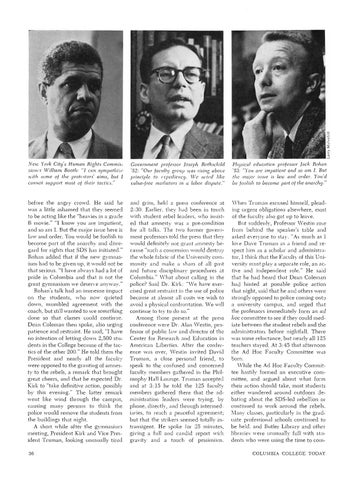
New York CUy's Human Rights Commissioner 'William Booth: "[ can sympathize with some of the protestors' aims, but 1 cannot support most of their tactic5."
Government professor Joseph Rothschild '52: "Our faculty group was Tising above principle to expediency. We acted like value-fl'ee mediators ill a labor dispute."
Physical education prOfessor Jack Rohan '53: "You are impatient and so am I. But the maior issue is law and order. You'd be foolish to become pwt of the anal'chy."
before the angry crowd. He said he was a little ashamed that they seemed to be acting like the "heavies in a grade B movie." "I know you are impatient, and so am 1. But the major issue here is law and order. You would be foolish to become part of the anarchy and disregard for rights that SDS has initiated." Rohan added that if the new gymnasium had to be given up, it would not be that serious. "I have always had a lot of pride in Columbia and that is not the great gymnasium we deserve anyway." Rohan's talk had an immense impact on the students, who now quieted down, mumbled agreement with the coach, but still wanted to see something done so that classes could continue. Dean Coleman then spoke, also urging patience and restraint. He said, "I have no intention of letting down 2,500 students in the College because of the tactics of the other 200." He told them the President and nearly all the faculty were opposed to the granting of amnesty to the rebels, a remark that brought great cheers, and that he expected Dr. Kirk to "take definitive action, possibly by this evening." The latter remark went like wind through the campus, causing many persons to think the police would remove the students from the buildings that night. A short while after the gymnasium meeting, President Kirk and Vice President Truman, looking unusually tired
and grim, held a press conference at 2:30. Earlier, they had been in touch with student rebel leaders, who insisted that amnesty was a pre-condition for all talks. The two former government professors told the press that they would definitely not grant amnesty because "such a concession would destroy the whole fabric of the University community and make a sham of all past and future disciplinary procedures ut Columbia." What about calling in the police? Said Dr. Kirk: "We have exercised grea t restrain t in the use of police because at almost all costs we wish to avoid a physical confrontation. We wi!! continue to try to do so." Among those present at the press conference were Dr. Alan \Vestin, professor of public law and director of the Center for Research and Education in American Liberties. After the conference was over, \iVestin invited David Truman, a close personal friend, to speak to the confused and concerned faculty members gathered in the Philosophy Hall Lounge. Truman accepted and at 3: 15 he told the 125 faculty members gathered there that the administration leaders were trying, by phone, directly, and through intermediaries, to reach a peaceful agreement; but that the strikers seemed totally inh路ansigent. He spoke for 25 minutes, giving a full and candid report with gravity and a touch of pessimism.
'vVhen Truman excused himself, pleading urgent obligations elsewhere, most of the faculty also got up to leave. But suddenly, Professor \Vestin rose from behind the speaker's table and asked everyone to stay. "As much as I love Dave Truman as a friend and respect him as a scholar and administrator, I think that the Faculty of this University must playa separate role, an active and independent role." He said that he had heard that Dean Coleman had hinted at possible police action that night, said that he and others were strongly opposed to police coming onto a university campus, and urged that the professors immediately form an ad hoc committee to see if they could mediate between the student rebels and the administrators before nightfall. There was some reluctance, but nearly all 125 teachers stayed. At 3:45 that afternoon the Ad Hoc Faculty Committee was born. While the Ad Hoc Faculty Committee hastily formed an executive committee, and argued about what form their action should take, most students either wandered around outdoors debating about the SDS-led rebellion or continued to work around the rebels. Many classes, particularly in the graduate professional schools continued to be held, and Butler Library and other libraries were unusually full with students who were using the time to com-
36
COLUMBIA COLLEGE TODAY