the whole service as "morallv outra~e足 ous" since, he said, Columbia had followed a long and consistent "racist policy." About 20 of his fellow SDS members applauded loudly, then got up and followed Mark Rudd out of the chapel. The mourners were stunned and appalled. Whispers of "Shame," "Blasphemy," and "Incredible bad taste" (ould be heard. One person at the rear of the Chapel, who watched Rudd storm out-quivering, transfixed, and eyes bulging-said, "He's gone mad." Many of Columbia's students said after the service that they were outraged,
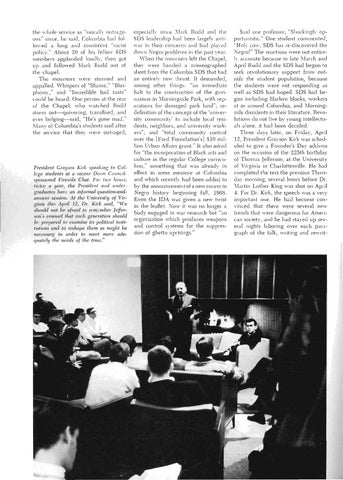
President Gmyson Kirk speaking to College sttldents at a 1"ecent Dorm Councilsponsored Fh'eside Chat. For two how's, ttvice a year, the President and 'undergraduates have an informal question-andanswer session. At the University of Virginia this Aplil 12, Dr. Kirk said, "We should not be afraid to remember Jefferson's counsel that each generation should be prepared to examine its political institutions 011d to reshape them as might be necessary in order to meet more adequately the needs of the time."
especiallv since :\Iark Rudd and the SDS leadership had been largelv antiwar in their concerns and had plaved down Negro problems in the past vear. \Vhen the mourners left the Chapel, they were handed a mimeographed sheet from the Columbia SDS that had an entirely new thrust. It demanded, among other things: "an immediate halt to the construction of the gymnasium in Morningside Park, with reparations for damaged park land"; redefinition of the concept of the \11liversity community' to include local residents, neighbors, and university workers"; and "total community control over the [Ford Foundation's] $10 million Urban Affairs grant." It also asked for "the incorporation of Black arts and culture in the regular College curriculum," something that was already in effect in some measure at Columbia and which recently had been added to by the announcement of a new course in Negro history beginning fall, 1968. Even the IDA was given a new twist in the leaflet. Now it was no longer a body engaged in war research but "an organization which produces weapons and control systems for the suppression of ghetto upriSings."
Said one professor, "Shockinglv opportunistic." One student commented, "Holy cow, SDS has re-discovered the Negro!" The reactions were not entirely accurate because in late March and April Rudd and the SDS had begun to seek revolutionary support from outside the student population, because the students were not responding as well as SDS had hoped. SDS had begun including Harlem blacks, workers at or around Columbia, and Morningside dissidents in their literature. Revolutions do not live by young intellectuals alone, it had been decided. Three days later, on Friday, April 12, President Grayson Kirk was scheduled to give a Founder's Day address on the occasion of the 225th birthday of Thomas Jefferson, at the University of Virginia in Charlottesville. He had completed the text the previous Thursday morning, several hours before Dr. ~Iartin Luther King was shot on April 4. For Dr. Kirk, the speech was a very important one. He had become convinced that there were several new trends that were dangerous for American society, and he had stayed up several nights laboring over each paragraph of the talk, writing and rewrit-