ADIFFERENTPOINTOFVIEW BY ANDREW EISENMAN
M
att Burger has answered all these questions before. He knows what I am going to ask; he knows what I am looking for. I ask if he’s up for an interview. He is. I ask if he can meet me for dinner. He can. When I peer through the door at the Gamertsfelder archway on East Green, Matt is eyelash-close to the lounge television. The door is locked. I call his cell. “You’re early,” he says, wearing a tiedyed T-shirt, his graham cracker-brown hair long and cool, in an Australian kind of way. He lets me in and hurries back to the TV to wait for the five-day forecast. (He is majoring in meteorology.) The forecast graphic glints across the TV screen. Rain and scattered t-storms. Already the rest of the week looks dreary, but Matt is still on Wednesday, so I don’t say anything. He likes to do things himself, anyway. His eyes work across the screen like a barcode scanner. He goes over the week a second time, absorbing temperatures and whatever else he might have missed. At my knees, fussing for attention, is
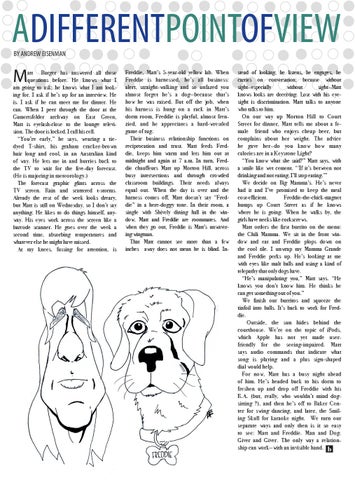
Freddie, Matt’s 5-year-old yellow lab. When Freddie is harnessed, he’s all business: alert, straight-walking and so unfazed you almost forget he’s a dog—because that’s how he was raised. But off the job, when his harness is hung on a rack in Matt’s dorm room, Freddie is playful, almost frenzied, and he appreciates a hard-wrestled game of tug. Their business relationship functions on reciprocation and trust. Matt feeds Freddie, keeps him warm and lets him out at midnight and again at 7 a.m. In turn, Freddie chauffeurs Matt up Morton Hill, across busy intersections and through crowded classroom buildings. Their needs always equal out. When the day is over and the harness comes off, Matt doesn’t say “Freddie” in a here-doggy tone. In their room, a single with Shively dining hall in the window, Matt and Freddie are roommates. And when they go out, Freddie is Matt’s unwavering wingman. That Matt cannot see more than a few inches away does not mean he is blind. In-
stead of looking, he listens, he engages, he carries on conversation; because without sight—especially without sight—Matt knows looks are deceiving. Lost with his eyesight is discrimination. Matt talks to anyone who talks to him. On our way up Morton Hill to Court Street for dinner, Matt tells me about a female friend who enjoys cheap beer, but complains about her weight. The advice he gave her—do you know how many calories are in a Keystone Light? “You know what she said?” Matt says, with a smile like wet cement. “‘If it’s between not drinking and not eating, I’ll stop eating.’” We decide on Big Mamma’s. He’s never had it and I’ve promised to keep the meal cost-efficient. Freddie-the-chick-magnet humps up Court Street as if he knows where he is going. When he walks by, the girls have necks like corkscrews. Matt orders the first burrito on the menu: the Chili Mamma. We sit in the front window and eat and Freddie plops down on the cool tile. I unwrap my Mamma Grande and Freddie perks up. He’s looking at me with eyes like malt balls and using a kind of telepathy that only dogs have. “He’s manipulating you,” Matt says. “He knows you don’t know him. He thinks he can get something out of you.” We finish our burritos and squeeze the tinfoil into balls. It’s back to work for Freddie. Outside, the sun hides behind the courthouse. We’re on the topic of iPods, which Apple has not yet made userfriendly for the seeing-impaired. Matt says audio commands that indicate what song is playing and a plus sign-shaped dial would help. For now, Matt has a busy night ahead of him. He’s headed back to his dorm to freshen up and drop off Freddie with his R.A. (but, really, who wouldn’t mind dogsitting ?), and then he’s off to Baker Center for swing dancing, and later, the Smiling Skull for karaoke night. We turn our separate ways and only then is it so easy to see: Matt and Freddie. Man and Dog. Giver and Giver. The only way a relationship can work—with an invisible hand.