GLOBAL A
I
R
C
A
R
G
O
W
E
E
K
MANAGEMENT
A
I
R
C
A
R
G
O
W
E
E
K
WORLD ACW Digital is sponsored by AIRPORTS.COM FREIGHTERS.COM
FREIGH
FRE
Tabloid page bled.indd 1
05/03/2020 10:24
The weekly newspaper for air cargo professionals No. 1,071
9 March 2020
Court says ‘no’ to LHR runway Breaking news: The IATA World Cargo Symposium in Istanbul has been postponed until further notice. More details next week.
IATA: Relax slot rules after COVID-19 chaos
T
he International Air Transport Association (IATA) is pushing that the rules on airport slots be suspended immediately and for the 2020 season, due to the impact of COVID-19. At present, rules for slot allocation mean that airlines must operate at least 80% of allocated slots under normal conditions. Failure to comply means the airline loses its right to the slot for the next equivalent season. Because of COVID-19, airlines are experiencing serious declines in demand. This included a carrier experiencing a 26% reduction across their operation and a hub carrier reporting bookings to Italy collapse to zero .
Carriers are reacting with crew being given unpaid leave and plans for aircraft to be grounded.
Flexibility needed
Given these extraordinary circumstances, the collective view of the airline industry is that the application of the 80% rule during the upcoming season is inappropriate. Regulators have waived slot rules during the crisis, primarily for operations to China and Hong Kong SAR. Without certainty that these waivers will continue for the summer season (or winter season in the Southern hemisphere), airlines are unable to plan ahead to ensure effi-
cient rostering of crew or deployment of aircraft. Suspending the requirement for the entire season (to October 2020) will mean airlines can respond to market conditions with appropriate capacity levels, avoiding any need to run empty services in order to maintain slots. Aircraft can be reallocated to other routes or parked, crew can have certainty on their schedules.
Traffic collapses
“IATA research has shown that traffic has collapsed on key Asian routes and that this is rippling throughout the air transport network globally, even between countries without major
outbreaks of COVID-19. There are precedents for previous suspension of the slot use rules and we believe the circumstances again calls for a suspension to be granted. We are calling for regulators worldwide to help the industry by suspending the slot use rules on a temporary basis,“ said Alexandre de Juniac, IATA’s director general and CEO. “The world is facing a huge challenge. Airlines are on the front line of that challenge and it’s essential that the regulatory community work with us to ensure airlines are able to operate in the most sustainable manner, both economically and environmentally, to alleviate the worst impacts of the crisis,” he said.
Page 3
INSIDE CEVA WINS 5-YEAR CONTRACT
FREIGHT forwarder CEVA has been awarded a five-year contract to manage spare parts and components for Airbus at the aircraft manufacturers ... PAGE 2
ROBIN COMES TO LAND
DRONE delivery Canada (DDC) will begin testing of its Robing XL (Robin). The Robin has a lift of 25 lbs of payload, a travel range ... PAGE 4 GAME, SET AND MATCH
FEDEX Express, a subsidiary of FedEx Corp, and the world’s largest express transportation company, announces its sponsorship ... PAGE 5
Cover to combat COVID-19 launched by TLX UK-based manufacturer TLX Cargo has launched what it claims is the world’s first cargo cover that aims to protect cargo from COVID-19. The viral barrier material will seal cargo during transport and will be both breathable and waterproof. There will be no stitching on the cover, rather it will be sealed with tape as an extra precaution.
The material has passed testing by Nelson Laboratories in Salt Lake City, USA, industry leaders for viral barrier testing. The specialist Web 15 fabric used in the new cover successfully passed the strenuous Nelson test when the bacteriophage applied at a pressure of 14 kPa (2 pounds per square inch) failed to permeate
from one side of the material to the other. ‘Our clients have been faced with the problem that although they can control their products against viral contamination within their premises, they are unable to assure their customers that the container itself is not contaminated,’ says Thomas Hunt, commercial director.
QATAR HELPS FIGHT COVID-19
FIVE Qatar Airways Cargo freighters, two Boeing 747Fs and three Boeing 777Fs departed to China on 21 February, carrying around 300 tonnes... PAGE 6
Follow Us:
aircargoweek.com
A
Hamburg Airport takes off for the digital future with FAIR@Link
HAMBURG Airport has launched new FAIR@ Link portal for digitally supported air cargo handling at Airport’s Cargo Centre. The platform was developed by DAKOSY and has been piloted for six months before being released. Alexander Müller, head of cargo at Hamburg Airport, said: “The new platform is an important step into the digital future for us. With FAIR@Link, we can significantly improve handling processes and manage the increasing volume of traffic on the ground more efficiently. At the same time, we increase sustainability and promote environmentally compatible growth for the location.” The main feature of FAIR@Link is that it enables forwarders to book time slots for deliveries. This results in shorter waiting and handling times, more transparency along the transport chain and improved documentation for handling agents, who no longer need to re-enter duplicate data, thus avoiding mistakes and saving time. A particular advantage of digitalisation is that the system can prepare export Customs declarations and then automatically submit the electronic forms to Customs upon entry to the Hamburg Airport Customs Office, which again saves time.
Efficiency Hamburg Airport, CROSS FREIGHT, Delta-Stallion, a.hartrodt and SABLE, the handling agents LUG and Swissport, the Hamburg Airport Customs Office and the Hamburg Forwarding Agents Association (VHSp) all participated in the pilot phase and saw increases in efficiency. Jens Sorgenfrei, managing director of CROSS FREIGHT Internationale Speditionsges, sums up the advantages for freight forwarders: “Transports pre-registered via FAIR@Link are handled preferentially by the handling agents at the airport. The slot bookings save us several hours every day. Processes are easier to plan. All in all, we benefit in Customs and door clearances.” Dr Jürgen Vogt, managing director of LUG, also sees it as positive from the viewpoint of handling agents: “With slot booking, our EDP
CEVA wins five-year contract with Airbus in Hamburg
FREIGHT forwarder CEVA has been awarded a five-year contract to manage spare parts and components for Airbus at the aircraft manufacturer’s site in Hamburg, Germany. This is effective from February 2020. CEVA will become responsible for consolidating spare parts and components at the site from other locations across Europe, including Germany, France, Spain and the UK. This changes aim at improving service performance for Airbus. Within the facility CEVA plans to implement over 20 improvement projects to transform and improve the site’s efficiency. The CEVA team will put particular emphasis on quality and value added services. The stock that will be managed is divided into shelving, pallets
and large-scale parts with an average of 31 kit line items. The core process are inbound and require 100% quality, put away, picking of materials and advance kitting with outbound and special consolidations projects being available to meet special airline requirements. “CEVA’s exceptional capabilities in aerospace logistics have been recognised by Airbus with the awarding of this long-term contract. “Our two companies have successfully worked together on other projects previously and the depth of CEVA’s specialist knowledge in this industry combined with its operational and delivery solutions have been key to securing this new business,” says Mathieu Friedberg, CEVA CEO.
THE Civil Air Navigation Services Organisation (CANSO) and Airports Council International (ACI) World have partnered to launch new guidance material for reducing aviation noise and emissions. CANSO and ACI, in collaboration with aviation industry partners, have worked to identify opportunities to enhance operational efficiency and capacity while maintaining the highest level of safety. New guidance material developed by CANSO’s Performance Based Navigation Workgroup and international contributors from ACI brings together extensive expertise
and experience from across the industry and explores the role of operational improvements like performance-based navigation in reducing aircraft noise and emissions Performance Based Navigation (PBN) is a concept that enhances aircraft routing and procedures using an advanced, satellite-enabled form of air navigation to enable aircraft to fly a precise vertical and lateral flight path. This offers a number of operational benefits including enhanced safety, increased efficiency and reduced cost.
Delhi
2
ACW 9 MARCH 2020
R
C
A
R
G
O
W
E
E
K
Etihad Cargo selects ECS Group in key markets
ETIHAD Cargo, the cargo and logistics arm of the Etihad Aviation Group, has selected ECS Group to deliver significant regional sales across multiple-territories. Etihad Cargo has entered into Cargo Service Provider (CSP) agreements with ECS Group’s subsidiary company Globe Air to provide customer service, reservations, post-flight support, operations support, accounting and billing support services in the US, UK, Germany, Netherlands, Singapore, Indonesia and Malaysia. Etihad Cargo will itself lead sales activities in those territories through its own commercial organisation. Abdulla Shadid, managing director cargo and logistics services at Etihad Aviation Group, said: “We are delighted to be working with ECS Group as a strategic partner to fulfil a key pillar of our all-encompassing commercial transformation. This milestone comes following an extensive 10-month evaluation process to source like-minded partners who share our vision for digital cargo transformation using data-driven market insights and deep customer knowledge.”
ATM and ACI to reduce aviation noise and emissions
Groupe ADP takes the first step to acquire 49% stake in GMR Airports
system receives all information before the arrival of the goods. The data does not have to be entered again when the document is received. This enables us to save a lot of time and speed up the receiving process. With FAIR@Link, we gain more transparency into all processes and can better manage our capacities with regard to door and personnel availability.”
I
Groupe ADP has signed an agreement with GMR Airports, the Indian airport operator, for the acquisition of the majority share. Groupe ADP now holds 24.99% of GMR Airports and joins the Board of directors with highly extended governance rights. The acquistion is to be performed in two phases: The first phase
is24.99% stake, and a second phase, subject to certain regulatory conditions, for 24.01%, which should occur in the upcoming months. Once the second phase is complete, GMR Airports will be jointly owned with GMR Infrastructure Limited, the listed entity of GMR Group, which will keep a 51% stake and retain control over the company.
aircargoweek.com
LUTZ Honerla (left) will become the new managing director of Flughafen Düsseldorf Cargo GmbH (FDCG) on 1 May 2020. Until the end of July, he will manage the business together with Gerton Hulsman, right, who will retire at the end of August.
A
I
R
C
A
R
G
O
W
E
E
K
London Heathrow third runway decision
Heathrow’s third runway expansion plans blocked by UK appeal court
T
he UK’s court of appeal ruled on February 27 in favour of London mayor Sadiq Khan, Hillingdon Council and various environmental groups, including Greenpeace, as they ruled the third runway expansion of Heathrow illegal. The expansion was ruled illegal as ministers had not assessed how this expansion will be consistent with the Paris Agreement targets, that aim to limit global temperature rise well below 2c, as well as other factors such as traffic and noise and air pollution. This is the first time the Paris Agreement has ever been cited in a court case, showing it has a binding effect. The decision may come as good news to the climate conscious but it will mean air freight growth will be hindered. In the wake of the ruling, prime minister Boris Johnson, who was famously against the expansion while London mayor, could decide to put the expansion plans to rest or appeal the decision to the UK supreme court.
GMB response
The government must now come up with a proper aviation strategy for the UK, says GMB, the union for airport workers. In response to the ruling on the Heathrow expansion, Nadine Houghton, GMB national officer, said: “GMB is disappointed by today’s court ruling. Heathrow expansion is a complicated issue, but we have consistently backed it because the benefits more than outweigh any risks. Expansion would protect the existing 80,000 jobs, create a further 114,000 – as well
THE UK government has chosen not to appeal the court ruling that the expansion of Heathrow will be unlawful. However, Heathrow will challenge the decision. as 10,000 apprenticeships. “Like everyone else, GMB members are very worried about climate change, but we would have held Heathrow Airport Ltd’s feet to the fire on their target for zero carbon by the mid-2030s. “The government must now come up with a proper aviation strategy for the UK – and unions must be front and centre in those discussions,” she said.
Heathrow response
Heathrow Airport released a statement in response to the court ruling against the expansion of the airport and the third runway. The airport is optimistic that their plans will be successful and will contribute to a ‘Global Britain’ in
a more sustainable way. “The Court of Appeal dismissed all appeals against the government – including on “noise” and “air quality” – apart from one which is eminently fixable. We will appeal to the Supreme Court on this one issue and are confident that we will be successful. In the meantime, we are ready to work with the Government to fix the issue that the court has raised. Heathrow has taken a lead in getting the UK aviation sector to commit to a plan to get to Net Zero emissions by 2050, in line with the Paris Accord. Expanding Heathrow, Britain’s biggest airport and only hub, is essential to achieving the Prime Minister’s vision of Global Britain. We will get it done the right way, without jeopardising the planet’s future. Let’s get Heathrow done.”
FTA response
In response to the decision by the Court of Appeal regarding Heathrow Airport, Alex Veitch, head of multimodal Policy at FTA, comments: “This decision is a blow to the economy. However, planning consent for a third runway at Heathrow Airport has always been contingent upon meeting climate obligations, and with the rapid improvements in aviation fuel and engine technology we are confident that Heathrow will be able to demonstrate that this challenge can be met. “Now more than ever, the UK needs worldclass global gateways. Heathrow accounts for 40% of the UK’s non-EU trade by value but has been operating at peak capacity for freight for many years; expansion is long overdue.”
Freight forwarders urge government to work with Heathrow SPEAKING after the ruling by the Court of Appeal in London in favour of campaigners challenging the legality of the UK government’s decision to allow a third runway at Heathrow Airport, Robert Keen, director general of the British International Freight Association (BIFA) said: “The Lord Justices
have made it perfectly clear that their judgment didn’t mean that there could never be a third runway at Heathrow, but that the government now has the opportunity to reconsider, in accordance with the clear statutory requirements that parliament has imposed. “On behalf of BIFA mem-
ber companies, which are keen for the greater number of flights and accompanying airfreight capacity that would result from a new runway, the British International Freight Association urges the government to revise the Airports National Policy Statement (ANPS) and work with Heathrow to
solve the legal issues. “In 2018, when the government gave approval for the third runway, I said it would be nice to think that decision is a further nail in the coffin of procrastination over the expansion of UK aviation capacity, and another important step towards bringing fifty years of
aircargoweek.com
indecision and delay on expanding Heathrow to a welcome close. “At the time, I also expressed my foreboding that the likelihood of further legal challenges to an extra runway still left me questioning whether the spades will ever actually hit the ground,” said Keen.
A planning expert’s perspective on court verdict ACCORDING to Heidi Copland, a partner and head of planning at City law firm DMH Stallard, in a “victory for climate campaigners,” the Court of Appeal determined that the Secretary of State acted unlawfully in failing to take into account the 2015 Paris Agreement on Climate Change when deciding to designate the Airports National Policy Statement (“ANPS”) in support of the expansion of Heathrow Airport. “The new runway, which would bring roughly 700 extra planes to the airport everyday would see a large increase in carbon emissions. Initial cost indications for the project of £14bn are now claimed at more than double that. “In its judgement the Court was careful to state that it was not making a decision that a third runway would always be incompatible with the UK’s commitment to reducing carbon emissions and mitigating climate change under the Paris Agreement, but as things currently stood, the ANPS was of no legal effect. “This is the first decision of its kind to hold that the temperature goal set out in the Paris Agreement has binding effect on those who signed up to it. In 2015 then Secretary of State for Transport Chris Grayling stated that 2015 Paris agreement, which set a target of keeping global temperature rise below 2C, was “not relevant” to climate policy..”
Blocked expansion of Heathrow Airport is unlikely to be the last FOLLOWING the news that Heathrow’s third runaway expansion has been ruled illegal, Johanna Bonhill-Smith, travel and tourism analyst at GlobalData, a leading data and analytics company, offers her view on the future situation for UK airports: “Many airlines were banking on the third runway expansion at Heathrow airport to reach more markets and increase capacity at the UK’s busiest airport, but have now been dealt a major blow as the expansion has been blocked. “[The] announcement highlights the intensity of the climate change movement, and this battle between the airspace industry and environmental enforcements will no doubt be ongoing and the undoing of many growth or expansion strategies for years to come. “Numerous airports throughout the UK are currently in the process of planning ways to expand in order to increase capacity in both the domestic and international aviation space. However, with the term ‘climate catastrophe’ more widely broadcast than ever, the rise of ‘Flygskam’ and environmental campaigners gaining more traction throughout Europe, the aviation industry is under more intense scrutiny than ever to consider wider environmental impacts. “Heathrow is not the first expansion project to be rejected in 2020 as found with Bristol Airport and is unlikely to be the last.”
ACW 9 MARCH 2020
3
A
I
R
C
A
R
G
O
W
E
E
K
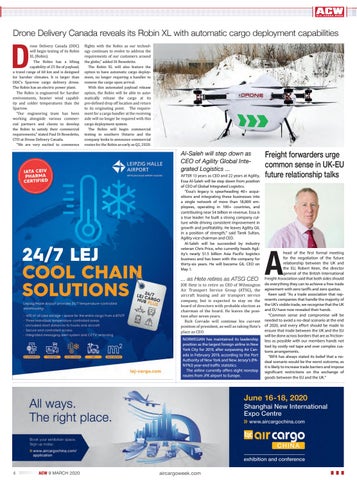
Drone Delivery Canada reveals its Robin XL with automatic cargo deployment capabilities
D
rone Delivery Canada (DDC) will begin testing of its Robin XL (Robin). The Robin has a lifting capability of 25 lbs of payload, a travel range of 60 km and is designed for harsher climates. It is larger than DDC’s Sparrow cargo delivery drone. The Robin has an electric power plant. The Robin is engineered for harsher environments, heavier wind capability and colder temperatures than the Sparrow. “Our engineering team has been working alongside various commercial partners and clients to develop the Robin to satisfy their commercial requirements,” stated Paul Di Benedetto, CTO at Drone Delivery Canada. “We are very excited to commence
flights with the Robin as our technology continues to evolve to address the requirements of our customers around the globe,” added Di Benedetto. The Robin XL will also feature the option to have automatic cargo deployment, no longer requiring a handler to remove the cargo upon arrival. With this automated payload release option, the Robin will be able to automatically release the cargo at its pre-defined drop off location and return to its originating point. The requirement for a cargo handler at the receiving side will no longer be required with this cargo deployment system. The Robin will begin commercial testing in southern Ontario and the company looks to announce commercial routes for the Robin as early as Q2, 2020.
Al-Saleh will step down as CEO of Agility Global Integrated Logistics ...
AFTER 13 years as CEO and 22 years at Agility, Essa Al-Saleh will be step down from position of CEO of Global Integrated Logistics. “Essa’s legacy is spearheading 40+ acquisitions and integrating these businesses into a single network of more than 18,000 employees, operating in 100+ countries, and contributing near $4 billion in revenue. Essa is a true leader: he built a strong company culture while driving consistent improvement in growth and profitability. He leaves Agility GIL in a position of strength,” said Tarek Sultan, Agility vice-chairman and CEO. Al-Saleh will be succeeded by industry veteran Chris Price, who currently heads Agility’s nearly $1.5 billion Asia Pacific logistics business and has been with the company for thirty-six years. He will become GIL CEO on May 1.
... as Hete retires as ATSG CEO
JOE Hete is to retire as CEO of Wilmington Air Transport Service Group (ATSG), the aircraft leasing and air transport service company, but is expected to stay on the board of directors with probable election as chairman of the board. He leaves the position after seven years. Rich Corrado will continue his current position of president, as well as taking Hete’s place as CEO. NORWEGIAN has maintained its leadership position as the largest foreign airline in New York City for 2019, after surpassing Air Canada in February 2019, according to the Port Authority of New York and New Jersey’s (PANYNJ) year-end traffic statistics. The airline currently offers eight nonstop routes from JFK airport to Europe.
4
ACW 9 MARCH 2020
aircargoweek.com
Freight forwarders urge common sense in UK-EU future relationship talks
A
head of the first formal meeting for the negotiation of the future relationship between the UK and the EU, Robert Keen, the director general of the British International Freight Association said that both sides should do everything they can to achieve a free-trade agreement with zero tariffs and zero quotas. Keen said: “As a trade association that represents companies that handle the majority of the UK’s visible trade, we recognise that the UK and EU have now revealed their hands. “Common sense and compromise will be needed to avoid a no-deal scenario at the end of 2020, and every effort should be made to ensure that trade between the UK and the EU will be done across borders that are as frictionless as possible with our members hands not tied by costly red tape and over complex customs arrangements. “BIFA has always stated its belief that a nodeal scenario would be the worst outcome, as it is likely to increase trade barriers and impose significant restrictions on the exchange of goods between the EU and the UK.”
Hearing the airforwarders’ voice A
I
R
C
A
R
G
O
W
E
E
K
Airforwarders Association testifies at US senate committee hearing
O
n 24 February, the executive director of the Airforwarders Association, Brandon Fried, testified before the United States Senate Committee on Commerce, Science and Transportation Subcommittee on Security, at a Field Hearing in Boston, Massachusetts entitled ‘Promoting Safe Skies through Scanning and Screening: Oversight of Air Cargo Security.’ Other industry experts were also called as THE special hearing, entitled, "Promoting Safe Skies through Scanning and Screening: Oversight of Air Cargo Security," was convened by Senator Edward J Markey to discuss air cargo security topics at Boston Logan International Airport. Industry experts were called as witnesses to examine specific topics such as oversight of certified cargo screening facilities, screening technology, and the efficiency of the global supply chain. The full list of witnesses included: • John Beckius, executive director, air cargo division, Transportation Security Administration • Edward Freni, director of aviation, Massachusetts Port Authority • Brandon Fried, executive director, Airforwarders Association • Jennifer Ritter, flight attendant, United Airlines, on behalf of Association of Flight Attendants-CWA, AFL-CIO • Steve Urchuk, chief technology officer, Analogic
witnesses to examine issues such as oversight of certified cargo screening facilities, screening technology, and the efficiency of the global supply chain. Considering the considerable amount of airfreight that passes through the Unites States, Fried is sure that the air cargo environment is safer than ever. “Thanks to a very robust multi-layered approach to security which we have championed from day one, any security risk from differing interpretations has been all but eliminated,” Fried says. The security of the industry will always have threats in terms of programme interpretation and specific implementation details, it is how to minimise these threats that Fried has emphasised. He believes it’s doubtful that peak security will ever be reached. “We don’t live in a static world and threats are always evolving, so we need to be ever vigilant and one step ahead of those who are intent on doing harm to aviation.”
Screening technology Cargo airlines and forwarders and other service providers have invested huge amounts into securing air cargo. “These costs range from additional personnel, training, support systems, secure facilities, screening technology and so on,” explains Fried. But there are advancements, particularly screening facilities and technologies that will minimize these costs and increase security. “More needs to
IAG Cargo’s 2019 FY results after ‘challenging’ year
IAG Cargo has announced its 2019 full year results, reporting commercial revenues of €1,117m over the period from January 1 to December 31, 2019, a decrease of 7.2% on 2018 at constant currency. Overall yield for the year was down 4.9% at constant currency. Sold tonnes were down 2.8% and CTK volumes were down 2.4% whilst capacity grew by 1.0%. Lynne Embleton, CEO at IAG Cargo, commented: “As IATA has noted, it has been a tough year for the air cargo industry. The decline in our reported revenues for 2019 reflects these challenging macroeconomic and market conditions, whilst the strength of our network and products has shielded us from the worst of the drop in demand. “Amidst the overall downturn, there are some notable positives. In particular, we have seen strong export growth out of Africa over the course of the year and, more recently, a boost to perishable volumes from Latin America. Our state-of-the-art Constant Climate product, for the transportation of temperature-sensitive pharmaceutical products, has also remained resilient with strong demand, again, from Latin America in particular. “At the start of 2019, we announced the opening of a pharmaceutical centre at our Madrid hub, dedicated to our Constant Climate product. Since opening this Good Distribution Practice (GDP) certified facility, Constant Climate revenue out of Spain has grown by over 20%, giving strong return on our multi-mil-
lion-euro investment and demonstrating the continued importance of the product. “Our quest to use innovation to improve how air cargo works has continued apace. In December, we saw the successful trial of autonomous drone technology within our Madrid warehouse. We are now confident that the technology will help to improve the efficiency and reliability of our operations. As part of this year’s Hangar 51, our group wide innovation programme, we have been working alongside a start-up that uses machine-learning technology to optimise data extraction processes.,” she said. “These exciting developments are part of IAG Cargo’s continuous programme of investment to ensure we are delivering the best possible service for our customers. As we head in to 2020, we are confident that our strategy of focusing on customer service, technology and the strength of our products will continue to deliver for customers worldwide.”
be invested in screening technology in a few major categories,” Friedman explains. “Technology must get better at adapting to the heavyweight cargo world, and must be able to screen the broad spectrum of goods moving in the air.” The Third Party Canine programme is a scheme that Brandon thinks will be effective. “Canines have proven to be amazingly adaptable to performing efficient screening in the cargo environment. Explosive detection trained dog teams can be used for a broad spectrum of possible threats. “The canines can go to the freight, rather than bringing the freight to the screening technology. So far, we have found their presence to be very efficient, reliable, and extremely adaptable.” For these improvements to be successful it is imperative that employees of the air freight supply chain are adequately trained but it is the industry that will need to make the resource investment. “The TSA should then provide assistance in screener training, screener selection guidance, a comprehensive profile of training aids and a current threat resource library, readily available to private screeners,” says Fried.
Differing interpretations These advancements would solve security issues by reducing differing interpretations of the incredibly complex regulatory requirements. “We hope the TSA will continue to work
in reducing decision stovepipes within the agency, and inconsistent rule interpretations among its own workers to eliminate confusion within the private screener community.” Like many issues within the airfreight industry this comes down to improving means of communication. “We would urge TSA to establish a centralised point of contact, a sort of Ombudsman, to whom legitimate differences of opinion can be referred for adjudication,” suggests Fried.
DPDHL Group meets 2019 earnings target DEUTSCHE Post DHL Group has announced that its 2020 earnings guidance is, as of now,, excluding any effect induced by the coronavirus. Since the Chinese government introduced measures to contain it, DPDHL Group has been consistently monitoring the volume development in its networks. In recent weeks, trade volumes have weakened, not only on the inbound and outbound China trade lanes but also in other countries of Asia; constraints on industrial production are increasingly expected also outside of China. The Group had seen a very good start into 2020 in January and was prepared for the usual effects around Chinese New Year in February when the measures of the Chinese
Game, set and match at ATP for FedEex Express FEDEX Express, a subsidiary of FedEx Corp. has renewwed its sponsorship of the ATP World Tour. While continuing to benefit from global promotional rights, together with an on-site presence at tournaments throughout the season, FedEx also becomes the new title
aircargoweek.com
government were introduced. Since then the business development in Post & Parcel Germany as well as in DHL Supply Chain and DHL eCommerce Solutions has only been marginally impacted by the Corona crisis. In contrast, the Group currently sees more significant effects for the DHL Express and DHL Global Forwarding divisions, where the business is particularly affected with regards to cross-border trade flows into and out of China. Deutsche Post DHL Group continued to post profitable growth during the past financial year. Group revenue was up 2.9% year on year to EUR 63.3 billion, with all five divisions contributing to this positive performance.
sponsor of the ATP Rankings to echo the premium nature of this sponsorship, which now includes 13 tournaments across the world. “The ATP World Tour perfectly reflects what FedEx stands for: a global footprint, speed, excitement and precision,” says Wouter Roels, SVP marketing international, FedEx Express. Massimo Calvelli, ATP CEO, said: “The outlook for men’s professional tennis is looking very bright and we are delighted to announce the extension of the Tour’s partnership with FedEx as a part of that. “In addition to various tournament partnerships, the ATP Rankings will provide FedEx with an unparalleled association with an asset that links the whole Tour, and we look forward to a continued partnership over the next four years.”
ACW 9 MARCH 2020
5
MIDDLE EAST
A
I
R
C
A
R
G
O
W
E
E
K
Qatar contributes to COVID-19 relief efforts
F
IVE Qatar Airways Cargo freighters, two Boeing 747Fs and three Boeing 777Fs departed to China on 21 February, carrying around 300 tonnes of medical supplies donated by the airline to support COVID-19 relief efforts. The flights which headed to Beijing, Shanghai and Guangzhou, formed part of the airline’s voluntary offer of free air cargo transportation for medical relief to combat the virus emergency. Qatar Airways Group chief executive, HE Akbar Al Baker, said: “When this crisis began, we knew we had to contribute to support our friends in China. “As one of the leading air cargo carriers in the world, we are in a unique position where were able to provide immediate humanitarian support through the provision of aircraft and donating medical supplies as well as coordinating logistical arrangements.” Amongst other supplies, Qatar have donated
2,500,000 face masks and 500,000 bottles of hand sanitiser. This donation follows one from 2 February which saw 100,000 medical-grade N95 respiratory masks and 2,700 medi-
cal-grade disposable latex gloves transported to Hubei province China, the epicentre of the virus. Meanwhile, Qatar Airways announced at the Kuwait Aviation Show in January that they will be flying to eight new destinations. Flights will start at staggered dates throughout 2020.
As well as announcing new destination plans Qatar also showcased two of their newest aircrafts, the ultra-modern Airbus A350-1000 as well as the state-of-the-art Gulfstream G500, business jet. Al Baker said: ‘The Kuwait Aviation Show is the perfect platform for us to kick start the New Year and unveil some of our exciting plans for 2020.’ The new routes include two flights a week to Nur Sultan and Almaty, starting 30 March and 1 April respectively. Three weekly flights to Cebu, Philippines starting 8 April and daily flights to Accra, Ghana starting 15 April. Qatar Airways has also added three weekly flights to Trabzon Turkey, starting 20 May and Lyon, France five times a week, starting 23 June. Towards the end of the year four weekly flights to Luando, Angola will be added and Siem Reap, Cambodia five times a week, starting 14 October and 16 November respectively. With these new networks the Qatar Airways destinations list will now expand to 117 worldwide.
SKYCARGO, the freight division of Emirates, is geared up for 2020 with innovative product development and new infrastructure following a challenging 2019. “The global air cargo industry witnessed what was a very challenging year in 2019. Economic uncertainty, tensions in global trade and unrest in key markets negatively impacted cargo volumes. “However, the tough market conditions were an opportunity for us to review our core offering to our customers and ensure that we remained market leaders with our specialised product offering, superior capabilities and infrastructure as well as our agility in responding to customer demand,” said Nabil Sultan, Emirates divisional senior vice president (pictured). In 2019, Emirates SkyCargo continued to roll out specialised products catered for specific industry verticals. More than 400,000 tonnes of perishables were flown by Emirates Fresh, the airlines specialised product for perishables. In November and December, the carrier operated nine charter flights form Santiago, Chile for uniquely transporting cherries. Emirates AOG product, specialised in high-priority shipments saw 11,000 shipments moved across six continents. Emirates Pets also saw an increase in demand of 12%, for transporting cats and dogs. The year also saw progress for SkyCargo in regard to pharmaceutical as they moved their pharma handling operations to Copenhagen airport to a dedicated GDP certified facility. A new
handling facility dedicated to pharma at Chicago airport was also unveiled, which will be one of the most important pharma stations for Emirates across the world. However, unfortunately 2020 has got off to a turbulent start for many airlines. The COVID-19 outbreak has negatively affected the movement of key cargo trade routes, as flights to China have been limited. ‘The outlook for 2020 is more positive with the air cargo industry set to post a modest recovery thanks to improved economic activity and trade growth,’ says Sultan.
Etihad Cargo joins WebCargo to expand digital air cargo reach Emirates looks to opportunities in tough market in 2020
FROM February 10, Etihad Cargo and Webcargo by Freightos became a new partnership which will improve the booking process of Etihad cargo, joining the cargo airline to the world’s largest air cargo rates and ebooking platform. The partnership will extend Etihad Cargo’s digital reach to more than 1700 logistics providers and forwarder customers globally as it can be used as well as their own ebookings portal, which was created in 2018 and now receives around 50% of all their cargo bookings. The WebCargo booking system will provide instant Etihad Cargo booking schedules, promotional rates, and ebooking, enabling sales and operations teams and forwarders to compare and book air freight in seconds. An industry first, Webcargo was born out of a need to modernise the freight booking process, says the company, as the sector was being left behind others in the aviation industry when it came to digitalisation.
Webcargo have noted that ‘buying a plane ticket online is easy. With a few clicks, you have our ticket in your inbox. But when it comes to booking freight shipments on the very same airplane, the experience is nowhere near as easy. It takes days of phone calls and back and forth before you can book cargo shipment.’ Now, over 1400 freight forwarders and 300 carriers across more than 90 countries use WebCargo by Freightos. Following the announcement, Etihad Cargo’s flight schedules and market rates in mainland Europe and the UK will roll out on the Webcargo platform, allowing all platform members to compare airline offers. Instant ebooking functionality will follow in April upon the successful completion of API testing and systems integration. Spain, France and the UK will be the first countries to enable ebooking, with a gradual rollout to more markets to ultimately cover the whole of Europe by the end of 2020.
Oman Ministry of Transport announces National Aviation Strategy 2030
DESIGNED with Oman Aviation Group, the strategy empowers the aviation sector to take a lead in the Sultanate’s economic growth in the next decade. Oman Aviation Group has immediately begun two projects from the Strategy: Muscat Airport City and the National Travel Operator. Muscat Airport City will be a development district and free zone around the capital’s airport while the National Travel Operator is a comprehensive
6
ACW 9 MARCH 2020
online platform to sell Omani travel services to the international tourism industry. Recently marking its second anniversary, Oman Aviation Group has succeeded in reducing losses in the sector from 211m OMR to 93m OMR.
Job creation The Strategy aims to boost job creation, increase the local skill base, and
co-ordinate different organisations in the aviation sector. In relation to airfreight. It has a number of key aims. Oman Aviation Group is adopting a master plan to launch Muscat Airport City. This development district will have five main areas: Muscat Airport Free Zone, devoted to light industries like e-commerce; a logistics gate for airfreight; a mixed-use business gate, including office units; an aviation gate for aviation, cultural and social
aircargoweek.com
activities, innovation centres and a specialised emergency hospital serving the sector; and a hospitality gate. A comprehensive airfreight strategy will help Oman maintain its air cargo market share and support key national industries, like fisheries, in global markets. A new services centre will help international companies looking to increase freight traffic through the Sultanate’s airports.
HE Dr Ahmed bin Mohammed Al Futaisi, Minister of Transport, said: “The Strategy will enable the aviation sector in the Sultanate to compete on a global level with an integrated organisation that aims to secure a bigger share in the international aviation market.” He added that “the aviation, logistics and travel sectors play an important role in achieving Oman’s Vision 2040 main goals.”
TRADE&EVENTSFINDER Freight Forwarders
azfreight.com : Premium Listings
Hong Kong
Freight Forwarders USA
Industry Event
World Air Cargo Awards 2020
Industry Event
aircargoweek.com 11_09 March 2020.indd 1
ACW 9 March 2020
7 04/03/2020 14:39
CROYDON Airport Visitor Centre micro-museum, located in Airport House, Purley Way, Croydon CR0 0XZ, tells the story of Britain's first major international airport through WWI, Imperial Airways and BOAC, record-breaking flights by the likes of Amy Johnson, the Battle of Britain and much, much more. More info: www.historiccroydonairport.org.uk
SARF LONDON, MATE, INNIT, GEEZER
Croydon calling!
The London suburb of Croydon has two unlikely claims to fame – as the site of the world’s first airport control tower and the origin of the aviation distress call “Mayday”
L
ast month, an unlikely milestone was passed: the centenary of the world’s first Air Traffic Control (ATC) tower. The fact that it occurred in the south London suburb of Croydon at an airport that saw its last scheduled flight depart at 18:15 on 30 September 1959, is even more remarkable. A Morton Air Services de Havilland Heron (G-AOXL) brought down the curtain that day.
A first
On the 25 February 1920, the UK’s Air Ministry detailed the specification and construction of the world’s first technical building to control air traffic. It was known as the “Aerodrome Control Tower” and was to be installed at Croydon Aerodrome. This was the first time that the “Control Tower” terminology had been coined. The civil servants specified that “platform of the tower to be 15 feet above ground level”; it was to “have large windows placed in all four walls”, have a “wind-vane to be fitted to the roof of the hut with a geared-down indicator placed inside […] enabling the control officer to read changes of wind”. Thus the world’s first ATC tower was born.
Sound waves
Speech radio was the new cutting edge technology of the 1920s at the same time the tower was being constructed. This represented a move
from Morse code carried by radio-telegraphy to speech carried by radio-telephony. As the early radio equipment was crackly and intermittent, efforts were made to ensure speech was intelligible between the tower and pilot. One aspect of this was how pilots were to contact the tower in the event of an emergency. The year after the tower came into operation, Croydon’s senior radio officer Frederick Stanley Mockford, was asked to think of a word that would indicate distress and could easily be understood by all pilots and ground staff in an emergency. It would also have to be unlike any aviation term then in use to avoid confusion. As much of the traffic at the time was between Croydon and Le Bourget Airport in Paris, he proposed the expression “mayday” from the French m’aider (‘help me’), a shortened form of venez m’aider (‘come and help me’). It is unrelated to the holiday May Day. Six years later, in 1927, the International Radiotelegraph Convention of Washington adopted the voice call ‘mayday’ as the radiotelephone distress call in place of the SOS radiotelegraph (Morse code) call.
The tower
The control tower at Croydon, which survives to this day, is an outstanding, bold and distinctive design. Instantly recognisable for its square shape, it is striking in its restrained classical design that ingeniously houses many technical and operational functions that are not obvious
to the onlooker. It was constructed over four floors with three floors dedicated to supporting many ATC functions. The 1928 building was a step change, improvement on the timber structure it replaced on the
site and was designed around the operational experience gained by the first Air Traffic Controllers. The progress of the dozen or so daily flights was tracked using basic radio-based navigation and plotted on paper maps and using pins and flags.
aircargoweek.com