. U.S
SE
IT R U C
Y SPIE Names Mark Neifeld 2014 Fellow Mark Neifeld, who has joint appointments in electrical and computer engineering and optical sciences, has been named a 2014 SPIE fellow. SPIE is the International Society for Optics and Photonics.
ge
ga g a B ft ra c ir A in s b m o B g Detectin
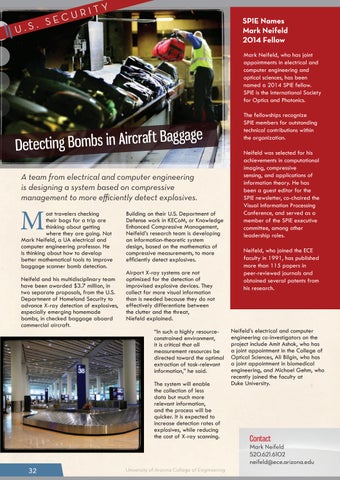
A team from electrical and computer engineering is designing a system based on compressive management to more efficiently detect explosives.
M
ost travelers checking their bags for a trip are thinking about getting where they are going. Not Mark Neifeld, a UA electrical and computer engineering professor. He is thinking about how to develop better mathematical tools to improve baggage scanner bomb detection. Neifeld and his multidisciplinary team have been awarded $3.7 million, in two separate proposals, from the U.S. Department of Homeland Security to advance X-ray detection of explosives, especially emerging homemade bombs, in checked baggage aboard commercial aircraft.
Building on their U.S. Department of Defense work in KECoM, or Knowledge Enhanced Compressive Management, Neifeld’s research team is developing an information-theoretic system design, based on the mathematics of compressive measurements, to more efficiently detect explosives. Airport X-ray systems are not optimized for the detection of improvised explosive devices. They collect far more visual information than is needed because they do not effectively differentiate between the clutter and the threat, Niefeld explained. “In such a highly resourceconstrained environment, it is critical that all measurement resources be directed toward the optimal extraction of task-relevant information,” he said. The system will enable the collection of less data but much more relevant information, and the process will be quicker. It is expected to increase detection rates of explosives, while reducing the cost of X-ray scanning.
32
The fellowships recognize SPIE members for outstanding technical contributions within the organization. Neifeld was selected for his achievements in computational imaging, compressive sensing, and applications of information theory. He has been a guest editor for the SPIE newsletter, co-chaired the Visual Information Processing Conference, and served as a member of the SPIE executive committee, among other leadership roles. Neifeld, who joined the ECE faculty in 1991, has published more than 115 papers in peer-reviewed journals and obtained several patents from his research.
Neifeld’s electrical and computer engineering co-investigators on the project include Amit Ashok, who has a joint appointment in the College of Optical Sciences, Ali Bilgin, who has a joint appointment in biomedical engineering, and Michael Gehm, who recently joined the faculty at Duke University.
Contact
Mark Neifeld 520.621.6102 neifeld@ece.arizona.edu University of Arizona College of Engineering