U
UA RESEARCHERS, partnering with local consulting firm Apex Applied Technology, delivered a mobile watertreatment system to a school in a water-scarce Navajo community on Sept. 7, 2017. The solarpowered system is built into a refurbished school bus, which also houses an educational laboratory. “It’s a way to extend infrastructure to these communities,” said Bob Arnold, professor of chemical and environmental engineering. The Navajo Nation desert in northeastern Arizona gets only 7 to 11 inches of rain annually. But there’s plenty of groundwater. It’s just high in salinity and contaminated with metals, including, in some areas, uranium.
STAR School students and other members of the Navajo Nation will learn how to operate the lowmaintenance system. “We want students to be motivated to learn more and hopefully go into hard sciences, and help their people that way,” said the school’s cofounder Mark Sorensen.
micron ratings – 10, 5 and 1. The lower the micron rating, the smaller the particles a filter can remove. A grain of ordinary table salt is about 100 microns. Next the water is forced through a series of semipermeable membranes. “With the pressure that we apply, we basically
“It’s a way to extend infrastructure to these communities.” BOB ARNOLD, chemical & environmental engineering professor
This makes the third water purification system to come out of the UA-Apex Applied Tech partnership. It is the first, however, to be built into a school bus.
“It can provide water for many decades if we treat it,” said Vicky Karanikola, chemical and environmental engineering research professor.
“Our mission is to take the research and apply it to technology to solve real-world problems,” said AATech vice president Jing Luo, who earned a PhD in environmental engineering at the UA in 2003.
Out of the Lab and Into the World
Technology Under the Hood
The multicultural team, including a number of graduate students, developed the waterpurification system for the pre-K-8 STAR School, which operates off the grid near Flagstaff, Arizona.
The system is straightforward. Water is drawn up from wells into a feed tank on the bus. Then it passes through three filters with progressively lower
squeeze clean water through the membrane,” said Karanikola. About 20 percent of the water is filtered into drinkable water. The rest is returned to the source.
Maintaining low recovery levels extends the life of the operation.
Birth of an Idea The bus notion came to Sorensen a few years ago as the Standing Rock Sioux began pushing back against Dakota Access Pipeline developers to protect the tribe’s drinking water and ancestral lands. With nearly 40 percent of families on the Navajo Reservation living without running water, and much of the available water either unsafe or unpalatable, he shifted his thinking homeward. “If you get together a great group of people who are motivated and can think creatively, you can solve some pretty serious problems at the local level,” Sorensen said.
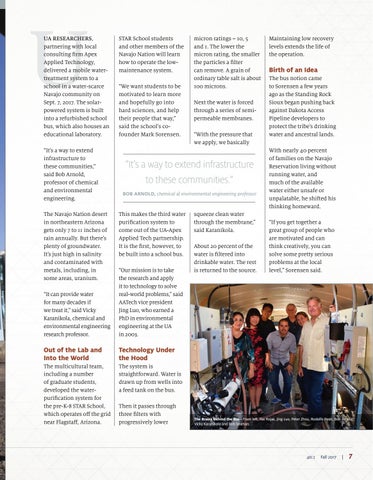
The Brains Behind the Bus—From left, Ilse Rojas, Jing Luo, Peter Zhou, Rodolfo Peon, Bob Arnold, Vicky Karanikola and Bob Seaman.
40:2
Fall 2017
|
7