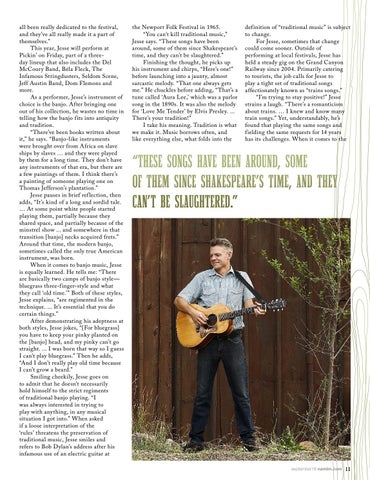
all been really dedicated to the festival, and they’ve all really made it a part of themselves.” This year, Jesse will perform at Pickin’ on Friday, part of a threeday lineup that also includes the Del McCoury Band, Béla Fleck, The Infamous Stringdusters, Seldom Scene, Jeff Austin Band, Dom Flemons and more. As a performer, Jesse’s instrument of choice is the banjo. After bringing one out of his collection, he wastes no time in telling how the banjo fits into antiquity and tradition. “There’ve been books written about it,” he says. “Banjo-like instruments were brought over from Africa on slave ships by slaves … and they were played by them for a long time. They don’t have any instruments of that era, but there are a few paintings of them. I think there’s a painting of someone playing one on Thomas Jefferson’s plantation.” Jesse pauses in brief ref lection, then adds, “It’s kind of a long and sordid tale. … At some point white people started playing them, partially because they shared space, and partially because of the minstrel show ... and somewhere in that transition [banjo] necks acquired frets.” Around that time, the modern banjo, sometimes called the only true American instrument, was born. When it comes to banjo music, Jesse is equally learned. He tells me: “There are basically two camps of banjo style— bluegrass three-finger-style and what they call ‘old time.’” Both of these styles, Jesse explains, “are regimented in the technique. ... It’s essential that you do certain things.” After demonstrating his adeptness at both styles, Jesse jokes, “[For bluegrass] you have to keep your pinky planted on the [banjo] head, and my pinky can’t go straight. ... I was born that way so I guess I can’t play bluegrass.” Then he adds, “And I don’t really play old time because I can’t grow a beard.” Smiling cheekily, Jesse goes on to admit that he doesn’t necessarily hold himself to the strict regiments of traditional banjo playing. “I was always interested in trying to play with anything, in any musical situation I got into.” When asked if a loose interpretation of the ‘rules’ threatens the preservation of traditional music, Jesse smiles and refers to Bob Dylan’s address after his infamous use of an electric guitar at
the Newport Folk Festival in 1965. “You can’t kill traditional music,” Jesse says. “These songs have been around, some of them since Shakespeare’s time, and they can’t be slaughtered.” Finishing the thought, he picks up his instrument and chirps, “Here’s one!” before launching into a jaunty, almost sarcastic melody. “That one always gets me.” He chuckles before adding, “That’s a tune called ‘Aura Lee,’ which was a parlor song in the 1890s. It was also the melody for ‘Love Me Tender’ by Elvis Presley. ... There’s your tradition!” I take his meaning. Tradition is what we make it. Music borrows often, and like everything else, what folds into the
definition of “traditional music” is subject to change. For Jesse, sometimes that change could come sooner. Outside of performing at local festivals, Jesse has held a steady gig on the Grand Canyon Railway since 2004. Primarily catering to tourists, the job calls for Jesse to play a tight set of traditional songs affectionately known as “trains songs.” “I’m trying to stay positive!” Jesse strains a laugh. “There’s a romanticism about trains. … I knew and know many train songs.” Yet, understandably, he’s found that playing the same songs and fielding the same requests for 14 years has its challenges. When it comes to the
“These songs have been around, some of them since Shakespeare’s time, and they can’t be slaughtered.”
september18 april18 namlm.com
11