78
Technical Papers
EXPLORING THE RESIDENTIAL WATER-ENERGY NEXUS IN REMOTE REGIONS Results from a Far North Queensland water end-use pilot study CD Beal, RA Stewart, S Larsen
ABSTRACT This research was undertaken as part of a collaboration between the Queensland Department of Energy and Water Supply, Queensland Department of Local Government, Community Recovery and Resilience, Cook Shire Council, Wujal Wujal Aboriginal Shire Council and Griffith University. The main aim of the project was to undertake a pilot study to provide some preliminary knowledge of water consumption patterns in remote Queensland towns, and to compare rated versus non-rated communities. This pilot study of 10 Far North Queensland homes (n=5 in Wujal Wujal and n=5 in Cooktown) has, for the first time, revealed some specific patterns of residential water end-use in these remote regions.
WATER & ENERGY EFFICIENCY
BACKGROUND Knowledge of how, where and why water is being used in non rate-based remote communities can enable appropriate and efficient demand management and communication strategies. Such proactive approaches can significantly reduce the demand pressure on already scarce water supplies in regional Queensland. This information can also underpin aligned studies regarding the potential cost savings of reducing water usage, and on the access to and quality of drinking water supplies in these areas. As such, a collaboration between Griffith University and the Queensland Department of Energy and Water Supply (DEWS) sought to undertake a pilot project to provide some preliminary knowledge of water consumption patterns in remote Queensland towns, and to compare rated versus non-rated Indigenous communities (Beal and Stewart, 2014a). The pilot study was conducted in the remote Indigenous community of Wujal Wujal and in Cooktown, both located in Far North Queensland (FNQ).
WATER MAY 2014
The main aims of the project were to: • Obtain high-resolution water use data from a small number of homes in two separate communities in Far North Queensland; • Obtain an understanding of the water use stock (e.g. number of tap fixtures, irrigation system types, the nature of water-efficient technology in each of the households); and how these stock differ from urban households; • Compare water end-use consumption between rated and non-rated households.
METHODS SITE LOCATIONS AND HOUSEHOLD CHARACTERISTICS
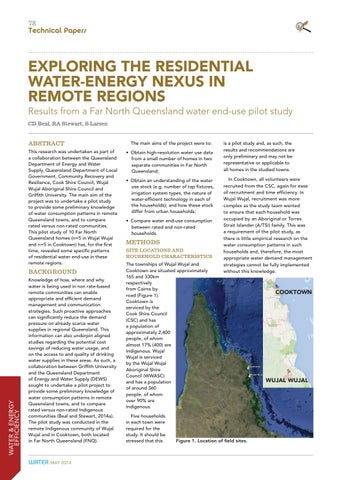
The townships of Wujal Wujal and Cooktown are situated approximately 165 and 330km respectively from Cairns by road (Figure 1). Cooktown is serviced by the Cook Shire Council (CSC) and has a population of approximately 2,400 people, of whom almost 17% (400) are Indigenous. Wujal Wujal is serviced by the Wujal Wujal Aboriginal Shire Council (WWASC) and has a population of around 360 people, of whom over 90% are Indigenous. Five households in each town were required for the study. It should be stressed that this
is a pilot study and, as such, the results and recommendations are only preliminary and may not be representative or applicable to all homes in the studied towns. In Cooktown, all volunteers were recruited from the CSC, again for ease of recruitment and time efficiency. In Wujal Wujal, recruitment was more complex as the study team wanted to ensure that each household was occupied by an Aboriginal or Torres Strait Islander (A/TSI) family. This was a requirement of the pilot study, as there is little empirical research on the water consumption patterns in such households and, therefore, the most appropriate water demand management strategies cannot be fully implemented without this knowledge.
Figure 1. Location of field sites.
COOKTOWN
WUJAL WUJAL