CRC
FOR
FRESHWATER
ECOLOGY
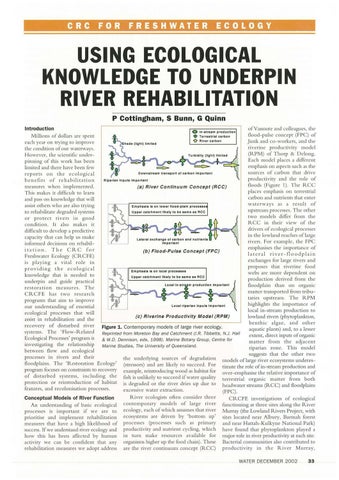
USING ECOLOGICAL KNOWLEDGE TO UNDERPIN RIVER REHABILITATION P Cottingham, S Bunn, G Quinn Introduction of Vannote and co ll eagues, the 0 In- strea m producti on flo od- pu lse co ncept (FPC) of M ill ions of do llars are spent • T errestrial ca rb on -0 River carb on J unk an d co-wo rkers, and th e each year on trying to improve ri veri ne produ ctivity m odel th e condition of our waterv-1ays. (R PM) of T horp & D elo n g. However , the scientific u nde rEach m odel places a differe nt pin ni ng of chis work has been emphasis o n aspects such as the li mited and there have been few sources Down stream tra nspo rt of ca rb o n Im portant o f carbon that drive reports on t h e eco lo g ica l prod ucti vity and th e role of R ipa rian Inputs Impo rta nt b e n e fit s of rehabi l it at io n flo ods (Figure 1) . Th e R CC measures when implem ented. (a) River Continuum Concept (RCC) places em phasis on terrestrial This makes it di fficult to learn carbon and nutrients that enter and pass on know ledge that w ill w ate r w ays as a res u l t o f assist others who are also trying Emphasis 11 on lower fl o od -plain procesao u pstream processes. T he other Upper catchm ent likel y to be sa me as RCC to rehabilitate degraded systems two mod els differ from th e or protec t ri ve rs in go od R CC in their view of th e con dition . It also makes it drive rs o f ecological processes d ifficult to develop a predictive in the lo wland reac hes ofla rge capacity that ca n help us make rivers. Fo r exa mpl e, the FP C in fo rmed decisions on rehabilemp hasises th e importan ce of i t a ti on . T h e C R C fo r (b) Flood- Pulse Concept (FPC) l a t e ra l r iver- fl oo dp la in Freshwa ter Ecology (CR C FE) exchanges fo r large ri ve rs and is p lay in g a v ital rol e in proposes chat riverin e fo od providing t h e eco l o g ica l Emph 11l1 11 on local proce11es webs are more depend ent o n knowledge that is needed to Upper ca tc hment like ly t o be same u RCC productio n deri ved fro m th e u nderpin and gu ide practi cal floodplain than o n organ ic r es to ra tio n m easu re s. Th e m atter transported fro m tribuCRC FE h as tw o r es ear ch taries upstrea m. T h e RPM programs th at aim to improve highlights th e impo rtance o f our understandi ng of esse ntial lo cal in-stream production to ecologica l processes that will (c) Riverine Productivity Model (RPM) lowland rivers (phytoplankton, assist in rehabili tation and the b e n thic algae , and ot h e r recove ry o f disturb ed rive r Figure 1. Contemporary models of large river ecology. aquati c plants) and , to a lesser sys tem s. T he ' Flow- Related Reprinted from Moreton Bay and Catchment (I.R. Tibbetts, N.J. Hall extent, direct inputs of organic Ecological Processes' program is & W.D. Dennison, eds, 1998). Marine Botany Group, Centre for matter from the adj ace nt investigati ng the relati o nship Marine Studies, The University of Queensland. riparian zone . T h is model between flo w and ecolo gical suggests that the o th er two processes in rivers and their the u nderl ying so urces of degradation models o flarge river ecosystems underesflo odplains. The 'R estoratio n Ecology' (stresso rs) and are likely to succeed. For timate the role of in-stream production and program focuses on constraints to recovety example, reintroducing wood as habitat for over-emphasise the relative importance o f o f d istu rbed sys te m s, incl u din g th e fish is unl ikely to su cceed if wa ter quality terres tri al organi c m atter from bo th protection or reintroduction of habitat is degraded or th e river dries up du e to headwater streams (R C C) and floodplai ns featu res, and recolo nisation p rocesses . excessive water extractio n. (FPC) . River ecologists o ften co nsider three Conceptual Models of River Function CR C FE investigatio ns of ecological co n temp o rary models of large ri ve r fun ction ing at th ree sites alo ng the River An understanding o f basic ecological processes is imp ortant if we are to ecology, each o f which assu mes that ri ver Murray (the Lowland Rivers Project, with p rio ritise and im plem ent rehabilitatio n ecosystems are driven by ' b ottom up ' sites located near Albury, Barm ah fo rest m easures that have a high likelihood of processes (processes su ch as primary and n ear H attah- Kulkyne N ational Park) success. If we understand river ecology and productivity and n utrient cycling, which have found that phyto plankton played a how this has been affected by human in turn make resources available fo r major role in river productivity at each site. activity we can be co nfident that any organisms higher up the foo d chain). These Bacterial commu nities also contributed to rehabilitation measures we adopt address are the river co ntinuum co ncept (R CC) p ro d uc tiv ity in th e Ri ve r Murra y, WATER DEC EMBER 2002
33