THE PEEL-HARVEY ESTUARINE SYSTEM REVIEW OF STUDY PROGRESS P. B. Birch, J. 0. Gabrielson and E. P. Hodgkin ABSTRACT
A report on thi s st udy iss ued December I 980 showed that the eutrophic condition of the estuary resulted from the great increase in input of phosph orus to the estuary over the last three decades, 80 per ce nt of it being derived from agricultural drainage on the coastal plain. Since then the study has concentrated on two aspects : the factors mediating massive blooms of the blue-green a lga Nodu laria and recycling phosphorus through the estuarine sedim ents to it; identifyin g fert ili zer phosphorus flow paths through the various so il types and devising appropriate agronomic measu res to reduce loss of phosphorus to drainage . INTRODUCTION
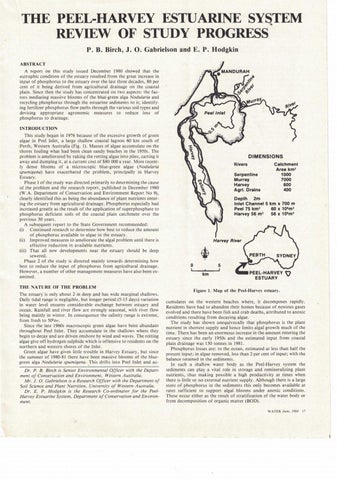
This study began in 1976 beca use of the excessive growth of green algae in Peel In let, a large shall ow coasta l lagoon 60 km so uth of -Perth, Western Austra lia (Fig. !). Masses of algae accumu late on the ·s hores fouling what had been clean sand y beaches in the I 950s. The problem is a meliorated by raking the rotting algae into piles, cart ing it away and dumping it, at a cu rrent cost of $80 000 a year. More recently dense blooms of a microscopic blue-green a lgae (Nodularia spumigena) have exacerbated the problem, principally in Harvey Estuary. Phase I of the study was directed primarily to determining the cause of the problem an d the research report, published in December 1980 (W .A. Department of Conservation and Environment Report No 9), clearly identified this as being the abundance of plant nutrients entering the estuary from agricultural drainage. Phosphoru s espec ially had increased greatly as the result of th e application of superp hosp hate to phosphoru s deficient so ils of the coas tal plain catchment over the previous 30 years. A subseque nt report to the State Government recommended: (i) Continued research to determine how best to reduce the amount of phosphorus available to algae in the est uary. (ii) Improved measures to ameliorate the algal problem until there is effective reduction in available nutrients. (iii) That a ll new developments near the estuary shou ld be deep sewered. Phase 2 of the study is directed mainly towards determining ho w best to reduce the input of phosphorus from agricultural drainage. However, a number of other management measures have also been exam ined . THE NATURE OF THE PROBLEM ·
The estuary is only about 2 m deep and has wide ma rginal shallows. Daily tidal range is negligible, but longer period (5-15 days) variation in water level ensures co nsiderable exchange between estuary and ocean. Rainfall and river flow are strongly seasonal, with river flow being mainl y in winter. In co nseq uence the salinit y range is ex treme, from fresh to 500,60. Since the late 1960s macroscopi c green algae have been abundant throughout Peel Inl et. They accumulate in the shallows where they begin to decay and are driven onshore by wind and waves. The rotting argae give off hydrogen sulphide which is offensive to residents on the northern and western shores of the Inl et. Green algae ha ve given little trouble in Harvey Est ua ry, but since the summer of 1980-81 there have been massive blooms of the bluegreen alga Nodularia spumigena. _Thi s drifts into Peel Inlet and ac-
Dr. P. B. Birch is Senior Environmental Officer with the Department of Conservation and Environment, Western Australia. Mr. J . 0. Gabrielson is a Research Officer wirh the Department of Soil Science and Plant N utrition, Universiry of Western Ausrralia. Dr. E. P. Hodgkin is the Research Co-ordinator for the Pee/Harvey Estuarine Sysrem, Departmen t of Conservation and Environment.
DIMENSIONS Rivers Serpentine Murray Harvey Agri. Drains
Catchment Area km' 1000 7000
600 400
Depth 2m Inlet Channel 5 km x 700 m Peel 75 km' 60 x 1o•m• Harvey 56 m' 56 x 1o•m•
0
km
Figure 1. Map of the Peel-Harvey estuary . cu mulates on th e western beaches where, it decomposes rapidly. Residents have had to abandon their homes because of noxious gases evo lved and there have been fish and crab deaths, attributed to anoxic conditions resu lting from decaying algae. The study has shown unequivocally that phosphorus is the plant nutrient in shortest supply and hence limits algal growt h much of the time. There has been an enormous increase in the amount entering the est uary since the early I 950s and the estimated input from coastal plain drainage was 130 tonnes in I 98 I. Phosphprus losses are: to the ocean, estimated at less than half the present input; in algae removed, less than 2 per cent of input; with the balance retained in the sediments . In such a sha ll ow water body as the Peel-Harvey system the sediments can play a vital role in storage and remineraii zing pla nt nutrients, thus making possible a high productivity at times when there is little or no external nutrient supply . Although there is a large store of phosphorus in the sed iments this only becomes available at rates sufficient to support algal blooms under anoxic conditions. These occur either as the result of strat ificat ion of the water body or from decomposition of organic matter (BOD). WATER June, 1984
17