The effects of organic and nutrient enrichment .on the Benthic , Macroinvertebrate community of Moggill Creek, Queensland C. C. MclVOR* INTRODUCTION Moggill Creek arises in the foothills of the D'Aguilar Range, southeast Queensland in the vicinity of Upper Brookfield to the west of Brisbane. It is a small but perennia l stream which flows into the Brisbane River opposite the suburb of Jindalee, approximately 24 kilometres (15 miles) from the river mouth. The stream is approximately 25 kilometres in length of which the lower 1.3 kil ometres are under t idal influence. It is normally a relatively clear stream with riffle areas separated by longer poo l stretches. However, it is subject to flash f looding following seasonally heavy rainfall in its catchment, at which time turb id conditions preva il. Land use in the creek catchment is primarily
pastoral in the upper reaches and residential in the lower reaches. A Brisbane City Council Sewage Treatment Plant situated on a meander of Moggill Creek in the suburb of Kenmore releases an estimated volume of 308,000 li tres (100,000 gal.) per day of treated sewage effluent into the creek. The plant which serves a populat ion of approximate ly 2000 persons, uses Imhoff tanks and a trick ling filter designed to produce an effluent of 15 ppm B.0 .D.5 and 20 ppm suspended solids . Based on figures quoted in the engineering literature, nutrient remova l is expected to be 50% at a maximum. (Westman , 1972.) Routi ne bacterio logical and chemical analyses are conducted on the sewage
~ ~
effluent and on Mogg ill Creek upstream and downstream of the outfall by the City Chemists Laboratory , while the Irrigation and Water Supply Commission maintains a stream gauging station behind th plant and conducts occasional analyses . The aim of this investigation was to describe the "normal " macroinvertebrate commun ity composition of the creek and to record changes in composition with nutrient enrichment. The macroinvertebrate portion of the total aquatic community has been shown to be particularly sensitive to a degradat ion in water qua lity and liv ing conditions as the majority of these organisms are incapab le of active movement out of a zone of stress
{/ Gok/Cru/,. Resu voi
/
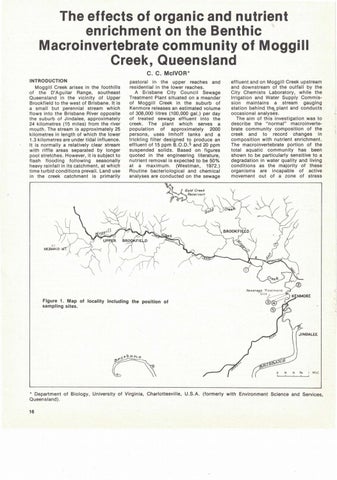
Figure 1. Map of locality including the position of sampling sites.
Y+
}t
3/•
I
MI LE
• Department of Biology , Univers ity of Virg inia, Charlottesville, U.S.A. (formerly with Environment Science and Services, Queensland) . 16
l