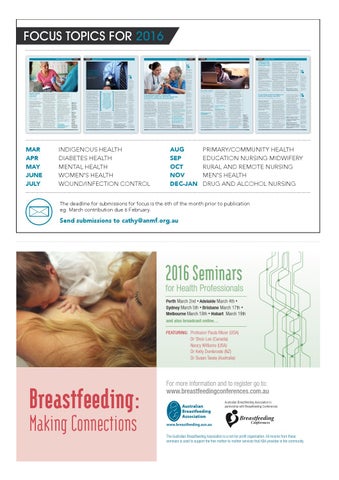
FOCUS TOPICS FOR 2016 Wound / Infection Control
FOCUS
FOCUS
Education: Part 2
Education: Part 2
FOCUS
FOCUS
Education: Part 2
FOCUS
Education: Part 2
Flexible learning in midwifery and nursing education By Sara Stelfox In undergraduate courses a challenge exists to improve both students’ access and engagement. This has been countered with the use of various technologies to best meet the needs of both professional practice preparation and students’ need for improved access and flexibility.
References Algoso, M., & Peters, K. (2012). The experiences of undergraduate Assistants in Nursing (AIN). Nurse Education Today, 32(3), 197-202.
BP measurement: practice without evidence. Are we teaching it wrong? By Sara Geale and Elisabeth Jacob
Beckett, A., Gilbertson, S., & Greenwood, S. (2007). Doing the right thing: Nursing students, relational practice, and moral agency. Journal Of Nursing Education, 46(1), 28-32.
References Alexis O. (2009). Providing best practice in manual blood pressure measurement. BJN. 18(7), 410-415.
Healthy healing and wound prevention By K Price, A Dyer, T Rando and P Hickman Critical to achieving best outcomes in any clinical setting is ensuring decision making in wound prevention and healthy healing of a wound, has successful client centred outcomes. The Wound Management Innovation CRC (WMI CRC) was formed on 1 July 2010 to: alleviate suffering of people with chronic wounds; improve wound prevention; deliver clinical resources of national importance; develop next generation wound management products; educate researchers and healthcare providers; and reduce the cost of healthcare to people with wounds. www.woundcrc.com/ Among the critical indicators of quality services and resident satisfaction in residential aged care as legislated in the Aged Care Act 1997 is the prevalence of pressure injuries and skin tears. A service delivery model is under
evaluation that incorporates healthy healing and wound prevention approaches. The model is aimed to provide near zero incidences of preventable pressure injury or skin tears resulting in significant benefits in resident quality of life, staff productivity, cost savings and accreditation processes. In collaboration with Southern Cross Care (SA&NT), the WMI CRC is working with the University of South Australia undertaking a research project. The project uses descriptive methodology to identify processes implemented by staff to increase the focus on ensuring healthy healing and wound prevention of residents; and to deliver quality outcomes in an efficacious manner in aged care settings. The research is not focused on any one specific staff member or resident, rather on the value of the processes being used to collect information and improve resident outcomes. www. southerncrosscare.com.au/ As an inaugural member of the South Australian Innovation Hub funded by the Commonwealth government, Southern Cross Care (SA&NT) acknowledges healthy healing and wound prevention as an essential component of its service delivery model. Involvement
anmf.org.au
32_43_ANMJ Sep15_Research_Focus.indd 33
MAR APR MAY JUNE JULY
with the Wound CRC may assist other approved providers in the implementation of a systematic approach to wound prevention and healthy healing for all residents, informed by best available evidence. The research project has four phases: Phase 1: What is happening now? A descriptive account of everyday activities that involves a triangulation of data collection methods including: Wound Prevalence Survey; Wound Prevention and Management Audit; and EQ 5D Quality of Life survey. Phase 2: Education, training and service provision where SCC staff have access to wound experts and wound products, online education resources and access to a telehealth Wound Advisory Service (Wounds West). Phase 3: A repeat of data collection tools from Phase 1. Phase 4: Analysis, reporting and sustainability of the approach. Findings will be available in early 2016. www.dss.gov.au/ ourresponsibilities/ ageingandagedcare/ ensuring qualitythesouthaustralian innovationhubtrial
We would like to throw down the gauntlet or in this case the blood pressure cuff. Blood pressure (BP) assessment is reportedly the most frequently done of the vital sign measurements in healthcare. The importance of accuracy in BP measurements is well recognised (Rabbia et al. 2013).
Associate Professor K Price and T Rando are in the School of Nursing and Midwifery at the University of SA A Dyer is Research Director, Wound Management Innovation Collaboration Research Centre P Hickman is Group Manager, Strategy (Research and Development), Southern Cross Care (SA&NT)
September 2015 Volume 23, No. 3
33
21/08/2015 4:33 pm
Measuring BP is usually taught to student nurses early in their education program. Mastering the skills required to measure BP with accuracy is demanding for nursing students. Taking a BP requires the development of new psychomotor skills, an understanding of what they are measuring and an ability to achieve a level of accuracy (Alexis, 2009).
Historically in Australian schools of nursing, students are taught to do a preliminary palpatory systolic determination (PPSD) prior to a complete BP reading (Tollefson, 2010). Students are directed to palpate a brachial pulse with the BP cuff insitu. They then pump up the cuff until they cannot longer feel a brachial pulse. The student is advised that they have now palpated the systolic BP. They lower the cuff, wait two to three minutes and reinflate the cuff to 30 to 40mmHg above the systolic BP that they had initially palpated. The 34
August 2015 Volume 23, No. 2
34-45_ANMJ Aug15_Focus.indd 34
AS SUPPORTERS OF EVIDENCE BASED PRACTICE WE, THE ACADEMICS TEACHING THIS PROCESS, NEED TO QUESTION WHY WE ARE TEACHING A PRACTICE THAT SEEMS TO BE BASED ON ‘DOING WHAT WE HAVE ALWAYS DONE’ student then takes and documents the systolic and diastolic BP. They have now pumped the cuff up occluding blood flow to the periphery, lowered it slowly to produce the turbulent flow required to hear Korotkoff sounds and they have done this twice within a short period of time. While there may be an argument for the PPSD helping to increase reading accuracy by enabling identification of an auscultatory gap (Blank et al. 1991) to date there is no research to show that the gap is being recognised or documented
by nurses or that it makes any difference to patient outcomes. Current recommendations from The Joanna Briggs Institute, (2014) exclude the use of PPSD or use it in conjunction with the first BP reading. It is questionable that this practice is carried into the clinical area especially given nursing time management issues associated with large patient loads in most healthcare areas and the need to wait for one to two minutes between cuff inflation for traditional PPSD (Tollefson, 2010). It is also questionable if this procedure leads to improved patient outcomes and satisfaction. As supporters of evidence based practice we, the academics teaching this process, need to question why we are teaching a practice that seems to be based on ‘doing what we have always done’. We need to ask if by doing what we have always done we are actually improving the student experience and improving patient care. We should be asking if there is a better way to teach BP measurement that would encourage accuracy and reduce risk. Dr Sara Geale is a Lecturer and Dr Elisabeth Jacob is a Senior Lecturer in the School of Nursing and Midwifery at Edith Cowan University in WA
Beecroft, P.C., Dorey, F., & Wenten, M. (2008). Turnover intention in new graduate nurses: a multivariate analysis. Journal of Advanced Nursing, 62(1), 41-52.
Blank, S. G., West, J. E., Muller, F. B., Pecker, M. S., Laragh, J. H., & Pickering, T. G. (1991), Characterization of auscultatory Gaps with Wideband External Pulse Recording, Hypertension, 17(2), 225-233. doi: 10.1161/01. HYP.17.2.225 Gordon, C.J. Frotjold, A., Fethney, J., Green, J.; Hardy, J., Maw, M., Buckley, T. (2013, October). The Effectiveness of Simulation-Based Blood Pressure Training in Preregistration Nursing Students. Journal of Simulation in Healthcare. 8(5), 335-340. doi: 10.1097/ SIH.0b013e3182a15fa7 Rabbia, F., Testa, E., Rabbia, S., Praticò, S., Colasanto, C., Montersino, F., Veglio, F. (2013). Effectiveness of blood pressure educational and evaluation program for the improvement of measurement accuracy among nurses. High Blood Pressure & Cardiovascular Prevention, 20(2), 77-80. Retrieved from http:// ezproxy.ecu.edu.au/ login?url=http://search. proquest.com/ docview/1462385739? accountid=10675 The Joanna Briggs Institute. (2014). Vital signs. Retrieved 29 April 2015 from http:// ovidsp.tx.ovid.com. ezproxy.ecu.edu.au/ sp-3.15.1b/ovidweb. cgi?&S=LDEFFPOP HBDDAMCANCKK AHIBKEDMAA00& Link+Set=S. sh.21|12|sl_190 Tollefson, J. (2010). Clinical Psychomotor Skills: Assessment tools for nursing students (4th Ed.). South Melbourne, Vic: CENGAGE Learning
anmf.org.au
22/07/2015 5:08 pm
Clark, T., & Holmes, S. (2007). Fit for practice? An exploration of the development of newly qualified nurses using focus groups. International Journal of Nursing Studies, 44(7), 1210-1220. El Haddad, M., Moxham, L., & Broadbent, M. (2013). Graduate registered nurse practice readiness in the Australian context: An issue worthy of discussion. The Australian Journal of Nursing Practice.
Undergraduate Assistant in Nursing (AIN) employment in aged care: Does this prepare new graduates for the clinical work environment? By Maricris Algoso Nursing education made the transition from hospitalbased training to the tertiary sector over 20 years ago. However, grave concerns about the quality and quantity of undergraduate nurses’ clinical experiences prior to graduation remains (Clark & Holmes, 2007; Ong, 2013; Spence, et al, 2012), raising issues surrounding new graduate preparedness for practice (Beckett, et al, 2007; Beecroft, et al, 2008; Mannix, et al, 2006). In 2001, New South Wales (NSW) Health developed and implemented an incentive where Bachelor of Nursing students were actively recruited to work as Assistants in Nursing (AINs) whilst completing their undergraduate nursing program. The aim of this incentive was to support further development of clinical skills for
Bachelor of Nursing students. Most undergraduate AIN positions are in aged care settings, which are perceived to provide limited opportunities to practice a narrow set of nursing skills (Algoso & Peters, 2012; Stombaugh & Judd, 2014). However, previous research has not determined whether undergraduate AIN employment prior to graduation assists in work readiness for this group. The aim of the proposed study is to explore the perceptions of new graduate (NG) nurses regarding whether undergraduate AIN employment in aged care assisted in preparing them for the clinical work environment. Exploring undergraduate AIN employment in preparing nursing students for the clinical work environment has the potential to unite the service and education sector, a relationship that is crucial to providing quality nursing education. The author is seeking NG nurses
with at least three months RN, experience who were previously employed as undergraduate AIN in aged care facilities. Participants will be required to complete an online survey and/or be willing to participate in one-to-one interviews. To complete an online survey, please follow the link: www. surveymonkey.com/r/Preparation_ for_Clinical_Practice Alternatively, a paper copy of the survey can be requested from the author and will be mailed out. If you are interested in participating in this study (either in completing a survey or participating in an interview) or require more information, please contact Maricris Algoso (m.algoso@uws.edu.au). HREC Approval Number: H10915 Maricris Algoso is a PhD candidate from the School of Nursing and Midwifery at the University of Western Sydney.
anmf.org.au
Ong, G.L. (2013). Using final placements to prepare student nurses. Nursing Times, 109(3), 12-14. Spence, D., Vallant, S., Roud, D., & Aspinall, C. (2012). Preparing registered nurses depends on “us and us and all of us”. Nursing Praxis in New Zealand, 28(2), 5-13. Stombaugh, A., & Judd, A. (2014). Does nursing assistant certification increase nursing student’s confidence level of basic nursing care when entering a nursing program? Journal Of Professional Nursing, 30(2), 162-167. Wolff, A.C., Pesut, B., & Regan, S. (2010). New graduate nurse practice readiness: perspectives on the context shaping our understanding and expectations. Nurse Education Today, 30(2), 187-191.
August 2015 Volume 23, No. 2
34-45_ANMJ Aug15_Focus.indd 35
INDIGENOUS HEALTH DIABETES HEALTH MENTAL HEALTH WOMEN’S HEALTH WOUND/INFECTION CONTROL
Mannix, J., Faga, P., Beale, B., & Jackson, D. (2006). Towards sustainable models for clinical education in nursing: An ongoing conversation. Nurse Education in Practice, 6, 3 - 11.
35
22/07/2015 5:08 pm
AUG SEP OCT NOV DEC-JAN
Education options By Pauline Wong and Jacqui McGregor La Trobe is an Australian pioneer in nursing and midwifery education. In 1974, La Trobe became the first provider of tertiary-based education for nurses. Our experience has helped us build an innovative curriculum that produces highly respected graduates. We offer education programs including undergraduate, postgraduate, research higher degrees and continuing professional development (CPD) programs. CPD short courses and single subjects Our short courses, workshops and webinars will help you stay current in a constantly changing environment and earn you CPD hours. With the standards for registration as a nurse in Australia and the professional contexts and roles for nurses evolving, we maintain a proactive approach to ensuring our nursing courses meets current best practice standards. Our suite of CPD short courses, webinars and workshops are practical and engaging, relevant 40
to today’s nursing practice environment and delivered via a variety of flexible modes to suit busy working nurses. We can also customise sessions for groups and deliver them at your workplace. Our short courses include: • Arterial blood gas interpretation • ECG fundamentals • Introduction to breast care nursing • Nurse immuniser program • Prostate nursing care • Wound management training For more information visit latrobe.edu.au/short-courses/ nursing
Postgraduate courses If you are looking for something more substantial to build your career, we have a range of postgraduate coursework programs. With Masters level courses you can develop the knowledge and skills to be an expert clinical practitioner. Our Master of Nursing helps registered nurses build their careers by qualifying in one of our 14 specialisations including emergency care, intensive care, neonatal care and urology. You would enrol in Masters of Nursing in your chosen specialty area and can exit with either a grad cert grad diploma or Masters. We also offer child family and
community for qualified midwives who want advanced training to qualify as a maternal and child health nurse. Our postgraduate midwifery programs are for those with a nursing degree who want to work as midwives and for qualified midwives wishing to advance their practice. With our Master of Nursing (Nurse Practitioner) specialist nurses can build on their knowledge and clinical skills to practice at an advanced level of contemporary clinical and professional nursing specialties and provide leadership. Our fully online Masters of Nursing Science provides nurses with the knowledge and skills in research and their chosen area of professional practice. It is delivered via a flexible online mode which comprises learning modules over six week blocks. The flexibility of the course structure allows the student to complete their degree in just 20 months, or pause their studies and re-join during one of our seven yearly intakes. Our programs are taught using a variety of approaches, including onsite workshops and lectures, and online study. We also offer parttime, full-time and flexi-modes so you decide how much you take on. To discuss your study options, book a one-on-one consultation. Call 1300 135 045 or visit latrobe.edu.au/consult
Midwifery and nursing students now access information online, complete teamwork activities in virtual classrooms, submit assessments online and practice clinical skills using virtual environments, in addition to more traditional face to face learning. In 2011, students in the combined Bachelor of Nursing/ Bachelor of Midwifery at Deakin
Incorporating emotional intelligence in nursing and midwifery education By Dolores Dooley, Cate Nagle and Leah East Emotional intelligence (EI) is defined as the ability to monitor one’s own and others’ feelings and emotions, discriminate between the positive and negative effects of emotions and use this information to guide one’s thinking and actions (Salovey & Mayer, 1990).
Pauline Wong is Coordinator, Professional Development and Jacqui McGregor is Postgraduate Course Coordinator, Master of Nursing. Both are at La Trobe University anmf.org.au
August 2015 Volume 23, No. 2
University were surveyed regarding their use of and satisfaction following the introduction of flexible education technologies. The redesign of courses to include flexible learning, was underpinned by assumptions of students’ capacity to engage and succeed within a different learning environment. Students’ ability to succeed with online learning has been extensively considered and is influenced by a number of factors including, perception of technology, learning style, previous experiences, time available and support for studies and learning motivation (Drennan et al. 2005 & Muilenburg & Berge, 2005). Although many undergraduate students can be described by their year of birth as ‘digital natives’ and are considered to be skilled with the online world (Prensky, 2001), this study found that some students experienced difficulty with access and use of online education technologies and did not always consider that it afforded them an improved education experience.
34-45_ANMJ Aug15_Focus.indd 40
22/07/2015 5:17 pm
Emotions permeate nursing and midwifery practice, understanding one’s own emotions is the basis of understanding the emotions of others, a critical skill for healthcare professionals (Freshwater & Stickley, 2004). Historically, the emotional aspects of clinical practice were deemed far too perilous for the nursing and midwifery student which resulted in a task orientated approach to the delivery of care (Menzies, 1960). More recently, the attributes of EI have been deemed central to nursing practice, influencing 36
the quality of student learning, ethical decision-making, critical thinking, leadership abilities, quality patient care and improved patient outcomes (Akerjordet & Severinsson, 2007; Patterson & Begley, 2011). Indeed, EI has been considered especially important within nursing and midwifery where developed interpersonal skills are required (Freshwater & Stickley, 2004; Patterson & Begley, 2011). Yet, Harrison and Fopma-Loy (2010, p 644) remark that “Nurse Educators often speak of preparing “safe practitioners” and “critical thinkers” but it is relatively rare to hear a conversation in which faculty speak of preparing a student who is emotionally intelligent” adding that emotions are often overlooked in nursing education. The emotional cost of caring among student nurses and midwives grappling with managing their emotions in the clinical arena is well documented (Akerjordet & Severinsson, 2007; Harrison & Fopma-Loy, 2010). This has
Students self-rated their information technology (IT) confidence at lower than expected levels (35% ‘limited’ or ‘average’). Many students reported that they had never before used online educational technologies such as virtual classrooms (60%) and had limited or no experience with online lectures (55%). Despite these challenges 60% of students reported that online education technologies allowed them more flexibility to better manage their time and incorporate study with other competing responsibilities such as paid work and family responsibilities. These findings highlight that despite the proliferation of technologies used by students’ in their social world, their competence with educational IT and related characteristics needs to be carefully considered when designing innovative courses. Sara Stelfox is a Lecturer in the School of Nursing and Midwifery at Deakin University
prompted calls for the explicit inclusion of EI within undergraduate nursing and midwifery curricula to prepare students for the complexities of their clinical roles including the social and emotional demands of clinical practice. (Freshwater & Stickley, 2004; Patterson & Begley, 2011). While, EI cannot be considered a general panacea, the literature suggests that it could impart new ways of thinking and being for students as it considers their emotional needs and how these impact on their education and clinical practice. As the clinical environment becomes more complex, academics and educators are challenged to embed EI in curricula in meaningful ways with appropriate evaluative frameworks. Dolores Dooley is a lecturer and Dr Leah East is a Senior Lecturer in the School of Nursing and Midwifery at Deakin University Cate Nagle is Associate Professor in the School of Nursing and Midwifery at Deakin University and Sunshine Hospital, Women’s and Children’s Division, Western Health
References Drennan, J, Kennedy, J & Pisarski, A. (2005), Factors affecting student attitudes toward flexible online learning in management education. The Journal of Education Research, Vol. 98, No. 6, pp. 331-338 Muilenburg, L & Berge, Z. (2005), Student barriers to online learning; a factor analytic study. Distance Education, Vol. 26, No.1, pp. 29-48 Prensky, M. (2001), Digital natives, digital immigrants. On the Horizon, Vol. 9, No. 5, pp 1–6
References Akerjordet, K & Severinsson, E 2007. Emotional intelligence: a review of the literature with specific focus on empirical and epistemological perspectives, Journal of Clinical Nursing. 16(8):1405-1416. Freshwater, D & Stickley, T 2004. The heart of the art: Emotional Intelligence in Nurse education. Nursing Inquiry. 11(2):91-98. Harrison, P & Fopma-Loy, J 2010. Reflective Journal Prompts: A Vehicle for Stimulating Emotional Competence in Nursing. Journal of Nursing Education. 49(11):644-652. Menzies, I 1960. A CaseStudy in the Functioning of Social Systems as a Defence against Anxiety: A Report on a Study of the Nursing Service of a General Hospital. Human Relations. 13(2):95-121. Patterson, D & Begley, AM 2011. An exploration of the importance of emotional intelligence in midwifery. Evidence Based Midwifery. 9(2):53-60. Salovey, P & Mayer, JD 1990. Emotional intelligence. Imagination, Cognitation and Personality. 9(3):185-211.
August 2015 Volume 23, No. 2
anmf.org.au
34-45_ANMJ Aug15_Focus.indd 36
PRIMARY/COMMUNITY HEALTH EDUCATION NURSING MIDWIFERY RURAL AND REMOTE NURSING MEN’S HEALTH DRUG AND ALCOHOL NURSING
The deadline for submissions for focus is the 6th of the month prior to publication eg. March contribution due 6 February.
Send submissions to cathy@anmf.org.au
2016 Seminars
for Health Professionals Perth March 2nd • Adelaide March 4th • Sydney March 5th • Brisbane March 17th • Melbourne March 18th • Hobart March 19th and also broadcast online… FeAturing: Professor Paula Meier (USA) Dr Shoo Lee (Canada) Nancy Williams (USA) Dr Kelly Dombroski (NZ) Dr Susan Tawia (Australia)
Breastfeeding: Making Connections
For more information and to register go to: www.breastfeedingconferences.com.au Australian Breastfeeding Association in partnership with Breastfeeding Conferences
www.breastfeeding.asn.au
The Australian Breastfeeding Association is a not-for-profit organisation. All income from these seminars is used to support the free mother-to-mother services that ABA provides in the community.
22/07/2015 5:11 pm