
5 minute read
Co-designing improvements in partnership with Aboriginal and Torres Strait Islander peoples

KALEENA WEBBE Manager Primary Care Development COORDINARE (SENSW PHN)
LINDA BLACKMORE Health Coordination Consultant COORDINARE (SENSW PHN)
Advertisement
General practice improvement
Experience based co-design is described as offering a way to, ‘…bring health workers and consumers together in an authentic and equal partnership to co-design care to deliver an improved experience. In doing so, the approach not only improves the experience of patients but also of the workforce. The combined benefit is an overall improvement in quality of care.’1
COORDINARE from the South Eastern New South Wales Primary Health Network (SE NSW PHN) is committed to improving access to culturally sensitive and respectful primary care for the more than 24,000 people who identify as Aboriginal and/ or Torres Strait Islander within the catchment.
In June 2021, COORDINARE funded five mainstream general practices to support them in forming partnerships with Aboriginal and/or Torres Strait Islander people who were regular users of their service. Practices were selected from geographic areas with the highest proportion of people who identify as Aboriginal and/or Torres Strait Islander and/or some distance from an Aboriginal Community Controlled Health Organisation (ACCHOs).
Purpose
Using an experience based co-design approach this two-year program seeks to:
• Support practices to be culturally sensitive and responsive by developing meaningful partnerships with their Aboriginal and/or Torres Strait Islander patients.
• Facilitate better access to primary care for all Aboriginal people.
• Progress reconciliation through advocacy and influence in the primary care sector.
• Support practices to provide enhanced services with a strong consumer focus.
Objectives
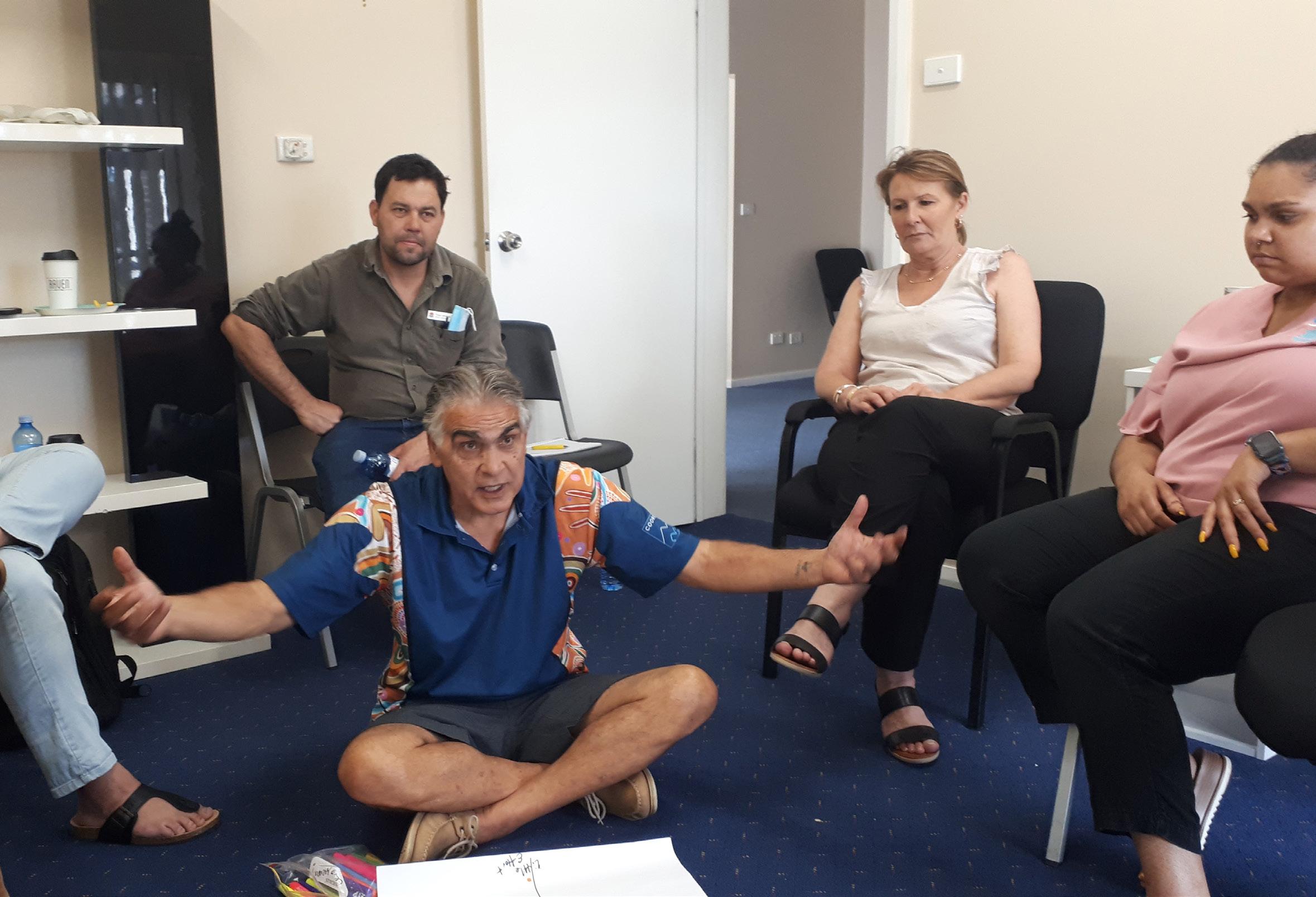
COORDINARE Community Engagement Consultant, Terry Hill, with staff and consumer representatives from Narooma Medical Centre.
Using a consumer centred approach, the objectives of the program are to:
• Commission general practice to develop and implement models of care that integrate Aboriginal and/or Torres Strait Islander consumers in the process from program design through to service delivery.
• Support general practice to develop culturally safe and appropriate approaches to patient care in partnership with their Aboriginal and/or Torres Strait Islander patients.
• Develop consumer leadership through capacity building approaches in general practice.
• Support upskilling of general practice (and COORDINARE) workforce through: cultural competency training, experience based codesign training and relationship development with Aboriginal members of the community.
First steps
Each practice has engaged Aboriginal and/or Torres Strait Islander people who are regular users of their service to be participants in the co-design process.
Cultural competency training was provided for each practice by Koorimunication, and involved the GPs, nurses and administrative staff who would play a key role in the project.
Experience based co-design training was then provided for practices, their consumer representatives and COORDINARE staff by the Australian Healthcare & Hospitals Association (AHHA).
Commencing co-design work
Experience based co-design training was followed by a mentoring workshop for each practice. Some frank and constructive discussions took place concerning the practice environment, >
practice culture, workflow and access issues. These workshops helped people develop a deeper understanding of the co-design process and provided an open and safe environment for participants to: • Share their thoughts about areas the practice could improve. • Gain a deeper understanding of the challenges faced by both the consumers and the practice. • Highlight some early priorities for the practice to develop culturally safe and appropriate approaches to care.
Obtaining patient feedback
An important role played by the consumer representatives is to work with their practice to develop processes that enable patients to give ongoing feedback easily and safely about the practice environment and service, which will drive continuous quality improvement.
Initially, patient feedback is being gathered by all practices using an anonymous patient survey, completed online or on a Tablet at the practice, supported by practice staff where required. Practices are currently undertaking the first round of surveys which will be repeated at several points throughout the project. The aim is that the practice will be set up with an ongoing mechanism to receive feedback and take appropriate action that results in consumer reported improvements to cultural safety.
Practice reflection
There are a number of regular opportunities for practices to reflect on where they are at and how they are progressing as they move along on their cultural safety journey including:
• A quality improvement toolkit.
• An Aboriginal cultural audit.
• A staff survey that has been undertaken and will be repeated at several points during the project.
These resources and activities are designed to encourage reflection, identify areas of strength and areas for improvement and support practices to implement change through collaboration with Aboriginal consumers.
Where we are and next steps
It was recognised quite early in the project that there was a cultural need to spend more time ‘yarning’ with consumers. Additional funding has been provided to ensure practices can take the time they need to do the co-design process justice.
The practice and patient representatives are currently progressing work on their project plans, including identifying priorities and deciding how to track and monitor progress. They will continue to work together throughout the life of the project as part of a continuous quality improvement cycle. In line with this year’s NAIDOC theme, Get Up, Stand Up and Show Up, the idea is for these practices to keep chipping away, to continue their efforts to remove barriers to access for Aboriginal people and to include consumers in the design of their programs. ha
1.(Australian Healthcare and Hospitals Association (AHHA) and Consumers Forum of Australia (CHF) Evidence Based Co-Design Toolkit https://chf.org.au/experience-based-co-design-toolkit)
