PROVIDE GREAT CUSTOMER SERVICE Focus on people—with respect, tactfulness, patience, graciousness, and a desire to serve. Never be annoyed by end user problems. Keep the end users’ productivity in mind and not your own ease. What they need is more important than what you are doing (not always, but you need to act like it is). Listen well. When someone comes into your office, stop working and focus on them and their concerns. Focus on delivery—deliver more than you promised. Serve others the way you would like to be served. Provide service like the best service you have ever had from others. Watch others who provide great service and mimic them. Deliver 100 percent or more of what was expected. Offer a bit more. Do a little more.
COMMUNICATE Discuss CAD/BIM/Tech areas at high levels with support staff and at understandable levels for non-tech staff. Keep end users advised of progress when troubleshooting a problem. Report to management when solutions are in place. Let others know what is happening and what is coming next. Talk more. Tell people what you are doing and when you expect it to be fixed. Let people know what you plan to do next. Talk to them about new software coming. Keep them informed on your short- and long-term plans.
SHARE KNOWLEDGE Don’t hoard knowledge. Be willing to tell others what caused a problem, how it was fixed, and how to avoid it in the future. Do not withhold technical information from users or other support staff. Constantly look for opportunities to share what you know with all users. Give more. Pass out tips and tricks to everyone you come in contact with. Always offers more information. Discuss new technology with staff. Ask them to help you research new tools. Provide background information about decisions.
is in place works well and even if you do not have the money in the budget to buy. Review all your areas of oversight on a regular basis to verify functionality and productivity. Ask yourself hard questions. Don’t settle for easy answers. Move in a direction to see if you are on the right path. Anticipate what might happen. Ask “what if ” questions. Ask dumb questions. Don’t be afraid to try something.
COLUMN
CAD Manager
BE ORGANIZED Keep track of tasks and deadlines. Know how to prioritize. What is most important right now? What can be done later? What is the impact of doing or not doing this or that? Be aware of other people’s priorities and how they impact your own. Use tools and methods that help yourself stay organized and let others know that structures are in place. Generate structure where none exists. File it, store it, scan it, index it. Do whatever it takes to be able to quickly access, retain, and reuse information. Get rid of things that are no longer useful—yes, throw them out. If they are digital, then put them in cold cloud storage. You can get them if you really need them.
PLAN Investigate things that come your way or are mentioned in passing. Don’t let that idea you had at lunch founder. Plan on how you might make it happen. Develop options, methods, pathways for progress, and alternates. Think about it all until you can think no more (or run out of time), then select the best option. Once selected, break down large projects and processes into smaller steps. Prioritize efforts as projects move along. Know what needs to be worked on next. Learn project management processes and how to execute on plans. Share your plans with others. Seek to help others plan their work. This is just the beginning of my list. I will share more next time. Until then, use my list or start making your own. Have the reminders ready so you can be on top of your game and provide the best at work, home, or wherever you might be.
TAKE INITIATIVE Constantly look for areas to improve. Do not wait for others to assign tasks. Look for ways to assist others. Research troubles on your own to find solutions. When you see something that needs to be fixed, fix it. When you know what needs to be done, do it— before something breaks and before someone else assigns it to you. I have a sign over my desk that says “Don’t just sit there, do something.” Keep moving forward. There is a fix out there. There is a new way of approaching a problem. Take action and go find it.
BE PROACTIVE Look for ways to prevent problems from happening. Look into new areas before others ask about it. Search for information when something new comes along. Look for new technology, even when what March 2018
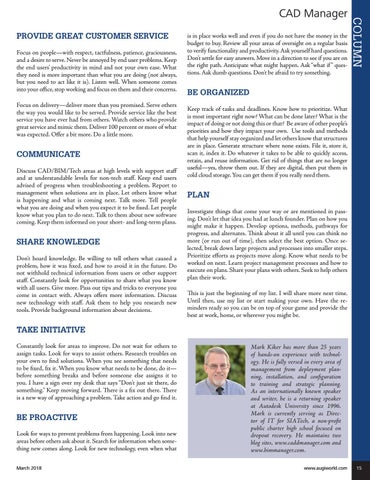
Mark Kiker has more than 25 years of hands-on experience with technology. He is fully versed in every area of management from deployment planning, installation, and configuration to training and strategic planning. As an internationally known speaker and writer, he is a returning speaker at Autodesk University since 1996. Mark is currently serving as Director of IT for SIATech, a non-profit public charter high school focused on dropout recovery. He maintains two blog sites, www.caddmanager.com and www.bimmanager.com . www.augiworld.com 15