Once your internal and external clients are communicating more and providing positive feedback, trust begins to build among team members. and improve quality standards, standard details, and layer/ line types along with other CAD standards. Once our standards were developed, we formed a Revit Team. This team included one enthusiastic person from each discipline (Electrical, Fire Protection, Mechanical, Plumbing and Structural) who would start out doing all Revit projects. The Revit Team was—and continues to be— responsible for producing template files and standards and keeping them current as we moved forward. Because team members are the most experienced with Revit and its processes, they provided technical support for the next phase of users on projects.
• •
You do, I watch. You get a new apprentice. Everyone keeps on mission, passing forward the standards.
Team environment There is no doubt that this new structure of sharing work has interrupted routine workf low at times. Showing someone in a different office your daily progress can be a stressful obstacle. However, the increased communication during a project can lead to partnerships down the road. Once your internal and external clients are communicating more and providing positive feedback, trust begins to build among team members. With Revit as a vehicle for change, this is when we started to see the underlying benefits it could provide. Our experience with Revit has been that the more projects we complete, the more excited people are to use and market its capabilities. I recently attended a leadership conference where the speaker said, “People who accomplish things get talked about.” Employees are proud to be part of the circle of progress that Revit implementation generates. Revit also has given us an opportunity to communicate outside of our Building Services sector. We have started to develop a workf low between our high-definition scanner and Revit, and are looking at new opportunities to incorporate our GIS technologies as well. This will foster more com-
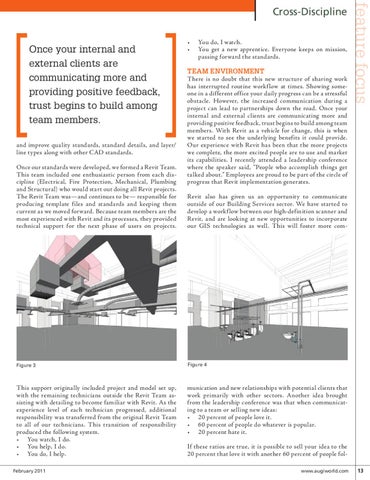
Figure 3
Figure 4
This support originally included project and model set up, with the remaining technicians outside the Revit Team assisting with detailing to become familiar with Revit. As the experience level of each technician progressed, additional responsibility was transferred from the original Revit Team to all of our technicians. This transition of responsibility produced the following system. • You watch, I do. • You help, I do. • You do, I help.
munication and new relationships with potential clients that work primarily with other sectors. Another idea brought from the leadership conference was that when communicating to a team or selling new ideas: • 20 percent of people love it. • 60 percent of people do whatever is popular. • 20 percent hate it.
February 2011
feature focus
Cross-Discipline
If these ratios are true, it is possible to sell your idea to the 20 percent that love it with another 60 percent of people fol
www.augiworld.com 13