feature focus
Cross-Discipline
by: Troy DeGroot
Could BIM stand for Build Improved Milieu?
➲
E
veryone has read implementation plans from countless companies that have had varying levels of success with BIM. Meanwhile, several companies are waiting for all of the bugs to get worked out before undergoing such a large and expensive task. During the transition from AutoCAD® to Autodesk® Revit® within Ulteig’s Building Services Sector, we have experienced the same successes and frustrations as others that have gone before us. We have been successful at
Project Management • Quality standards • CAD standards • Standard details Team Environment • Communication • Trust Marketing • Visual marketing • Quick and cheap
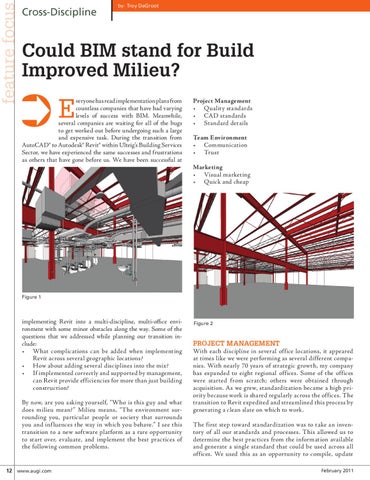
Figure 1
implementing Revit into a multi-discipline, multi-office environment with some minor obstacles along the way. Some of the questions that we addressed while planning our transition include: • What complications can be added when implementing Revit across several geographic locations? • How about adding several disciplines into the mix? • If implemented correctly and supported by management, can Revit provide efficiencies for more than just building construction? By now, are you asking yourself, “Who is this guy and what does milieu mean?” Milieu means, “The environment surrounding you, particular people or society that surrounds you and inf luences the way in which you behave.” I see this transition to a new software platform as a rare opportunity to start over, evaluate, and implement the best practices of the following common problems.
12 www.augi.com
Figure 2
Project management With each discipline in several office locations, it appeared at times like we were performing as several different companies. With nearly 70 years of strategic growth, my company has expanded to eight regional offices. Some of the offices were started from scratch; others were obtained through acquisition. As we grew, standardization became a high priority because work is shared regularly across the offices. The transition to Revit expedited and streamlined this process by generating a clean slate on which to work. The first step toward standardization was to take an inventory of all our standards and processes. This allowed us to determine the best practices from the information available and generate a single standard that could be used across all offices. We used this as an opportunity to compile, update February 2011