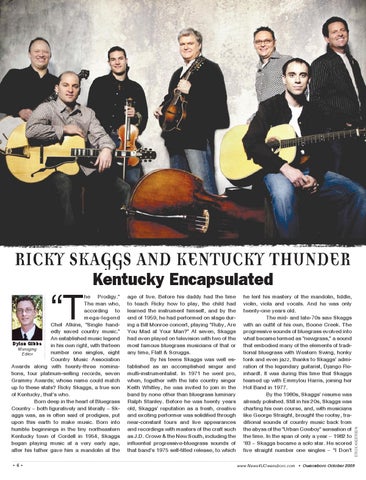
he Prodigy.” The man who, according to mega-legend Chet Atkins, “Single handedly saved country music.” An established music legend Dylan Gibbs in his own right, with thirteen Managing number one singles, eight Editor Country Music Association Awards along with twenty-three nominations, four platinum-selling records, seven Grammy Awards; whose name could match up to these stats? Ricky Skaggs, a true son of Kentucky, that’s who. Born deep in the heart of Bluegrass Country – both figuratively and literally – Skaggs was, as is often said of prodigies, put upon this earth to make music. Born into humble beginnings in the tiny northeastern Kentucky town of Cordell in 1954, Skaggs began playing music at a very early age, after his father gave him a mandolin at the •6•
age of five. Before his daddy had the time to teach Ricky how to play, the child had learned the instrument himself, and by the end of 1959, he had performed on stage during a Bill Monroe concert, playing “Ruby, Are You Mad at Your Man?” At seven, Skaggs had even played on television with two of the most famous bluegrass musicians of that or any time, Flatt & Scruggs. By his teens Skaggs was well established as an accomplished singer and multi-instrumentalist. In 1971 he went pro, when, together with the late country singer Keith Whitley, he was invited to join in the band by none other than bluegrass luminary Ralph Stanley. Before he was twenty years old, Skaggs’ reputation as a fresh, creative and exciting performer was solidified through near-constant tours and live appearances and recordings with masters of the craft such as J.D. Crowe & the New South, including the influential progressive-bluegrass sounds of that band’s 1975 self-titled release, to which
he lent his mastery of the mandolin, fiddle, violin, viola and vocals. And he was only twenty-one years old. The mid- and late-70s saw Skaggs with an outfit of his own, Boone Creek. The progressive sounds of bluegrass evolved into what became termed as “newgrass,” a sound that embodied many of the elements of traditional bluegrass with Western Swing, honky tonk and even jazz, thanks to Skaggs’ admiration of the legendary guitarist, Django Reinhardt. It was during this time that Skaggs teamed up with Emmylou Harris, joining her Hot Band in 1977. By the 1980s, Skaggs’ resume was already polished. Still in his 20s, Skaggs was charting his own course, and, with musicians like George Straight, brought the rootsy, traditional sounds of country music back from the abyss of the “Urban Cowboy” sensation of the time. In the span of only a year – 1982 to ’83 – Skaggs became a solo star. He scored five straight number one singles – “I Don’t
ERICK ANDERSON
“T
Kentucky Encapsulated
www.News4UOwensboro.com • Owensboro October 2009