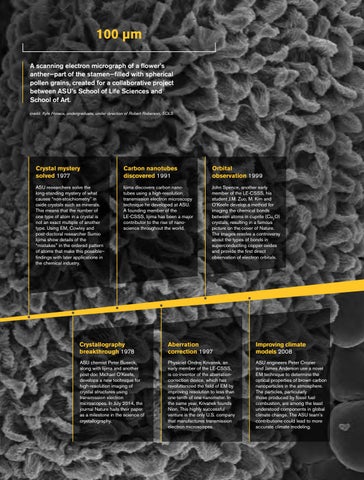
100 µm A scanning electron micrograph of a flower’s anther—part of the stamen—filled with spherical pollen grains, created for a collaborative project between ASU’s School of Life Sciences and School of Art. credit: Kyle Horace, undergraduate, under direction of Robert Roberson, SOLS
Crystal mystery solved 1977
Carbon nanotubes discovered 1991
Orbital observation 1999
ASU researchers solve the long-standing mystery of what causes “non-stoichiometry” in oxide crystals such as minerals. This means that the number of one type of atom in a crystal is not an exact multiple of another type. Using EM, Cowley and post-doctoral researcher Sumio Iijima show details of the “mistakes” in the ordered pattern of atoms that make this possible— findings with later applications in the chemical industry.
Iijima discovers carbon nanotubes using a high-resolution transmission electron microscopy technique he developed at ASU. A founding member of the LE-CSSS, Iijima has been a major contributor to the rise of nanoscience throughout the world.
John Spence, another early member of the LE-CSSS, his student J.M. Zuo, M. Kim and O’Keefe develop a method for imaging the chemical bonds between atoms in cuprite (Cu2O) crystals, resulting in a famous picture on the cover of Nature. The images resolve a controversy about the types of bonds in superconducting copper oxides and provide the first direct observation of electron orbitals.
Crystallography breakthrough 1978
Aberration correction 1997
Improving climate models 2008
ASU chemist Peter Buseck, along with Iijima and another post-doc Michael O’Keefe, develops a new technique for high-resolution imaging of crystal structures using transmission electron microscopes. In July 2014, the journal Nature hails their paper as a milestone in the science of crystallography.
Physicist Ondrej Krivanek, an early member of the LE-CSSS, is co-inventor of the aberrationcorrection device, which has revolutionized the field of EM by improving resolution to less than one-tenth of one nanometer. In the same year, Krivanek founds Nion. This highly successful venture is the only U.S. company that manufactures transmission electron microscopes.
ASU engineers Peter Crozier and James Anderson use a novel EM technique to determine the optical properties of brown carbon nanoparticles in the atmosphere. The particles, particularly those produced by fossil fuel combustion, are among the least understood components in global climate change. The ASU team’s contributions could lead to more accurate climate modeling.
research.asu.edu/book