faculty awards and research highlights
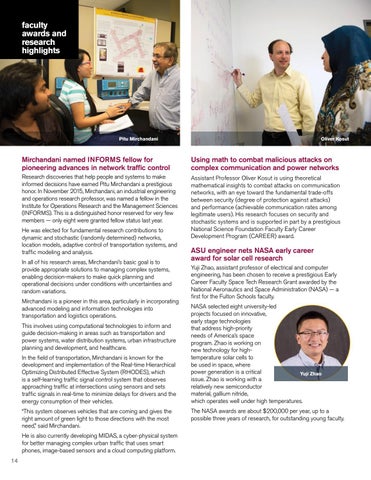
Pitu Mirchandani
Mirchandani named INFORMS fellow for pioneering advances in network traffic control
Using math to combat malicious attacks on complex communication and power networks
Research discoveries that help people and systems to make informed decisions have earned Pitu Mirchandani a prestigious honor. In November 2015, Mirchandani, an industrial engineering and operations research professor, was named a fellow in the Institute for Operations Research and the Management Sciences (INFORMS). This is a distinguished honor reserved for very few members — only eight were granted fellow status last year.
Assistant Professor Oliver Kosut is using theoretical mathematical insights to combat attacks on communication networks, with an eye toward the fundamental trade-offs between security (degree of protection against attacks) and performance (achievable communication rates among legitimate users). His research focuses on security and stochastic systems and is supported in part by a prestigious National Science Foundation Faculty Early Career Development Program (CAREER) award.
He was elected for fundamental research contributions to dynamic and stochastic (randomly determined) networks, location models, adaptive control of transportation systems, and traffic modeling and analysis. In all of his research areas, Mirchandani’s basic goal is to provide appropriate solutions to managing complex systems, enabling decision-makers to make quick planning and operational decisions under conditions with uncertainties and random variations. Mirchandani is a pioneer in this area, particularly in incorporating advanced modeling and information technologies into transportation and logistics operations. This involves using computational technologies to inform and guide decision-making in areas such as transportation and power systems, water distribution systems, urban infrastructure planning and development, and healthcare. In the field of transportation, Mirchandani is known for the development and implementation of the Real-time Hierarchical Optimizing Distributed Effective System (RHODES), which is a self-learning traffic signal control system that observes approaching traffic at intersections using sensors and sets traffic signals in real-time to minimize delays for drivers and the energy consumption of their vehicles. “This system observes vehicles that are coming and gives the right amount of green light to those directions with the most need,” said Mirchandani. He is also currently developing MIDAS, a cyber-physical system for better managing complex urban traffic that uses smart phones, image-based sensors and a cloud computing platform. 14
Oliver Kosut
ASU engineer nets NASA early career award for solar cell research Yuji Zhao, assistant professor of electrical and computer engineering, has been chosen to receive a prestigious Early Career Faculty Space Tech Research Grant awarded by the National Aeronautics and Space Administration (NASA) — a first for the Fulton Schools faculty. NASA selected eight university-led projects focused on innovative, early stage technologies that address high-priority needs of America’s space program. Zhao is working on new technology for hightemperature solar cells to be used in space, where power generation is a critical Yuji Zhao issue. Zhao is working with a relatively new semiconductor material, gallium nitride, which operates well under high temperatures. The NASA awards are about $200,000 per year, up to a possible three years of research, for outstanding young faculty.