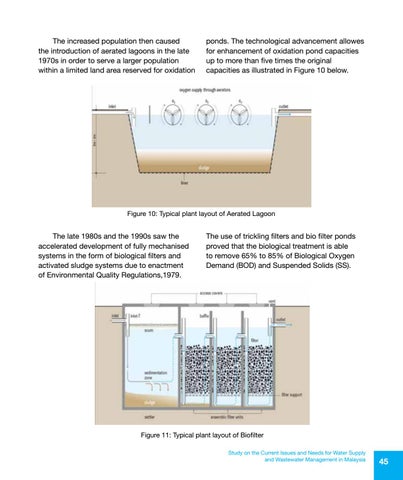
The increased population then caused the introduction of aerated lagoons in the late 1970s in order to serve a larger population within a limited land area reserved for oxidation
ponds. The technological advancement allowes for enhancement of oxidation pond capacities up to more than five times the original capacities as illustrated in Figure 10 below.
Figure 10: Typical plant layout of Aerated Lagoon
The late 1980s and the 1990s saw the accelerated development of fully mechanised systems in the form of biological filters and activated sludge systems due to enactment of Environmental Quality Regulations,1979.
The use of trickling filters and bio filter ponds proved that the biological treatment is able to remove 65% to 85% of Biological Oxygen Demand (BOD) and Suspended Solids (SS).
Figure 11: Typical plant layout of Biofilter Study on the Current Issues and Needs for Water Supply and Wastewater Management in Malaysia
45