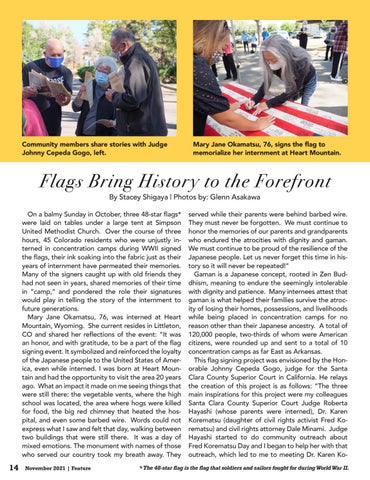
Community members share stories with Judge Johnny Cepeda Gogo, left.
Mary Jane Okamatsu, 76, signs the flag to memorialize her internment at Heart Mountain.
Flags Bring History to the Forefront By Stacey Shigaya | Photos by: Glenn Asakawa
On a balmy Sunday in October, three 48-star flags* were laid on tables under a large tent at Simpson United Methodist Church. Over the course of three hours, 45 Colorado residents who were unjustly interned in concentration camps during WWII signed the flags, their ink soaking into the fabric just as their years of internment have permeated their memories. Many of the signers caught up with old friends they had not seen in years, shared memories of their time in “camp,” and pondered the role their signatures would play in telling the story of the internment to future generations. Mary Jane Okamatsu, 76, was interned at Heart Mountain, Wyoming. She current resides in Littleton, CO and shared her reflections of the event: “It was an honor, and with gratitude, to be a part of the flag signing event. It symbolized and reinforced the loyalty of the Japanese people to the United States of America, even while interned. I was born at Heart Mountain and had the opportunity to visit the area 20 years ago. What an impact it made on me seeing things that were still there: the vegetable vents, where the high school was located, the area where hogs were killed for food, the big red chimney that heated the hospital, and even some barbed wire. Words could not express what I saw and felt that day, walking between two buildings that were still there. It was a day of mixed emotions. The monument with names of those who served our country took my breath away. They
14
November 2021 | Feature
served while their parents were behind barbed wire. They must never be forgotten. We must continue to honor the memories of our parents and grandparents who endured the atrocities with dignity and gaman. We must continue to be proud of the resilience of the Japanese people. Let us never forget this time in history so it will never be repeated!” Gaman is a Japanese concept, rooted in Zen Buddhism, meaning to endure the seemingly intolerable with dignity and patience. Many internees attest that gaman is what helped their families survive the atrocity of losing their homes, possessions, and livelihoods while being placed in concentration camps for no reason other than their Japanese ancestry. A total of 120,000 people, two-thirds of whom were American citizens, were rounded up and sent to a total of 10 concentration camps as far East as Arkansas. This flag signing project was envisioned by the Honorable Johnny Cepeda Gogo, judge for the Santa Clara County Superior Court in California. He relays the creation of this project is as follows: “The three main inspirations for this project were my colleagues Santa Clara County Superior Court Judge Roberta Hayashi (whose parents were interned), Dr. Karen Korematsu (daughter of civil rights activist Fred Korematsu) and civil rights attorney Dale Minami. Judge Hayashi started to do community outreach about Fred Korematsu Day and I began to help her with that outreach, which led to me to meeting Dr. Karen Ko-
* The 48-star flag is the flag that soldiers and sailors fought for during World War II.