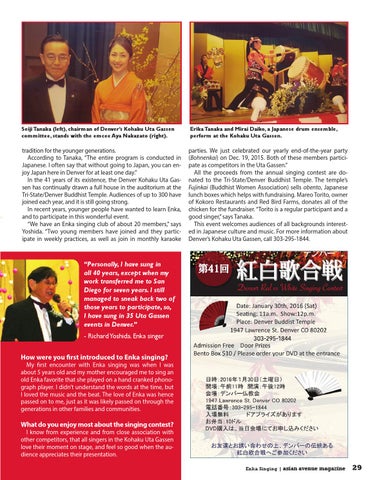
Seiji Tanaka (left), chairman of Denver’s Kohaku Uta Gassen committee, stands with the emcee Aya Nakazato (right).
Erika Tanaka and Mirai Daiko, a Japanese drum ensemble, perform at the Kohaku Uta Gassen.
tradition for the younger generations. According to Tanaka, “The entire program is conducted in Japanese. I often say that without going to Japan, you can enjoy Japan here in Denver for at least one day.” In the 41 years of its existence, the Denver Kohaku Uta Gassen has continually drawn a full house in the auditorium at the Tri-State/Denver Buddhist Temple. Audiences of up to 300 have joined each year, and it is still going strong. In recent years, younger people have wanted to learn Enka, and to participate in this wonderful event. “We have an Enka singing club of about 20 members,” says Yoshida. “Two young members have joined and they participate in weekly practices, as well as join in monthly karaoke
parties. We just celebrated our yearly end-of-the-year party (Bohnenkai) on Dec. 19, 2015. Both of these members participate as competitors in the Uta Gassen.” All the proceeds from the annual singing contest are donated to the Tri-State/Denver Buddhist Temple. The temple’s Fujinkai (Buddhist Women Association) sells obento, Japanese lunch boxes which helps with fundraising. Mareo Torito, owner of Kokoro Restaurants and Red Bird Farms, donates all of the chicken for the fundraiser. “Torito is a regular participant and a good singer,” says Tanaka. This event welcomes audiences of all backgrounds interested in Japanese culture and music. For more information about Denver’s Kohaku Uta Gassen, call 303-295-1844.
“Personally, I have sung in all 40 years, except when my work transferred me to San Diego for seven years. I still managed to sneak back two of those years to participate, so, I have sung in 35 Uta Gassen events in Denver.” - Richard Yoshida, Enka singer
How were you first introduced to Enka singing?
My first encounter with Enka singing was when I was about 5 years old and my mother encouraged me to sing an old Enka favorite that she played on a hand cranked phonograph player. I didn’t understand the words at the time, but I loved the music and the beat. The love of Enka was hence passed on to me, just as it was likely passed on through the generations in other families and communities.
What do you enjoy most about the singing contest? I know from experience and from close association with other competitors, that all singers in the Kohaku Uta Gassen love their moment on stage, and feel so good when the audience appreciates their presentation.
Enka Singing | asian avenue magazine
29