(
A
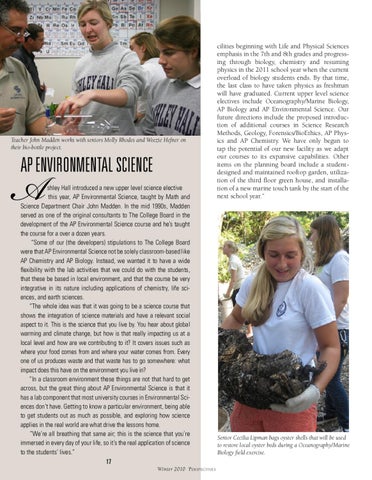
Teacher John Madden works with seniors Molly Rhodes and Weezie Hefner on their bio-bottle project.
AP ENVIRONMENTAL SCIENCE shley Hall introduced a new upper level science elective this year, AP Environmental Science, taught by Math and Science Department Chair John Madden. In the mid 1990s, Madden served as one of the original consultants to The College Board in the development of the AP Environmental Science course and he’s taught the course for a over a dozen years. “Some of our (the developers) stipulations to The College Board were that AP Environmental Science not be solely classroom-based like AP Chemistry and AP Biology. Instead, we wanted it to have a wide flexibility with the lab activities that we could do with the students, that these be based in local environment, and that the course be very integrative in its nature including applications of chemistry, life sciences, and earth sciences. “The whole idea was that it was going to be a science course that shows the integration of science materials and have a relevant social aspect to it. This is the science that you live by. You hear about global warming and climate change, but how is that really impacting us at a local level and how are we contributing to it? It covers issues such as where your food comes from and where your water comes from. Every one of us produces waste and that waste has to go somewhere: what impact does this have on the environment you live in? “In a classroom environment these things are not that hard to get across, but the great thing about AP Environmental Science is that it has a lab component that most university courses in Environmental Sciences don’t have. Getting to know a particular environment, being able to get students out as much as possible, and exploring how science applies in the real world are what drive the lessons home. ”We’re all breathing that same air; this is the science that you’re immersed in every day of your life, so it’s the real application of science to the students’ lives.” 17 Winter 2010 P ERSPECTIVES
cilities beginning with Life and Physical Sciences emphasis in the 7th and 8th grades and progressing through biology, chemistry and resuming physics in the 2011 school year when the current overload of biology students ends. By that time, the last class to have taken physics as freshman will have graduated. Current upper level science electives include Oceanography/Marine Biology, AP Biology and AP Environmental Science. Our future directions include the proposed introduction of additional courses in Science Research Methods, Geology, Forensics/BioEthics, AP Physics and AP Chemistry. We have only begun to tap the potential of our new facility as we adapt our courses to its expansive capabilities. Other items on the planning board include a studentdesigned and maintained rooftop garden, utilization of the third floor green house, and installation of a new marine touch tank by the start of the next school year.”
Senior Cecilia Lipman bags oyster shells that will be used to restore local oyster beds during a Oceanography/Marine Biology field exercise.
THE SCHOOL
(
“Across the board, in math and science, our faculty is our greatest strength. They are exceptionally well-qualified, dynamic, personable, and love what they do,” says Madden. “Any school, and probably more than a few colleges, would envy our facilities.” Math Assessment “The University of Chicago Everyday Mathematics program is back in the Lower School curriculum this year and is proving effective and popular with students and teachers. Everyday Mathematics focuses on using math concepts to solve real-life problems so that students can readily grasp that math is both a useful skill and tool relevant to their lives and not just an intellectual exercise. “The Intermediate School math curriculum focuses on preparing students for Pre-Algebra and, for advanced students, Algebra I when they enter the 7th grade. “In our Upper School, students generally progress from Pre-Algebra in the seventh grade through Algebra I, Geometry, and Algebra II by the end of their sophomore year. Depending on their individual abilities, juniors and seniors may select from Algebra III/Trigonometry and Honors Pre-Calculus. We also currently offer AP Calculus and AP Statistics to upper level students. Our future directions include offering Integrated AP Calculus/AP Physics, Mathematical Modeling, and a co-registered College Algebra course with the College of Charleston. “One of our great successes this year has been the implementation of the Science and Math Enrichment Center in
Esther Hoshall Beaumont ’53, second from the right, and family members (left to right) Thaddeus Hoshall, Jessica Hoshall, Frank A. Hoshall and Ann Hoshall at the dedication ceremony for the Science and Math Center named for her father.
the Upper School. Here, students who need assistance and those looking for challenges beyond the classroom program can both find what they seek.” “As educators, we understand the essential roles that science and math must play in addressing so many of the critical issues that face the world,” said Madden. “We also understand the many contexts – historical, contemporary, cultural, disciplinary, etc. - in which these problems must be considered to construct viable solutions. Tomorrow’s best leaders will need a breadth of knowledge that encompasses all of human experience – in short, a classical education – to have any hope of effectively dealing with global concerns. This is precisely the educational experience we strive for here. To further that end, Ashley Hall took the decisive step to unite Math and Science as one department to produce a more deliberate integration of these two disciplines as 18 Winter 2010 P ERSPECTIVES
well as a more cohesive school curriculum overall.” “It’s been a very full year so far,” says Madden, “and the next few years will be just as busy as we implement an ambitious slate of proposed programmatic enhancements and further exploit the capabilities of our outstanding teachers and incredible facilities. The natural environment of the Lowcountry as well as the academic environment provides a surfeit of resources that we will continue to develop, especially those offered by our proximity and relationships with the College of Charleston and the Medical University of South Carolina. We are very well-positioned for all of the changes contemplated. In assessing our Math and Science curricula, I find that our significant strengths vastly outweigh areas of concern and we have the right people and solutions to address all of those. ‘Enthusiasm’ should be our watchword as we move forward.”