4
Envy, July, Issue 22
Hunting for treasures Story Anna Money Photos Kirsty Graham Most of us will remember, walking along the beach as young children, filling up our pockets with pretty-coloured stones and shells and imagining finding some half-buried treasure in the sand. For us, however, that memory stays in our childhood. Not for Malcolm Luxton.
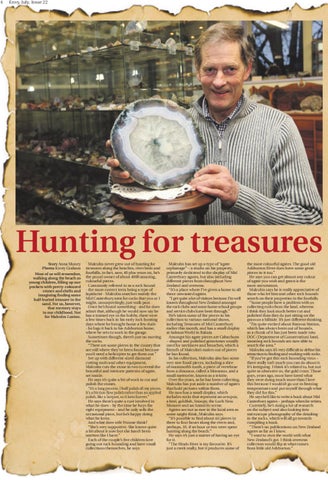
Malcolm never grew out of hunting for treasures along the beaches, river beds and foothills, in fact, now, 40 plus years on, he’s the proud owner of about 4000 amazing, colourful pieces. Commonly referred to as a rock hound - the more correct term being a type of lapidarist - Malcolm searches mainly the Mid Canterbury area for rocks that you or I might, unsuspectingly, just walk past. Once he’s found something - and he does admit that, although he would now say he has a trained eye in the hobby, there were a few times back in his early rock hunting days where he brought home a few duds - he lugs it back to his Ashburton home, where he sets to work in the garage. Sometimes though, there’s just no moving the rocks. “There are some pieces in the county that are still where they’ve been found because you’d need a helicopter to get them out.” Set up with different-sized diamond cutting tools and other equipment, Malcolm cuts the stone in two to reveal the beautiful and intricate patterns of agate, set inside. He says it’s quite a bit of work to cut and polish the stones. “It’s a long process. I buff polish all my pieces. It’s a friction flow polish rather than an applied polish, like a lacquer, so it lasts forever.” He says there’s quite a cost involved in what he does – by the time he buys the right equipment – and he only sells the occasional piece, but he’s happy doing what he loves. And what does wife Yvonne think? “She’s very supportive. She knows quite a bit about it now but she hasn’t been smitten like I have.” Each of the couple’s five children love going out rock hounding and have small collections themselves, he says.
Malcolm has set up a type of “agate orphanage” – a studio on his property, primarily dedicated to the display of Mid Canterbury agates, but also including different pieces from throughout New Zealand and overseas. “It’s a place where I’ve given a home to all these unwanted agates. “I get quite a lot of visitors because I’m well known throughout New Zealand amongst the rock clubs and some home school groups and service clubs have been through.” He’s taken some of the pieces in his collection to various national shows, including Treasures of Mid Canterbury earlier this month, and has a small display at Salmon World in Rakaia. Amongst his agate pieces are Cabachons – shaped and polished gemstones usually used for necklaces and brooches, which a friend’s of Malcolm’s makes out of pieces he has found. In his collection, Malcolm also has some very rare fossil pieces, including a slice of mammoth’s tooth, a piece of vertebrae from a dinosaur, called a Mosasaur, and a small meteorite, known as a tektite. Over the years, as he has been collecting, Malcolm has put aside a number of agates that hold pictures within them. He now has a small display, which includes rocks that represent an octopus, a bird, goldfish, Snoopy, the Loch Ness Monster and an Antarctic scene. Agates are not as rare in the local area as some might think, Malcolm says. “It’s possible to find about six pieces in three to four hours along the rivers and, perhaps, 10, if an hour or two were spent hunting along the beach.” He says it’s just a matter of having an eye for it. “The Hinds River is my favourite. It’s just a creek really, but it produces some of
the most colourful agates. The good old Ashburton River does have some great pieces in it too.” He says you can get almost any colour of agate you wish and green is the most uncommon. Malcolm says he is really appreciative of those who let him and other rock hounds search on their properties in the foothills. “Some people have a problem with us collecting rocks from the land, whereas I think they look much better cut and polished than they do just sitting on the grass on a hillside. It’s just different thinking. “I’m quite excited about Barossa Station, which has always been out of bounds, as a chunk of it has just been made into DOC (Department of Conservation) land, meaning rock hounds are now able to search the area.” Malcolm says it’s very difficult to define his attraction to finding and working with rocks. “If you’ve got this rock hounding virus – there really isn’t much you can do about it. It’s intriguing. I think it’s related to, but not quite as obsessive as, the gold craze. Those guys, years ago, must have loved what they were doing much more than I love this because I wouldn’t go out in freezing temperatures and put myself through what they did for this.” He says he’d like to write a book about Mid Canterbury agates – perhaps when he retires. Currently, he’s doing a lot of research on the subject and also looking into microscope photography of the detailing in the rocks, which will all go towards compiling a book. “There’s no publications on New Zealand agates as far as I know. “I want to stun the world with what New Zealand’s got. I think overseas collectors would flip at what comes from little old Ashburton.”